
What is Mythology Definitions and Functions Have You




- Slides: 24
What is Mythology? Definitions and Functions
Have You Ever Heard of … • • Nike Amazon. com Midas The days of the week The planets The constellations The Venus razor Pegasus • • Lord of the Rings Harry Potter Percy Jackson Star Wars Max Payne Fallout: New Vegas The dollar bill Quarters (non-state)
What is this Quote Describing? • A young person cannot judge what is allegorical (fake) and what is literal (real); therefore it is most important that the [stories] which the young first hear should be the models of virtuous thoughts.
What about this quote? • You say there are good examples to be learned [here]. Yes, there are: if you want to learn exaggeration; if you want to learn deception; if you want to learn hypocrisy and lying; if you want to learn to joke and laugh scornfully; if you want to learn about vices, to swear, tear, and blaspheme both Heaven and Earth; if you want to learn lasciviousness, premarital sex, and adultery; if you want to learn to brutally murder, to steal, rob, and brawl; if you want to learn to rebel against your government, to commit treasons, to overindulge in material things, to be lazy, to sing and talk of sex; if you want to learn to deride, scoff, mock, and flaunt, to flatter and smooth; if you want to learn to be a pimp, a glutton, a drunkard, or an incestuous person; if you want to learn to become proud, haughty, and arrogant; and, finally, if you want to learn to condemn God and all His laws, to care neither for heaven nor hell, and to commit all kind of sin and mischief, you need to go to no other school, for all these good examples are found [here].
Mythology • • • Definition: Mythology is an accumulation of the wisdom of a given society it is humankind’s early attempts at trying to explain the world and to teach society about the world. In short. . . Myths are stories that explain phenomena, reveal culture, and express religion.
Mythology (cont. ) • • • Myths are often explanations of creation rationalization for the existence of things. Myths are sometimes stories of a quest depicting what the society sees as important, of value, or expected of citizens in that society. Quests may be an individual fighting a society or a traditional battle of good vs. evil, or an initiation into adulthood. Myths also explain or keep alive the story of certain historical events of societies that lack written historical accounts they are told with a liberal literary license, but they often focus on events of national significance (i. e. a war, treaty, discovery).
Mythology vs. Legend, History, Fairy Tales • • • History tells the strict chronology of events HISTORY IS FACTS Legends and tall tales are exaggerated truths Paul Bunyan, Robin Hood, Socrates LEGENDS HAVE SOME FACTS Fairy Tales, parables, and fables, are pure fiction. Sometimes they have a moral; sometimes they do not. FAIRY TALES CONTAIN NO FACTS
Why Mythology Has Lasted • • “A message from ourselves to ourselves. ” ─Erich Fromm “Man [sic] longs for some more permanent and extensive vision of human life made over into the image of desire. It is this longing that has produced literature [and film]. It is this vision that has formed the backbone of mythology. ” ─W. T. Jewkes
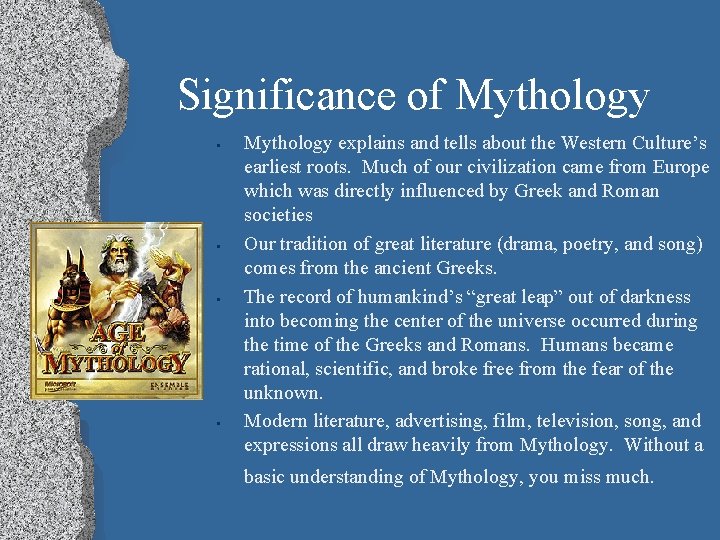
Significance of Mythology • • Mythology explains and tells about the Western Culture’s earliest roots. Much of our civilization came from Europe which was directly influenced by Greek and Roman societies Our tradition of great literature (drama, poetry, and song) comes from the ancient Greeks. The record of humankind’s “great leap” out of darkness into becoming the center of the universe occurred during the time of the Greeks and Romans. Humans became rational, scientific, and broke free from the fear of the unknown. Modern literature, advertising, film, television, song, and expressions all draw heavily from Mythology. Without a basic understanding of Mythology, you miss much.
Mythology: Joseph Campbell’s Four Functions
Four Functions of Mythology There are four basic functions of mythology, according to Campbell. 1) The mystical function – stories that express the awe and wonder of the universe 2) The cosmological function – stories that attempt to explain the processes of nature 3) The sociological function – stories that support and validate a certain social order 4) The pedagogical function – stories that explain how to live a full, happy life
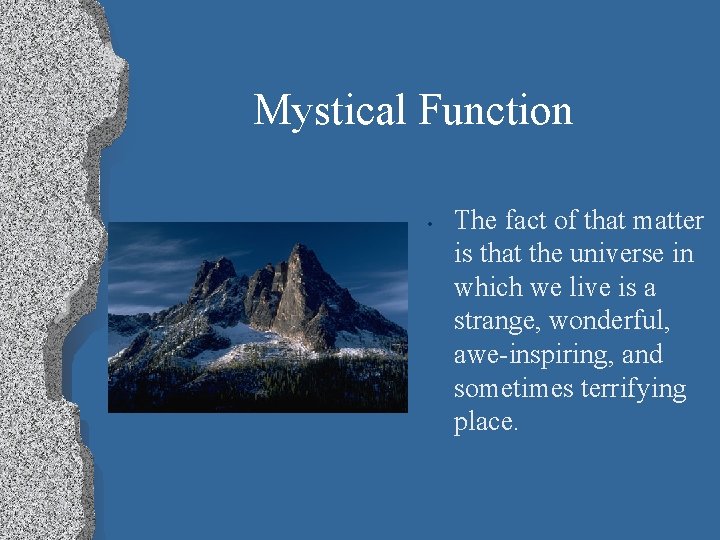
Mystical Function • The fact of that matter is that the universe in which we live is a strange, wonderful, awe-inspiring, and sometimes terrifying place.
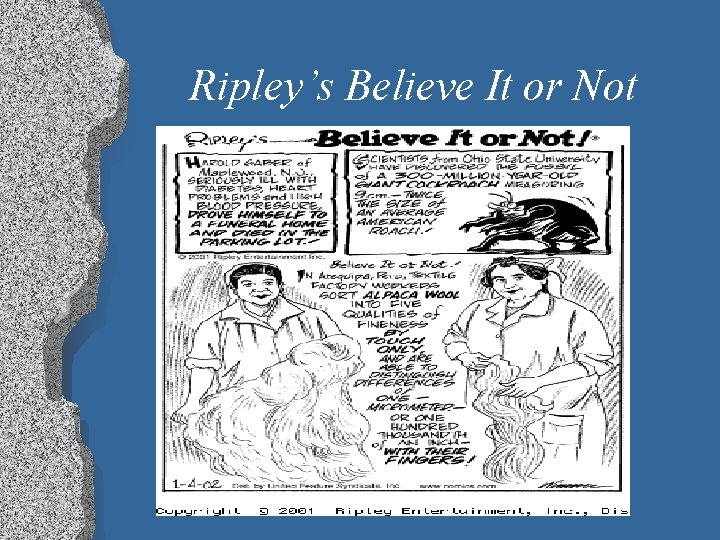
Mystical Function • • • Myths that fulfill the mystical function are myths that remind us of how strange and wonderful (and scary and miraculous) the universe really is. Ghost stories are one example of this function. Ripley’s Believe It or Not stories are another.
Urban Legend • • According to Jan Harold Brunvand, an urban legend is a story that circulates from person to person, that is retained in a group tradition, and that can be found in different versions through time and space. Alligators (or ninja turtles) in New York sewers are a prime example
Ripley’s Believe It or Not
Tabloid Magazines • These strange stories are another example of Campbell’s mystical function.
Cosmological Function • • Stories that are told to explain something in nature fulfill the Cosmological Function, according to Campbell. In addition to many native American myths, examples can be found in the Old Testament.
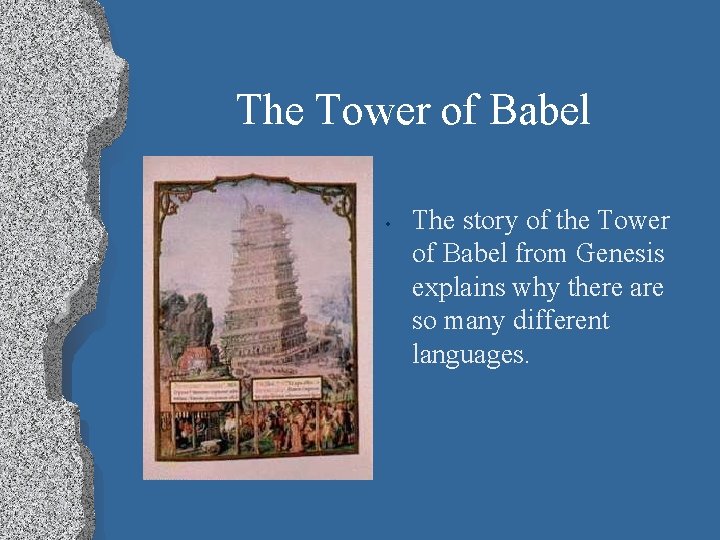
The Tower of Babel • The story of the Tower of Babel from Genesis explains why there are so many different languages.
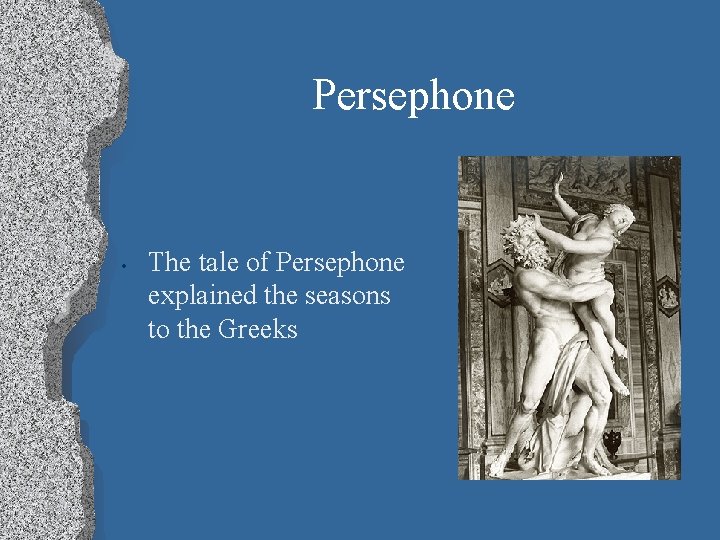
Persephone • The tale of Persephone explained the seasons to the Greeks
Sociological Function • • Stories told to back up, justify, or promote a certain social order fulfill the sociological function. These stories help bind people to a certain social group, or help explain to them their place within society.
Dishing the Family Dirt • For example, when you tell a newcomer stories about your family to make them feel welcome or feel like a part of the family, you are using this function of storytelling.
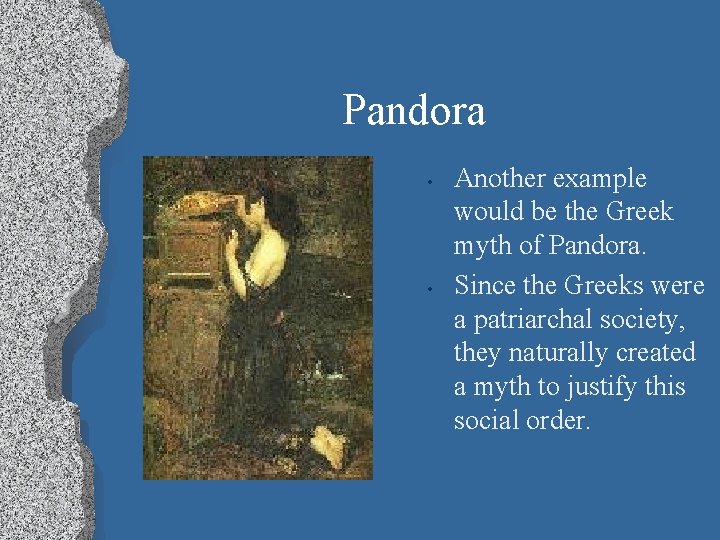
Pandora • • Another example would be the Greek myth of Pandora. Since the Greeks were a patriarchal society, they naturally created a myth to justify this social order.
Pedagogical Function • • The most important of the four functions, according to Campbell, is the pedagogical function. These are stories that teach. They tell us how to live, how to be happy, how to be good, how to love.
The Parables of Christ • One example of this can be found in the New Testament. Throughout his ministry, Christ often taught by telling a story – the story of the Good Samaritan or the story of the Prodigal Son, for example.