
What is moderation and why should we moderate

- Slides: 17
What is moderation and why should we moderate? Module One: Moderation Series for Primary Teachers Page 1 © New Zealand Ministry of Education – copying restricted to use by New Zealand education sector.
Module Overview This module is designed to support teachers to develop shared expectations and understanding of student learning and progress through the process of moderation. It looks at: • What is moderation? • The principles of moderation. • The benefits of moderation. Page 2 © New Zealand Ministry of Education – copying restricted to use by New Zealand education sector.
Moderation • Moderation is the process of teachers sharing their expectations and understandings of standards with each other in order to improve the consistency of their decisions about student learning and achievement. (http: //assessment. tki. org. nz/Moderation#1) • Moderation supports teachers to compare their judgments to either confirm or adjust them. The process involves teachers sharing evidence of learning and collaborating to establish a shared understanding of what quality of evidence looks like. Schools use moderation to increase dependability of teacher judgments. Page 3 © New Zealand Ministry of Education – copying restricted to use by New Zealand education sector.
Moderation • “ Moderation is concerned with the consistency, comparability and fairness of professional judgments about the levels demonstrated by students”. (Maxwell 2002) • The National Standards support consistency of judgment and moderation by providing examples and illustrations of the standard required. Page 4 © New Zealand Ministry of Education – copying restricted to use by New Zealand education sector.
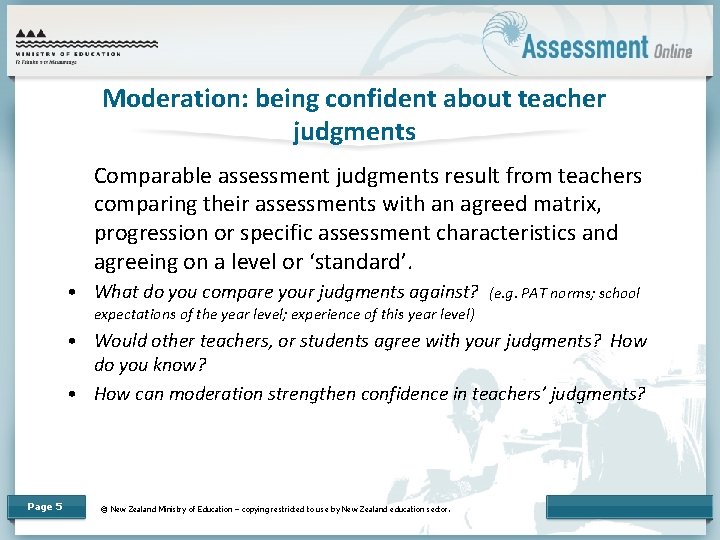
Moderation: being confident about teacher judgments Comparable assessment judgments result from teachers comparing their assessments with an agreed matrix, progression or specific assessment characteristics and agreeing on a level or ‘standard’. • What do you compare your judgments against? (e. g. PAT norms; school expectations of the year level; experience of this year level) • Would other teachers, or students agree with your judgments? How do you know? • How can moderation strengthen confidence in teachers’ judgments? Page 5 © New Zealand Ministry of Education – copying restricted to use by New Zealand education sector.
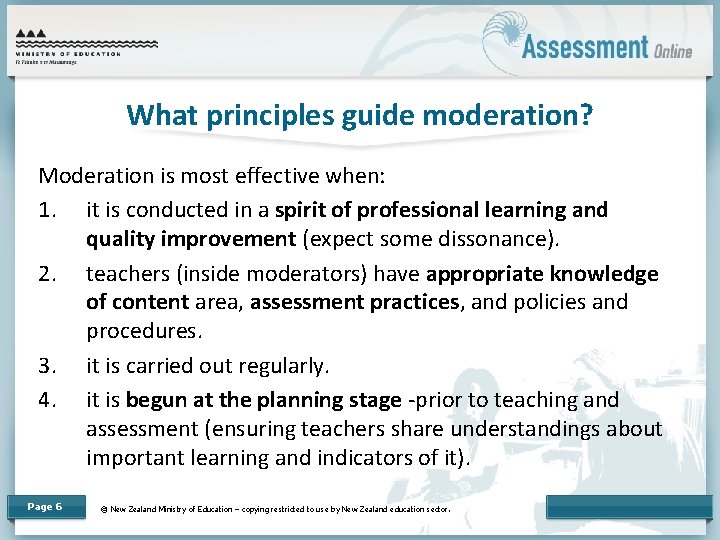
What principles guide moderation? Moderation is most effective when: 1. it is conducted in a spirit of professional learning and quality improvement (expect some dissonance). 2. teachers (inside moderators) have appropriate knowledge of content area, assessment practices, and policies and procedures. 3. it is carried out regularly. 4. it is begun at the planning stage -prior to teaching and assessment (ensuring teachers share understandings about important learning and indicators of it). Page 6 © New Zealand Ministry of Education – copying restricted to use by New Zealand education sector.
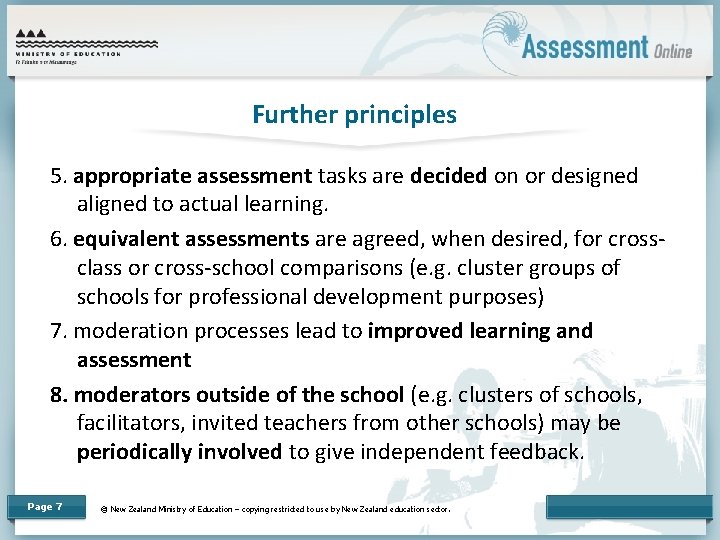
Further principles 5. appropriate assessment tasks are decided on or designed aligned to actual learning. 6. equivalent assessments are agreed, when desired, for crossclass or cross-school comparisons (e. g. cluster groups of schools for professional development purposes) 7. moderation processes lead to improved learning and assessment 8. moderators outside of the school (e. g. clusters of schools, facilitators, invited teachers from other schools) may be periodically involved to give independent feedback. Page 7 © New Zealand Ministry of Education – copying restricted to use by New Zealand education sector.
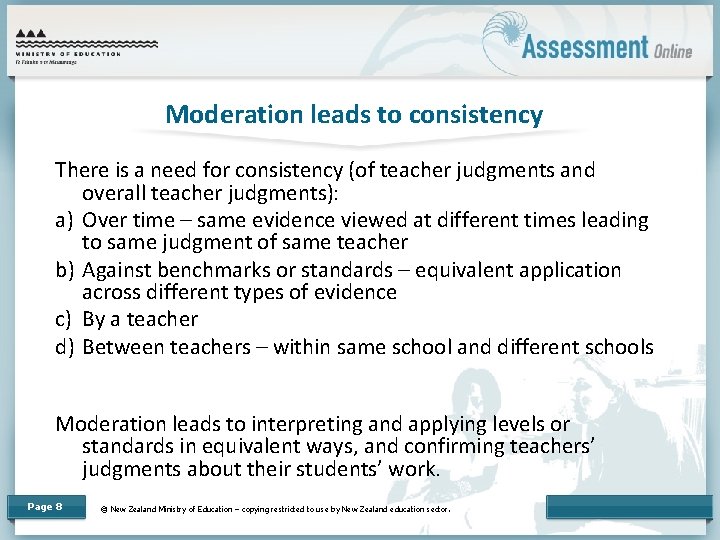
Moderation leads to consistency There is a need for consistency (of teacher judgments and overall teacher judgments): a) Over time – same evidence viewed at different times leading to same judgment of same teacher b) Against benchmarks or standards – equivalent application across different types of evidence c) By a teacher d) Between teachers – within same school and different schools Moderation leads to interpreting and applying levels or standards in equivalent ways, and confirming teachers’ judgments about their students’ work. Page 8 © New Zealand Ministry of Education – copying restricted to use by New Zealand education sector.
Moderation leads to comparability • The focus of comparability is on the assessable performance, not on the assessment task. • Students can be set different tasks or tests but demonstrate a common standard of achievement. • While surface features of the performance may differ, the “characteristics of the knowledge, understanding and skills expected for the level of achievement will be equivalent. ” (Maxwell, 2002) Page 9 © New Zealand Ministry of Education – copying restricted to use by New Zealand education sector.
Moderation and equity • Equity for moderation means that every student has the opportunity to demonstrate their current capability compared with a benchmark or performance standard. • Opportunity can be idiosyncratic, because common assessment tasks do not necessarily enable each student to perform optimally – e. g. a writing task about experiences of sport will exclude some students. • Characteristics of task and context are important. Page 10 © New Zealand Ministry of Education – copying restricted to use by New Zealand education sector.
The benefits of involving students • When students are actively involved they can participate in selecting evidence (e. g. samples of their work) that best demonstrate the intended learning outcomes. • The process of assessment develops students’ understanding of the desired outcomes and success criteria. • Making judgments is closely linked to developing the skills of self and peer-assessment. • This can lead to shared expectations of learning and understandings of standards between teachers and students. • Greater student confidence in teacher judgments. • Provides greater transparency of the assessment process. Page 11 © New Zealand Ministry of Education – copying restricted to use by New Zealand education sector.
The benefits of moderation - to teachers • Brings together collective wisdom, resulting in greater consistency of judgment, and focused teaching. • Provides greater confidence in teacher judgments and assurance that judgments are consistent with other professionals. • Leads to shared expectations of learning and understandings of standards and progression of learning. • Develops deeper understandings about content and progressions of learning. • Improves quality of assessment. • Alignment of expectations and judgments with standards or progressions, and hence improved teaching and learning. • Assurance to parents and others that interpretations of students’ achievements are in line with other professionals. Page 12 © New Zealand Ministry of Education – copying restricted to use by New Zealand education sector.
The benefits of moderation - to leadership teams and Boards of Trustees • Greater confidence in teachers’ judgments and assurance that judgments are consistent within and across schools. • Provides useful, dependable information for target setting. • Provides information that can shape future professional development needs for teachers. Page 13 © New Zealand Ministry of Education – copying restricted to use by New Zealand education sector.
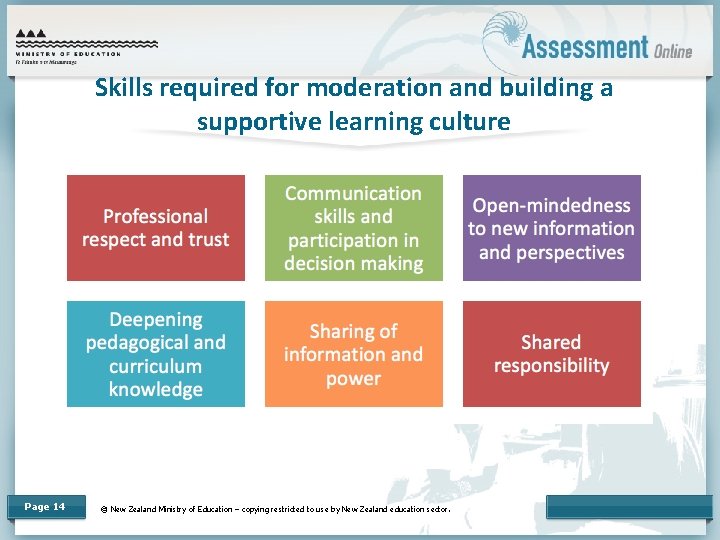
Skills required for moderation and building a supportive learning culture Page 14 © New Zealand Ministry of Education – copying restricted to use by New Zealand education sector.
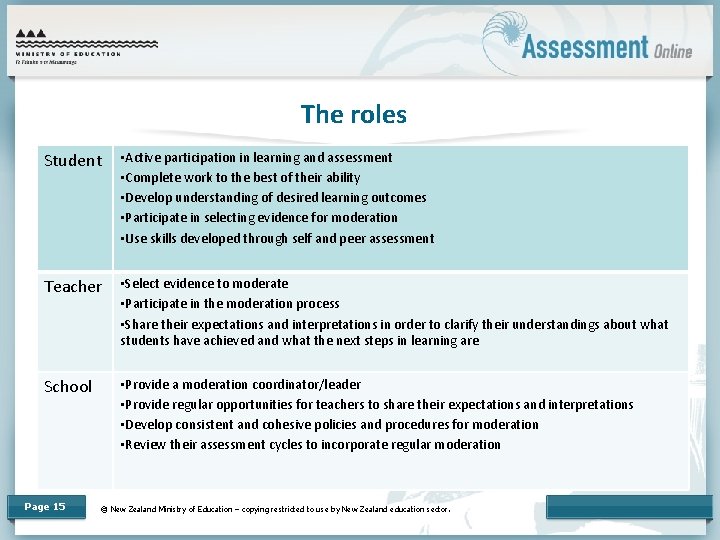
The roles Student • Active participation in learning and assessment • Complete work to the best of their ability • Develop understanding of desired learning outcomes • Participate in selecting evidence for moderation • Use skills developed through self and peer assessment Teacher • Select evidence to moderate • Participate in the moderation process • Share their expectations and interpretations in order to clarify their understandings about what students have achieved and what the next steps in learning are School Page 15 • Provide a moderation coordinator/leader • Provide regular opportunities for teachers to share their expectations and interpretations • Develop consistent and cohesive policies and procedures for moderation • Review their assessment cycles to incorporate regular moderation © New Zealand Ministry of Education – copying restricted to use by New Zealand education sector.
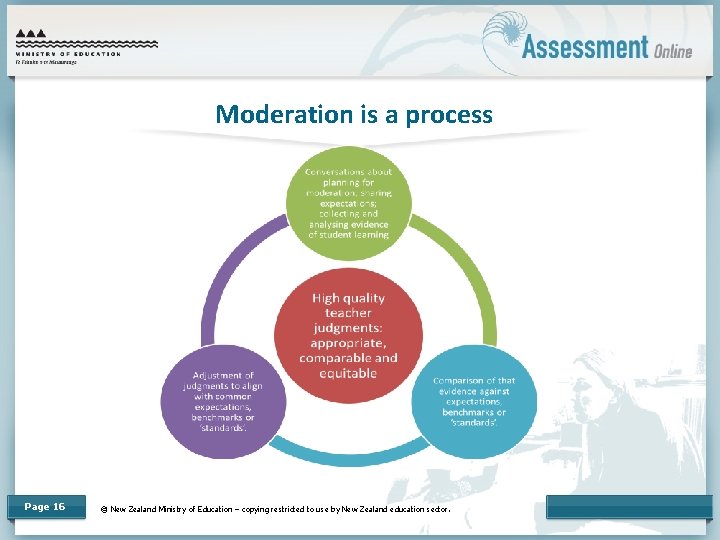
Moderation is a process Page 16 © New Zealand Ministry of Education – copying restricted to use by New Zealand education sector.
References MOE (2010). National Standards Factsheet: Overall teacher judgment www. tki. org. nz (retrieved 10 March 2010) Maxwell, G. S. (2002). Moderation of teacher judgements in student assessment. Discussion paper on assessment and reporting. School of Education: The University of Queensland Ministry of Education. (2003). Consistency of teacher judgements research project. Ministry of Education: Queensland. Sutton, R. (2009) Scottish Learning Festival Sept 2009 http: //www. ltscotland. org. uk/Images/C 1 C_Ruth. Sutton_tcm 4565316. ppt#256, 1, ‘Moderation’ (retrieved 09 July 2010) Scottish Government. (2010). Curriculum for excellence. Building the curriculum 5. A framework for assessment; quality assurance and moderation. Edinburgh: Scottish Government. Wyatt-Smith, C. , Klenowski, V. , Gunn, S. (2010). The centrality of teachers’ judgement practice in assessment: a study of standards in moderation. Assessment in Education: Principles, Policy & Practice. 17: 1, p. 59– 75. Page 17 © New Zealand Ministry of Education – copying restricted to use by New Zealand education sector.