
What is Mindfulness Circle 1 Give an example


- Slides: 29
What is Mindfulness
Circle 1) Give an example of a time when you felt emotionally or mentally overwhelmed. What led to this feeling? 2) Give a time when you felt at peace and confident? What led to this feeling?
Bell Ringer Answer the following prompt. Think about three examples of good things that happened to you yesterday and write in the spaces provided. For each example, write how this good thing impacted you in a positive way.
What is mindfulness? Mindfulness means maintaining a moment-by-moment awareness of our thoughts, feelings, bodily sensations, and surrounding environment.
Mindfulness: An Introduction Mindfulness is the basic human ability to be fully present, aware of where we are and what we’re doing, and not overly reactive or overwhelmed by what’s going on around us. While mindfulness is something we all naturally possess, it’s more readily available to us when we practice on a daily basis. Whenever you bring awareness to what you’re directly experiencing via your senses, or to your state of mind via your thoughts and emotions, you’re being mindful. And there’s growing research showing that when you train your brain to be mindful, you’re actually remodeling the physical structure of your brain.
Mindfulness: An Introduction Mindfulness is characterized by attention to the senses, on what is happening right in front of you. It allows your thoughts to flow freely, never judging whether something is right or wrong. Our natural inclination is to look at what we have experienced or been taught, and to apply that to what we are experiencing now. We often feel guilty or ashamed by our thoughts, suppressing them and never examining why we are having them. But mindfulness asks that you allow your thoughts to not be filtered, and your only goal is to be aware of them. This allows you to understand your emotions and how they work. In the same way, mindfulness keeps your mind in the present. Instead of worrying about the future or obsessing about the past, you are focused on what is in front of you. This allows you to enjoy your life.
Mindfulness: An Introduction Section Questions: 1. How do you think mindfulness can help you get better control of your emotions? 2. How could you use mindfulness to help you with your relationships?
Growth Mindset Growth mindset and mindfulness truly work hand-in-hand. Our understanding is always changing; we use knowledge as it comes to us and do not let it settle into our minds and become fixed. When faced with a problem, both use every resource to understand the problem and try to fix it. Growth mindset and mindfulness do not allow defeat to shape who they are. Instead, they use defeat as a learning tool. When we are being mindful, we are allowing information and the things around us to pass us without our judgment or acceptance. Similarly, when we have a growth mindset, we approach knowledge with an open mind. The goal is to find the best answer for the current situation.
Growth Mindset Questions 1. How can having a growth mindset help us practice mindfulness? 2. How can we fall into mindless behaviors by having a fixed mindset?
How to Be Mindful An easy way to become more mindful is to practice every day. Once it becomes natural, it will be like any other behavior: you will do it without having to think about it. Below are a few of the basics of mindfulness so you can use to become more comfortable with being mindful: Mindfulness helps us put some space between ourselves and our reactions, breaking down our conditioned responses.
How to Be Mindful Here’s how to tune into mindfulness throughout the day: 1. Set aside some time. You don’t need a meditation cushion or bench, or any sort of special equipment to access your mindfulness skills—but you do need to set aside some time and space. 2. Observe the present moment as it is. The aim of mindfulness is not quieting the mind or attempting to achieve a state of eternal calm. The goal is simple: we’re aiming to pay attention to the present moment, without judgment. Easier said than done, we know.
How to Be Mindful 3. Let your judgments roll by. When we notice judgments arise during our practice, we can make a mental note of them, and let them pass. 4. Return to observing the present moment as it is. Our minds often get carried away in thought. That’s why mindfulness is the practice of returning, again and again, to the present moment. 5. Be kind to your wandering mind. Don’t judge yourself for whatever thoughts crop up, just practice recognizing when your mind has wandered off, and gently bring it back.
How to Be Mindful Have your students think about the guidelines above and come up with three Mindfulness rules for the classroom. After the class is finished, have everyone come together and talk about the rules that everyone came up with. Come up with a way to vote on five rules that your classroom can establish and use throughout the school year. Create a board, or have your students come up with something, that you can display.
Tool for Learning: Mindfulness
Tool for Learning: Mindfulness Section Questions: 1. What do you see as something you might struggle with in mindfulness? 2. What is an area with which you think mindfulness can help you? 3. Remember the message of the video: what do you want to grow?
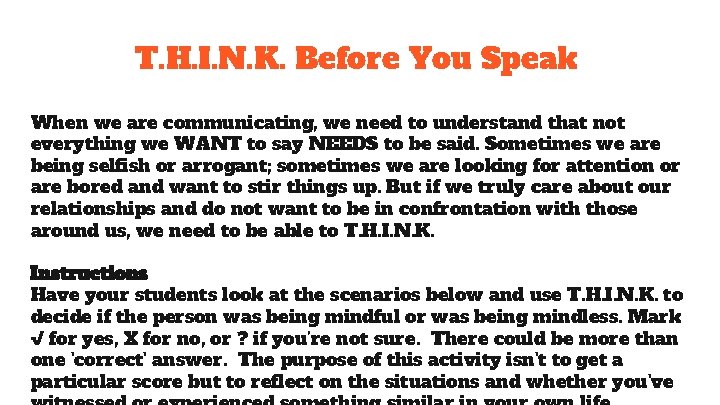
T. H. I. N. K. Before You Speak Activity: T. H. I. N. K. Before You Speak When we are communicating with our friends, family, classmates, etc. , we can often be impulsive and mindless in how we listen and how we speak to them. While it may not seem like you are doing anything wrong, the other person can be put off by you and your relationship can be strained in little ways. These little ways can add up and lead to a more permanent loss of relationship. Being mindful in how we communicate can lead to growth and flourishing in our relationships. In this activity, we will learn how to T. H. I. N. K. before we speak.
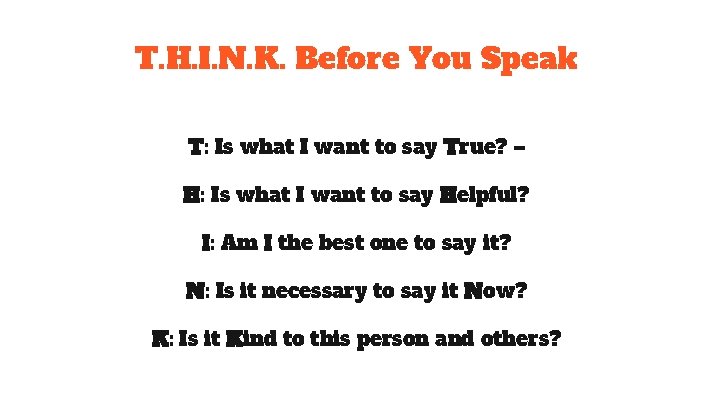
T. H. I. N. K. Before You Speak T: Is what I want to say True? – H: Is what I want to say Helpful? I: Am I the best one to say it? N: Is it necessary to say it Now? K: Is it Kind to this person and others?
T. H. I. N. K. Before You Speak When we are communicating, we need to understand that not everything we WANT to say NEEDS to be said. Sometimes we are being selfish or arrogant; sometimes we are looking for attention or are bored and want to stir things up. But if we truly care about our relationships and do not want to be in confrontation with those around us, we need to be able to T. H. I. N. K. Instructions Have your students look at the scenarios below and use T. H. I. N. K. to decide if the person was being mindful or was being mindless. Mark √ for yes, X for no, or ? if you’re not sure. There could be more than one 'correct' answer. The purpose of this activity isn't to get a particular score but to reflect on the situations and whether you've
T. H. I. N. K. Before You Speak 1. Cheryl got a really unflattering haircut. I told her, “Your hair looks great!” Did I T. H. I. N. K. before I spoke? ____T____H____I____N____K 2. As soon as Cheryl left the room, I said to my friends, “Cheryl’s hair looks terrible, doesn’t it? " Did I T. H. I. N. K. before I spoke? ____T____H____I____N____K
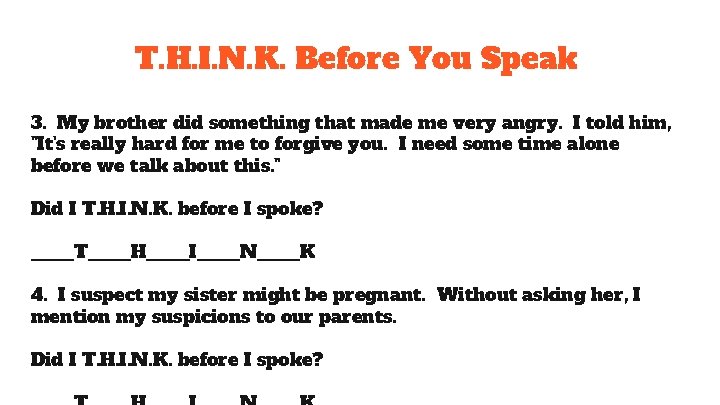
T. H. I. N. K. Before You Speak 3. My brother did something that made me very angry. I told him, "It's really hard for me to forgive you. I need some time alone before we talk about this. " Did I T. H. I. N. K. before I spoke? ____T____H____I____N____K 4. I suspect my sister might be pregnant. Without asking her, I mention my suspicions to our parents. Did I T. H. I. N. K. before I spoke?
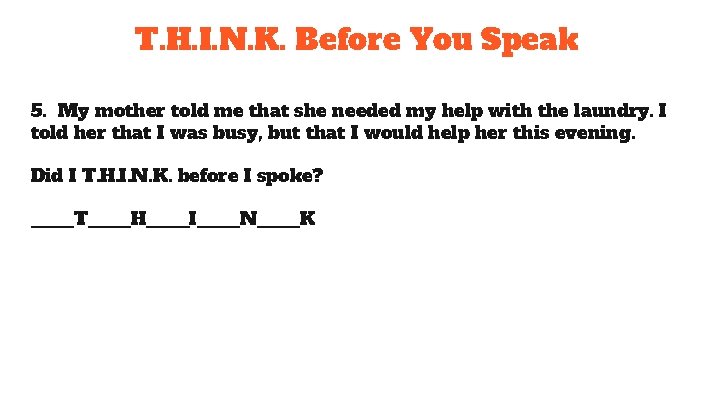
T. H. I. N. K. Before You Speak 5. My mother told me that she needed my help with the laundry. I told her that I was busy, but that I would help her this evening. Did I T. H. I. N. K. before I spoke? ____T____H____I____N____K
T. H. I. N. K. Before You Speak With your students, create an anchor chart of the T. H. I. N. K. guidelines. When there is a situation in the classroom that involves someone speaking mindlessly toward a classmate, have them refer back to the anchor chart.
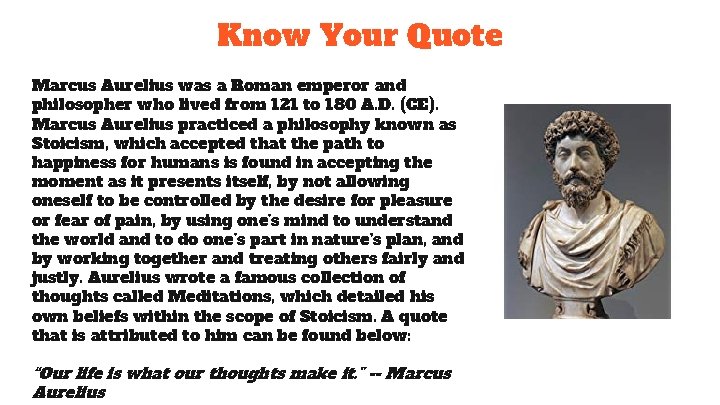
Know Your Quote Marcus Aurelius was a Roman emperor and philosopher who lived from 121 to 180 A. D. (CE). Marcus Aurelius practiced a philosophy known as Stoicism, which accepted that the path to happiness for humans is found in accepting the moment as it presents itself, by not allowing oneself to be controlled by the desire for pleasure or fear of pain, by using one’s mind to understand the world and to do one’s part in nature's plan, and by working together and treating others fairly and justly. Aurelius wrote a famous collection of thoughts called Meditations, which detailed his own beliefs within the scope of Stoicism. A quote that is attributed to him can be found below: “Our life is what our thoughts make it. ” -- Marcus Aurelius
Know Your Quote 1. Turn to the person next to you: Tell what you think this quote means. 2. Follow up question: How do our thoughts dictate the decisions we make?
Mindful Moment As this is one of our first times doing a meditation, we should start with a short version of the body scan. Usually this form of meditation can take up to 30 minutes, but we do not always have that kind of time to sit, breathe, and concentrate. So let’s do a walk-through of a beginner’s body scan: 1. Closing your eyes can be helpful to allow you to focus or, if you’d rather, you can always lower and half-close your eyes. 2. Bring awareness to the body breathing in and out, noticing touch and pressure where it makes contact with the seat or floor. Throughout this practice, allow as much time as you need or want to experience and investigate each area of the body.
Mindful Moment 3. When you’re ready (no rush), intentionally breathe in, and move your attention to whatever part of the body you want to investigate. You might choose to do a systematic body scan beginning at the head or feet. Or, you might choose to explore sensations randomly. Enjoy! Sensations might include buzzing, or tingling, pressure, tightness or temperature, or anything else you notice. What if you don’t notice any strong sensations or things feel neutral? You can simply notice that, too. There are no right answers. Just tune in to what’s present, as best you can, without judgement. You’ll notice judgement puts a different spin on things. The main point is being curious and open to what you are noticing, investigating the sensations as fully as possible, and then intentionally releasing the
Mindful Moment 4. At some point, you’ll notice Elvis and your attention have left the building. Yup. Great noticing! You’ll quickly discover that you can’t stop your attention from wandering. Sorry ’bout that. But over time you can train it to stay for longer periods: train it, not force it, there’s a difference. Each time your attention wanders, simply notice that this is happening, then gently and kindly (it’s really important that you don’t try to force anything) direct your attention back to exploring sensations in the body. Rinse and repeat until you’ve finished your entire body exploration. And hey! Neuroscience tells us that noticing drifting attention, and gently returning our focus to wherever we’ve placed it, over and over, is how we create new pathways in the brain.
Mindful Moment 5. At the end of this exploration of bodily sensations, spend a few moments to expand your attention to feeling your entire body breathing freely. 6. Open your eyes if they have been closed. Move mindfully into this moment.
Mindful Moment Regularly practicing the body scan help you: 1. Enhance your ability to bring your full attention to realtime experiences happening in the present moment— helpful when emotions or thoughts feel wild. 2. Train to explore and be with pleasant and unpleasant sensations, learning to notice what happens when we simply hang in there and feel what’s going on in “body-land” without trying to fix or change anything.