
What is message passing l Data transfer plus
- Slides: 17
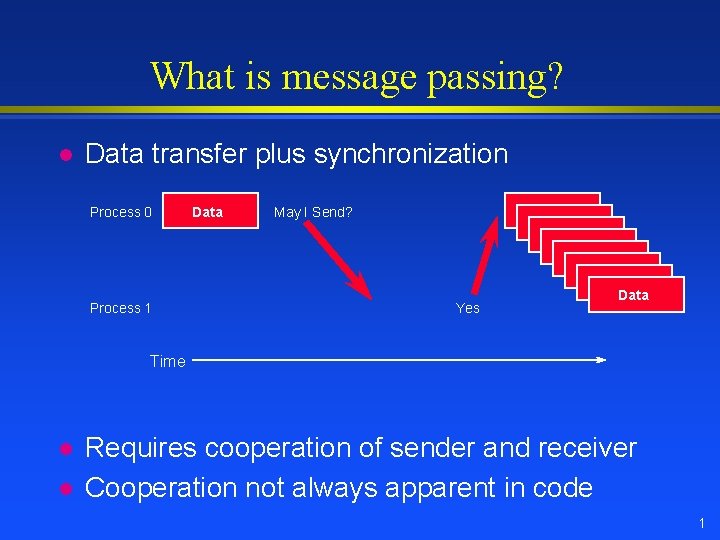
What is message passing? l Data transfer plus synchronization Process 0 Process 1 Data May I Send? Yes Data Data Time l l Requires cooperation of sender and receiver Cooperation not always apparent in code 1
Quick review of MPI Message passing l Basic terms » nonblocking - Operation does not wait for completion » synchronous - Completion of send requires initiation (but not completion) of receive » ready - Correct send requires a matching receive » asynchronous - communication and computation take place simultaneously, not an MPI concept (implementations may use asynchronous methods) 2
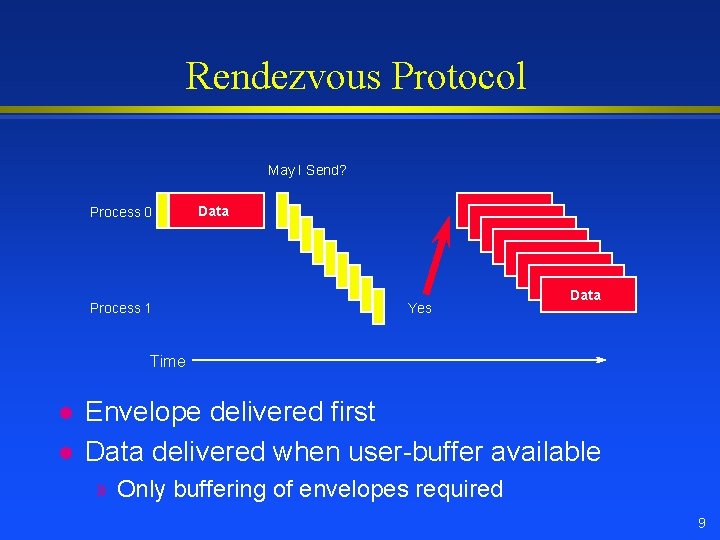
Message protocols l Message consists of “envelope” and data » Envelope contains tag, communicator, length, source information, plus impl. private data l Short » Message data (message for short) sent with envelope l Eager » Message sent assuming destination can store l Rendezvous » Message not sent until destination oks 3
Special Protocols for DSM l l Message passing is a good way to use distributed shared memory (DSM) machines because it provides a way to express memory locality. Put » Sender puts to destination memory (user or MPI buffer). Like Eager. l Get » Receiver gets data from sender or MPI buffer. Like Rendezvous. l Short, long, rendezvous versions of these 4
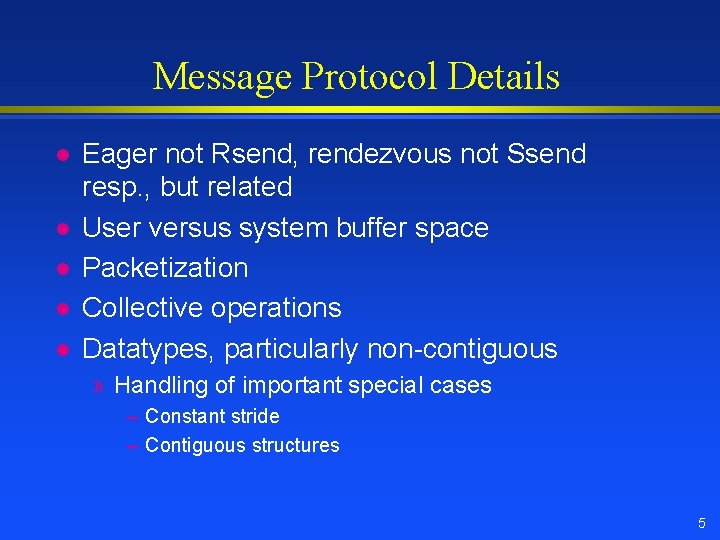
Message Protocol Details l l l Eager not Rsend, rendezvous not Ssend resp. , but related User versus system buffer space Packetization Collective operations Datatypes, particularly non-contiguous » Handling of important special cases – Constant stride – Contiguous structures 5
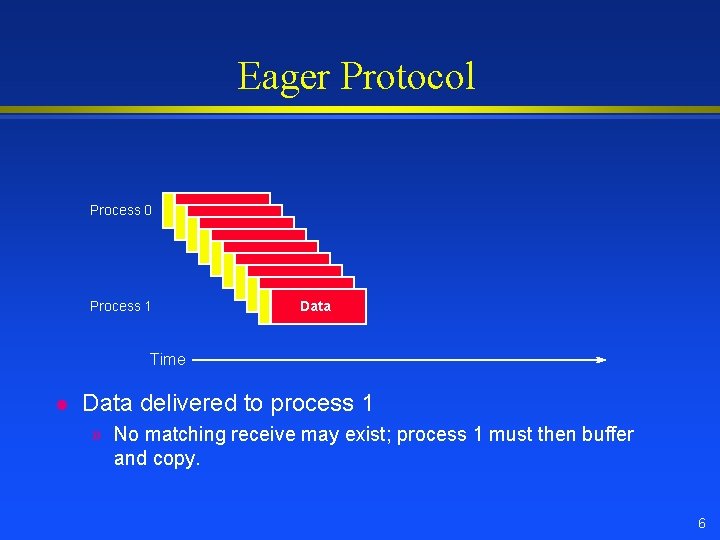
Eager Protocol Process 0 Process 1 Data Data Data Time l Data delivered to process 1 » No matching receive may exist; process 1 must then buffer and copy. 6
Eager Features l l l Reduces synchronization delays Simplifies programming (just MPI_Send) Requires significant buffering May require active involvement of CPU to drain network at receiver’s end May introduce additional copy (buffer to final destination) 7
How Scaleable is Eager Delivery? l l Buffering must be reserved for arbitrary senders User-model mismatch (often expect buffering allocated entirely to “used” connections). Common approach in implementations is to provide same buffering for all members of MPI_COMM_WORLD; this is optimizing for non-scaleable computations Scaleable implementations that exploit message patterns are possible 8
Rendezvous Protocol May I Send? Process 0 Process 1 Data Yes Data Data Time l l Envelope delivered first Data delivered when user-buffer available » Only buffering of envelopes required 9
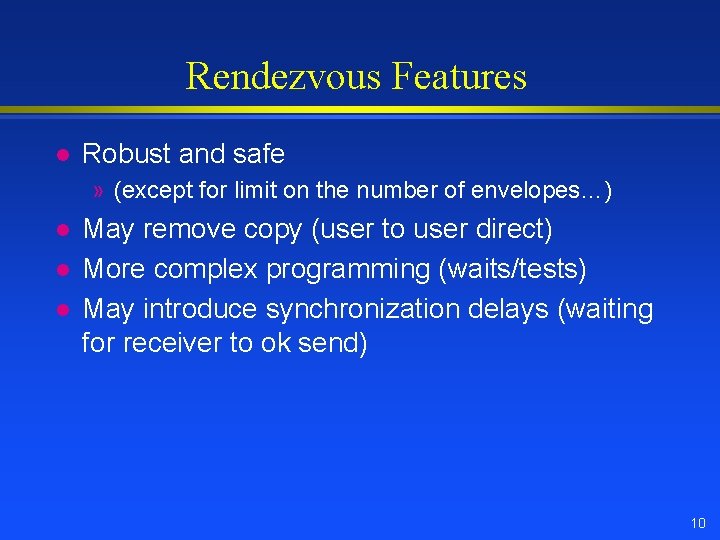
Rendezvous Features l Robust and safe » (except for limit on the number of envelopes…) l l l May remove copy (user to user direct) More complex programming (waits/tests) May introduce synchronization delays (waiting for receiver to ok send) 10
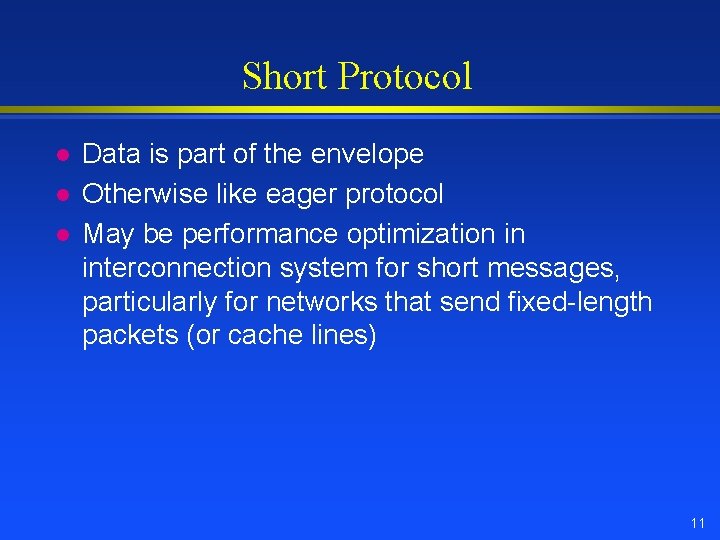
Short Protocol l Data is part of the envelope Otherwise like eager protocol May be performance optimization in interconnection system for short messages, particularly for networks that send fixed-length packets (or cache lines) 11
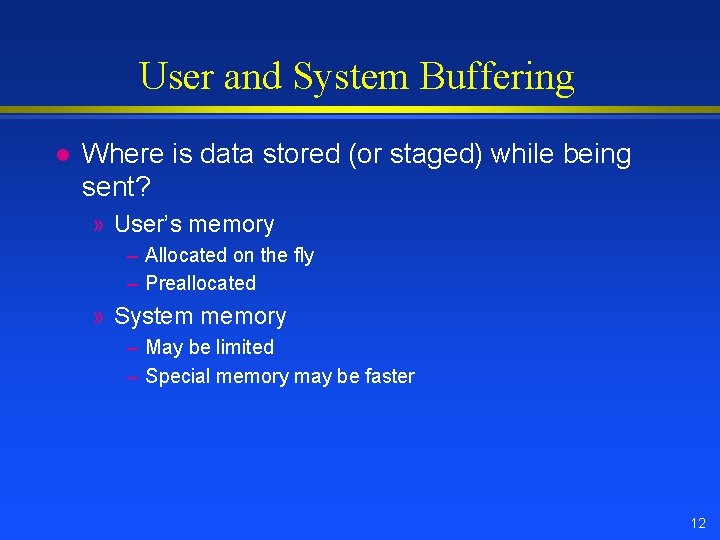
User and System Buffering l Where is data stored (or staged) while being sent? » User’s memory – Allocated on the fly – Preallocated » System memory – May be limited – Special memory may be faster 12
Implementing MPI_Isend l Simplest implementation is to always use rendezvous protocol: » MPI_Isend delivers a request-to-send control message to receiver » Receiving process responds with an ok-to-send – May or may not have matching MPI receive; only needs buffer space to store incoming message » Sending process transfers data l Wait for MPI_Isend request » wait for ok-to-send message from receiver » wait for data transfer to be complete on sending side 13
Alternatives for MPI_Isend l Use a short protocol for small messages » No need to exchange control messages » Need guaranteed (but small) buffer space on destination for short message envelope » Wait becomes a no-op l Use eager protocol for modest sized messages » Still need guaranteed buffer space for both message envelope and eager data on destination » Avoids exchange of control messages 14
Implementing MPI_Send l Can’t use eager always because this could overwhelm the receiving process if (rank != 0) MPI_Send( 100 MB of data ) else receive 100 MB from each process l l l Would like to exploit the blocking nature (can wait for receive) Would like to be fast Select protocol based on message size (and perhaps available buffer space at destination) » Short and/or eager for small messages » Rendezvous for longer messages 15
Implementing MPI_Rsend l Just use MPI_Send; no advantage for users l Use eager always (or short if small) » even for long messages 16
Why Bsend? l l Buffer space not infinite Careful management of buffering required for correctness and performance MPI provides user control over buffering modes Allows implementations freedom to pick specific protocols » Users give up some control for more convenient general-purpose send (MPI_Send) l Implementations could make Bsend fast, at least when buffering is available at the destination 17