
What is Meat Messaging A filing cabinet in

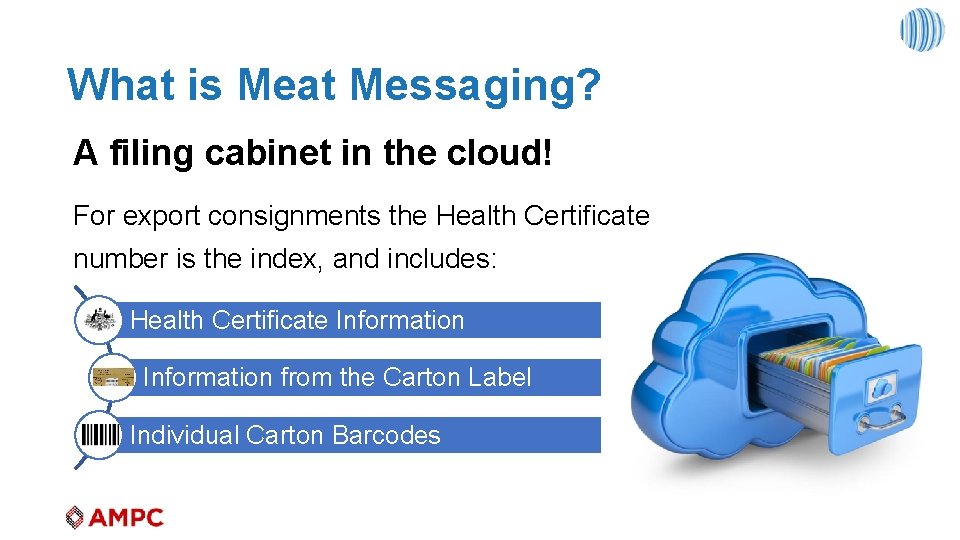
What is Meat Messaging? A filing cabinet in the cloud! For export consignments the Health Certificate number is the index, and includes: Health Certificate Information from the Carton Label Individual Carton Barcodes
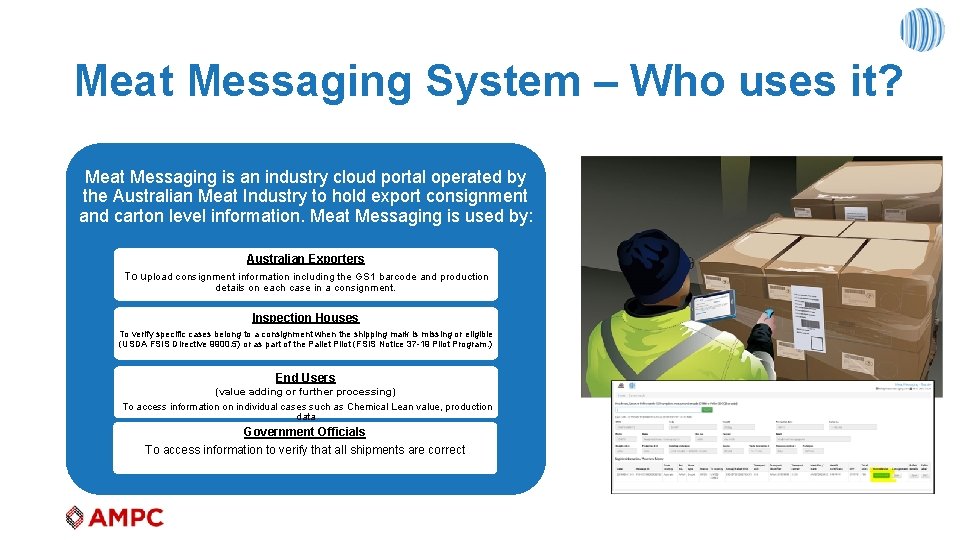
Meat Messaging System – Who uses it? Meat Messaging is an industry cloud portal operated by the Australian Meat Industry to hold export consignment and carton level information. Meat Messaging is used by: Australian Exporters To upload consignment information including the GS 1 barcode and production details on each case in a consignment. Inspection Houses To verify specific cases belong to a consignment when the shipping mark is missing or eligible (USDA FSIS Directive 9900. 5) or as part of the Pallet Pilot (FSIS Notice 37 -19 Pilot Program. ) End Users (value adding or further processing) To access information on individual cases such as Chemical Lean value, production data Government Officials To access information to verify that all shipments are correct
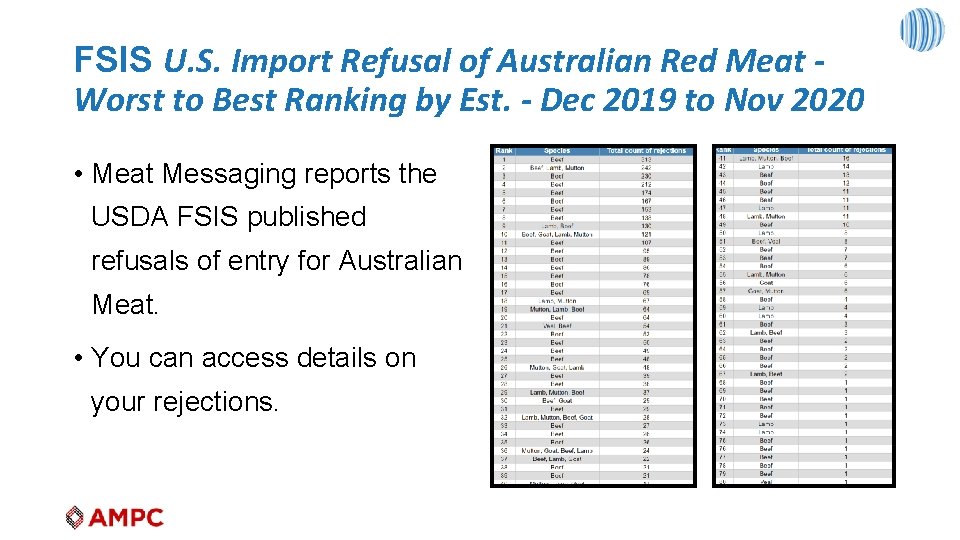
FSIS U. S. Import Refusal of Australian Red Meat Worst to Best Ranking by Est. - Dec 2019 to Nov 2020 • Meat Messaging reports the USDA FSIS published refusals of entry for Australian Meat. • You can access details on your rejections.
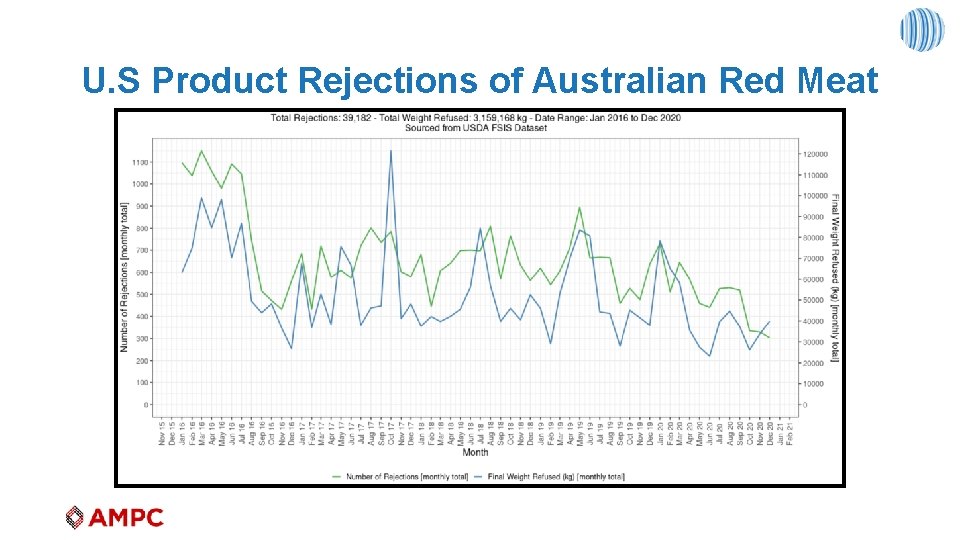
U. S Product Rejections of Australian Red Meat
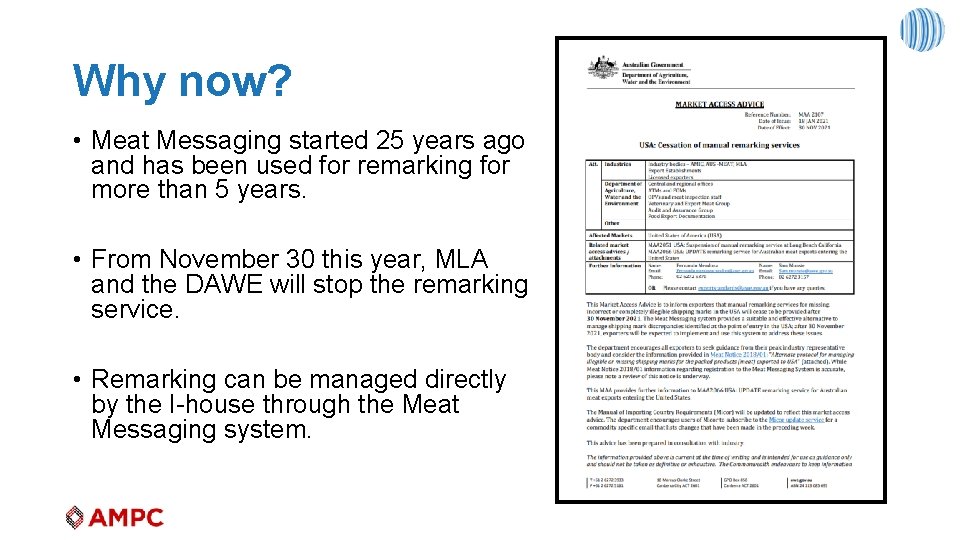
Why now? • Meat Messaging started 25 years ago and has been used for remarking for more than 5 years. • From November 30 this year, MLA and the DAWE will stop the remarking service. • Remarking can be managed directly by the I-house through the Meat Messaging system.
Official Import Facility Remarking FSIS Directive 9900. 5, Section VII, E. Procedures for Correcting Shipping Marks when Using Barcodes Import Establishment can correct shipping marks without having a representative of the foreign government to supervise ØOnly when FSIS can verify the unique identifier within a barcode on the shipping unit using supporting documentation from the foreign country. Supporting Documentation is available for Australian products through Meat Messaging ØMeat Messaging System can be accessed by import establishment to view barcodes linked to the certificate ØSame Day at no Cost Only allowed for countries that are eligible & only applies to establishments approved for such activity. ØAustralia is eligible & FSIS inspection personnel maintain a list of approved Australian establishments in the FSIS internal Share. Point site they access to verify eligibility.
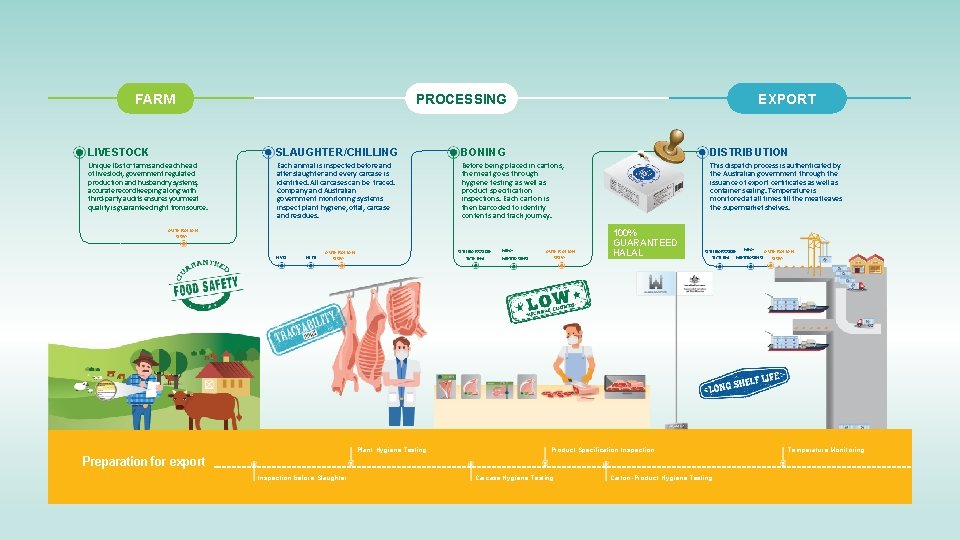
EXPORT PROCESSING FARM LIVESTOCK SLAUGHTER/CHILLING BONING DISTRIBUTION Unique IDs for farms and each head of livestock, government regulated production and husbandry systems, accurate record keeping along with third-party audits ensures your meat quality is guaranteed right from source. Each animal is inspected before and after slaughter and every carcase is identified. All carcases can be traced. Company and Australian government monitoring systems inspect plant hygiene, offal, carcase and residues. Before being placed in cartons, the meat goes through hygiene testing as well as product specification inspections. Each carton is then barcoded to identify contents and track journey. This dispatch process is authenticated by the Australian government through the issuance of export certificates as well as container sealing. Temperature is monitored at all times till the meat leaves the supermarket shelves. AUSTRALIAN GOVT. NVD NLIS GS 1 BARCODE SYSTEM AUSTRALIAN GOVT. Plant Hygiene Testing MEAT MESSAGING AUSTRALIAN GOVT. 100% GUARANTEED HALAL MEAT GS 1 BARCODE AUSTRALIAN SYSTEM MESSAGING GOVT. Product Specification Inspection Preparation for export Inspection before Slaughter Carcase Hygiene Testing Carton-Product Hygiene Testing Temperature Monitoring
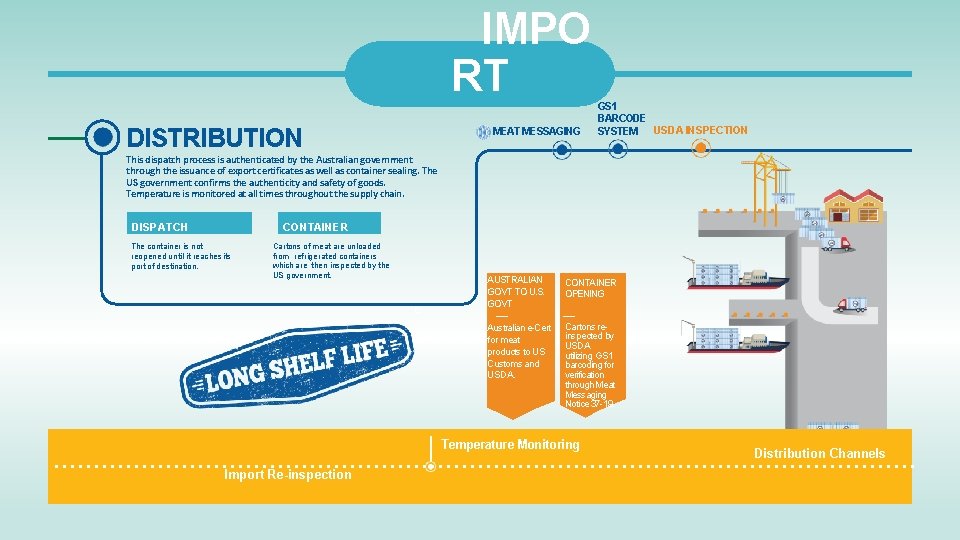
IMPO RT DISTRIBUTION MEAT MESSAGING GS 1 BARCODE SYSTEM USDA INSPECTION This dispatch process is authenticated by the Australian government through the issuance of export certificates as well as container sealing. The US government confirms the authenticity and safety of goods. Temperature is monitored at all times throughout the supply chain. DISPATCH CONTAINER The container is not reopened until it reaches its port of destination. Cartons of meat are unloaded from refrigerated containers which are then inspected by the US government. E AUSTRALIAN GOVT TO U. S. GOVT CONTAINER OPENING Australian e-Cert for meat products to US Customs and USDA. Cartons reinspected by USDA utilizing GS 1 barcoding for verification through Meat Messaging Notice 37 -19. Temperature Monitoring Import Re-inspection Distribution Channels

Meat Messaging – Industry program • Administered by AUS-MEAT with an industry committee comprising: AUS-MEAT, DAWE, AMPC, AMIC, MLA and industry representative. • Manages export consignments, e. MTCs and domestic loads. • Recognised by Government through Meat Notices and FSIS Directive 9900. 5 Rev. 2 - Procedures for Correcting Shipping Marks when Using Barcodes.
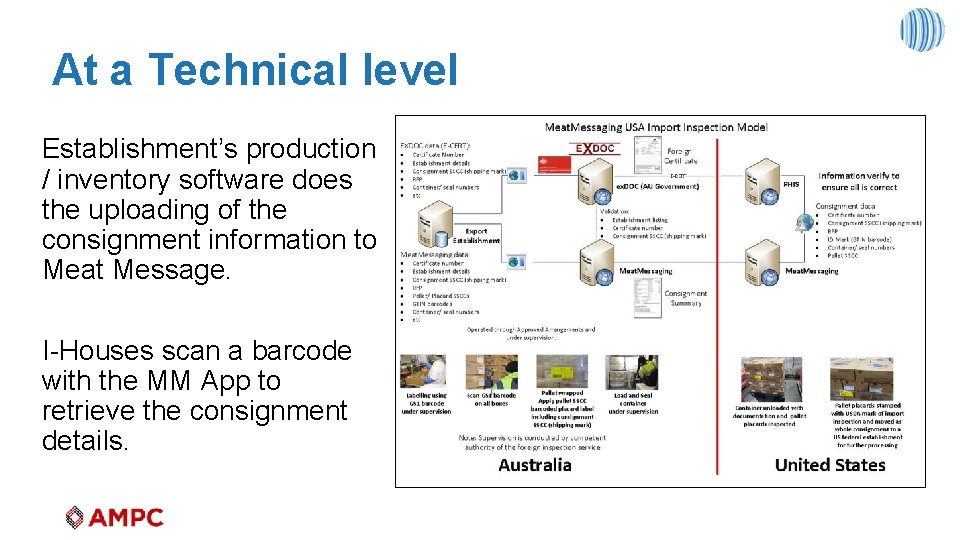
At a Technical level Establishment’s production / inventory software does the uploading of the consignment information to Meat Message. I-Houses scan a barcode with the MM App to retrieve the consignment details.
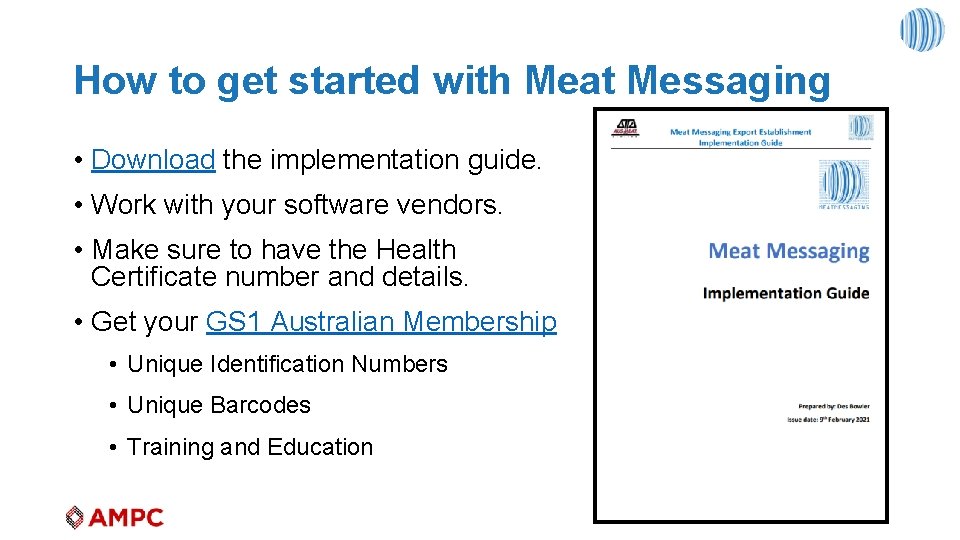
How to get started with Meat Messaging • Download the implementation guide. • Work with your software vendors. • Make sure to have the Health Certificate number and details. • Get your GS 1 Australian Membership • Unique Identification Numbers • Unique Barcodes • Training and Education
What information does Meat Messaging hold and is it secure? • The same information available on the carton label and the logistics information that applies to that carton. Such as what is on a Health Certificate. • Importing Country Inspection houses and Government representatives access the information by scanning a carton barcode. • No commercially sensitive data. DON’T UPLOAD IT! • Information in Meat Messaging should already be either publicly available or supply chain available and will be accessed by second and third parties.
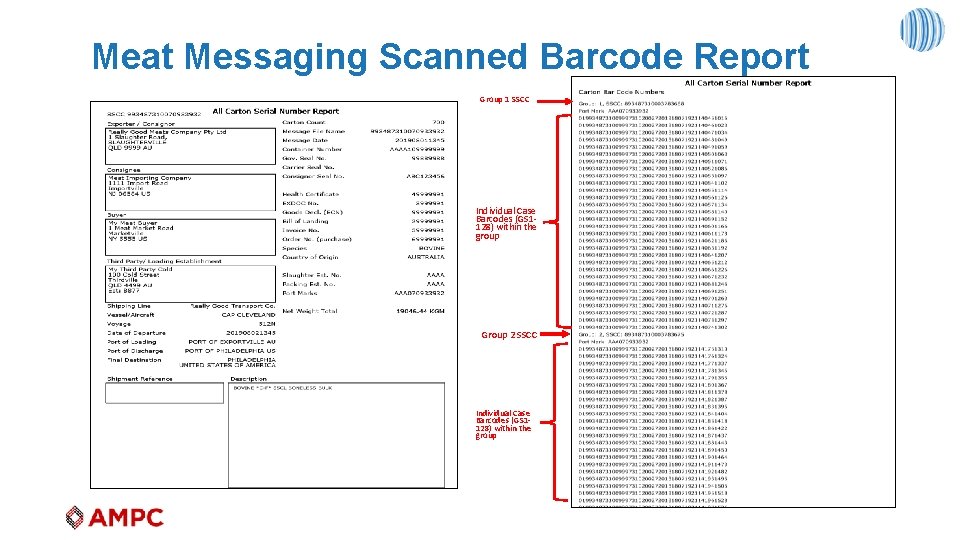
Meat Messaging Scanned Barcode Report Group 1 SSCC Individual Case Barcodes (GS 1128) within the group Group 2 SSCC Individual Case Barcodes (GS 1128) within the group
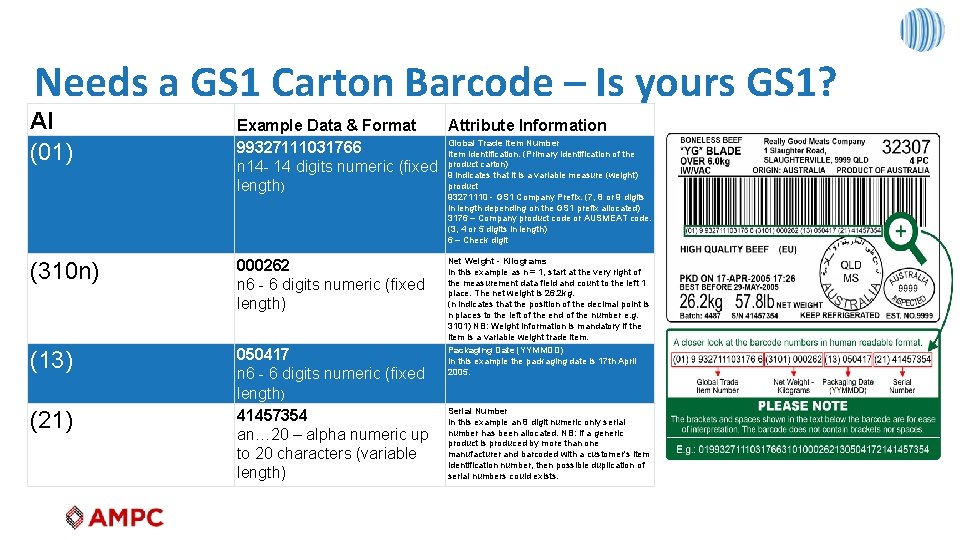
Needs a GS 1 Carton Barcode – Is yours GS 1? AI (01) Example Data & Format Attribute Information Global Trade Item Number 99327111031766 Item Identification. (Primary identification of the carton) n 14 - 14 digits numeric (fixed product 9 indicates that it is a variable measure (weight) product length) 93271110 - GS 1 Company Prefix. (7, 8 or 9 digits in length depending on the GS 1 prefix allocated) 3176 – Company product code or AUSMEAT code. (3, 4 or 5 digits in length) 6 – Check digit (310 n) 000262 n 6 - 6 digits numeric (fixed length) Net Weight - Kilograms In this example as n = 1, start at the very right of the measurement data field and count to the left 1 place. The net weight is 26. 2 kg. (n indicates that the position of the decimal point is n places to the left of the end of the number e. g. 3101) NB: Weight information is mandatory if the item is a variable weight trade item. (13) 050417 n 6 - 6 digits numeric (fixed length) 41457354 an… 20 – alpha numeric up to 20 characters (variable length) Packaging Date (YYMMDD) In this example the packaging date is 17 th April 2005. (21) Serial Number In this example an 8 digit numeric only serial number has been allocated. NB: If a generic product is produced by more than one manufacturer and barcoded with a customer's item identification number, then possible duplication of serial numbers could exists.
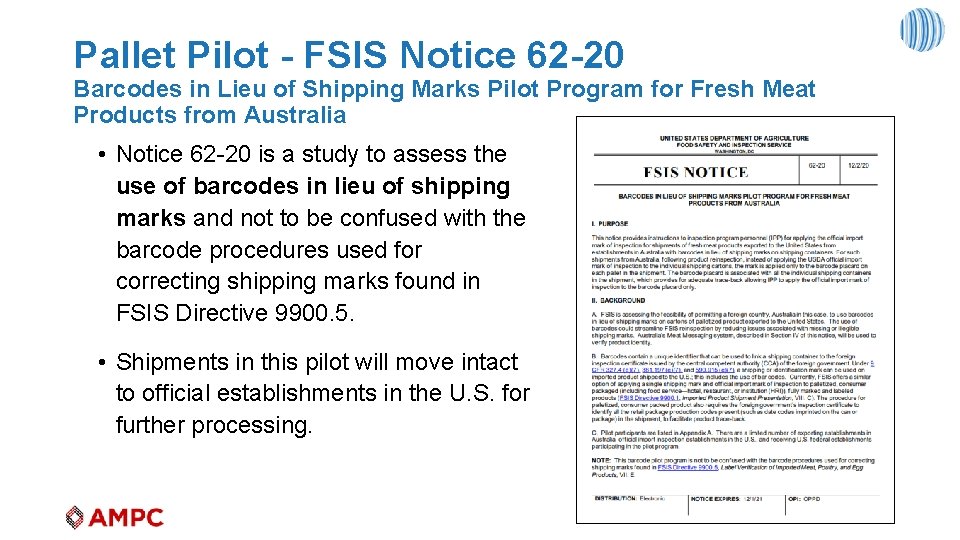
Pallet Pilot - FSIS Notice 62 -20 Barcodes in Lieu of Shipping Marks Pilot Program for Fresh Meat Products from Australia • Notice 62 -20 is a study to assess the use of barcodes in lieu of shipping marks and not to be confused with the barcode procedures used for correcting shipping marks found in FSIS Directive 9900. 5. • Shipments in this pilot will move intact to official establishments in the U. S. for further processing.
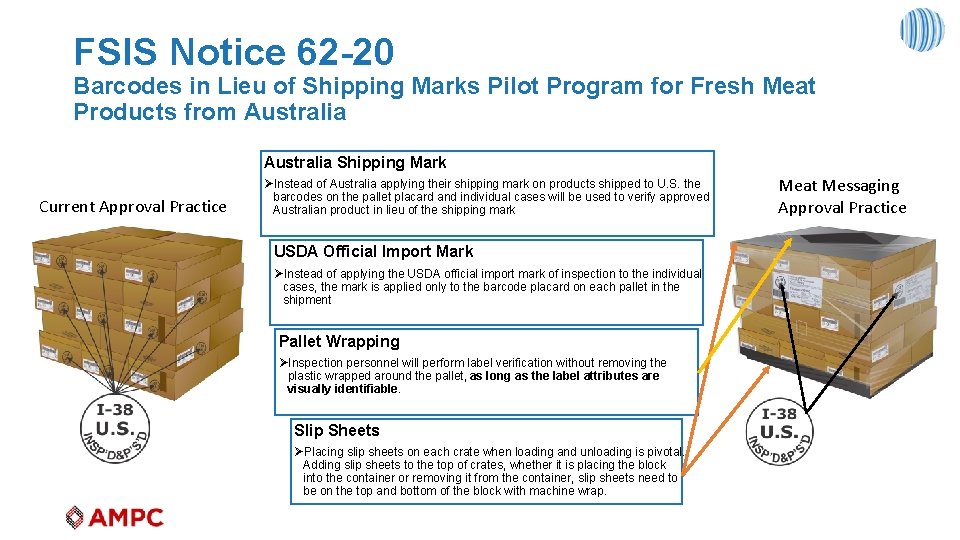
FSIS Notice 62 -20 Barcodes in Lieu of Shipping Marks Pilot Program for Fresh Meat Products from Australia Shipping Mark Current Approval Practice ØInstead of Australia applying their shipping mark on products shipped to U. S. the barcodes on the pallet placard and individual cases will be used to verify approved Australian product in lieu of the shipping mark USDA Official Import Mark ØInstead of applying the USDA official import mark of inspection to the individual cases, the mark is applied only to the barcode placard on each pallet in the shipment Pallet Wrapping ØInspection personnel will perform label verification without removing the plastic wrapped around the pallet, as long as the label attributes are visually identifiable. Slip Sheets ØPlacing slip sheets on each crate when loading and unloading is pivotal. Adding slip sheets to the top of crates, whether it is placing the block into the container or removing it from the container, slip sheets need to be on the top and bottom of the block with machine wrap. Meat Messaging Approval Practice
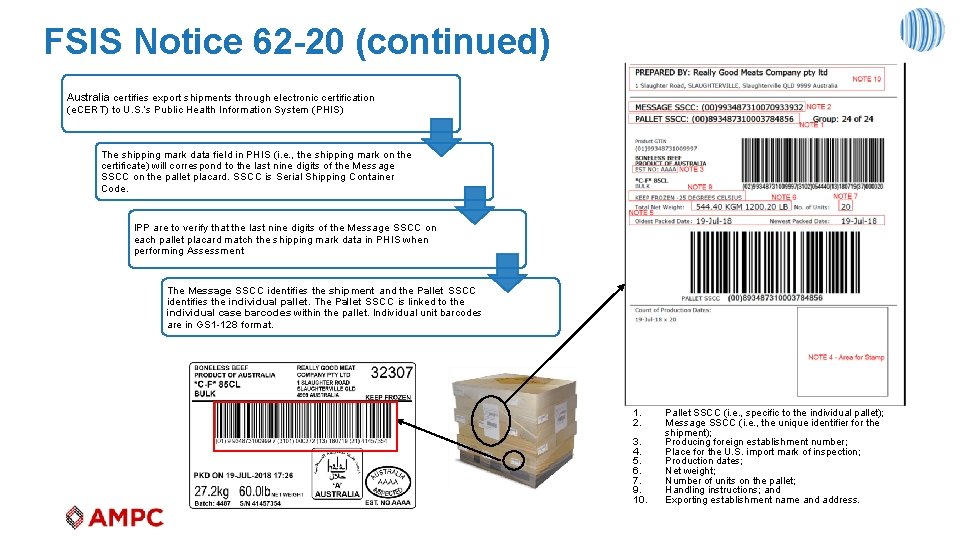
FSIS Notice 62 -20 (continued) Australia certifies export shipments through electronic certification (e. CERT) to U. S. ’s Public Health Information System (PHIS) The shipping mark data field in PHIS (i. e. , the shipping mark on the certificate) will correspond to the last nine digits of the Message SSCC on the pallet placard. SSCC is Serial Shipping Container Code. IPP are to verify that the last nine digits of the Message SSCC on each pallet placard match the shipping mark data in PHIS when performing Assessment The Message SSCC identifies the shipment and the Pallet SSCC identifies the individual pallet. The Pallet SSCC is linked to the individual case barcodes within the pallet. Individual unit barcodes are in GS 1 -128 format. 1. 2. 3. 4. 5. 6. 7. 9. 10. Pallet SSCC (i. e. , specific to the individual pallet); Message SSCC (i. e. , the unique identifier for the shipment); Producing foreign establishment number; Place for the U. S. import mark of inspection; Production dates; Net weight; Number of units on the pallet; Handling instructions; and Exporting establishment name and address.
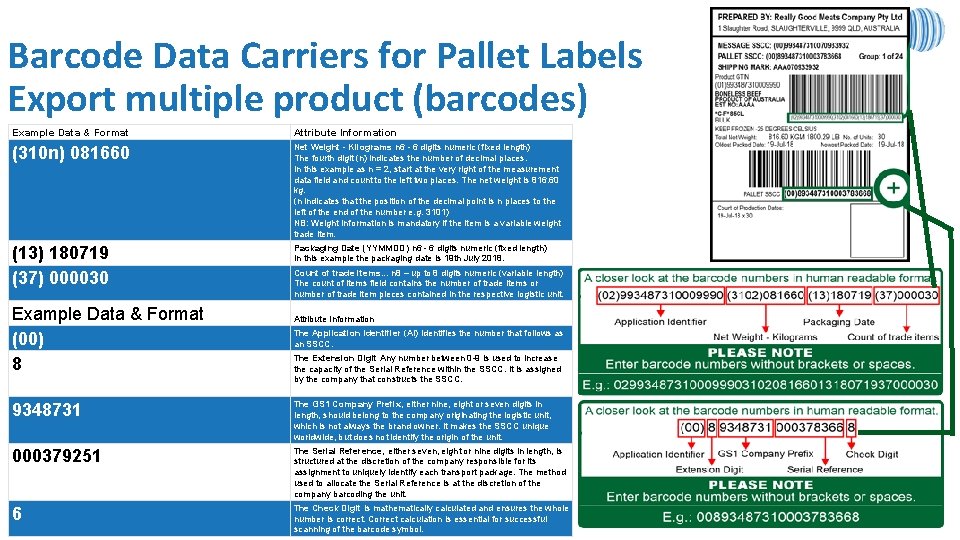
Barcode Data Carriers for Pallet Labels Export multiple product (barcodes) Example Data & Format Attribute Information (310 n) 081660 Net Weight - Kilograms n 6 - 6 digits numeric (fixed length) The fourth digit (n) indicates the number of decimal places. In this example as n = 2, start at the very right of the measurement data field and count to the left two places. The net weight is 816. 60 kg. (n indicates that the position of the decimal point is n places to the left of the end of the number e. g. 3101) NB: Weight information is mandatory if the item is a variable weight trade item. (13) 180719 (37) 000030 Packaging Date (YYMMDD) n 6 - 6 digits numeric (fixed length) In this example the packaging date is 19 th July 2018. Example Data & Format (00) 8 Count of trade items. . . n 8 – up to 8 digits numeric (variable length) The count of items field contains the number of trade items or number of trade item pieces contained in the respective logistic unit. Attribute Information The Application Identifier (AI) identifies the number that follows as an SSCC. The Extension Digit Any number between 0 -9 is used to increase the capacity of the Serial Reference within the SSCC. It is assigned by the company that constructs the SSCC. 9348731 The GS 1 Company Prefix, either nine, eight or seven digits in length, should belong to the company originating the logistic unit, which is not always the brand owner. It makes the SSCC unique worldwide, but does not identify the origin of the unit. 000379251 The Serial Reference, either seven, eight or nine digits in length, is structured at the discretion of the company responsible for its assignment to uniquely identify each transport package. The method used to allocate the Serial Reference is at the discretion of the company barcoding the unit. 6 The Check Digit is mathematically calculated and ensures the whole number is correct. Correct calculation is essential for successful scanning of the barcode symbol.
Additional Resources Meat Messaging • To register with Meat Messaging go to: https: //www. meatmessaging. info/register. asp • Meat Messaging implementation guide: https: //www. meatmessaging. info/docs/MM_Implementation_Guide. pdf • For workflow details on the Pallet Pilot go to: https: //www. meatmessaging. info/palletising. asp • Meat Messaging industry portal is based on the GS 1 standards for identification of consignments and barcodes on cases. For detail on case barcodes as supplied by Australian exporters go to: https: //www. rmscc. org/scis_1. asp GS 1 Resources • https: //www. gs 1 au. org • GS 1 Barcode Chart (link) • Meat and Poultry Implementation Guide (link) • Starters Guide to Using Barcodes (link) • Foodservice Manufacturer Implementation Checklist (link) • GS 1 Implementation Guide for Grocery Retailers (link) • GS 1 Implementation Guide for Foodservice (link) • GS 1 Barcode Guidelines for Cases/Cartons in Foodservice (link) • Find a GS 1 US Solution Partner (link) FSIS Directives and Notices • Title 9 CFR 327. 4 • FSIS Directive 9900. 5 Label Verification of Imported Meat, Poultry, and Egg Products • FSIS Notice 37 -19 Barcodes in Lieu of Shipping Marks Pilot Program For Fresh Meat Products From Australia

Questions?
- Slides: 21