
What is Marine Science It is the study





- Slides: 35
What is Marine Science? • It is the study of living organisms and their relationship to the chemical, physical, and geological nature of the ocean. It has two main divisions.
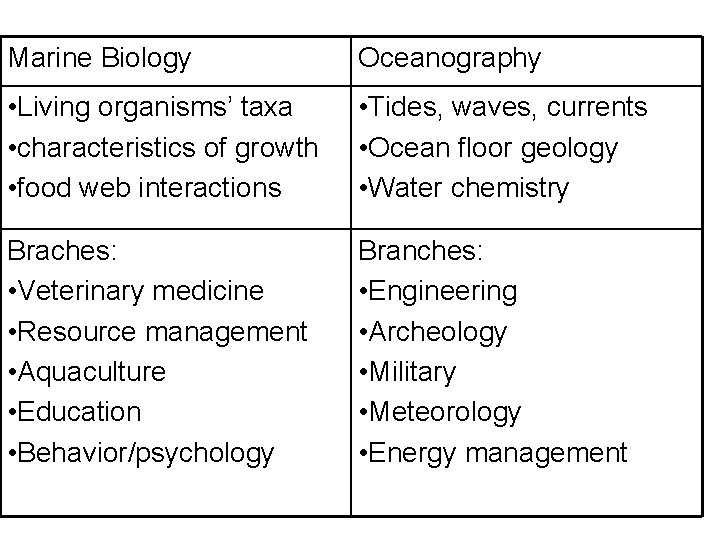
Marine Biology Oceanography • Living organisms’ taxa • characteristics of growth • food web interactions • Tides, waves, currents • Ocean floor geology • Water chemistry Braches: • Veterinary medicine • Resource management • Aquaculture • Education • Behavior/psychology Branches: • Engineering • Archeology • Military • Meteorology • Energy management
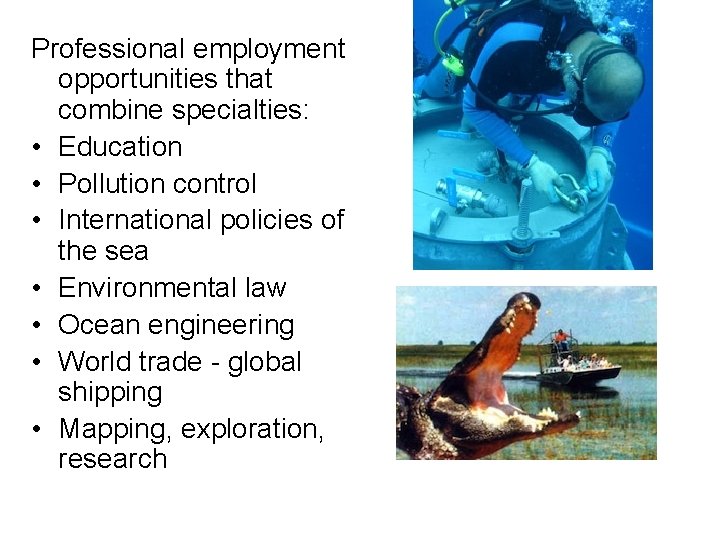
Professional employment opportunities that combine specialties: • Education • Pollution control • International policies of the sea • Environmental law • Ocean engineering • World trade - global shipping • Mapping, exploration, research
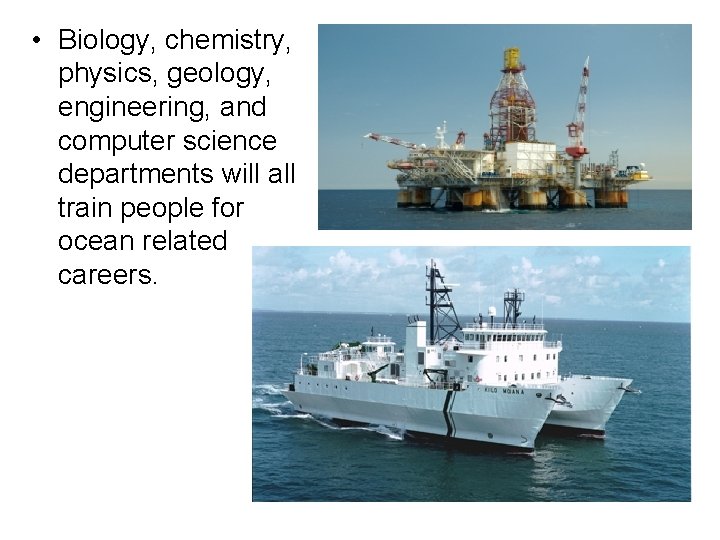
• Biology, chemistry, physics, geology, engineering, and computer science departments will all train people for ocean related careers.
Consider these ideas before you decide: • Many ocean related careers are relatively new and will continue to change. Well-rounded, interdisciplinary backgrounds are preferred. • Ocean careers can be the same as land careers - only in a different setting. With new technology, you do not have to live on a coastline. • Most marine scientists do not spend their days SCUBA diving on coral reefs nor training whales at Sea World. • Supply & demand determine the positions available. Student’s science and math skills should match their career objectives. • There is a shortage of applicants to graduate schools in oceanography, acoustics, and atmospheric chemistry; only marine biology attracts large numbers of applicants. • Marine careers are generally divided into 3 groups: all levels of governmental agencies, military, and academic or educational.
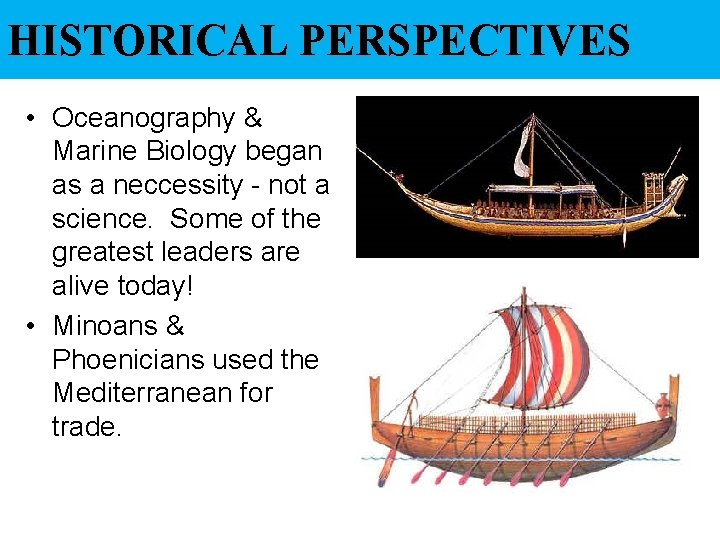
HISTORICAL PERSPECTIVES • Oceanography & Marine Biology began as a neccessity - not a science. Some of the greatest leaders are alive today! • Minoans & Phoenicians used the Mediterranean for trade.
• Greeks calculated the Earth’s size, shape, and latitude lines • Vikings led by Leif Erikson, colonized Iceland by 700 AD and North America by 1000 AD.
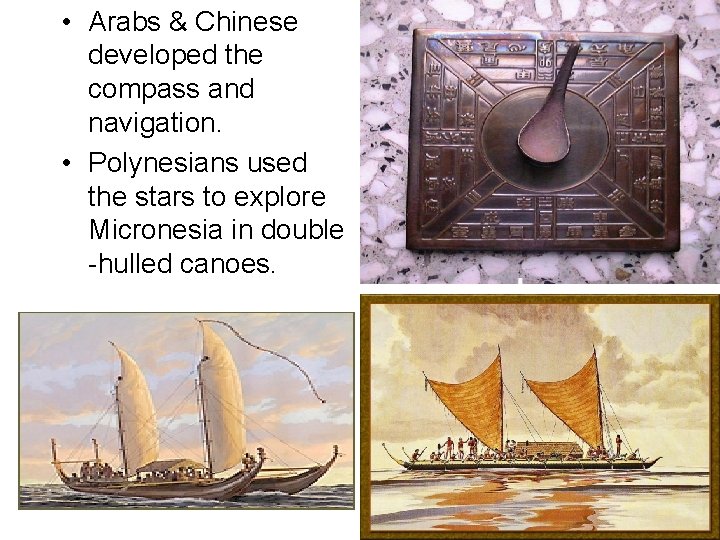
• Arabs & Chinese developed the compass and navigation. • Polynesians used the stars to explore Micronesia in double -hulled canoes.
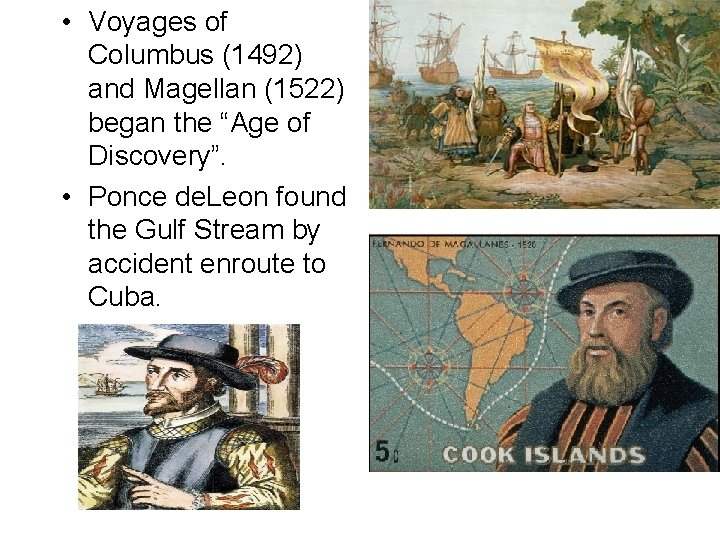
• Voyages of Columbus (1492) and Magellan (1522) began the “Age of Discovery”. • Ponce de. Leon found the Gulf Stream by accident enroute to Cuba.
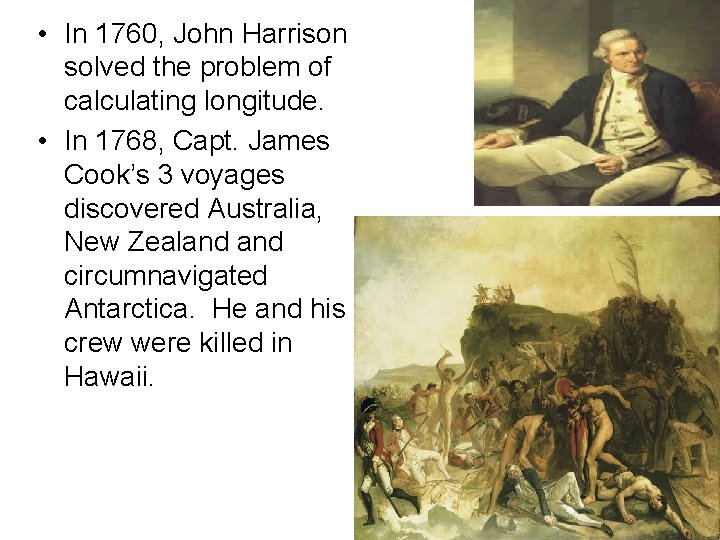
• In 1760, John Harrison solved the problem of calculating longitude. • In 1768, Capt. James Cook’s 3 voyages discovered Australia, New Zealand circumnavigated Antarctica. He and his crew were killed in Hawaii.
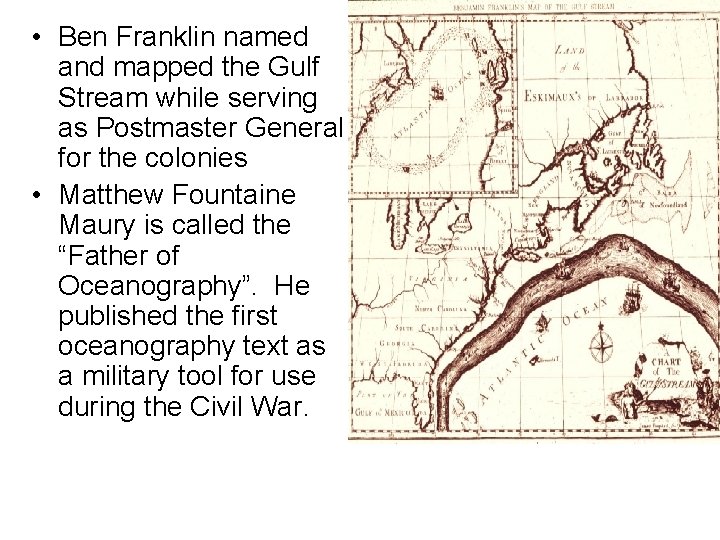
• Ben Franklin named and mapped the Gulf Stream while serving as Postmaster General for the colonies • Matthew Fountaine Maury is called the “Father of Oceanography”. He published the first oceanography text as a military tool for use during the Civil War.
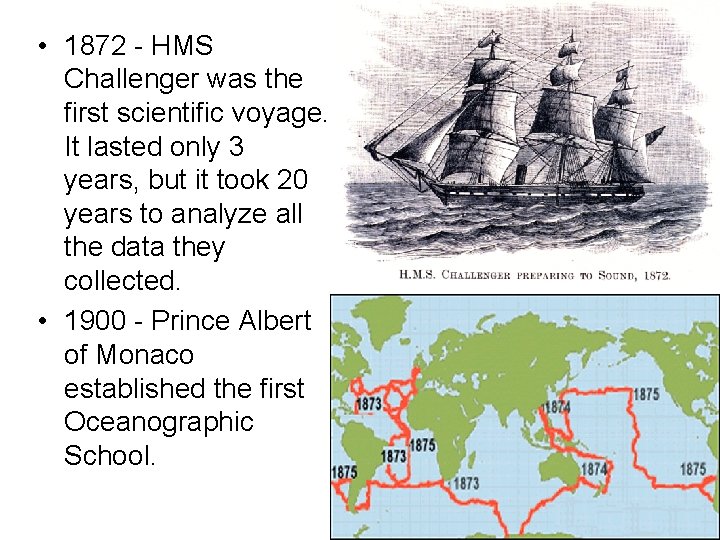
• 1872 - HMS Challenger was the first scientific voyage. It lasted only 3 years, but it took 20 years to analyze all the data they collected. • 1900 - Prince Albert of Monaco established the first Oceanographic School.
• An expedition on the ship, Meteor, made 14 crossings of the Atlantic Ocean. • William Beebe descended 3, 000 ft in the first bathysphere in 1930.
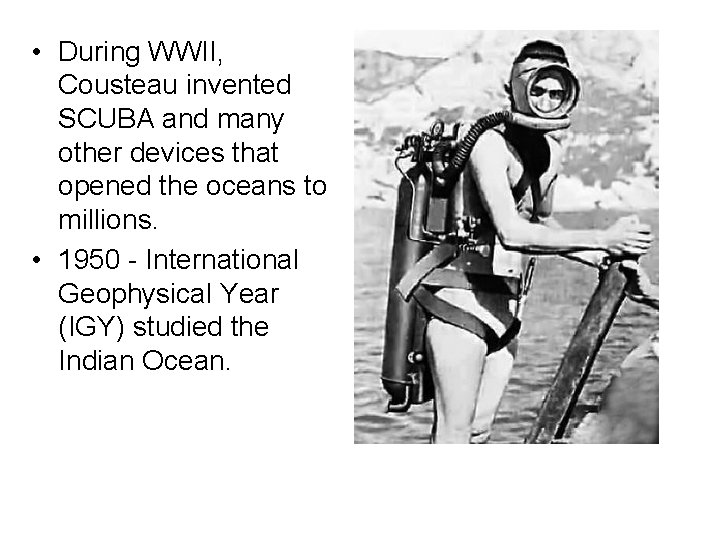
• During WWII, Cousteau invented SCUBA and many other devices that opened the oceans to millions. • 1950 - International Geophysical Year (IGY) studied the Indian Ocean.
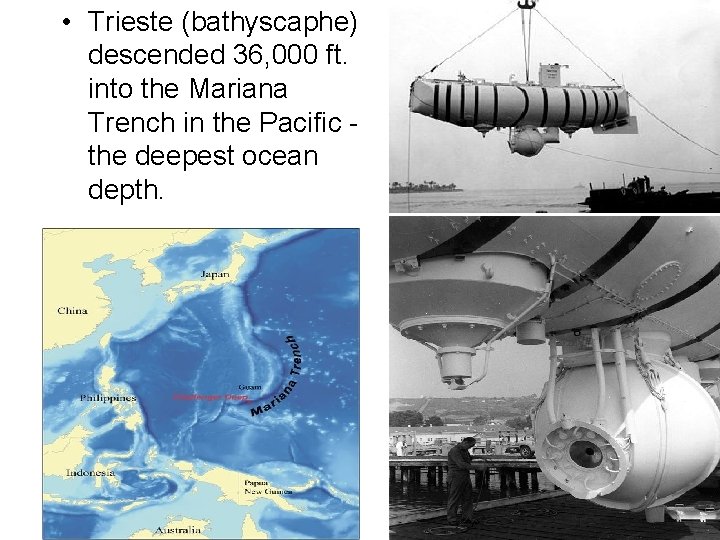
• Trieste (bathyscaphe) descended 36, 000 ft. into the Mariana Trench in the Pacific the deepest ocean depth.
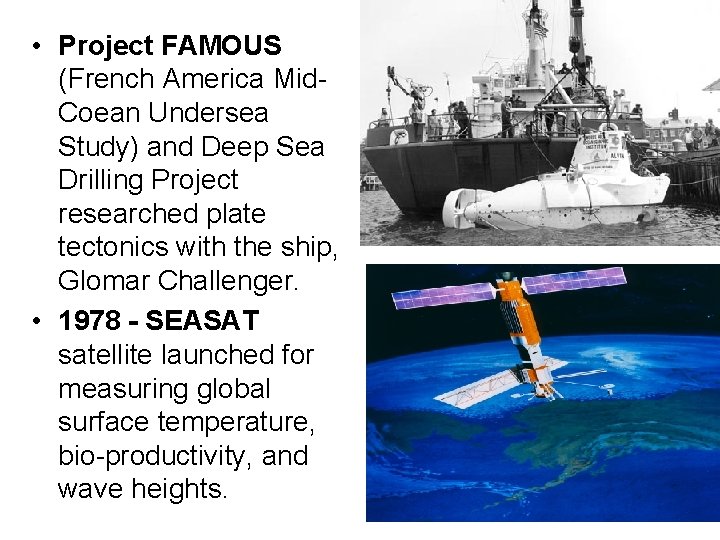
• Project FAMOUS (French America Mid. Coean Undersea Study) and Deep Sea Drilling Project researched plate tectonics with the ship, Glomar Challenger. • 1978 - SEASAT satellite launched for measuring global surface temperature, bio-productivity, and wave heights.
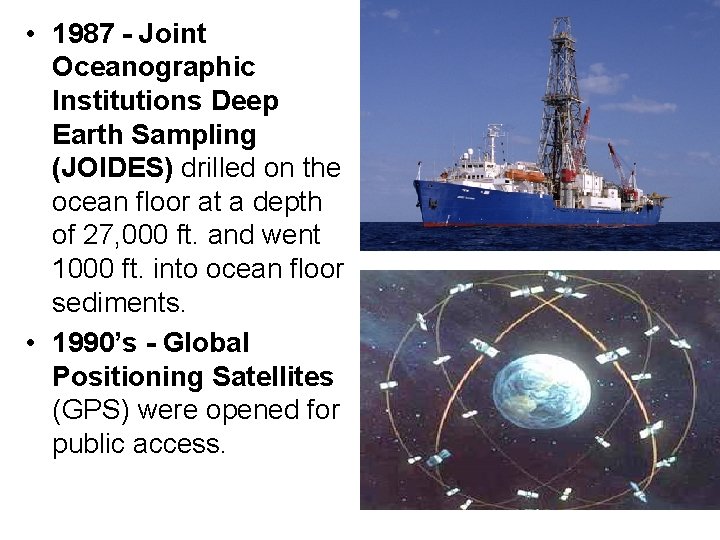
• 1987 - Joint Oceanographic Institutions Deep Earth Sampling (JOIDES) drilled on the ocean floor at a depth of 27, 000 ft. and went 1000 ft. into ocean floor sediments. • 1990’s - Global Positioning Satellites (GPS) were opened for public access.
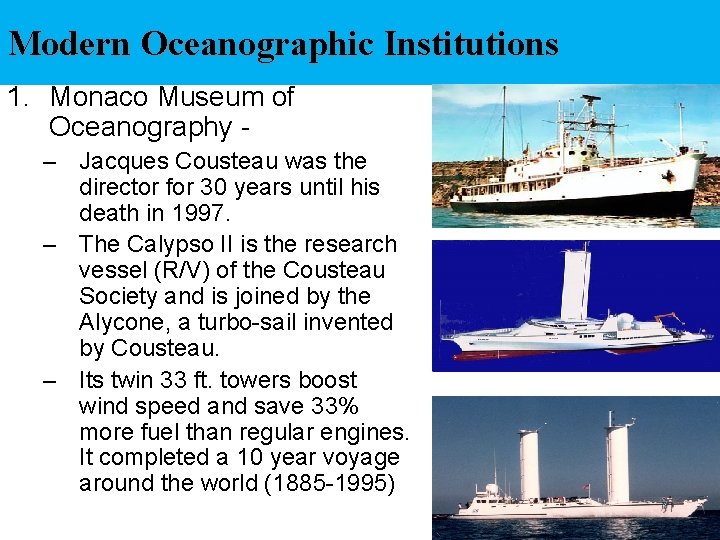
Modern Oceanographic Institutions 1. Monaco Museum of Oceanography – Jacques Cousteau was the director for 30 years until his death in 1997. – The Calypso II is the research vessel (R/V) of the Cousteau Society and is joined by the Alycone, a turbo-sail invented by Cousteau. – Its twin 33 ft. towers boost wind speed and save 33% more fuel than regular engines. It completed a 10 year voyage around the world (1885 -1995)
2. Wood’s hole Oceanographic Institutions, Mass. – Scientist Dr. Robert Ballard found the titanic, Bismark, and hydrothermal vent communities using “Alvin”. – Alvin is a deep submergence vehicle (DSV) deployed from the R/V Atlantis II. It can transport a crew of 3 to 13, 000 ft. – Alvin was built for the Navy in 1964, a year after a second submarine tragedy.
• 1927 - seven men died in 100 ft. of water in the S-4 near Cape cod. • 1963 - USS Thresher, a nuclear submarine, lost its entire crew off the coast of Maine at 1 -2 mile down. We still don’t know what happened. Black boxes were developed after that.
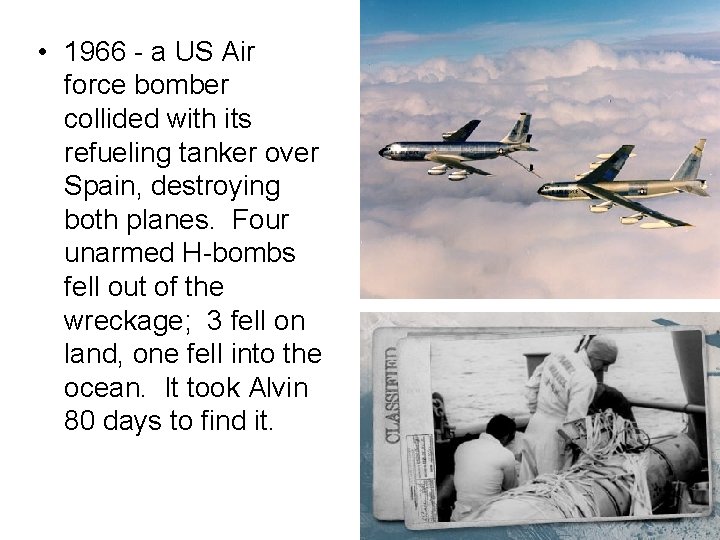
• 1966 - a US Air force bomber collided with its refueling tanker over Spain, destroying both planes. Four unarmed H-bombs fell out of the wreckage; 3 fell on land, one fell into the ocean. It took Alvin 80 days to find it.
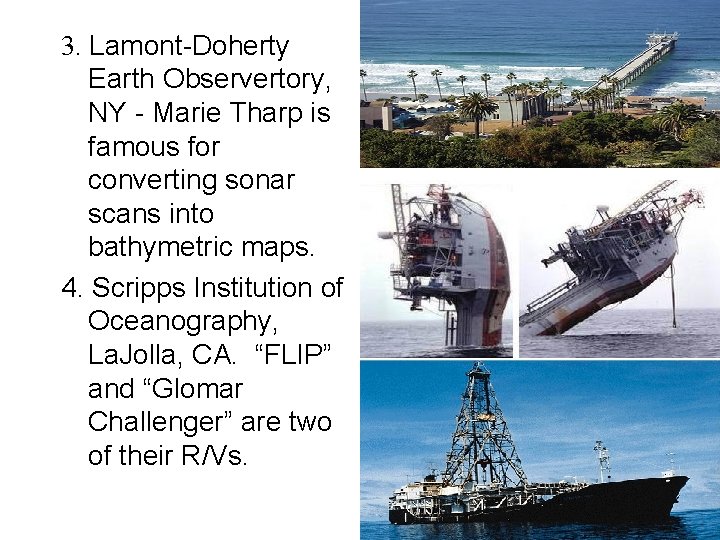
3. Lamont-Doherty Earth Observertory, NY - Marie Tharp is famous for converting sonar scans into bathymetric maps. 4. Scripps Institution of Oceanography, La. Jolla, CA. “FLIP” and “Glomar Challenger” are two of their R/Vs.
• FLIP is a 3345 ft. vessel, whose stern ballast tanks can be flooded to convert it into a 55 ft. stable platform for research.
• 1966 - Congress established the National Sea Grant College Program. • Currently, there are sea grant colleges in every coastal state and Puerto Rico, involved in a variety of graduate level studies.
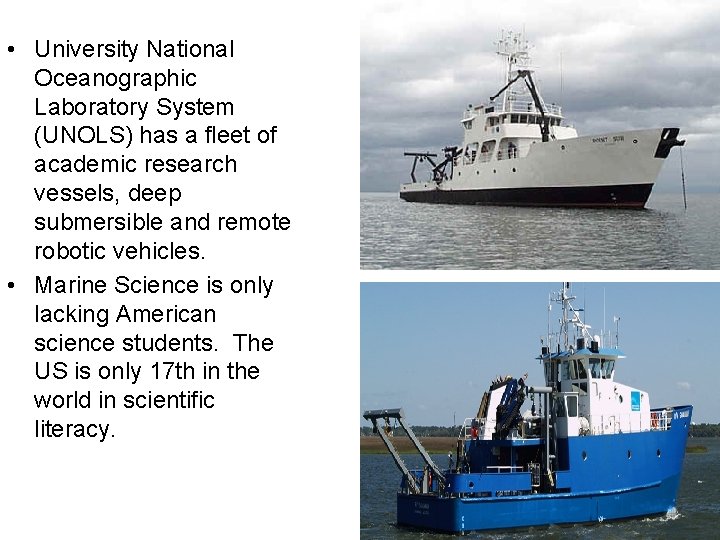
• University National Oceanographic Laboratory System (UNOLS) has a fleet of academic research vessels, deep submersible and remote robotic vehicles. • Marine Science is only lacking American science students. The US is only 17 th in the world in scientific literacy.
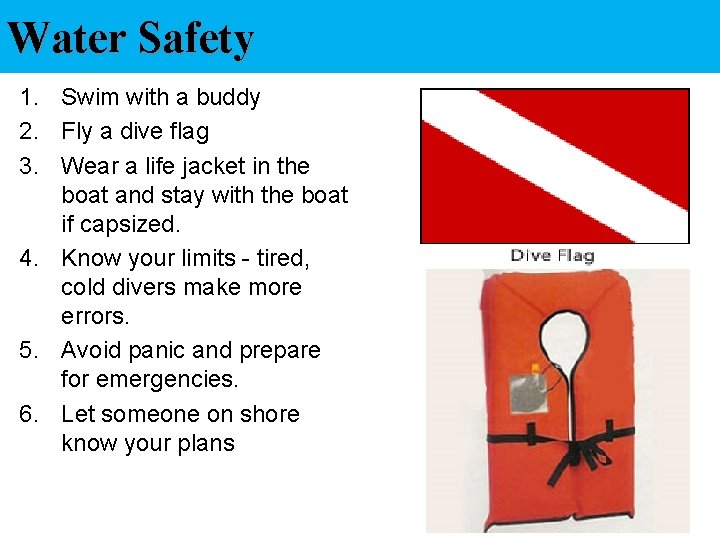
Water Safety 1. Swim with a buddy 2. Fly a dive flag 3. Wear a life jacket in the boat and stay with the boat if capsized. 4. Know your limits - tired, cold divers make more errors. 5. Avoid panic and prepare for emergencies. 6. Let someone on shore know your plans
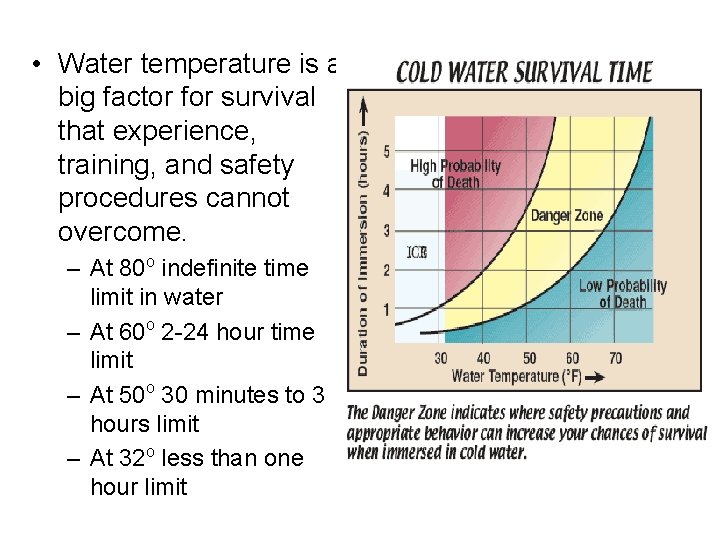
• Water temperature is a big factor for survival that experience, training, and safety procedures cannot overcome. – At 80 o indefinite time limit in water – At 60 o 2 -24 hour time limit – At 50 o 30 minutes to 3 hours limit – At 32 o less than one hour limit
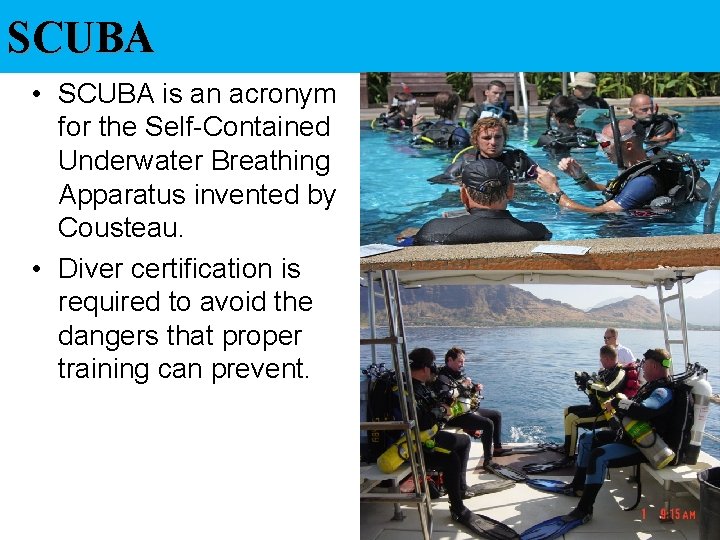
SCUBA • SCUBA is an acronym for the Self-Contained Underwater Breathing Apparatus invented by Cousteau. • Diver certification is required to avoid the dangers that proper training can prevent.
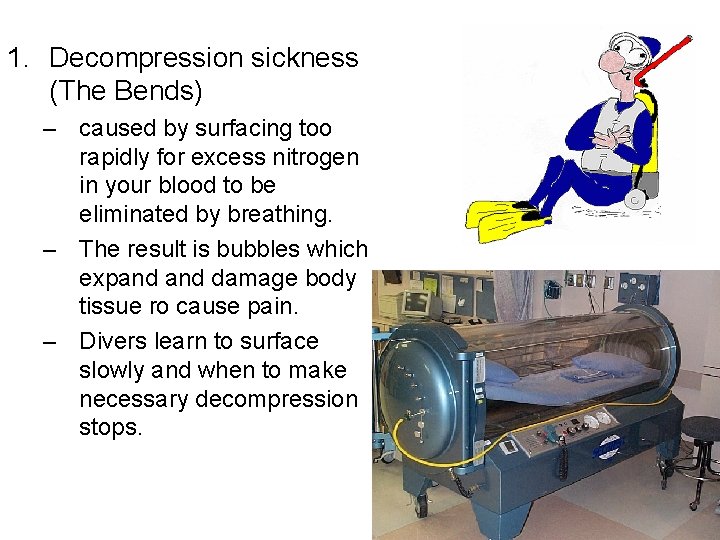
1. Decompression sickness (The Bends) – caused by surfacing too rapidly for excess nitrogen in your blood to be eliminated by breathing. – The result is bubbles which expand damage body tissue ro cause pain. – Divers learn to surface slowly and when to make necessary decompression stops.
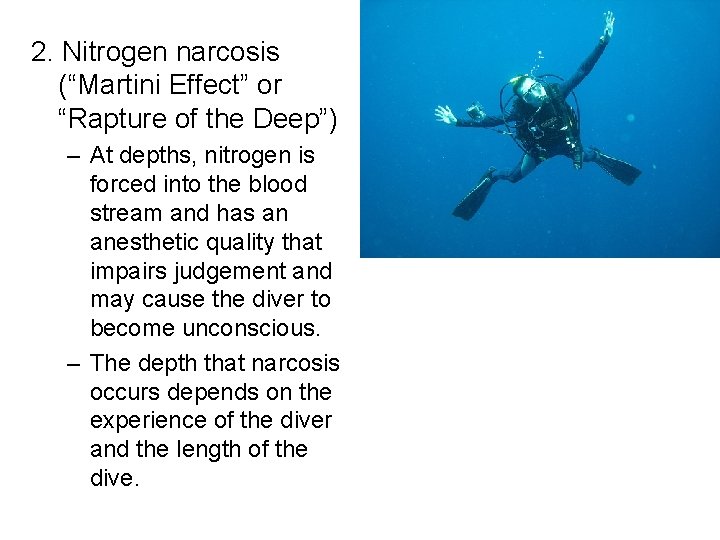
2. Nitrogen narcosis (“Martini Effect” or “Rapture of the Deep”) – At depths, nitrogen is forced into the blood stream and has an anesthetic quality that impairs judgement and may cause the diver to become unconscious. – The depth that narcosis occurs depends on the experience of the diver and the length of the dive.
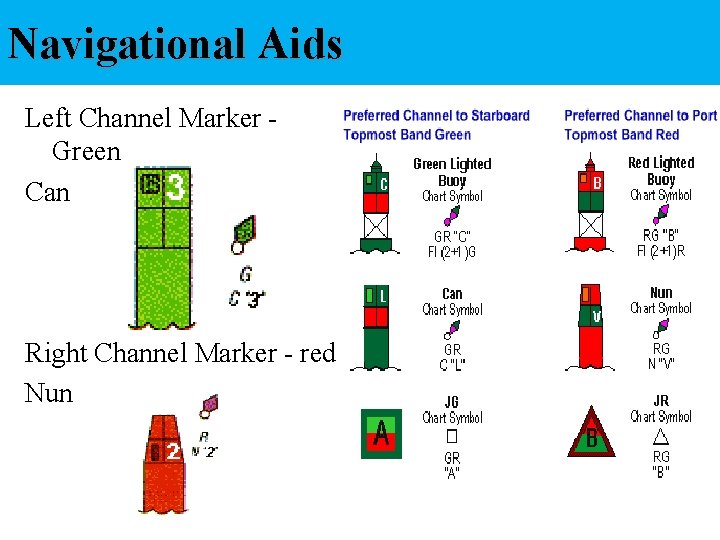
Navigational Aids Left Channel Marker Green Can Right Channel Marker - red Nun
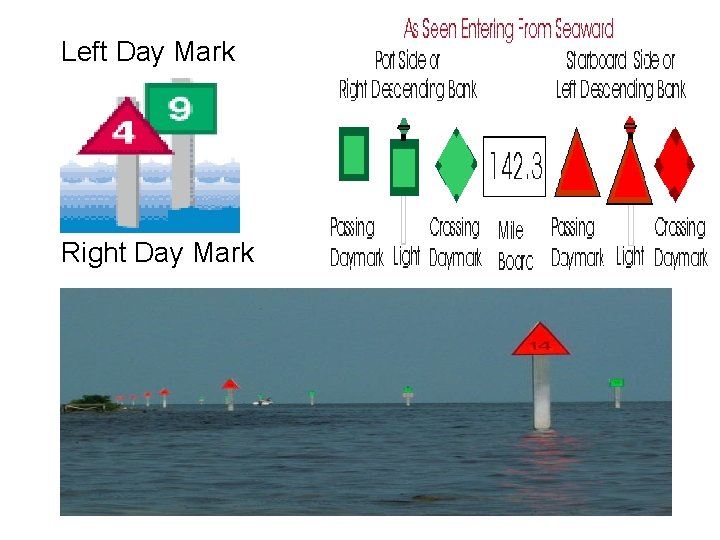
Left Day Mark Right Day Mark
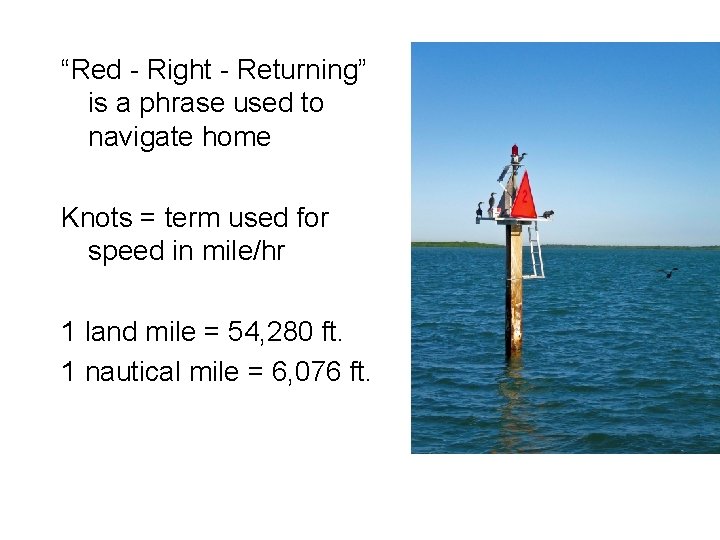
“Red - Right - Returning” is a phrase used to navigate home Knots = term used for speed in mile/hr 1 land mile = 54, 280 ft. 1 nautical mile = 6, 076 ft.
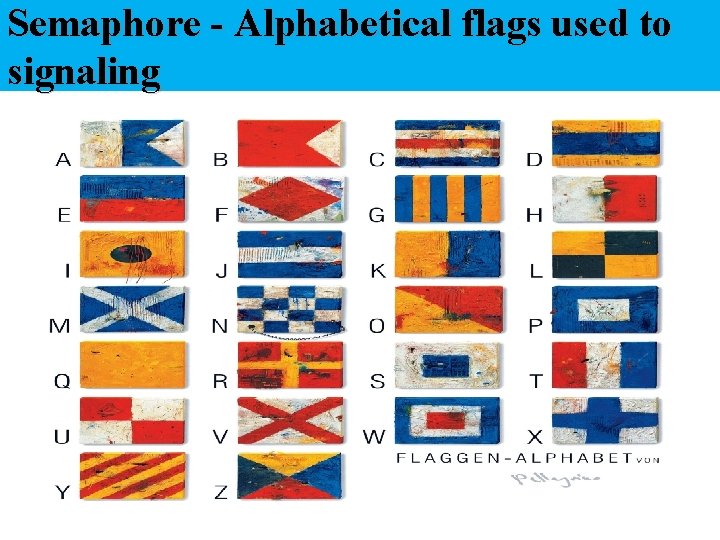
Semaphore - Alphabetical flags used to signaling
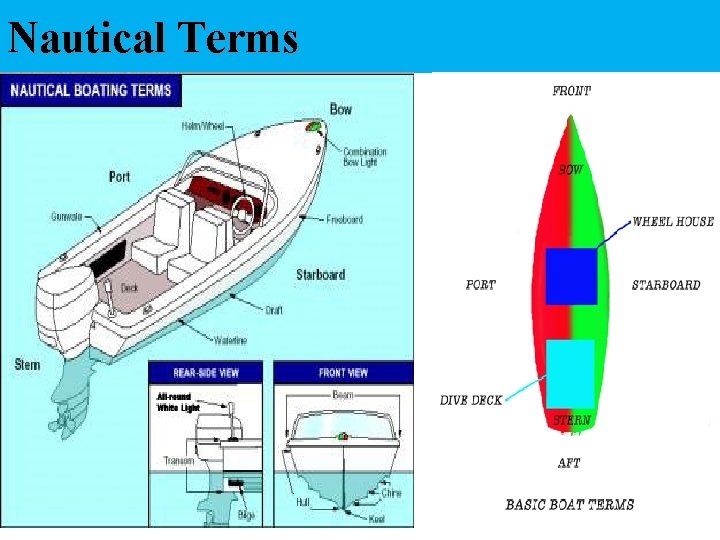
Nautical Terms