
What is Live Marking Giving students a structured

- Slides: 2
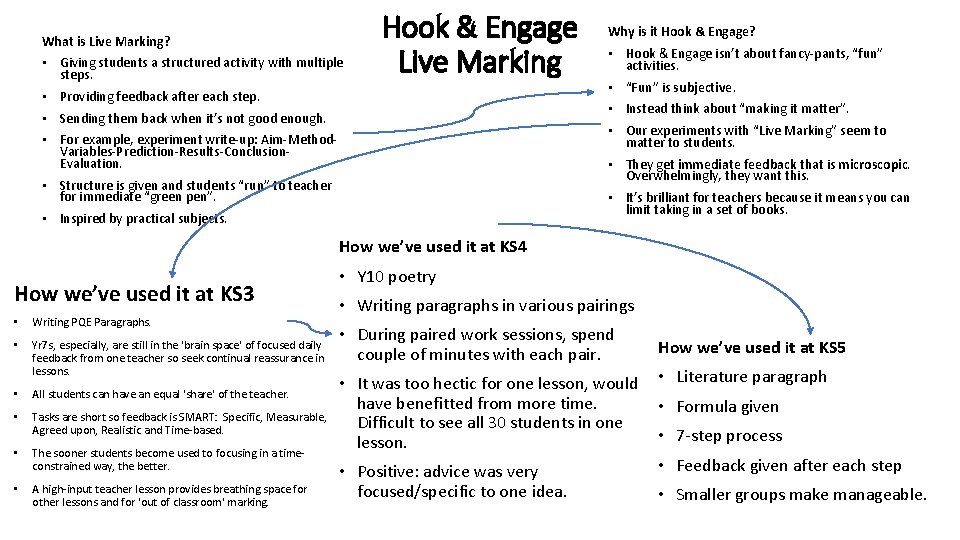
What is Live Marking? • Giving students a structured activity with multiple steps. Hook & Engage Live Marking • Providing feedback after each step. Why is it Hook & Engage? • Hook & Engage isn’t about fancy-pants, “fun” activities. • “Fun” is subjective. • Instead think about “making it matter”. • Sending them back when it’s not good enough. • Our experiments with “Live Marking” seem to matter to students. • For example, experiment write-up: Aim-Method. Variables-Prediction-Results-Conclusion. Evaluation. • They get immediate feedback that is microscopic. Overwhelmingly, they want this. • Structure is given and students “run” to teacher for immediate “green pen”. • It’s brilliant for teachers because it means you can limit taking in a set of books. • Inspired by practical subjects. How we’ve used it at KS 4 How we’ve used it at KS 3 • Writing PQE Paragraphs. • Yr 7 s, especially, are still in the 'brain space' of focused daily feedback from one teacher so seek continual reassurance in lessons. • All students can have an equal 'share' of the teacher. • Tasks are short so feedback is SMART: Specific, Measurable, Agreed upon, Realistic and Time-based. • • The sooner students become used to focusing in a timeconstrained way, the better. A high-input teacher lesson provides breathing space for other lessons and for 'out of classroom' marking. • Y 10 poetry • Writing paragraphs in various pairings • During paired work sessions, spend couple of minutes with each pair. How we’ve used it at KS 5 • It was too hectic for one lesson, would have benefitted from more time. Difficult to see all 30 students in one lesson. • Literature paragraph • Positive: advice was very focused/specific to one idea. • Feedback given after each step • Formula given • 7 -step process • Smaller groups make manageable.