
What is Job Corps An Overview What is
What is Job Corps? An Overview
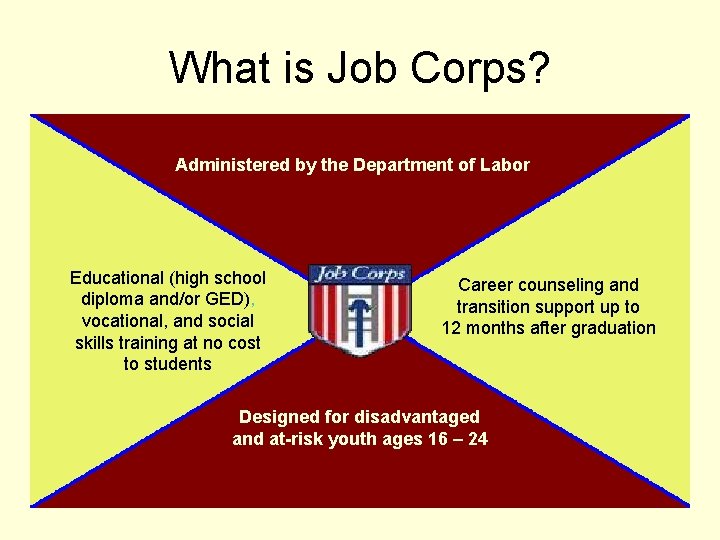
What is Job Corps? Administered by the Department of Labor Educational (high school diploma and/or GED), vocational, and social skills training at no cost to students Career counseling and transition support up to 12 months after graduation Designed for disadvantaged and at-risk youth ages 16 – 24

History • Funded by the U. S Congress, & administered through the DOL, Job Corps has been training young adults since 1964. • JC is committed to a safe, drug-free environment where trainees can take advantage of the provided resources to better their lives.

Mission Statement Training Today’s Youth for Tomorrow’s Jobs • As a national, primarily residential training program, JC‘s mission is to attract eligible young adults, teach them the skills they need to become employable & independent, & place them in meaningful jobs or further education.
Health & Wellness An integral component of JC
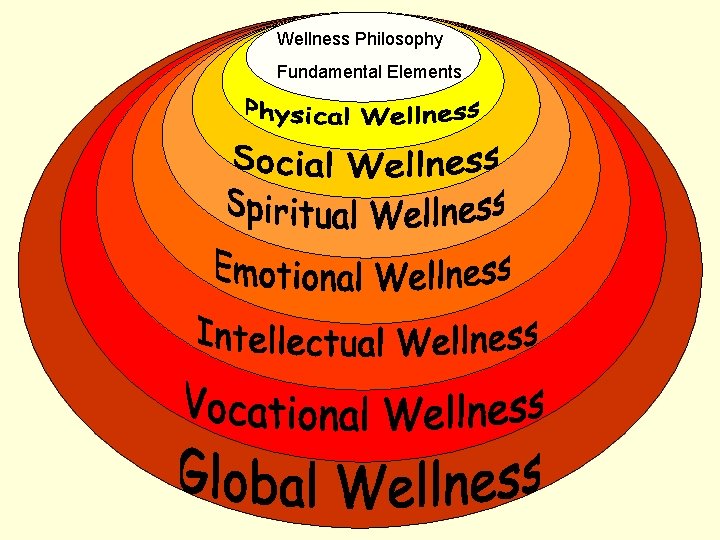
Wellness Philosophy Fundamental Elements

The Wellness Philosophy evolved from a “sick care model” to a “wellness model” • All areas of Wellness needs for the trainees are provided at no cost. • Let’s take a closer look at their 7 fundamental elements. . .
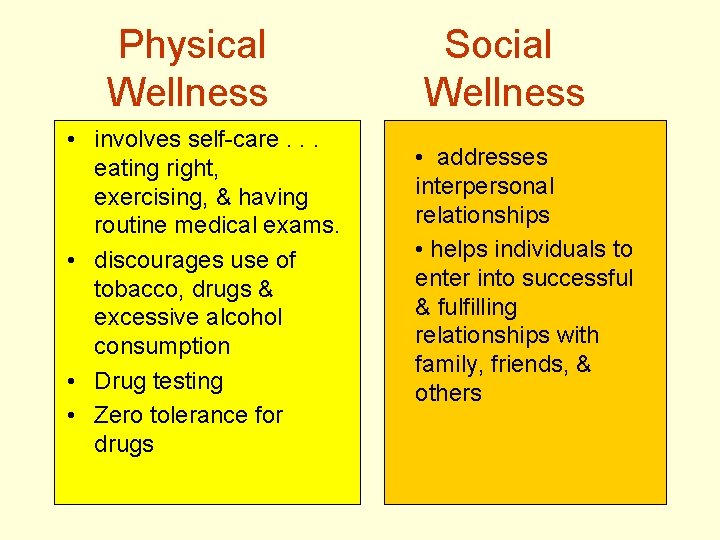
Physical Wellness • involves self-care. . . eating right, exercising, & having routine medical exams. • discourages use of tobacco, drugs & excessive alcohol consumption • Drug testing • Zero tolerance for drugs Social Wellness • addresses interpersonal relationships • helps individuals to enter into successful & fulfilling relationships with family, friends, & others
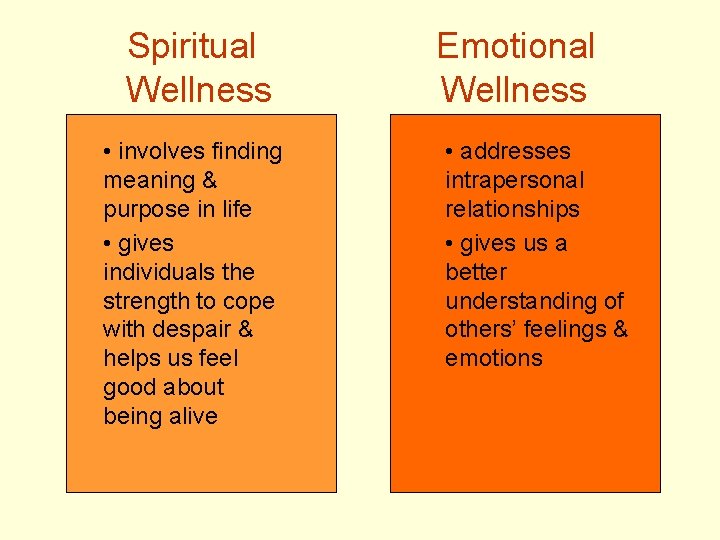
Spiritual Wellness • involves finding meaning & purpose in life • gives individuals the strength to cope with despair & helps us feel good about being alive Emotional Wellness • addresses intrapersonal relationships • gives us a better understanding of others’ feelings & emotions

Intellectual Wellness • involves the maintaining of cognitive stimulation to prevent mental stagnation. • Learning is seen as a lifelong process of mental challenges & creativity Vocational Wellness • addresses career goals & paths • finding a balance between life at home & work
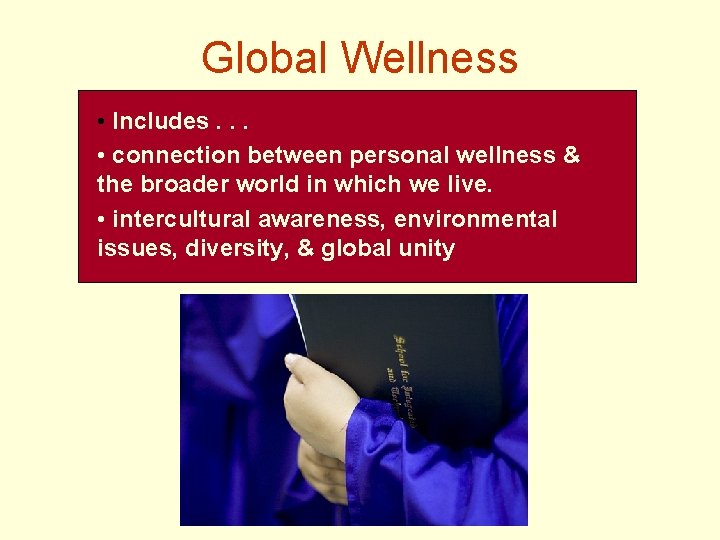
Global Wellness • Includes. . . • connection between personal wellness & the broader world in which we live. • intercultural awareness, environmental issues, diversity, & global unity

• 16 – 24 years of age • Applicants and/or applicant's family must meet low income requirements And at least one of the following: • High school drop out • In need of additional education, vocational training, or intensive career counseling to secure and hold employment • Basic skills deficient • Homeless, a runaway, or foster child, or • Is a parent
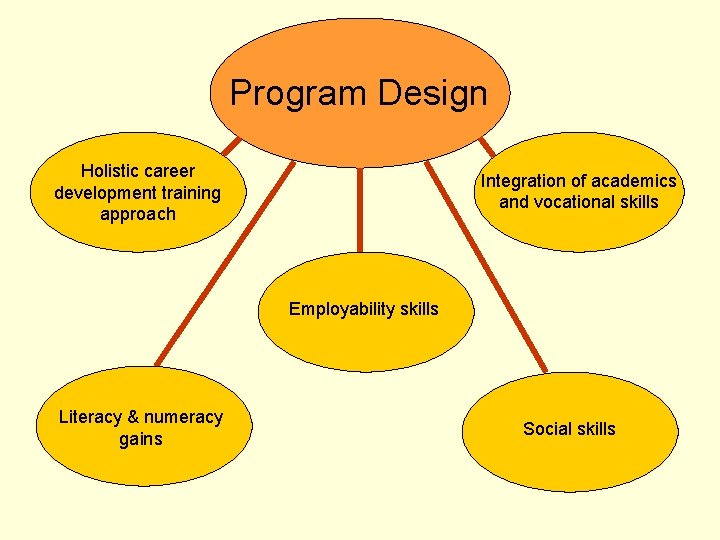
Program Design Holistic career development training approach Integration of academics and vocational skills Employability skills Literacy & numeracy gains Social skills
Applied Academics • Key elements: – Collaboration – Lesson Planning & Delivery • Problem solving • Implementation strategies • Supports – Documentation – Feedback
Applied Academics • Performance Standards – Academic skills: math, reading, science, vocabulary (taught in context), • Activity purpose • What is important • Text Structure: – includes visual clues such as bolding, graphics, headings, index, tables, etc. that help the reader find and “pull “ information from the text. • http: //jccdrc. jobcorps. gov/cttold/Auto/cert/ase-natef-automobilecertification/train/Application%20 of%20 Applied%20 Academics. ppt/view? searchterm=applied%20 academics
Applied Academics & SIATech • Considerations for the partnership – Collaborating with vocational instructors – Co-teaching with vocational instructors – Relating SIATech curriculum to student’s trade • Real Learning for Real Life!
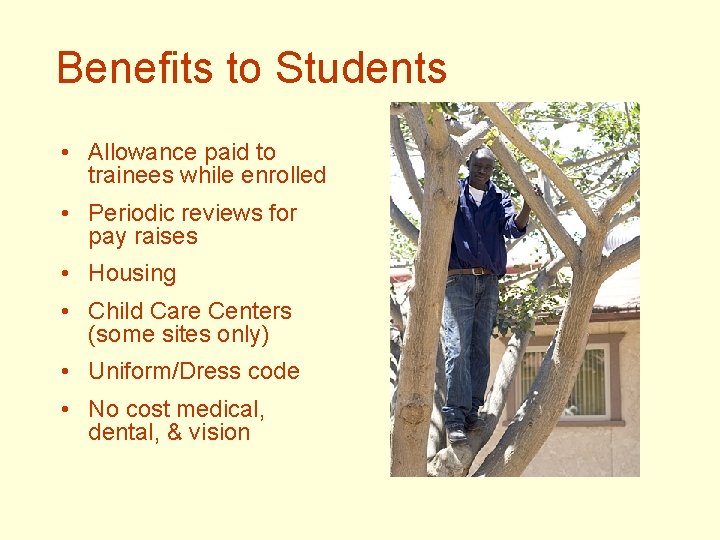
Benefits to Students • Allowance paid to trainees while enrolled • Periodic reviews for pay raises • Housing • Child Care Centers (some sites only) • Uniform/Dress code • No cost medical, dental, & vision
What Happens in Job Corps? The Student Life Cycle
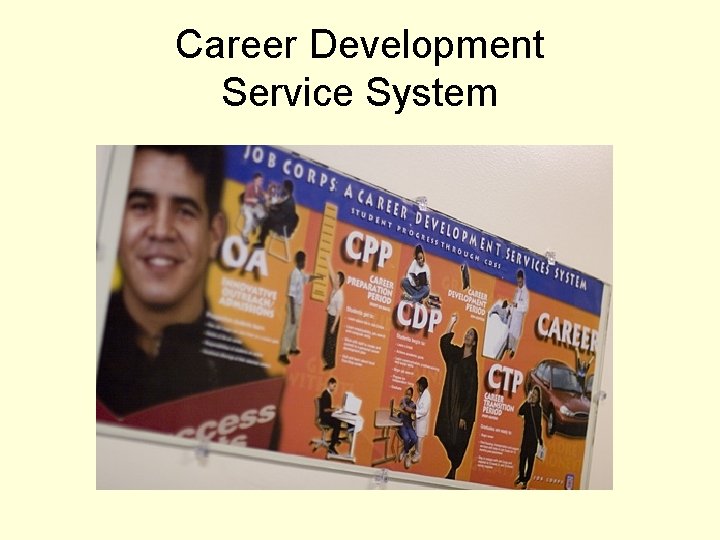
Career Development Service System
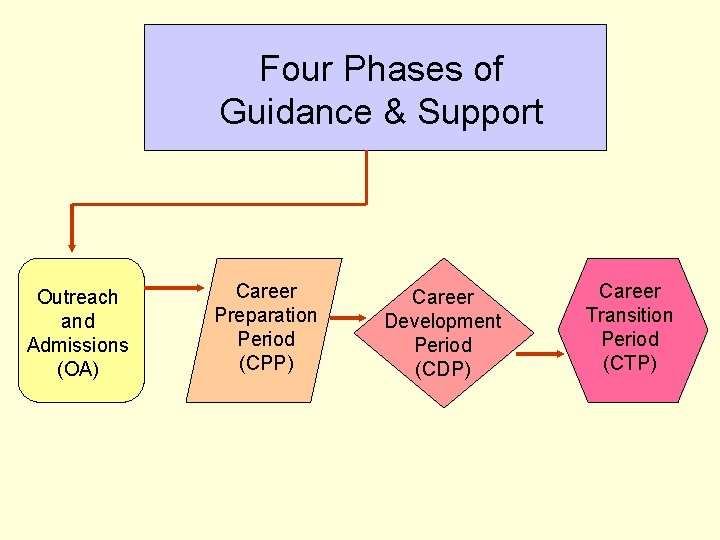
Four Phases of Guidance & Support Outreach and Admissions (OA) Career Preparation Period (CPP) Career Development Period (CDP) Career Transition Period (CTP)
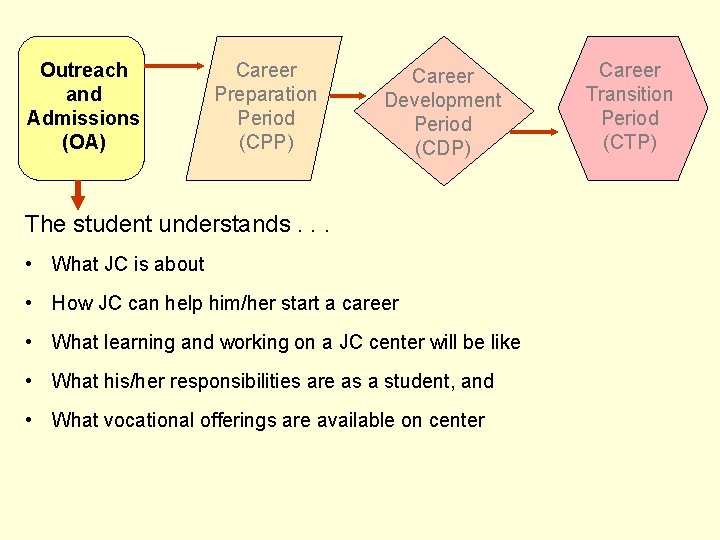
Outreach and Admissions (OA) Career Preparation Period (CPP) Career Development Period (CDP) The student understands. . . • What JC is about • How JC can help him/her start a career • What learning and working on a JC center will be like • What his/her responsibilities are as a student, and • What vocational offerings are available on center Career Transition Period (CTP)
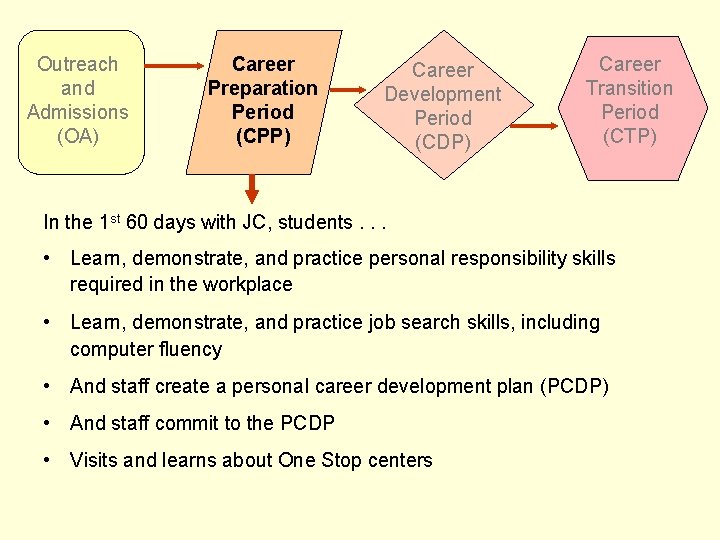
Outreach and Admissions (OA) Career Preparation Period (CPP) Career Development Period (CDP) Career Transition Period (CTP) In the 1 st 60 days with JC, students. . . • Learn, demonstrate, and practice personal responsibility skills required in the workplace • Learn, demonstrate, and practice job search skills, including computer fluency • And staff create a personal career development plan (PCDP) • And staff commit to the PCDP • Visits and learns about One Stop centers
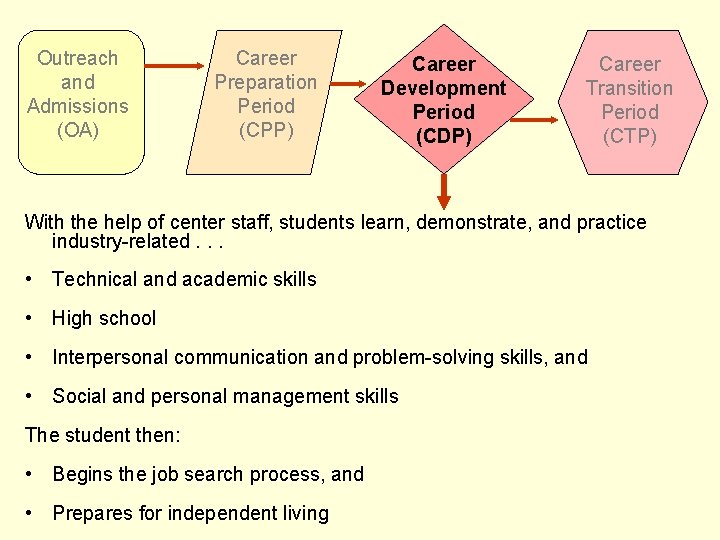
Outreach and Admissions (OA) Career Preparation Period (CPP) Career Development Period (CDP) Career Transition Period (CTP) With the help of center staff, students learn, demonstrate, and practice industry-related. . . • Technical and academic skills • High school • Interpersonal communication and problem-solving skills, and • Social and personal management skills The student then: • Begins the job search process, and • Prepares for independent living
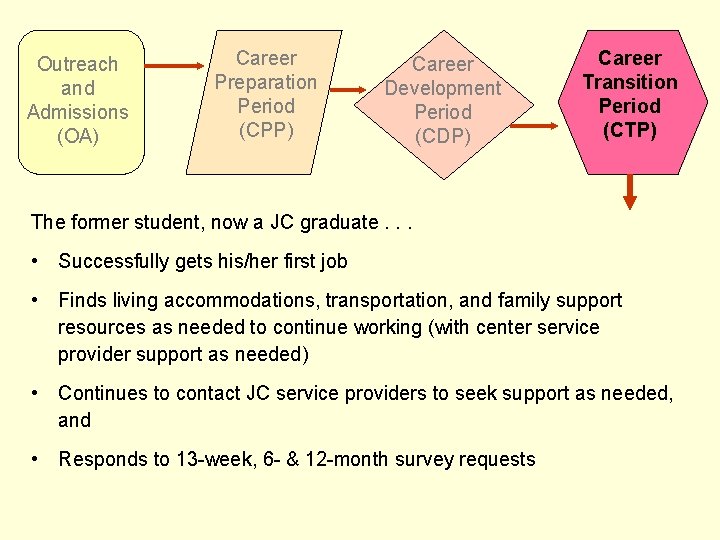
Outreach and Admissions (OA) Career Preparation Period (CPP) Career Development Period (CDP) Career Transition Period (CTP) The former student, now a JC graduate. . . • Successfully gets his/her first job • Finds living accommodations, transportation, and family support resources as needed to continue working (with center service provider support as needed) • Continues to contact JC service providers to seek support as needed, and • Responds to 13 -week, 6 - & 12 -month survey requests
Open Entry/Open Exit For us, this means. . . New students enter our labs every week.
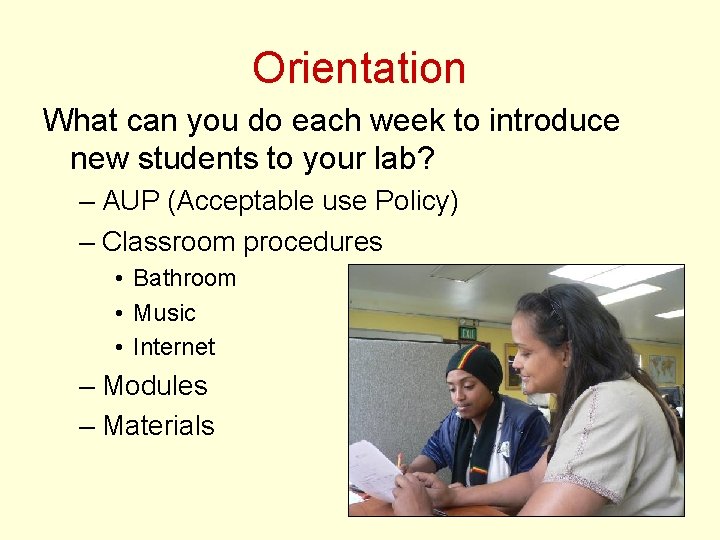
Orientation What can you do each week to introduce new students to your lab? – AUP (Acceptable use Policy) – Classroom procedures • Bathroom • Music • Internet – Modules – Materials
References • http: //jccdrc. jobcorps. gov/ • http: //jchealth. jobcorps. gov/
- Slides: 27