
What is International Relations Part 1 Why Study
- Slides: 9
What is International Relations?
Part 1: Why Study IR? 1. Why did the authors of this text think it was useful to begin the book with an anecdote about the Israeli-Palestinian Conflict? 2. As students of IR, what intellectual pursuit we have chosen to explore for the next 3 weeks? 3. Why do you think the authors chose to detail both the good and bad things happening in the world?
Part 2: IR Puzzles 1. Which two puzzles do you find most interesting? Why?
Part 3: Theories & Frameworks in IR 1. What is a theory and why is it useful in the study of IR? 2. What framework do the authors of this book offer to help us make sense of world politics? Partner work: 1. Apply the Framework to the anecdote provided at the beginning of the chapter. 2. Draw the Framework.
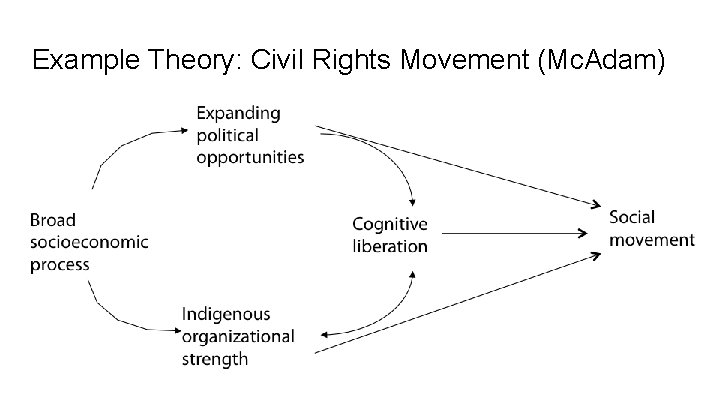
Example Theory: Civil Rights Movement (Mc. Adam)
Part 4: Levels of Analysis 1. What are the levels of analysis? 2. In the anecdotal example, which level would you choose? Why?
Part 5: The IR “-isms” 1. Take notes on realism, liberalism, and constructivism. 2. Which “ism” do you initially think lean toward? Why? 3. Draw your assigned “-ism” (flow chart, graphic organizer, comic, etc) Group Work: § Share your ideas with others who were assigned your “-ism”. Combine ideas to make a great visual representation of the approach to IR. It is to be used as a resource throughout our course, so make it legible, detailed, and accurate.
Strategy Games & the “isms” 1. After playing your game, do you think the gamemaker was a realist, liberal, constructivist, or a combination of more than one ism? Why? 2. Do you think the way that players interacted in the game was similar to the way nations/peoples interact in the real world? 3. If you had to create a game that was meant show the way different peoples interact with one another, what would you want to portray? How do you think you could portray it?
Clash of Civilizations Make Concept Posters for Huntington & Sen’s Views on Conflict! 8 and 7 in each group. Choose Roles: 1. One Discussion Facilitator Strengths: diplomatic, gently assertive, kind 2. Two Idea Makers (Make Blue Print) Strengths: decisive, quick, not perfectionists 3. One Image Generators Strengths: good interpreters, decent drawers, team players 4. Two Scribes Strengths: neat, plan-oriented, well-organized 5. One or Two Persons Consulting with Other Group to Ensure Differences are Clear. Strengths: articulate, solid understanding of both thinkers, good listeners