
What is Intelligence Cohen Swerdlik a multifaceted capacity
- Slides: 11
What is Intelligence? • Cohen & Swerdlik: a multifaceted capacity that manifests itself in different ways across the lifespan, but in general includes the abilities and capabilities to acquire and apply knowledge, to reason logically, to plan effectively, to infer perceptively, to exhibit sound judgment and problem-solving ability, to grasp and visualize concepts, to be mentally alert and intuitive, to be able to find the right words and thoughts with facility, and to be able to cope, adjust, and make the most of new situations
Synonyms • Cognitive ability • Mental ability • Scholastic aptitude
Theories of intelligence How many “intelligences” are there? • Spearman: g & s based on correlations among tests • g rather than s best prediction of overall intelligence – Abstract reasoning best measure of g • Can a single number/score represent a person’s intelligence?
Theorists de-emphasizing g • Thurstone: 7 primary mental abilities • Guilford: Structure of Intellect Model – 3 classifications of mental ability: • Operations-what a person does • Contents-the material on which operations are performed • Products-the form in which information is stored and processed • 120 separate abilities
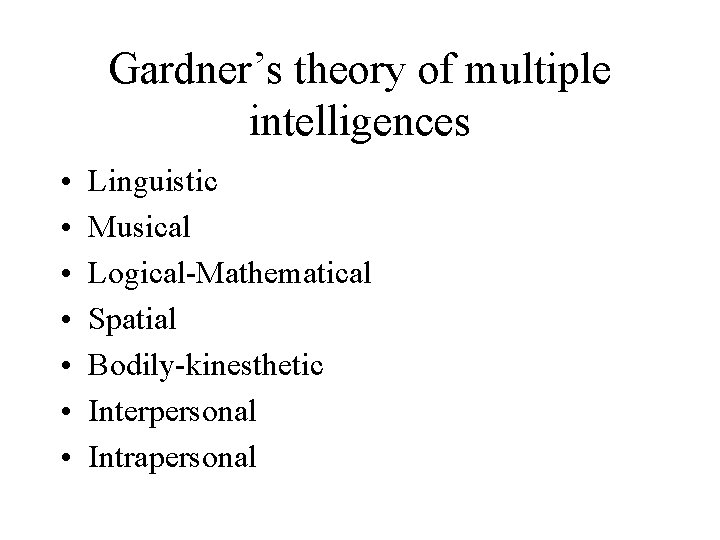
Gardner’s theory of multiple intelligences • • Linguistic Musical Logical-Mathematical Spatial Bodily-kinesthetic Interpersonal Intrapersonal
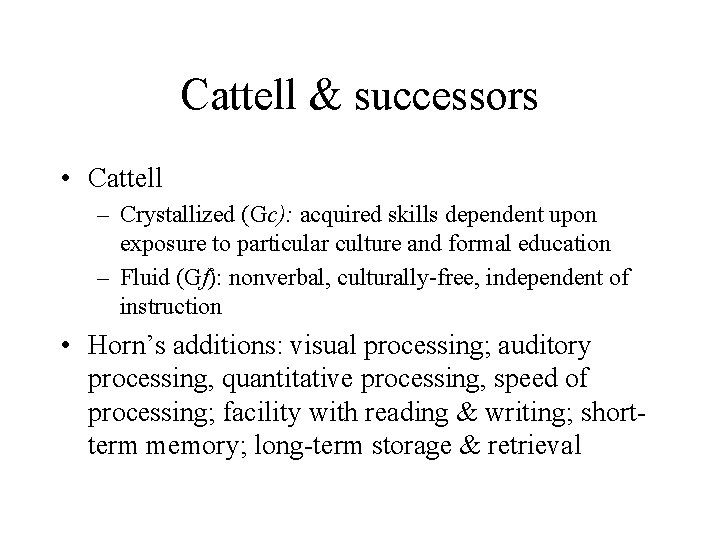
Cattell & successors • Cattell – Crystallized (Gc): acquired skills dependent upon exposure to particular culture and formal education – Fluid (Gf): nonverbal, culturally-free, independent of instruction • Horn’s additions: visual processing; auditory processing, quantitative processing, speed of processing; facility with reading & writing; shortterm memory; long-term storage & retrieval
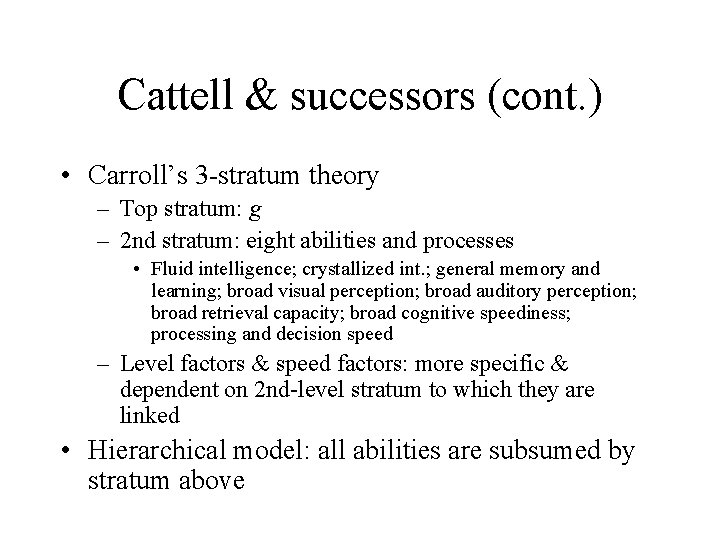
Cattell & successors (cont. ) • Carroll’s 3 -stratum theory – Top stratum: g – 2 nd stratum: eight abilities and processes • Fluid intelligence; crystallized int. ; general memory and learning; broad visual perception; broad auditory perception; broad retrieval capacity; broad cognitive speediness; processing and decision speed – Level factors & speed factors: more specific & dependent on 2 nd-level stratum to which they are linked • Hierarchical model: all abilities are subsumed by stratum above
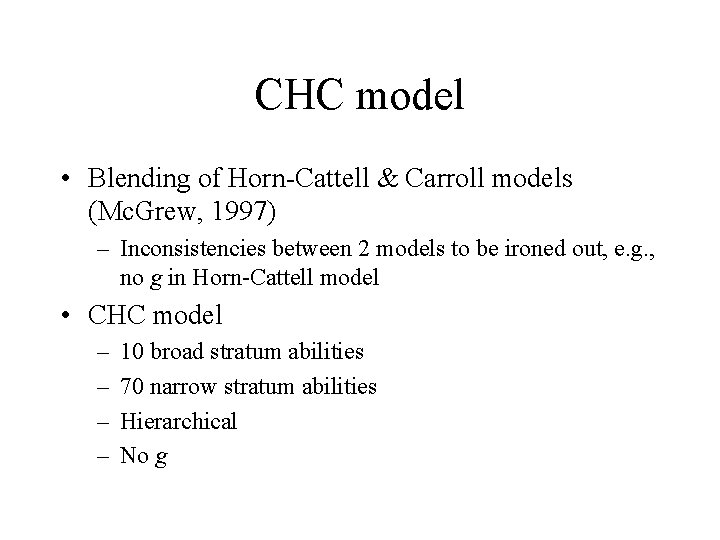
CHC model • Blending of Horn-Cattell & Carroll models (Mc. Grew, 1997) – Inconsistencies between 2 models to be ironed out, e. g. , no g in Horn-Cattell model • CHC model – – 10 broad stratum abilities 70 narrow stratum abilities Hierarchical No g
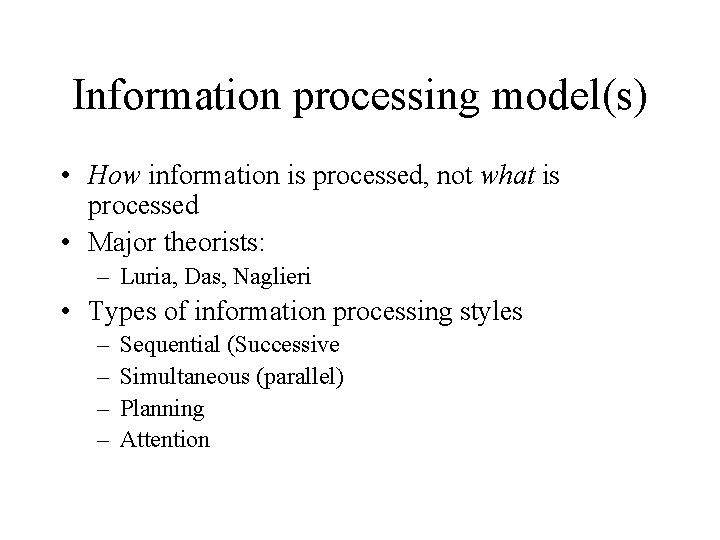
Information processing model(s) • How information is processed, not what is processed • Major theorists: – Luria, Das, Naglieri • Types of information processing styles – – Sequential (Successive Simultaneous (parallel) Planning Attention
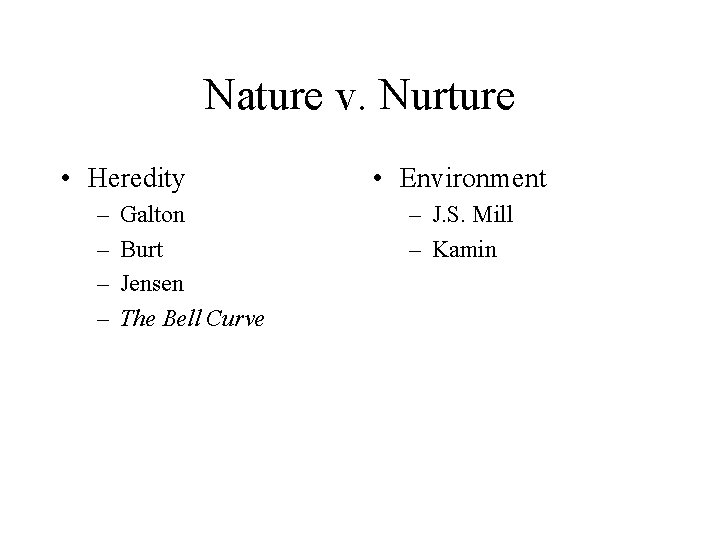
Nature v. Nurture • Heredity – – Galton Burt Jensen The Bell Curve • Environment – J. S. Mill – Kamin
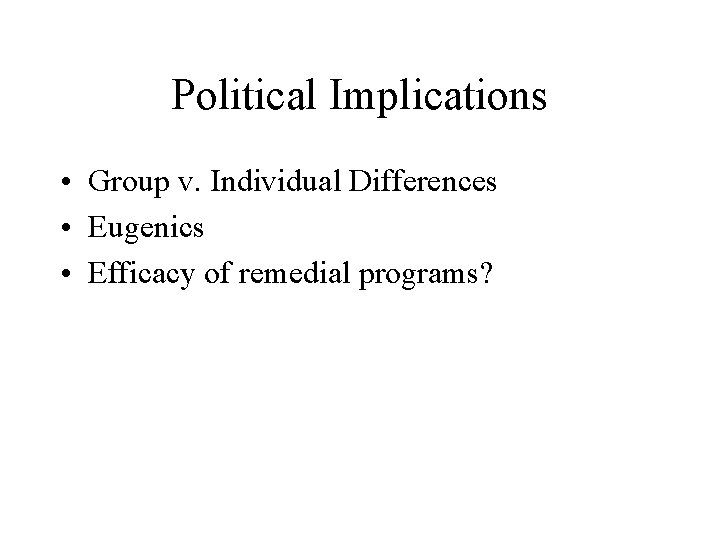
Political Implications • Group v. Individual Differences • Eugenics • Efficacy of remedial programs?