
What is Information Modelling and why do we
- Slides: 26
What is Information Modelling (and why do we need it in NEII…)? Dominic Lowe, Bureau of Meteorology, d. lowe@bom. gov. au 29 October 2013
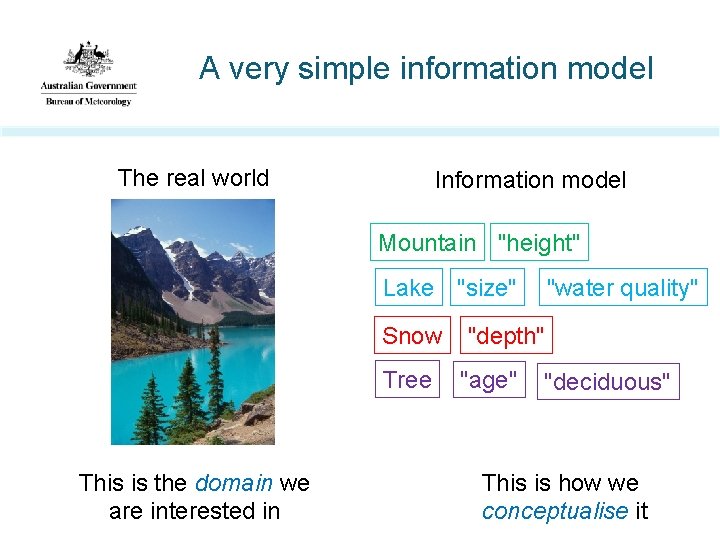
A very simple information model The real world Information model Mountain "height" Lake "size" Snow Tree This is the domain we are interested in "water quality" "depth" "age" "deciduous" This is how we conceptualise it
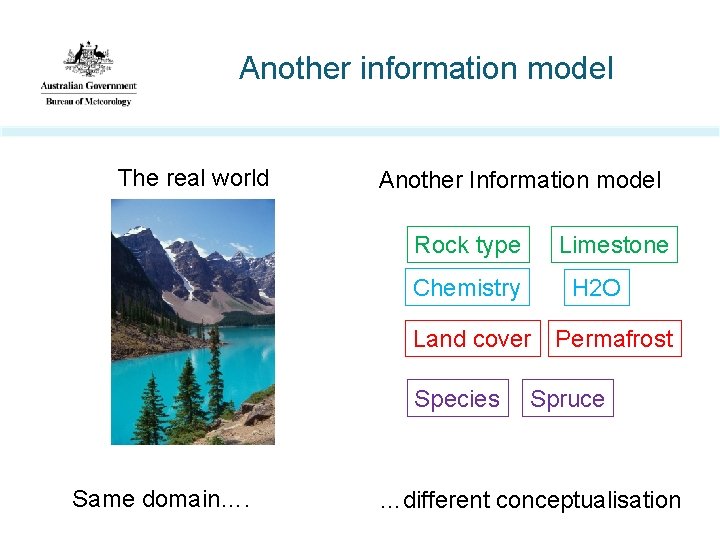
Another information model The real world Another Information model Rock type Chemistry Limestone H 2 O Land cover Permafrost Species Same domain…. Spruce …different conceptualisation
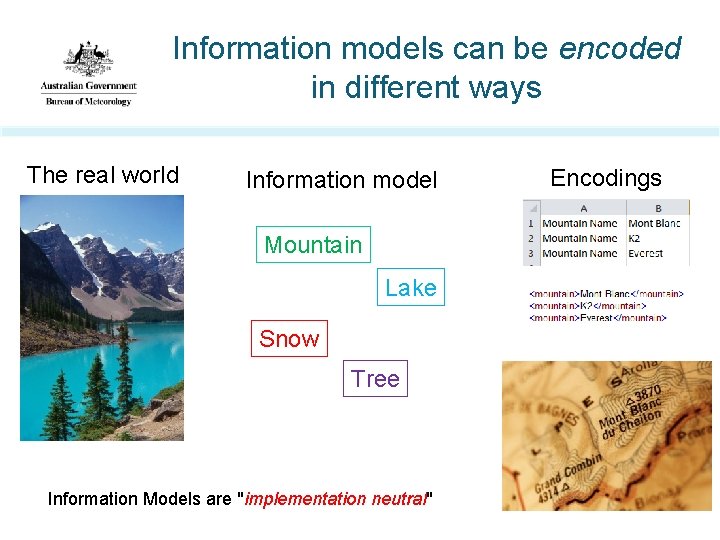
Information models can be encoded in different ways The real world Information model Mountain Lake Snow Tree Information Models are "implementation neutral" Encodings
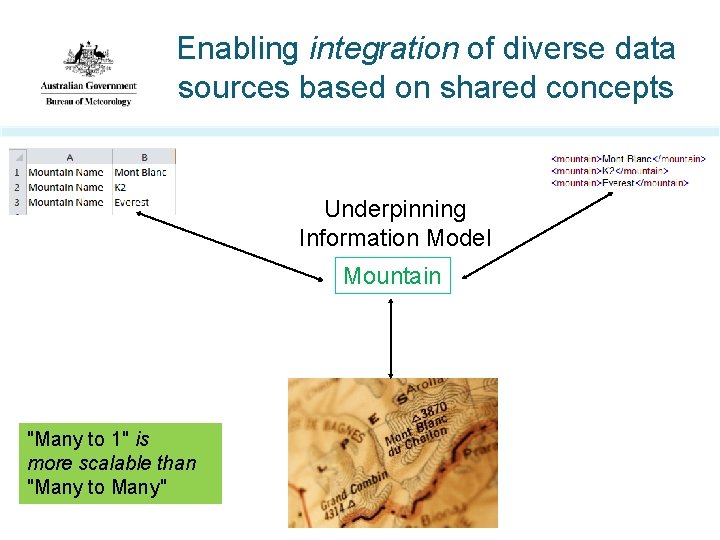
Enabling integration of diverse data sources based on shared concepts Underpinning Information Model Mountain "Many to 1" is more scalable than "Many to Many"
Information models • Everyone who writes or stores data has one, even if it's not well defined. • This is usually ok for closed systems where everyone roughly understands the same thing. • In distributed systems (hint: NEII ) it becomes problematic if there is no shared understanding of meaning across datasets. • Effective data integration requires mapping to shared information models at some level.
Why is information modelling important to NEII? • Data is our 'lifeblood' (S. Barrell, ISS division 1 st staff meeting) • Data carries information. • NEII is an information infrastructure. It is not just about delivering data files. • To what extent do we need to agree upon information models? • How far can NEII get without addressing this?
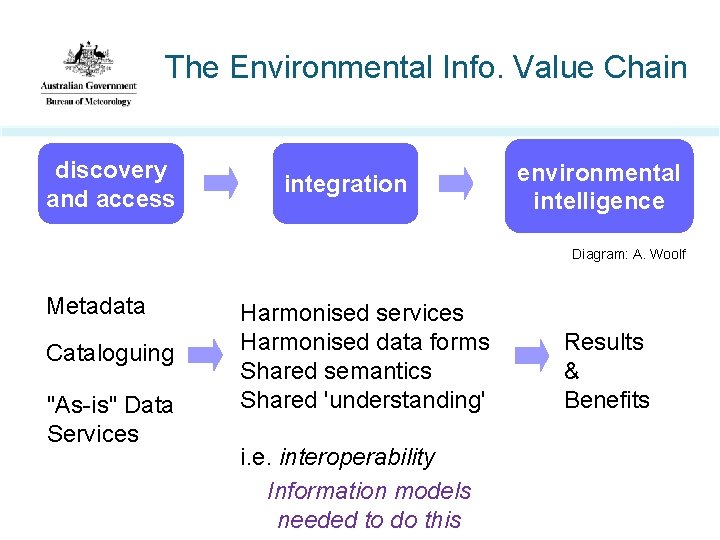
The Environmental Info. Value Chain discovery and access integration environmental intelligence Diagram: A. Woolf Metadata Cataloguing "As-is" Data Services Harmonised services Harmonised data forms Shared semantics Shared 'understanding' i. e. interoperability Information models needed to do this Results & Benefits
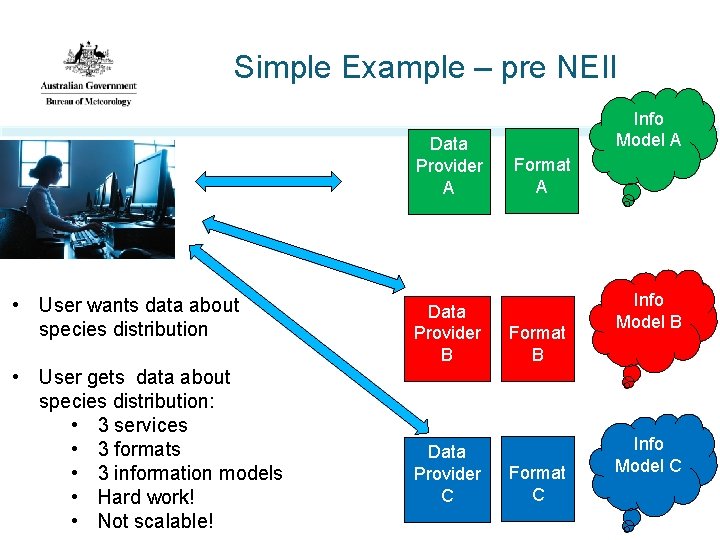
Simple Example – pre NEII Data Provider A • User wants data about species distribution • User gets data about species distribution: • 3 services • 3 formats • 3 information models • Hard work! • Not scalable! Data Provider B Data Provider C Info Model A Format B Format C Info Model B Info Model C
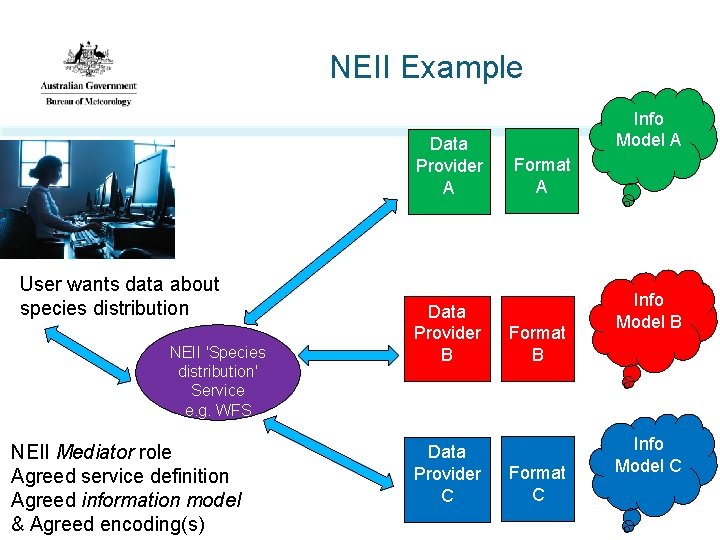
NEII Example Data Provider A User wants data about species distribution NEII 'Species distribution' Service e. g. WFS NEII Mediator role Agreed service definition Agreed information model & Agreed encoding(s) Data Provider B Data Provider C Info Model A Format B Format C Info Model B Info Model C
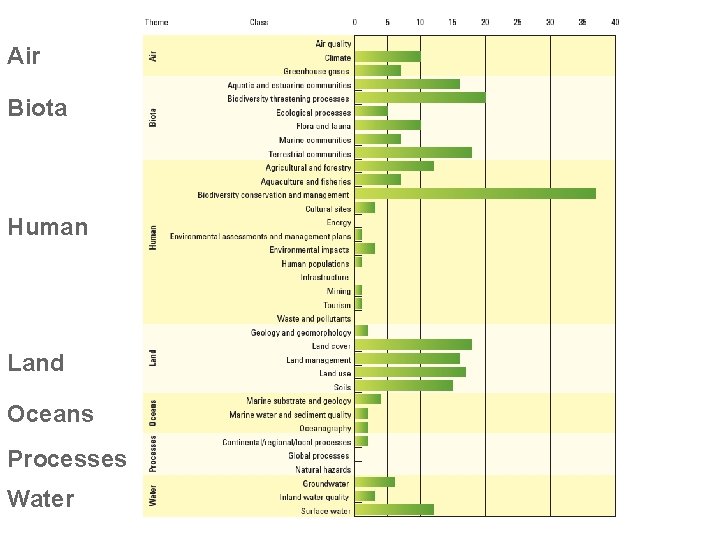
Really needed for NEII ? ? • How many data providers? • How many 'domains' of interest? • How many different information models exist… ? ! • … a lot probably • How many are well defined? • …probably not that many • Significant challenge is to integrate data in NEII by sharing common concepts.
Air Biota Human Land Oceans Processes Water
Context: NEII Implementation Based on Open Geospatial Consortium Services: Catalog Service Web Map Service Sensor Observation Service Web Feature Service Web Coverage Services (? ) + Vocabulary Services (RDF/Linked Data)
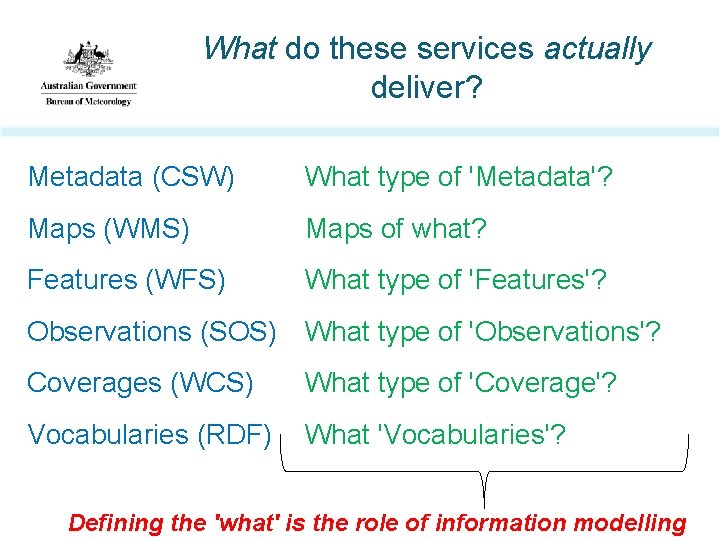
What do these services actually deliver? Metadata (CSW) What type of 'Metadata'? Maps (WMS) Maps of what? Features (WFS) What type of 'Features'? Observations (SOS) What type of 'Observations'? Coverages (WCS) What type of 'Coverage'? Vocabularies (RDF) What 'Vocabularies'? Defining the 'what' is the role of information modelling
How? Standards for Information Modelling ISO TC 211 Geographic information/Geomatics Overarching meta-model for geographic information and services OGC Open Geospatial Consortium • Implementation of ISO concepts • Service definitions used in NEII
ISO 19101 General Reference Model The Reference model describes the use of Conceptual Modelling and how it is used in the 19100 family of standards to enable conforming application systems to inter-operate and share conforming geographic data.
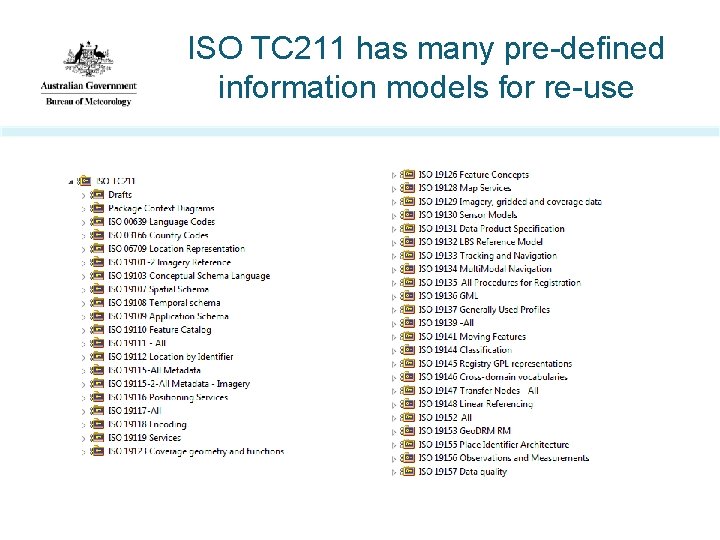
ISO TC 211 has many pre-defined information models for re-use
ISO General Feature Model Features are objects with identity: Road, Lake, Observation, Bio-region, Borehole, etc. . (anything!) Features have: - attributes/properties - associations with other features - operations that can be performed on them E. g. a "Reservoir" feature has: - 'perimeter', 'depth', 'use restrictions' - fed by river, created by dam - can be emptied
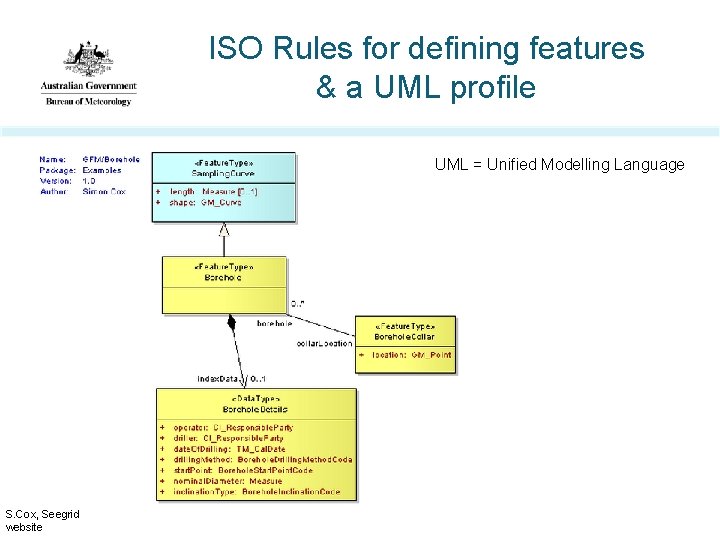
ISO Rules for defining features & a UML profile UML = Unified Modelling Language S. Cox, Seegrid website
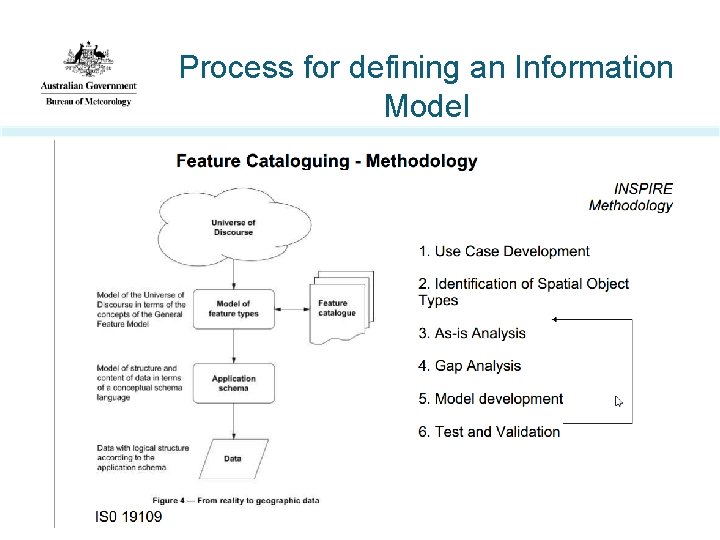
Process for defining an Information Model
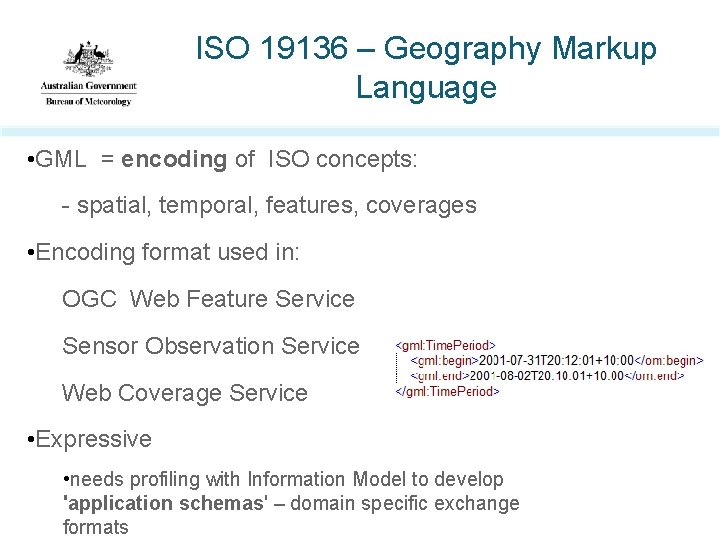
ISO 19136 – Geography Markup Language • GML = encoding of ISO concepts: - spatial, temporal, features, coverages • Encoding format used in: OGC Web Feature Service Sensor Observation Service Web Coverage Service • Expressive • needs profiling with Information Model to develop 'application schemas' – domain specific exchange formats
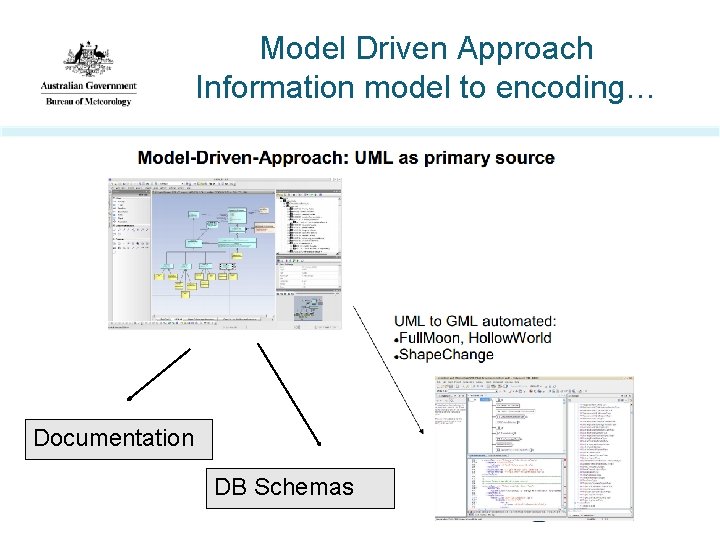
Model Driven Approach Information model to encoding… Documentation DB Schemas
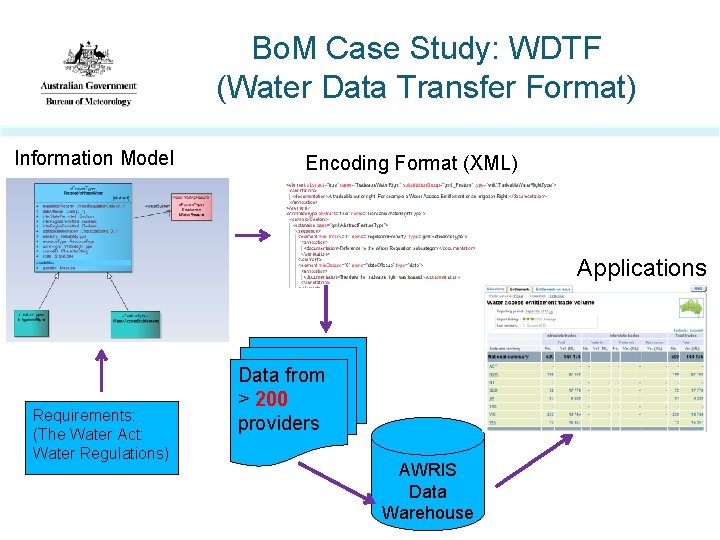
Bo. M Case Study: WDTF (Water Data Transfer Format) Information Model Encoding Format (XML) Applications Requirements: (The Water Act: Water Regulations) Data from > 200 providers AWRIS Data Warehouse
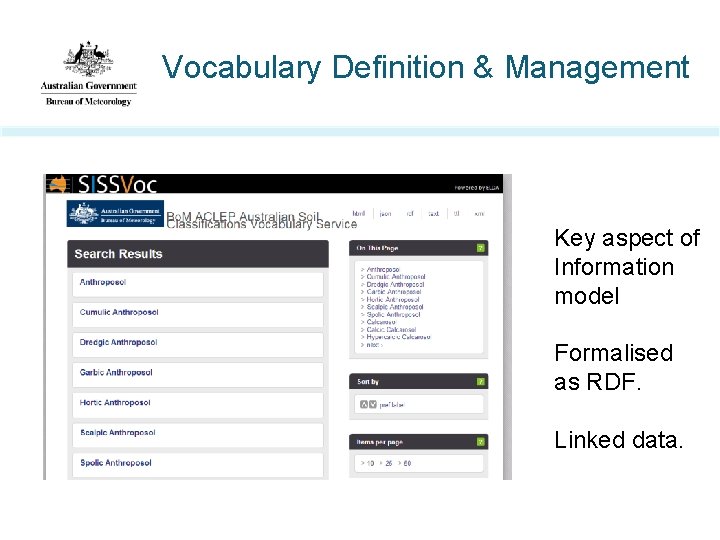
Vocabulary Definition & Management Key aspect of Information model Formalised as RDF. Linked data.
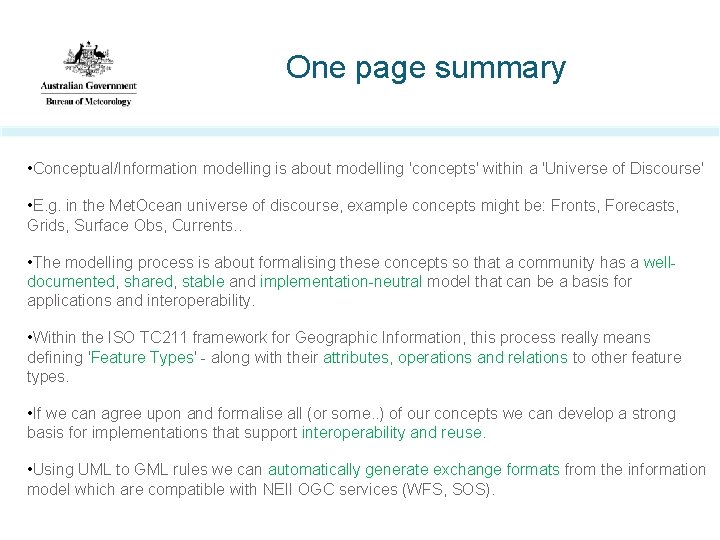
One page summary • Conceptual/Information modelling is about modelling 'concepts' within a 'Universe of Discourse' • E. g. in the Met. Ocean universe of discourse, example concepts might be: Fronts, Forecasts, Grids, Surface Obs, Currents. . • The modelling process is about formalising these concepts so that a community has a welldocumented, shared, stable and implementation-neutral model that can be a basis for applications and interoperability. • Within the ISO TC 211 framework for Geographic Information, this process really means defining 'Feature Types' - along with their attributes, operations and relations to other feature types. • If we can agree upon and formalise all (or some. . ) of our concepts we can develop a strong basis for implementations that support interoperability and reuse. • Using UML to GML rules we can automatically generate exchange formats from the information model which are compatible with NEII OGC services (WFS, SOS).
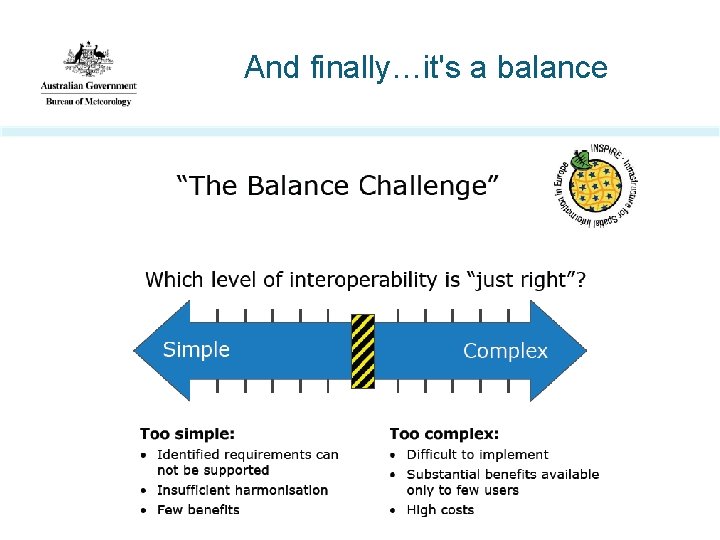
And finally…it's a balance