
What is in a Short Story What is

- Slides: 29
What is in a Short Story?
What is a Short Story? • A short story is : a brief work of fiction where, usually, the main character faces a conflict that is worked out in the plot of the story
Character • Character – a person in a story, poem or play. • Types of Characters: – Round: fully developed, has many different character traits – Flat: stereotyped, one-dimensional, few traits – Static: – Does not change – Dynamic: – Changes as a result of the story's events
Characterization • How the author develops the characters, especially the main character. • This is done through: – what the character does or says – what others say of and to the character – author’s word choice in descriptive passages
Characterization • Direct characterization – The author directly states what the character’s personality is like. Example: cruel, kind • Indirect characterization – Showing a character’s personality through his/her actions, thoughts, feelings, words, appearance or other character’s observations or reactions
Protagonist • Main character of the story that changes – (death is not a change) – the most important character – changes and grows because of experiences in the story
Antagonist • A major character who opposes the protagonist – the antagonist does not change • Types of antagonists: – people – nature – society
Conflict • A struggle between two opposing forces that propels the plot • There could be multiple conflicts within a story • Types – Internal: takes place in a character’s own mind • Man vs. Him(Her)self – External: a character struggles against an outside force • • Man vs. Nature Man vs. Society Man vs. Supernatural
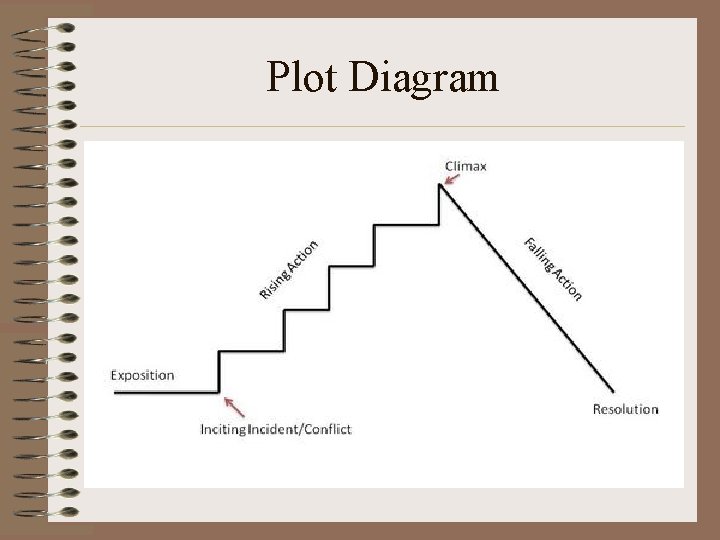
What is the Plot? • Plot: Series of related events that make up a story. – Exposition – Inciting Incident – – Rising Action Climax Falling Action Resolution (Dénouement)
Plot Diagram
Exposition (Introduction) • Introduces the reader to: – Setting – Basic situation – Characters involved – Narrative Hook: question or statement that grabs the reader’s attention
Setting • The time and place of the story’s action – Time (time of day, season, present, past, future) – Location (country, planet, town, buildings, PLUS a description of the surroundings) where the action occurs • Helps to create the mood and atmosphere of the text – Atmosphere: the feeling that the setting evokes (i. e. mysterious, happy, eerie) – Mood: the author evokes certain feelings or vibes in readers through words and descriptions. (i. e. excitement, nostalgia) • NOT the mood of the characters
Rising Action • Consists of a series of complications. • These occur when the main characters take action to resolve their problems and are met with further problems: – Fear – Hostility – Threatening situation
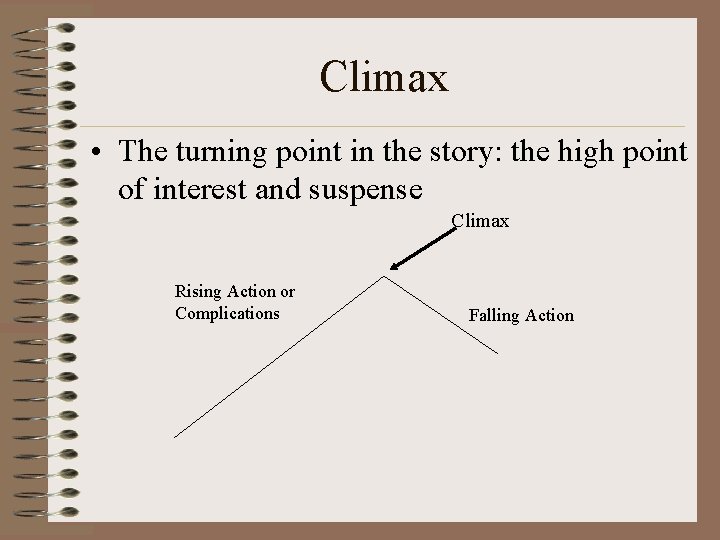
Climax • The turning point in the story: the high point of interest and suspense Climax Rising Action or Complications Falling Action
Falling Action • All events following the climax or turning point in the story. These events are a result of the action taken at the climax.
Resolution (Denouement) • The end of the central conflict: it shows how the situation turns out • All of the loose ends are tied up (usually)
Point of View • Vantage point from which the writer tells the story. – First person: One of the characters is actually telling the story using the pronoun “I” – Third person Objective: the author tells what happens without stating more than can be inferred from the story's action and dialogue. The narrator never discloses anything about what the characters think or feel, remaining a detached observer. – Third Person Omniscient: All knowing narrator. Can center on the thoughts and any actions of any and all characters.
Theme • The central MESSAGE or insight into life revealed through a literary work (universal truth. ) • Theme is NOT a subject (love, courage, family) • Theme is NOT a cliché – Cliché: an overused phrase or opinion – Example: One man’s trash is another man’s treasure
Determine the Theme • Cinderella – What is the action of the story/follow the plot? – Theme: Through hard work and determination you can achieve your dreams. • The Lion King – What is the action in the story/follow the plot? – Theme: One must overcome adversity in order to lead a population. • Now you try: Choose a familiar story to you and determine its theme.
Flashback • The present scene in the story is interrupted to flash backward and tell what happened in an earlier time.
Foreshadowing • Clues the writer puts in the story to give the reader a hint of what is to come. – Examples: • Weather • Colors • Dialogue • Red herring: a false clue to mislead the reader
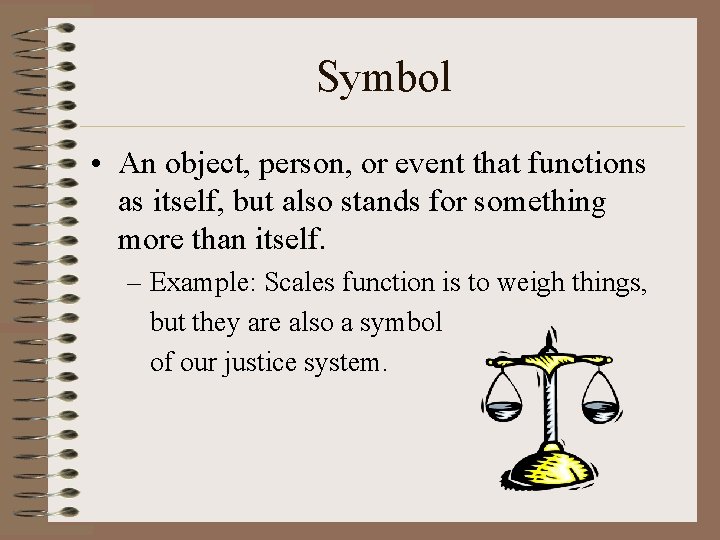
Symbol • An object, person, or event that functions as itself, but also stands for something more than itself. – Example: Scales function is to weigh things, but they are also a symbol of our justice system.
Figurative Language • Involves some imaginative comparison between two unlike things. – Simile: comparing two unlike things using like or as. • “I wandered lonely as a cloud” – Metaphor: comparing two unlike things (not using like or as) • Life is a roller coaster, it has lots of ups and downs.
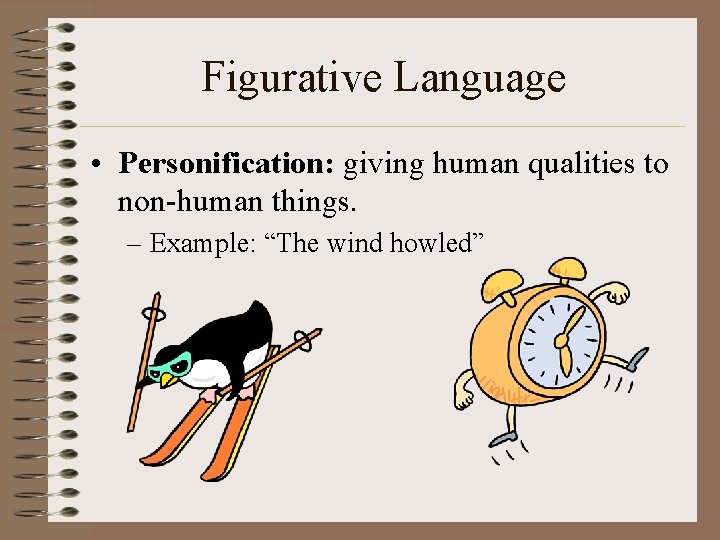
Figurative Language • Personification: giving human qualities to non-human things. – Example: “The wind howled”
Irony • A contrast between expectation and reality • Words are used in a way that their intended meaning is different than their actual meaning – Example: “You are so skilled” (the person is actually very clumsy)
Irony • Verbal Irony: saying one thing but meaning something completely different. – Calling a clumsy basketball player “Michael Jordan” • Situational Irony: a contradiction between what we expect to happen and what really does happen • Dramatic Irony: occurs when the reader knows something important that the characters in the story do not know.
Allusion • Reference to a statement, person, a place, or events from: – Literature – History – Religion – Mythology – Politics – Sports
Suspense • Uncertainty or anxiety the reader feels about what is going to happen next in a story. • created by making the readers wonder how the conflict will be resolved
Imagery • Language that appeals to the senses. – Touch – Taste – Sight – Sound – Smell Example: Creating a picture in the readers mind through description