
What is IFLA LRM LRM Module 1 Standing


- Slides: 11
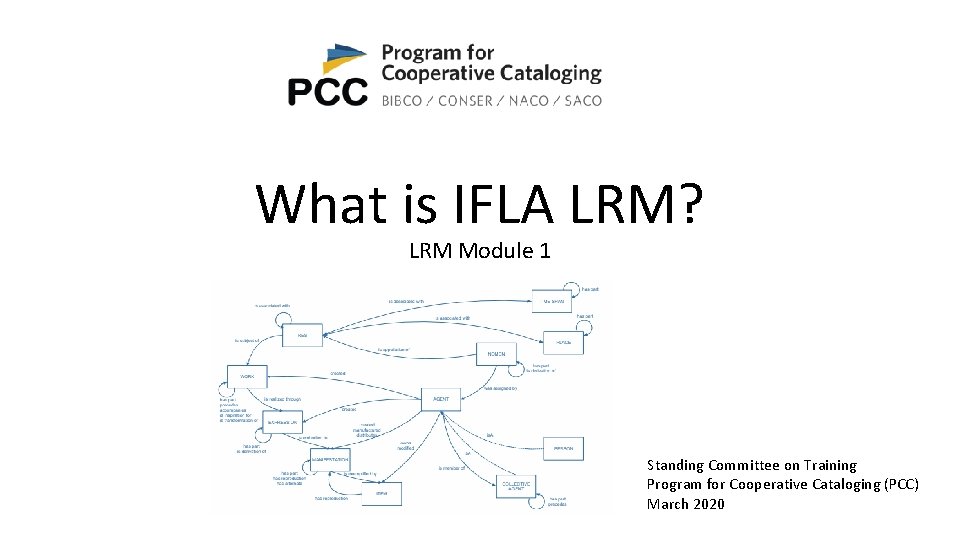
What is IFLA LRM? LRM Module 1 Standing Committee on Training Program for Cooperative Cataloging (PCC) March 2020
Learning Outcomes • By the end of this module, you will be able to: • • • Identify the predecessors of LRM Understand what LRM is Understand the concept of an entity-relationship model Identify the (end)-user tasks associated with LRM Understand how LRM can be used 2
The Acronyms… • • IFLA—International Federation of Library Associations and Institutions LRM—Library Reference Model • a high-level conceptual reference model developed within an entityrelationship modelling framework. It is the consolidation of the separately developed IFLA conceptual models: FRBR, FRAD, FRSAD 3
IFLA LRM Predecessors • Functional Requirements for Bibliographic Records (FRBR): is a conceptual entity-relationship model of metadata developed by IFLA for information objects. Published in 1998 by IFLA • Functional Requirements for Authority Data (FRAD): defines functional requirements of authority records. FRAD was developed as an extension and expansion of FRBR. Approved 2009 by IFLA • Functional Requirements for Subject Authority Data (FRSAD): conceptual entity-relationship model and a continuation of the work based upon the FRBR model. The main focus is how: “. . . entities that serve as subject of intellectual or artistic endeavor” can be related and controlled within the bibliographic universe. Approved 2010 IFLA Library Reference Model (LRM) combines and consolidates the FR family into a single coherent model 4
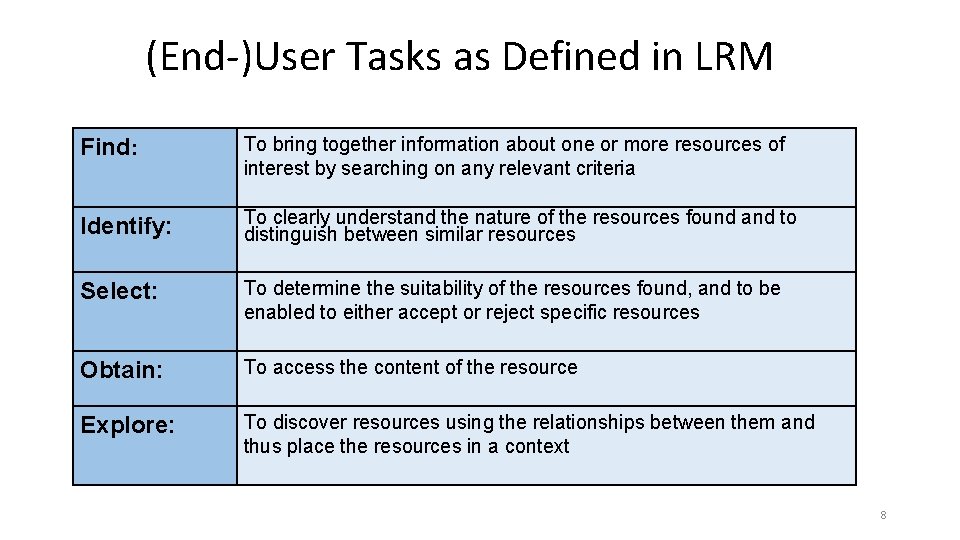
What are the principles of IFLA LRM? • • A high-level conceptual reference model developed with an enhanced entityrelationship modelling framework (see Slides 6 -7), covering bibliographic data in a broad, general sense Aims to make explicit general principles governing the logical structure of bibliographic information, without making presuppositions about how that data might be stored in any particular system or application • • does not make a distinction between data traditionally held separately as bibliographic, authority, or holdings data; includes it all Takes its functional scope from the user tasks, defined from the point-of-view of the end-user and the end-user’s needs (see Slide 8) 5
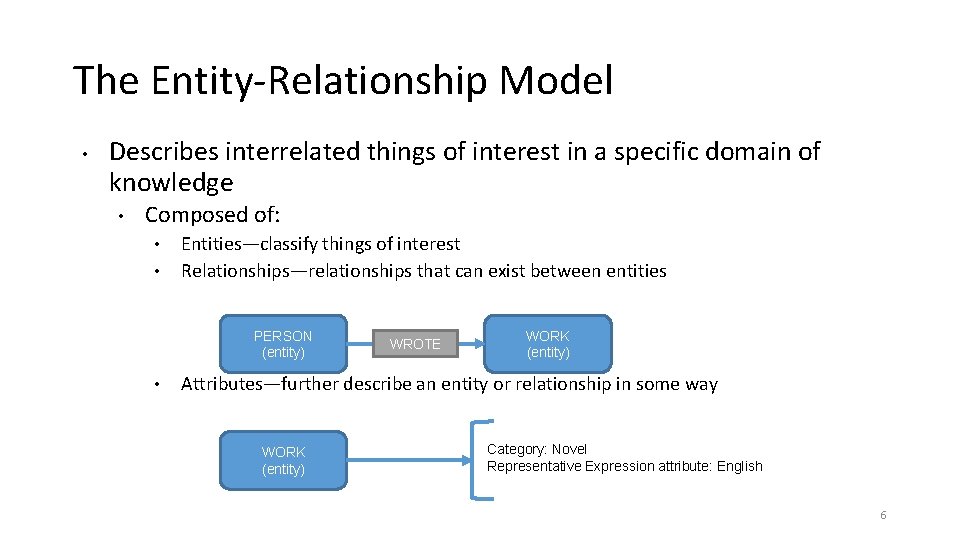
The Entity-Relationship Model • Describes interrelated things of interest in a specific domain of knowledge • Composed of: • • Entities—classify things of interest Relationships—relationships that can exist between entities PERSON (entity) • WROTE WORK (entity) Attributes—further describe an entity or relationship in some way WORK (entity) Category: Novel Representative Expression attribute: English 6
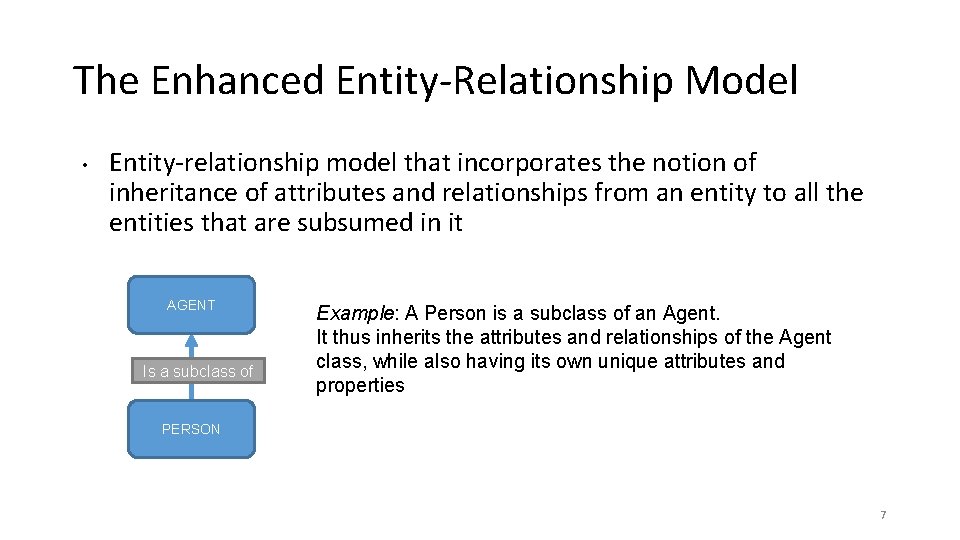
The Enhanced Entity-Relationship Model • Entity-relationship model that incorporates the notion of inheritance of attributes and relationships from an entity to all the entities that are subsumed in it AGENT Is a subclass of Example: A Person is a subclass of an Agent. It thus inherits the attributes and relationships of the Agent class, while also having its own unique attributes and properties PERSON 7
(End-)User Tasks as Defined in LRM Find: To bring together information about one or more resources of interest by searching on any relevant criteria Identify: To clearly understand the nature of the resources found and to distinguish between similar resources Select: To determine the suitability of the resources found, and to be enabled to either accept or reject specific resources Obtain: To access the content of the resource Explore: To discover resources using the relationships between them and thus place the resources in a context 8
How is IFLA LRM used? • In PCC, our metadata practices are built on 4 pillars: • • • Conceptual models Cataloging Codes Communication Formats / Encoding Standards Application profiles (APs) Current Next? Future? * Data Model FRBR LRM Cataloging Code RDA (Beta) Communication Format MARC RDF App. Profile LC-PCC PS / BSR / other? Formal AP? LRM is intended as a guide or basis on which to formulate cataloging rules and implement bibliographic system The new version of RDA is a set of cataloging guidelines based on LRM * Only one possible future scenario! There are more… 9
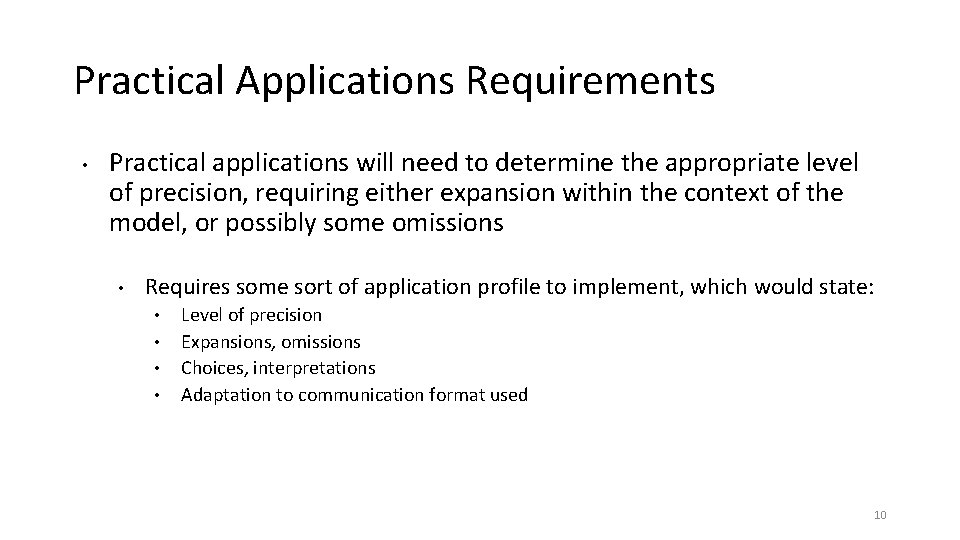
Practical Applications Requirements • Practical applications will need to determine the appropriate level of precision, requiring either expansion within the context of the model, or possibly some omissions • Requires some sort of application profile to implement, which would state: • • Level of precision Expansions, omissions Choices, interpretations Adaptation to communication format used 10
Summary • IFLA LRM • • • is a high-level conceptual reference model developed with an enhanced entity-relationship modelling framework covering bibliographic data is built on an entity-relationship model that incorporates the notion of inheritance of attributes and relationships from an entity to all the entities that are subsumed in it aims to make explicit general principles governing the logical structure of bibliographic information, without making presuppositions about how that data might be stored in any particular system or application Bases its functional scope based on user tasks—Find, Identify, Select, Obtain, Explore is intended as a guide or basis on which to formulate cataloging rules and implement bibliographic system 11