
What is Health Promotion Responsibilities of Health Promotion
What is Health Promotion & Responsibilities of Health Promotion Students Learn About: Responsibility for Health Promotion • Individuals • Community groups/schools • Non-government organisations • Government • International organisations (WHO, United Nations) Students Learn To: • Describe the various health promotion roles and responsibilities adopted by individuals, groups and governments
What is Health Promotion • What is health promotion? • Mostly people think everyone sees health promotion as advertising campaigns from the government or other health group, but health promotion is much more than this. • It involves: – – – Policy changes Environmental improvements Workplace Health and Safety Minimising risk behaviours, improving protective behaviours Creating supportive environments and networks for people Providing access to health care (just to mention a few). • Health promotion is the process of enabling people to increase control, and improve their health.
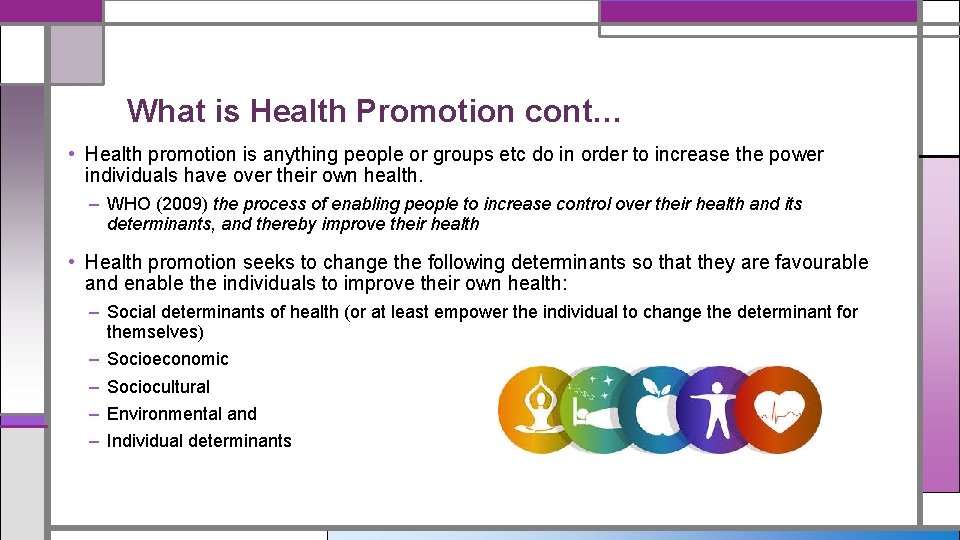
What is Health Promotion cont… • Health promotion is anything people or groups etc do in order to increase the power individuals have over their own health. – WHO (2009) the process of enabling people to increase control over their health and its determinants, and thereby improve their health • Health promotion seeks to change the following determinants so that they are favourable and enable the individuals to improve their own health: – Social determinants of health (or at least empower the individual to change the determinant for themselves) – Socioeconomic – Sociocultural – Environmental and – Individual determinants
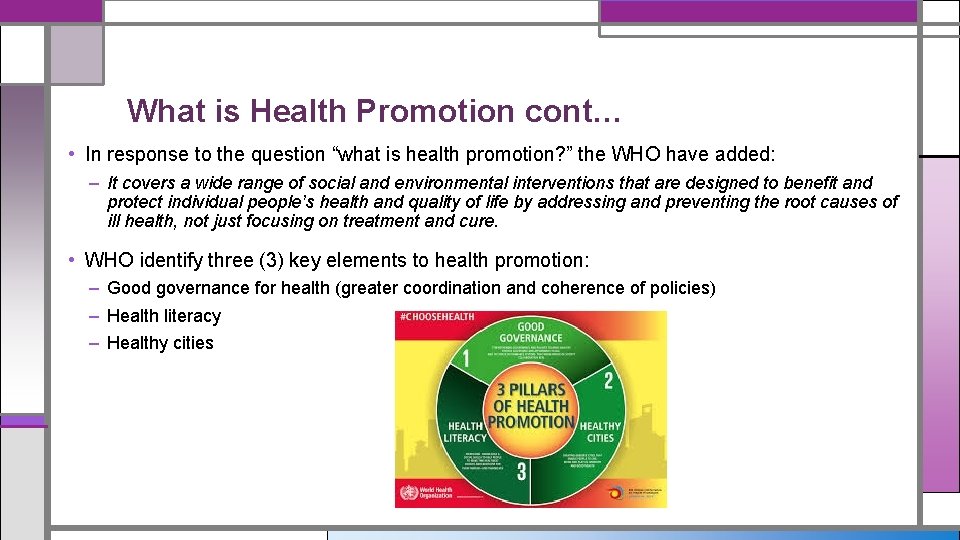
What is Health Promotion cont… • In response to the question “what is health promotion? ” the WHO have added: – It covers a wide range of social and environmental interventions that are designed to benefit and protect individual people’s health and quality of life by addressing and preventing the root causes of ill health, not just focusing on treatment and cure. • WHO identify three (3) key elements to health promotion: – Good governance for health (greater coordination and coherence of policies) – Health literacy – Healthy cities
Responsibility for Health Promotion • Responsibility for health promotion falls to: – – Individual Communities Governments International organisations • Each with their own responsibility for health promotion. • Every individual, group, organisation or government has a responsibility for health promotion and plays a particular role that others cannot. • This is because health has such a range of health determinants and because of this, in order to improve health outcomes the many determinants need to be addressed, which requires people working together and taking responsibility for health promotion.
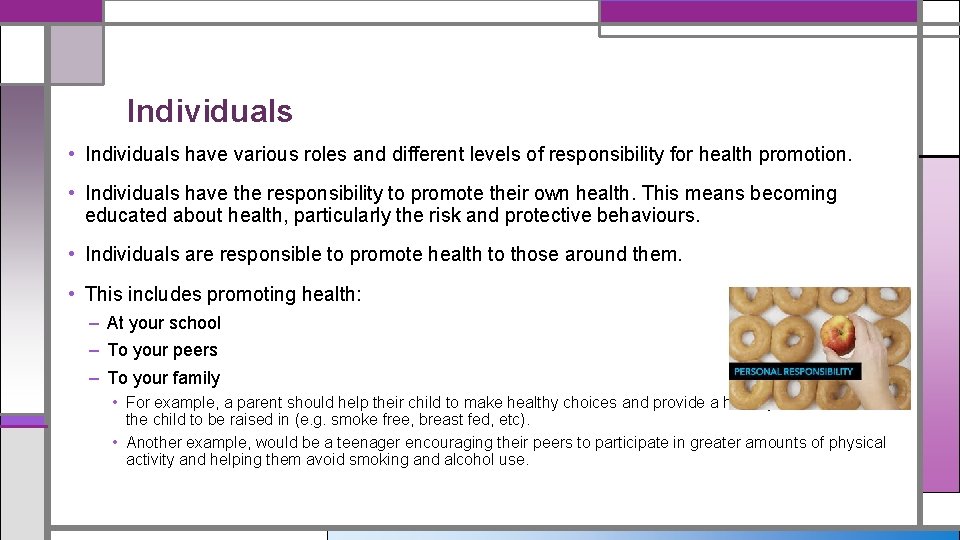
Individuals • Individuals have various roles and different levels of responsibility for health promotion. • Individuals have the responsibility to promote their own health. This means becoming educated about health, particularly the risk and protective behaviours. • Individuals are responsible to promote health to those around them. • This includes promoting health: – At your school – To your peers – To your family • For example, a parent should help their child to make healthy choices and provide a healthy environment for the child to be raised in (e. g. smoke free, breast fed, etc). • Another example, would be a teenager encouraging their peers to participate in greater amounts of physical activity and helping them avoid smoking and alcohol use.
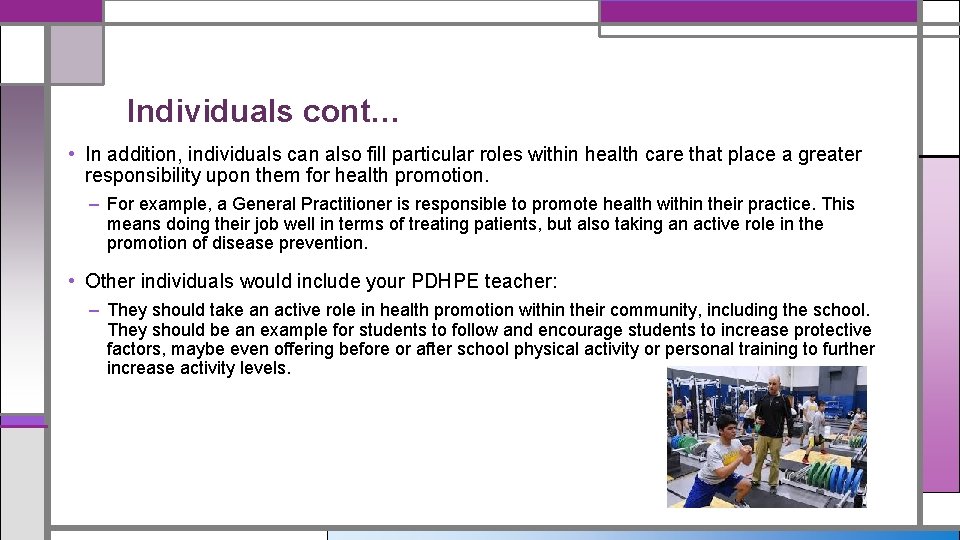
Individuals cont… • In addition, individuals can also fill particular roles within health care that place a greater responsibility upon them for health promotion. – For example, a General Practitioner is responsible to promote health within their practice. This means doing their job well in terms of treating patients, but also taking an active role in the promotion of disease prevention. • Other individuals would include your PDHPE teacher: – They should take an active role in health promotion within their community, including the school. They should be an example for students to follow and encourage students to increase protective factors, maybe even offering before or after school physical activity or personal training to further increase activity levels.
Individuals cont… • The role of the individual will vary depending on their position in society. • A parent should play a different role from a child, but both can be active in health promotion. • The same for a health care practitioner (physiotherapist, naturopath, community health worker, nurse, midwife etc). – Their role in health promotion should be larger, as they are sources of authoritative knowledge and have responsibility for their clients and to promote health to the wider community, not just those immediately around them. • This would apply similarly to elite athletes, who are now held up as role models and used in health promotion. • Extra responsibility also falls on celebrity health specialists such as Michelle Bridges, or celebrity chefs such as George Calombaris. Such people are in a privileged position to promote health as individuals. ** Watch video on weebly page **
Individuals cont… • Technology has also greatly increased the methods used to promote health. • An individual can promote health by writing a blog with health information. By sharing health information using social media and doing their own research into health concerning particular issues of relevance to them. • Such actions help to promote health and show individuals taking on roles and being responsible for health promotion, not just for their own health. • It is an individuals role and responsibility to be active in their own health promotion, promote health widely and influence the health of others.
Community Groups/Schools • Community groups, including schools play very important roles in health promotion and are responsible for health promotion within their community. • Of the community groups, schools possibly play the largest role in health promotion. SCHOOLS • Schools are the biggest community group • Are our societies main provider of education and child care between the ages of 5 and 18. • These years are some of the most important in developing healthy habits and gaining a solid basis for health literacy and general health knowledge.
SCHOOLS • PDHPE is a mandatory subject from K-10 and is one of the most chosen electives for Preliminary and HSC. • The PDHPE syllabus has a holistic view of health flowing down from WHO, to Australian government, state government and then through BOSTES (write our syllabus). • This holistic view of health educates students on the five (5) dimensions of health and seeks to promote life long wellbeing: – – – Eating properly Reading food information, Lifelong physical activity Social and mental health Individual value and purpose.

SCHOOLS • Schools also promote health through some of the various rules and regulations or guidelines. • Examples are: – WHS policies that help to ensure your PE lessons are safe as is the learning environment. – No-hat-no-play help to promote health and avoid skin cancer. – Fresh Tastes NSW Healthy School Canteen Strategy, which aims to provide healthy food in school cafeterias.
OTHER COMMUNITY GROUPS • Community groups health promotion is often the most effective form of health promotion. • Community groups know: – – Their context Know their community What they need Their health status etc, and are often equipped to meet these needs. • For example: – The National Centre of Indigenous Excellence – LINK in Redfern is a community group that promotes health amongst the local indigenous community. – Their is a leisure centre on site, job training programs, after school care and many other activities that help to promote health among the local indigenous population.
OTHER COMMUNITY GROUPS • Another example: – leisure centre in areas with large Muslim populations providing times for female only swimming. – Sessions promote health while being sensitive to the community values. • Community groups are often connected to religious groups (churches or mosques) • These community groups increase: – Social health – Provide purpose for life – Increase mental health though often they are not thought of when considering health promotion because of a lack of focus on physical health. • Many communities also have community health centres, where much health promotion takes place within the local community. Other community groups may include AA groups that help provide a supportive environment to improve the health of alcoholics, or home school parenting networks to help improve the social activity, education and opportunities for home schooled children.
OTHER COMMUNITY GROUPS • Community health centres where health promotion aids the local community. • Community groups may include: – AA groups that provide a supportive environment to alcoholics – Home school parenting networks to help improve the social activity, education and opportunities for home schooled children.
NON-GOVERNMENT ORGANISATIONS • Non-government organisations are non-profit organisations that focus on specific issues. • Can be health related or concern social justice (equity etc). • In Australia there are international non-government organisations and national organisations involved in health promotion. • The role of the non-government organisation is to conduct research, provide support and produce media campaigns.
NON-GOVERNMENT ORGANISATIONS RESEARCH • Non-government organisations conduct research into a particular chronic disease or illness. – For example, the Fred hollows Foundations conducts research into developing knowledge and understanding of eye diseases. They advocate for: – Strengthening national health systems with a focus on eye health – Encouraging in-country government support for better resources – Empowering local workers to implement effective, safe and quality eye interventions – Creating financial systems that ensure services are affordable and available to everyone – from cities to remote villages
RESEARCH CONT… • The research conducted by non-government organisations often revolves around a single issue and looks at: – The cause of the disease – Ways to prevent the disease – Assess epidemiology around the disease – including morbidity, mortality, survival rates, health expenditure – Provide information to government sectors with proposed actions to be taken to help improve outcomes for their particular issue.
NON-GOVERNMENT ORGANISATIONS SUPPORT • Non-government organisation provide support to those suffering from particular diseases or groups with social inequities. • Support can come in many forms: – Providing a network of people who can provide practical support and a sympathetic ear to listen to the issues. – Provide information about the regular interventions for particular diseases – Help people to prepare for what is ahead – Supporting them through their current situation.
SUPPORT CONT… • Non-government organisations will also provide support to schools in the education of students about particular diseases or issues. • Provide education packages and resources for free. • Non-government organisations also support the government in addressing the issue they are concerned with (both health and social justice). – For example, the Cancer Council provide information to cancer patients along with support networks and services. – Services include: • • Access to counselling services Assistance with practical matters and accommodation Online education, and education packages for schools, such as the “Eat it to Beat it” school program. Provide research and statistical analysis to the government to help them approach cancer prevention and health promotion most effectively.
NON-GOVERNMENT ORGANISATIONS MEDIA CAMPAIGNS • Responsible for raising awareness around particular health issues and social justice. • This awareness is often in conjunction with certain days throughout the year: – Jump Rope for Heart (Heart Foundation) – Pink Ribbon Day (Cancer Council) – Walk to Work day (Diabetes Australia). • Non-government organisations are also responsible for the production of many media campaigns to educate the public and raise awareness for health issues. – For example, Beyond Blue produce TV commercials to promote awareness around depression and the mental health issues. • Non-government organisations fulfil many roles – especially in research, support and media campaigns
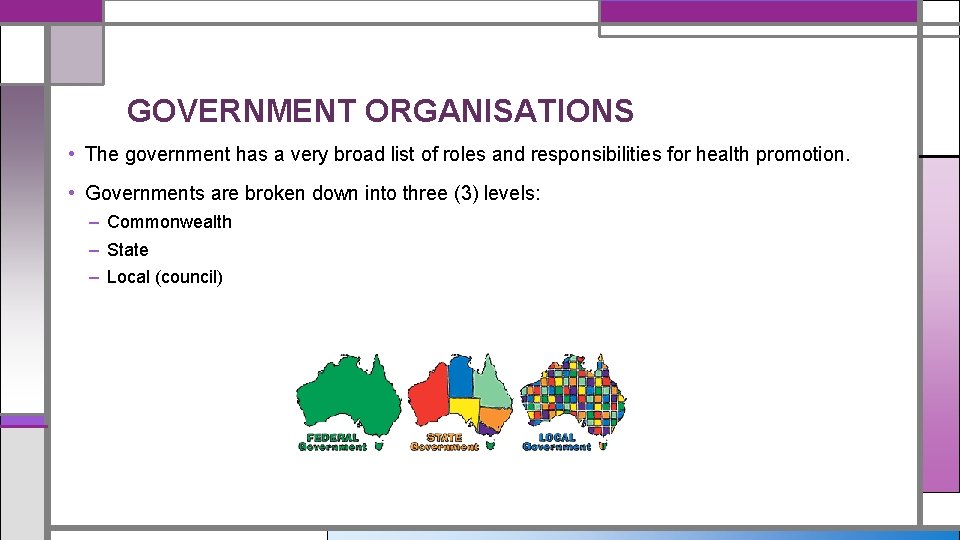
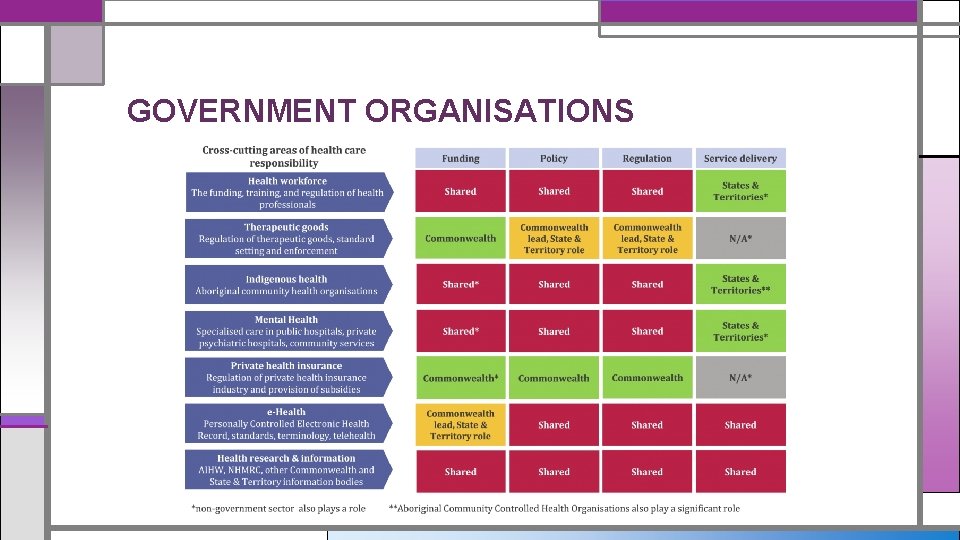
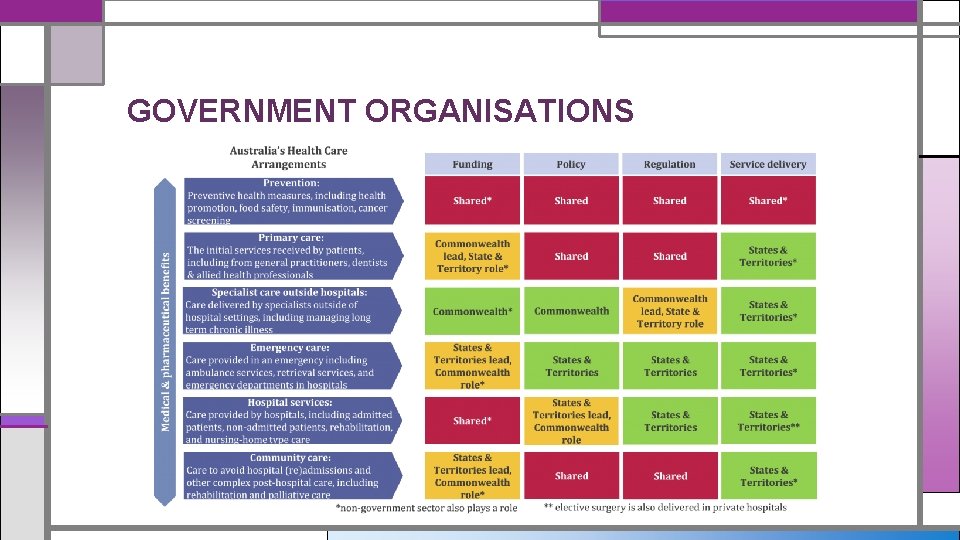
GOVERNMENT ORGANISATIONS • The government has a very broad list of roles and responsibilities for health promotion. • Governments are broken down into three (3) levels: – Commonwealth – State – Local (council)
GOVERNMENT ORGANISATIONS
GOVERNMENT ORGANISATIONS

COMMONWEALTH/FEDERAL GOVERNMENT • Commonwealth or Federal Government’s main role is to fund the health system through Medicare and write policies and regulations to help govern it. • This by collecting analysed data from various organisations including: – World Health Organisation • Decisions are made on how best to act on a national scale. • Role is to direct and organise the health care system by coordinating between various groups, including the various state governments. • Some Federal Government roles and responsibilities include: – Writing national health policies – Producing national health campaigns – Providing funding for various health products and services (e. g. Medicare, Pharmaceutical Benefits Scheme) – Helping state government implement health promotions.
STATE GOVERNMENT • State governments are responsible to help in the development of policy • Their main role and responsibility is to implement health policies and the regulation of health services in their state. – For example, in 2015 the NSW Ministry of Health “assumed responsibility for supporting the Minister for Women and Minister for the Prevention of Domestic Violence and Sexual Assault”. • As a result there has been a recent change to the 7 -10 PDHPE curriculum to directly address domestic violence, and many resources have been created to address this health concern.
STATE GOVERNMENT • The NSW Ministry of Health is the ‘system manager’ for NSW Health • Coordinates 15 health districts, and “operates more than 230 public hospitals, as well as providing community health and other public health services”. • NSW Health includes: – NSW Ambulance – responsible for providing care in emergencies. – Health Infrastructure – responsible for the hospital building program. – Health. Share NSW– “provide high-quality shared services to support the delivery of patient care within the NSW Health system. ” – NSW Health Pathology – provides pathology, forensic and analytical science services. – e. Health– responsible for delivering Information Communication Technology (ICT) led healthcare – Health Protection NSW – responsible for surveillance and response to infectious diseases.
LOCAL GOVERNMENT • Local government is your local council. • The council’s roles and responsibilities include: – – – WHS monitoring Waste removal (garbage & sewage) Amenities Town planning (roads, parks, etc) Food safety • Councils are also involved in: – Collection of information – Running some community health groups – Assessing local health needs.
INTERNATIONAL ORGANISATIONS • International organisations – eg WHO, are responsible for the promotion of health on a global scale. • WHO was established after WWII in 1948. It is the directing and coordinating authority on international health within the United Nations • Their goal is to build a better, healthier future for all people all over the world • International organisations help to combat both communicable and non-communicable diseases • Use experts in various health areas to analyse/assess health issues and propose solutions and recommendations to countries around the world • They respond to emergencies (breakouts)
INTERNATIONAL ORGANISATIONS • WHO undertakes a number of key responsibilities in the global promotion of better health for the citizens of all countries. These include: – providing leadership on health issues causing significant worldwide concern and establishing partnerships that will bring about the changes necessary to improve the health of all people • Eg - in 2004 WHO was responsible for developing the Global Strategy on Diet, Physical Activity and Health in an effort to reduce the worldwide incidence of death and chronic diseases related to poor diet and inactivity. – Working collaboratively with governments, NGOs and other agencies to support countries to establish and implement appropriate health promotion strategies and programs in order to bring about the highest attainable standard of health for all people – Setting international health standards for elements that are essential for promoting good health such as: • Water and air quality and food safety standards – Producing an annual report that provides governments, donor agencies, international organisations and others with the information necessary to make policy and funding decisions – Influencing research priorities and distributing information from the research to drive evidence-based change to health-related policies and practices.
- Slides: 30