
What is Health Literacy Why is it important
- Slides: 22
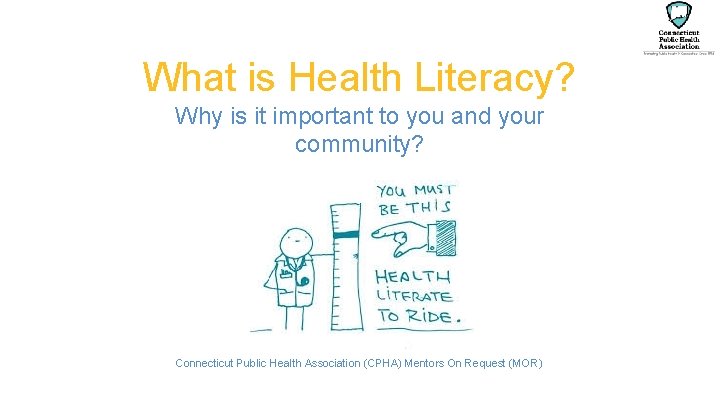
What is Health Literacy? Why is it important to you and your community? Connecticut Public Health Association (CPHA) Mentors On Request (MOR)
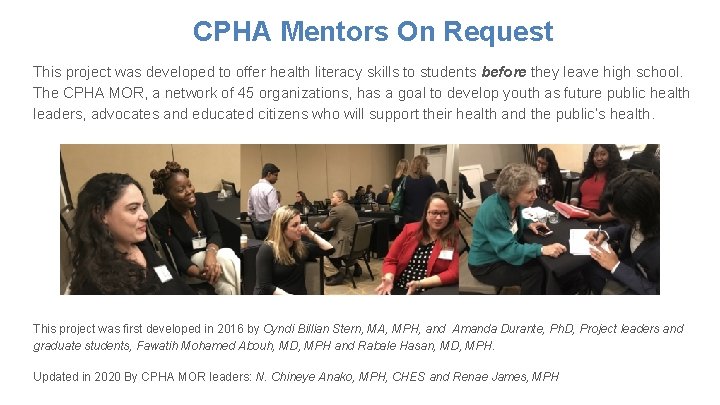
CPHA Mentors On Request This project was developed to offer health literacy skills to students before they leave high school. The CPHA MOR, a network of 45 organizations, has a goal to develop youth as future public health leaders, advocates and educated citizens who will support their health and the public’s health. This project was first developed in 2016 by Cyndi Billian Stern, MA, MPH, and Amanda Durante, Ph. D, Project leaders and graduate students, Fawatih Mohamed Abouh, MD, MPH and Rabale Hasan, MD, MPH. Updated in 2020 By CPHA MOR leaders: N. Chineye Anako, MPH, CHES and Renae James, MPH
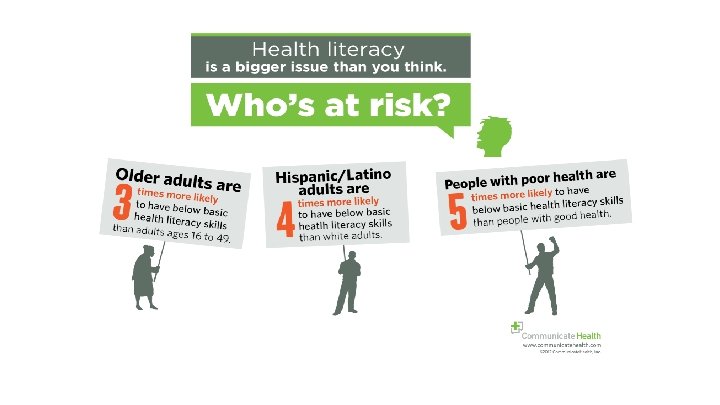
What you will learn: • The definition and scope of health literacy • The connection between your health and your community’s health • The high cost of low health literacy • 7 skills to be more health literate
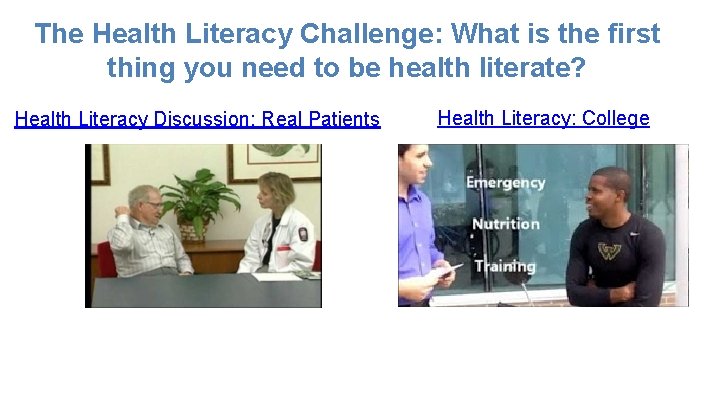
The Health Literacy Challenge: What is the first thing you need to be health literate? Health Literacy Discussion: Real Patients Health Literacy: College
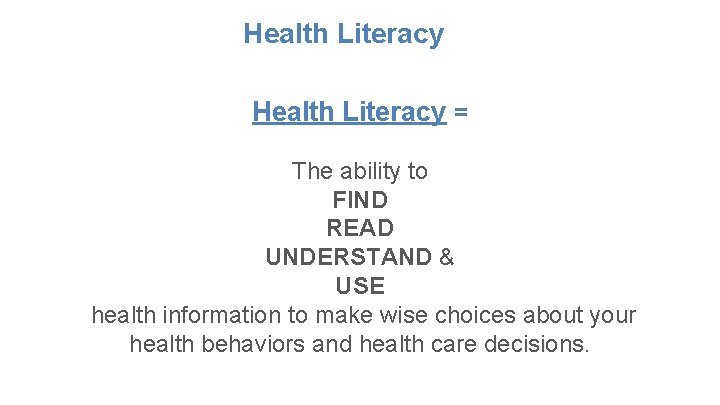
Health Literacy = The ability to FIND READ UNDERSTAND & USE health information to make wise choices about your health behaviors and health care decisions.
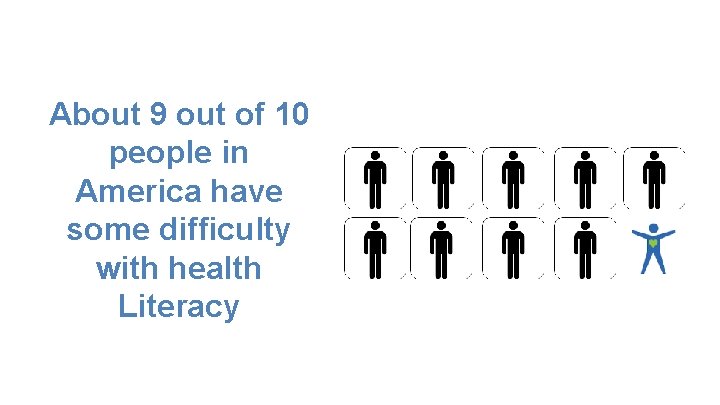
About 9 out of 10 people in America have some difficulty with health Literacy
Discussion Why do you think people have trouble understanding health information?
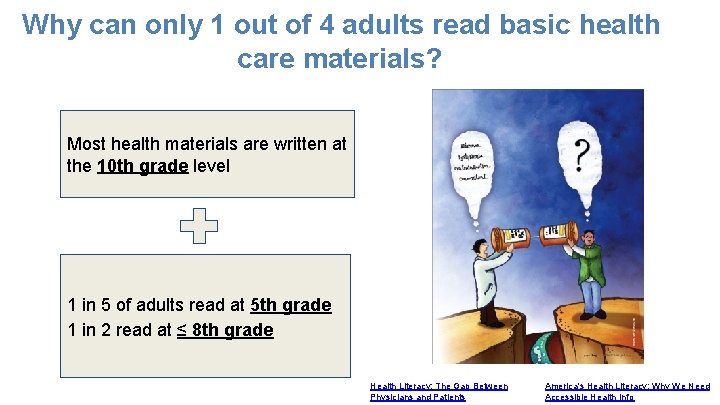
Why can only 1 out of 4 adults read basic health care materials? Most health materials are written at the 10 th grade level 1 in 5 of adults read at 5 th grade 1 in 2 read at ≤ 8 th grade Health Literacy: The Gap Between Physicians and Patients America's Health Literacy: Why We Need Accessible Health Info
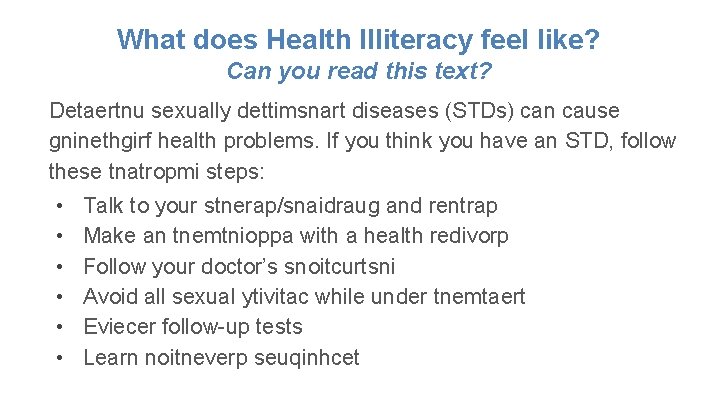
What does Health Illiteracy feel like? Can you read this text? Detaertnu sexually dettimsnart diseases (STDs) can cause gninethgirf health problems. If you think you have an STD, follow these tnatropmi steps: • • • Talk to your stnerap/snaidraug and rentrap Make an tnemtnioppa with a health redivorp Follow your doctor’s snoitcurtsni Avoid all sexual ytivitac while under tnemtaert Eviecer follow-up tests Learn noitneverp seuqinhcet
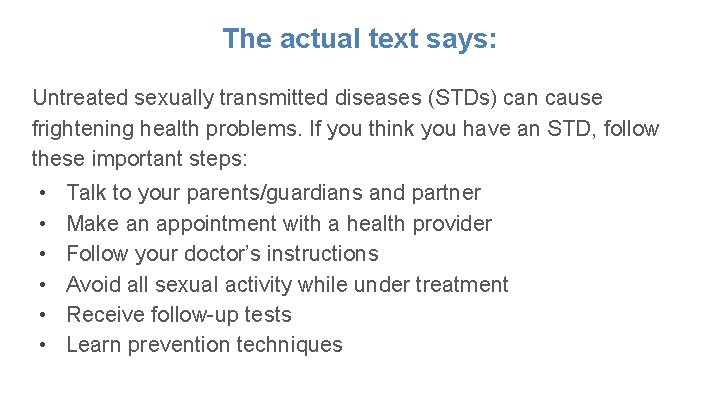
The actual text says: Untreated sexually transmitted diseases (STDs) can cause frightening health problems. If you think you have an STD, follow these important steps: • • • Talk to your parents/guardians and partner Make an appointment with a health provider Follow your doctor’s instructions Avoid all sexual activity while under treatment Receive follow-up tests Learn prevention techniques
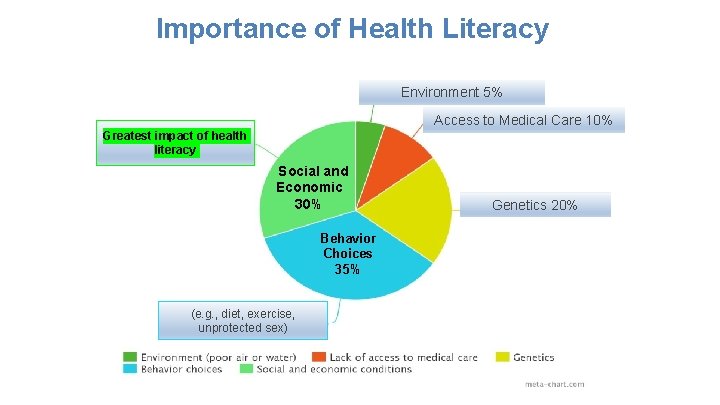
Importance of Health Literacy Environment 5% Access to Medical Care 10% Greatest impact of health literacy Social and Economic 30% Behavior Choices 35% (e. g. , diet, exercise, unprotected sex) Genetics 20%
Case Study: Social factors that determine health “Why is Jason in the hospital? ” Because he has a bad infection in his leg. He took his antibiotics incorrectly. But why does he have an infection? Because he has a cut on his leg and it got infected because he was playing in the junkyard next to his apartment building and he fell on jagged steel. But why was he playing in a junkyard? His neighborhood is kind of run down. There is no one there to supervise the children. But why does he live in that neighborhood? Because his parents can't afford a nicer place to live. But why can't his parents afford a nicer place to live? His Dad doesn't have much education and he can't find a job and his Mom is sick. I think his Dad had trouble reading the directions on the bottle of antibiotics that Jason had. So Jason’s infection got worse.
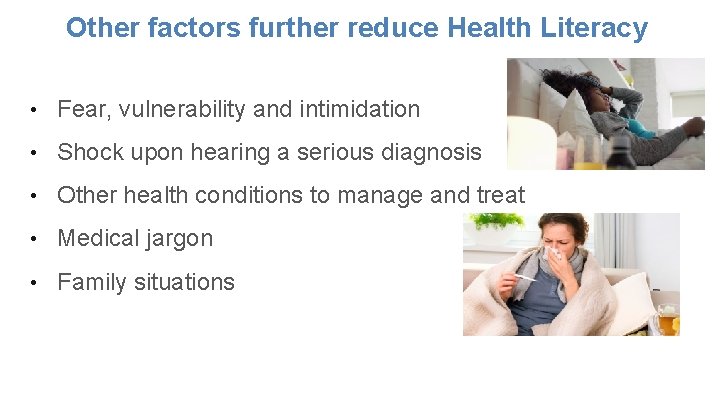
Other factors further reduce Health Literacy • Fear, vulnerability and intimidation • Shock upon hearing a serious diagnosis • Other health conditions to manage and treat • Medical jargon • Family situations
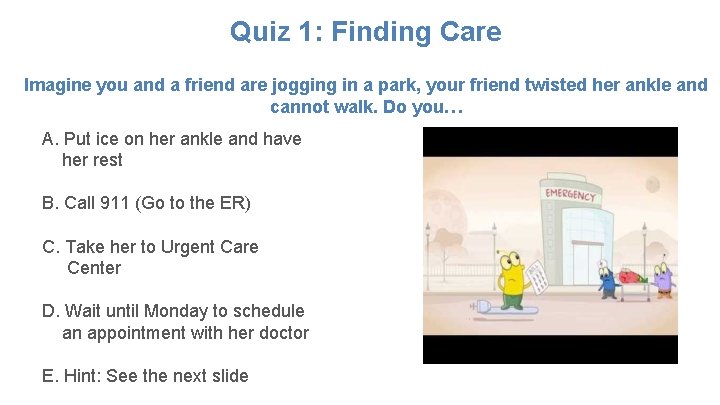
Quiz 1: Finding Care Imagine you and a friend are jogging in a park, your friend twisted her ankle and cannot walk. Do you… A. Put ice on her ankle and have her rest B. Call 911 (Go to the ER) C. Take her to Urgent Care Center D. Wait until Monday to schedule an appointment with her doctor E. Hint: See the next slide
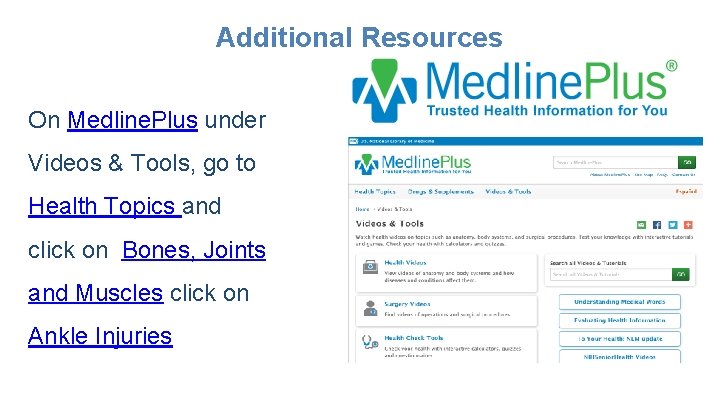
Additional Resources On Medline. Plus under Videos & Tools, go to Health Topics and click on Bones, Joints and Muscles click on Ankle Injuries
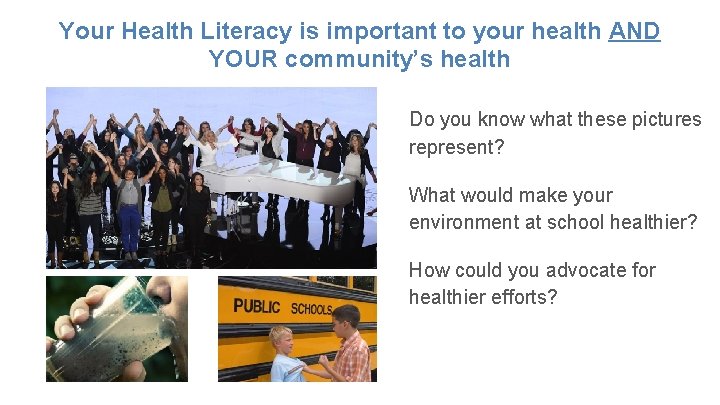
Your Health Literacy is important to your health AND YOUR community’s health Do you know what these pictures represent? What would make your environment at school healthier? How could you advocate for healthier efforts?
You Are Key in Solving this Costly Problem Low Health Literacy Costs the US Health Care System as much as $238 billion/year 1. 4 in 5 Teens report a high interest in learning more about health. 2
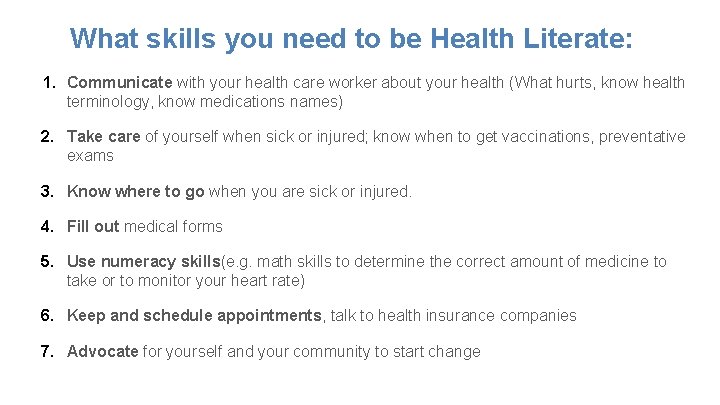
What skills you need to be Health Literate: 1. Communicate with your health care worker about your health (What hurts, know health terminology, know medications names) 2. Take care of yourself when sick or injured; know when to get vaccinations, preventative exams 3. Know where to go when you are sick or injured. 4. Fill out medical forms 5. Use numeracy skills(e. g. math skills to determine the correct amount of medicine to take or to monitor your heart rate) 6. Keep and schedule appointments, talk to health insurance companies 7. Advocate for yourself and your community to start change
Tools and Resources: Medline. Plus: Health Topics, drugs and supplements, videos and tools Words to Watch Fact Sheet Understanding Medical Words Plain Language Thesaurus for Health Communications
This Health Literacy Project was developed by: Connecticut Public Health Association’s Mentors On Request (CPHA-MOR) and Fawatih Mohamed-Abouh, MD, MPH and Rabale Hasan, MD, MPH Updated by MOR Co-Chairs N. Chineye Anako, MPH, CHES and Renae James, MPH
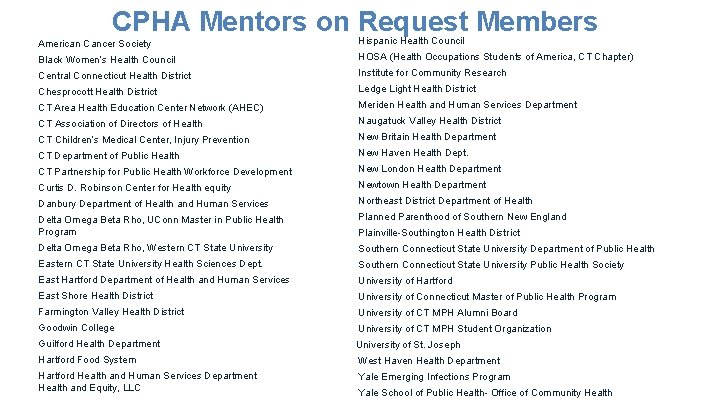
CPHA Mentors on Request Members American Cancer Society Hispanic Health Council Black Women’s Health Council HOSA (Health Occupations Students of America, CT Chapter) Central Connecticut Health District Institute for Community Research Chesprocott Health District Ledge Light Health District CT Area Health Education Center Network (AHEC) Meriden Health and Human Services Department CT Association of Directors of Health Naugatuck Valley Health District CT Children’s Medical Center, Injury Prevention New Britain Health Department CT Department of Public Health New Haven Health Dept. CT Partnership for Public Health Workforce Development New London Health Department Curtis D. Robinson Center for Health equity Newtown Health Department Danbury Department of Health and Human Services Northeast District Department of Health Delta Omega Beta Rho, UConn Master in Public Health Program Planned Parenthood of Southern New England Delta Omega Beta Rho, Western CT State University Southern Connecticut State University Department of Public Health Eastern CT State University Health Sciences Dept. Southern Connecticut State University Public Health Society East Hartford Department of Health and Human Services University of Hartford East Shore Health District University of Connecticut Master of Public Health Program Farmington Valley Health District University of CT MPH Alumni Board Goodwin College University of CT MPH Student Organization Guilford Health Department University of St. Joseph Hartford Food System West Haven Health Department Hartford Health and Human Services Department Health and Equity, LLC Yale Emerging Infections Program Plainville-Southington Health District Yale School of Public Health- Office of Community Health