
What is Government Review of Cornell Notes Set



- Slides: 43
What is Government?
Review of Cornell Notes
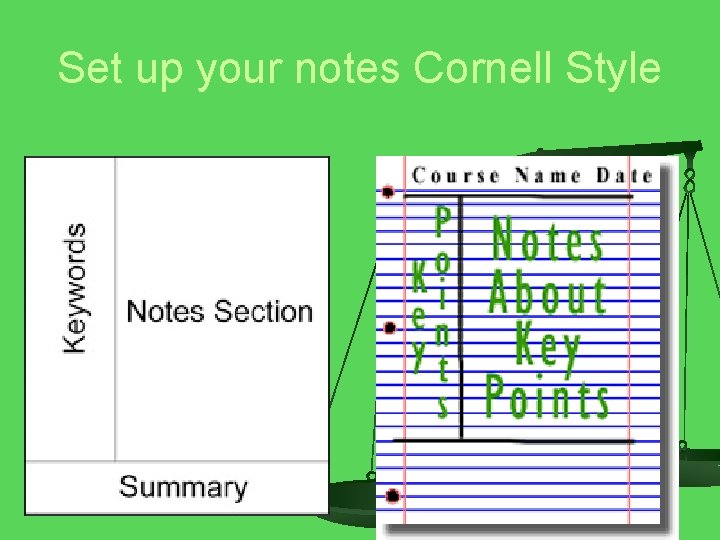
Set up your notes Cornell Style
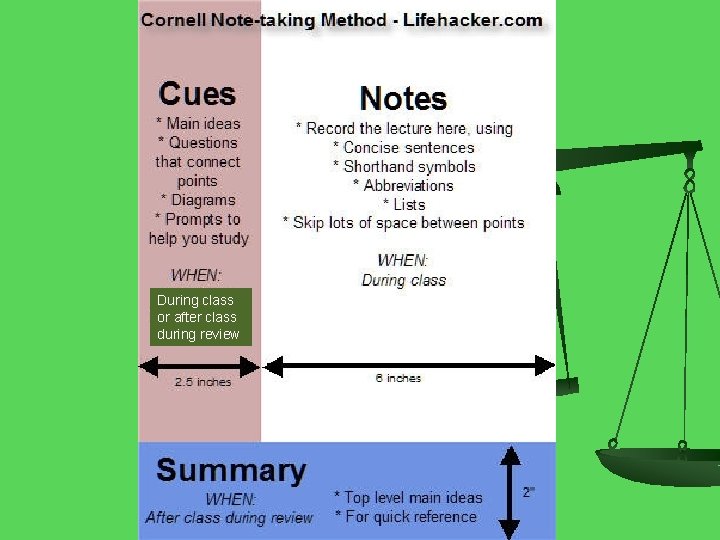
During class or after class during review
What is Government? You don’t have to write down anything in RED — they are instructions or interesting facts! Label the top of your page with the above heading!
What is Government? Government is a leadership system Remember when designed to help taking Cornell Notes you need the citizens to come up with at least 3 questions per page!
What is the purpose of Purpose: To maintain order Gov’t? in a society Remember you don’t have to write down stuff in red! Brainstorm: What are some things the government does for us?
What are some tools of a Modern Gov’t? n. Taxes n. Laws n. Courts n. Wars n. Police n Schools
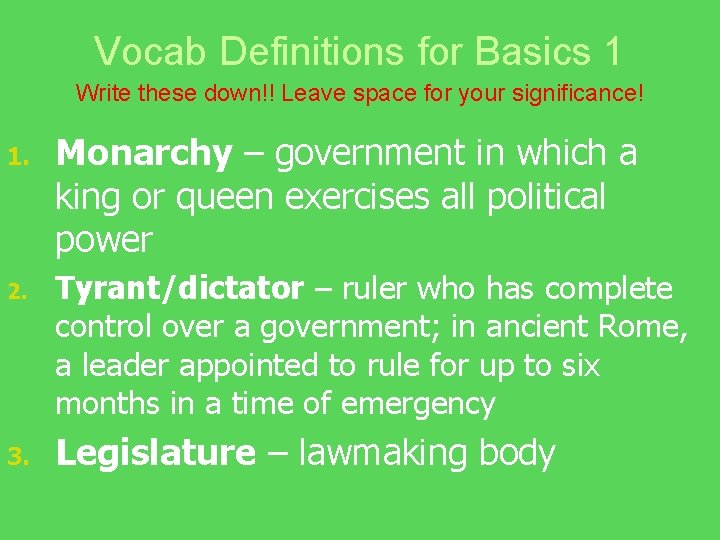
Vocab Definitions for Basics 1 Write these down!! Leave space for your significance! 1. 2. 3. Monarchy – government in which a king or queen exercises all political power Tyrant/dictator – ruler who has complete control over a government; in ancient Rome, a leader appointed to rule for up to six months in a time of emergency Legislature – lawmaking body
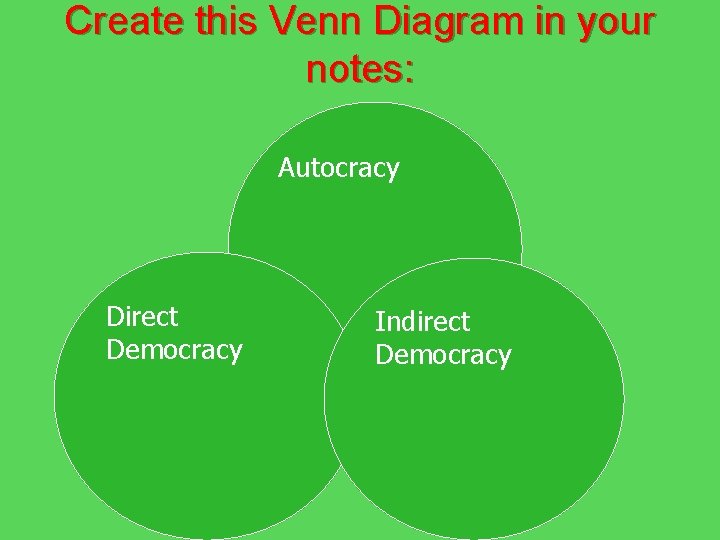
Create this Venn Diagram in your notes: Autocracy Direct Democracy Indirect Democracy
Brainstorm in your notes: What is the oldest type of Government?
n Add the facts from the next few slides on to your Venn Diagram
Autocracy n. One person makes all of the decisions for the society
Advantages n. Decisions are quick n. Debates are not necessary n. How can this also be a disadvantage?
Disadvantages n. People not allowed to give input n. Many people are unhappy n. Unfair ruler=bad news for you!
Types of Autocracies
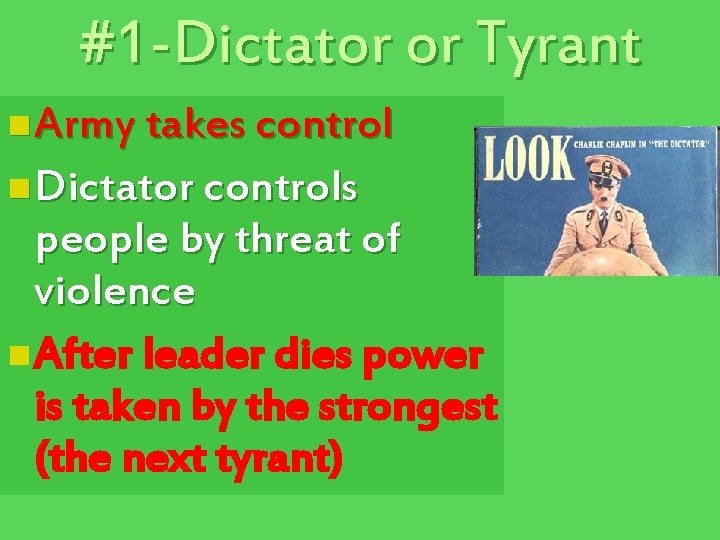
#1 -Dictator or Tyrant n Army takes control n Dictator controls people by threat of violence n After leader dies power is taken by the strongest (the next tyrant)
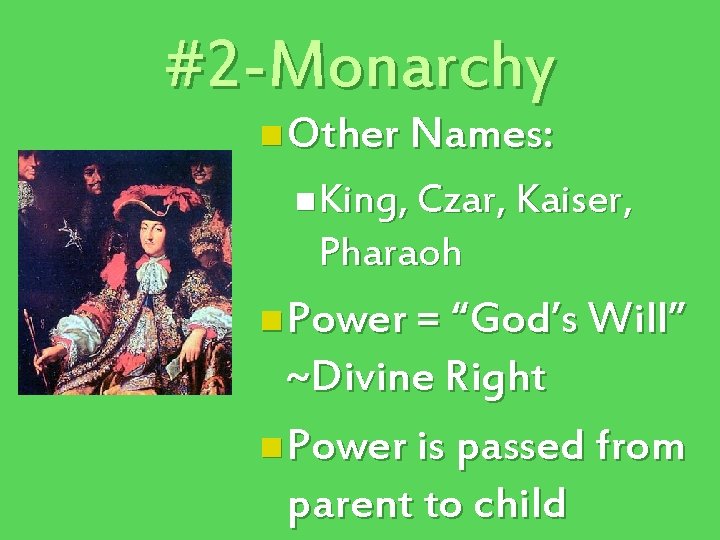
#2 -Monarchy n Other Names: n. King, Czar, Kaiser, Pharaoh n Power = “God’s Will” ~Divine Right n Power is passed from parent to child
More Basics 1 Vocab 1. 2. 3. Republic – system of government in which officials are chosen by the people Rights – vote, freedom of expression, freedom of religion, equality under the law Responsibilities – vote, pay taxes, draft, jury duty
The Road to Democracy How people go from autocracies to democracies?
The Greeks believed humans were unique because we could Greek reason and that all of us were Philosophy therefore equal According to the Greeks: “If you have a brain that can reason, you should be treated equally” n. If we are all humans… We can all reason… We are all equal… Then why do we have a king? ? ?
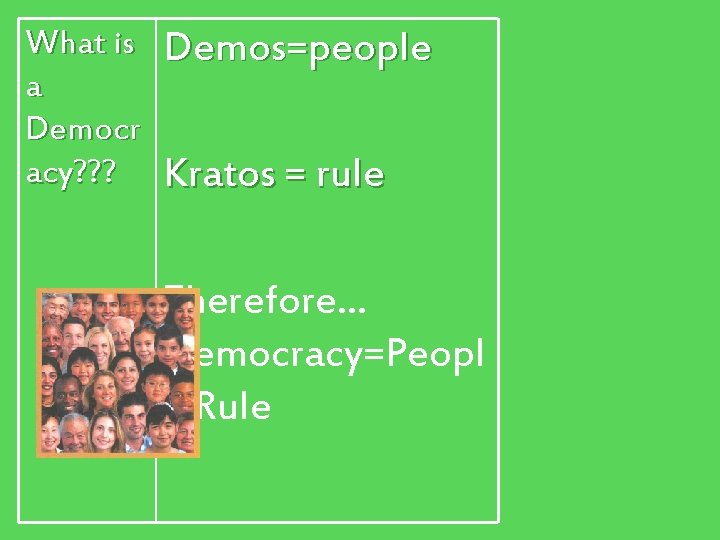
What is a Democr acy? ? ? Demos=people Kratos = rule Therefore… Democracy=Peopl e Rule
n Add info from these next few slides onto your Venn Diagram
2 types of Democracies n Direct Democracies n n From Ancient Greece Indirect Democracies n From Ancient Rome n What is the difference? ?
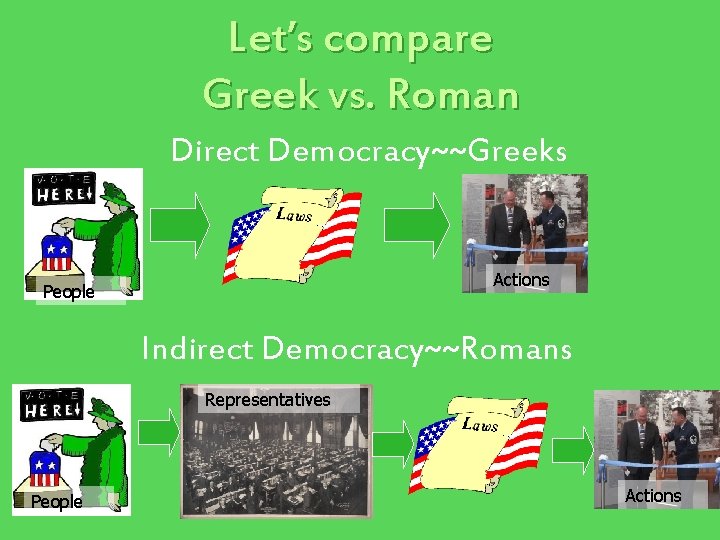
Let’s start with Greece… In about 500 B. C. E. in Athens Greece Direct Democracy: n. Every citizen voted on the laws and selected leaders to carry the laws out
Disadvantages of Direct Democracy n Slow decisions n Very few people are considered citizens n Who? ? Advantages of Direct Democracy n. Citizens are directly involved n. One crazy leader can’t make all the decisions
n. Wh o is a Citize n? n. A citizen is a full member of a Democratic Society n. In the Ancient world this was an adult, male, non-slave
n. Discuss with your neighbor: n. Who is considered a citizen in the US today? n. Do all citizens have all rights?
n What is the difference between a right and a responsibility? n What are some rights and responsibilities that we have in the US?
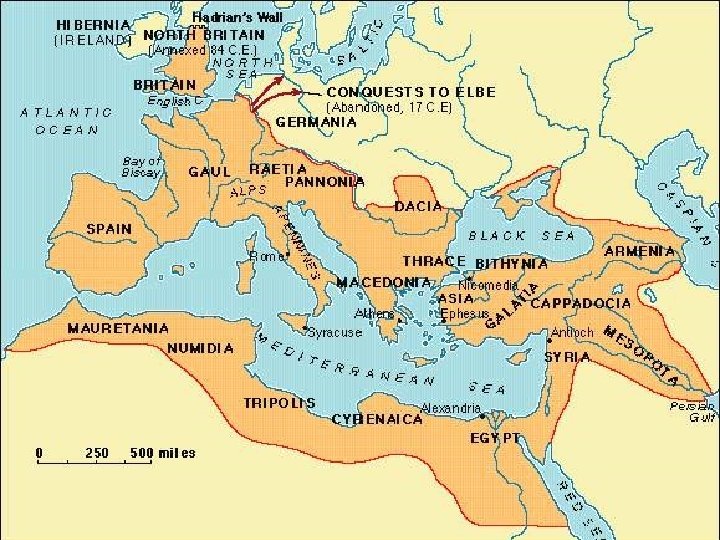
Now…let’s look at Rome n 200 B. C. E. Romans created a full Republic n. What is a republic?
Rome got BIG… n. With an empire it is impossible to have all the citizens in contact with one another. n. So the Romans modified the Greek’s Direct Democracy and created…
n Add facts from these next 2 slides to your Venn Diagram
Indirect Democracy n. Citizens voted for a representative to go to Rome and vote for laws.
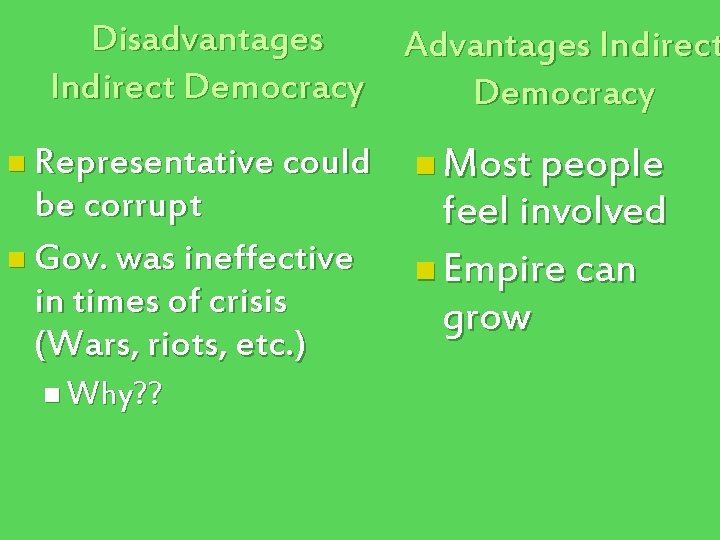
Disadvantages Advantages Indirect Democracy n Representative could be corrupt n Gov. was ineffective in times of crisis (Wars, riots, etc. ) n Why? ? n Most people feel involved n Empire can grow
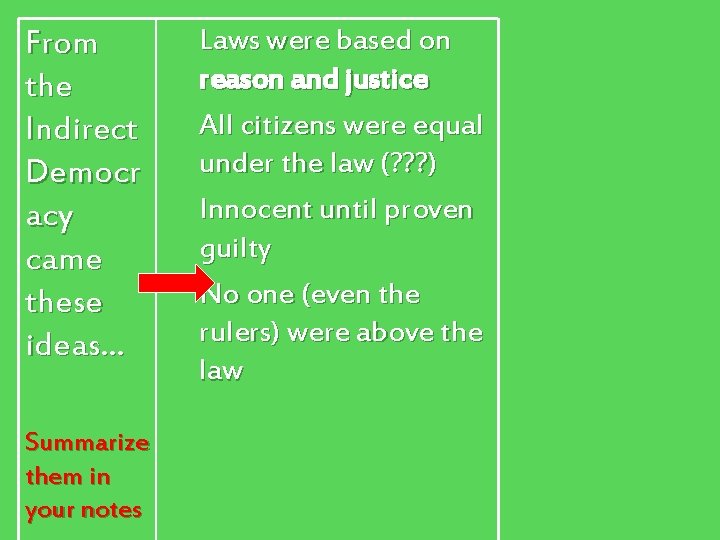
From the Indirect Democr acy came these ideas… Summarize them in your notes Laws were based on reason and justice All citizens were equal under the law (? ? ? ) Innocent until proven guilty No one (even the rulers) were above the law
All good things come to an end… Unfortunately Rome was conquered in the west and all that was left behind was the Roman Catholic Church and tribes We’ll talk more about that later…
Let’s compare Greek vs. Roman Direct Democracy~~Greeks Actions People Indirect Democracy~~Romans Representatives People Actions
Overall what is Democracy? n. When people vote for their leaders and laws.
Review: What were the Advantages of Democracy? Autocracy?
More Basics 1 Vocab n Judeo-Christian Beliefs– added morality to the law n Veto – power to block a government action n Monotheistic – belief in one God
Reminders: n n You need to find the rest of the vocab in your book For each word you need to add a sentence or two describing why it is significant to what we are learning.
Summary n Reminder: n When completing your notes you need to write a 3 -5 sentence summary of the lecture. This is a part of your notes grade