
What is goodwill Goodwill is an intangible asset
What is goodwill? Goodwill is an intangible asset representing non-physical items that add to a company’s value but cannot be easily identified or valued. Goodwill is usually associated with a business acquisition.
Intangible Assets (Goodwill) Valuation v Purchased – recorded as an asset at cost v Internally-created q most costs are expensed – valuation is too subjective to capitalize q legal costs to obtain the intangible may be capitalized
Amortization v Limited life intangibles q limited through legal or contractual provisions, obsolescence, competition q amortized v Indefinite life q not amortized q the “ 40 -year “ rule has been dropped!

Types of Intangible Assets 1) Marketing-related intangibles: eg. Trademark v capitalize design and registration fees v indefinite life 2) Customer-related intangibles: eg. Customer list v capitalize acquisition costs 3) Artistic-related intangibles: eg. Copyright v capitalize costs to acquire and defend v amortize over useful life
4) Contract-related intangibles: eg. Franchise v initial cost amortized if life is limited v annual payments are not capitalized 5) Technology-related intangibles: eg. Patent v R&D related to the development of a product or process is not capitalized v patent costs are amortized over legal or useful life 6) Goodwill
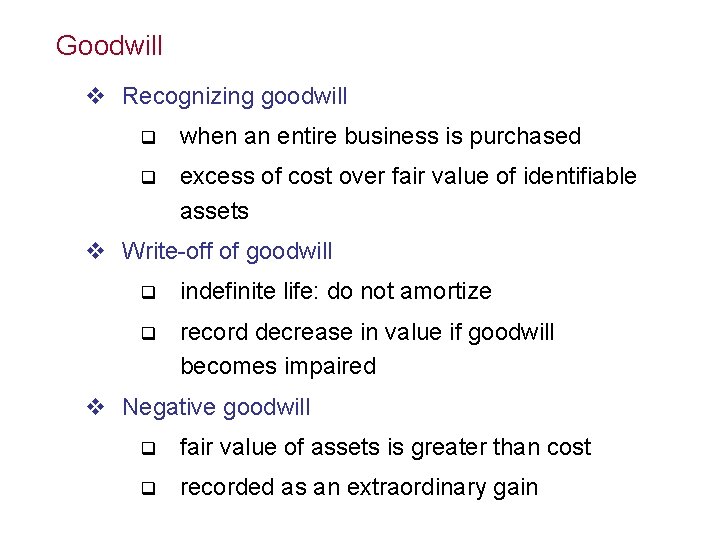
Goodwill v Recognizing goodwill q when an entire business is purchased q excess of cost over fair value of identifiable assets v Write-off of goodwill q indefinite life: do not amortize q record decrease in value if goodwill becomes impaired v Negative goodwill q fair value of assets is greater than cost q recorded as an extraordinary gain

IMPAIRMENT OF INTANGIBLE ASSETS Limited-Life Intangibles v Rules for long-lived assets apply (Chapter 11) 1. Recoverability test for impairment future net cash flows (undiscounted) < carrying value 2. If impaired, calculate the amount of the loss. carrying value - fair value of the asset 3. Entry: Loss on Impairment Patents 150, 000

Indefinite-Life Intangibles Other than Goodwill v Test for impairment at least annually 1. Fair value test for impairment fair value of the asset < carrying value 2. If impaired, record the difference as a loss. (as with limited-life intangibles)

Goodwill v Test for impairment is a two-step process 1. Fair value test on the reporting unit fair value of the unit < carrying value Cash & Receiv. PP&E Goodwill Less: Notes Payable Value of unit Carrying Value $ 1, 050 8, 700 2, 100 (950) $10, 900 Fair Value $10, 000 Perhaps based on expected net cash flows.
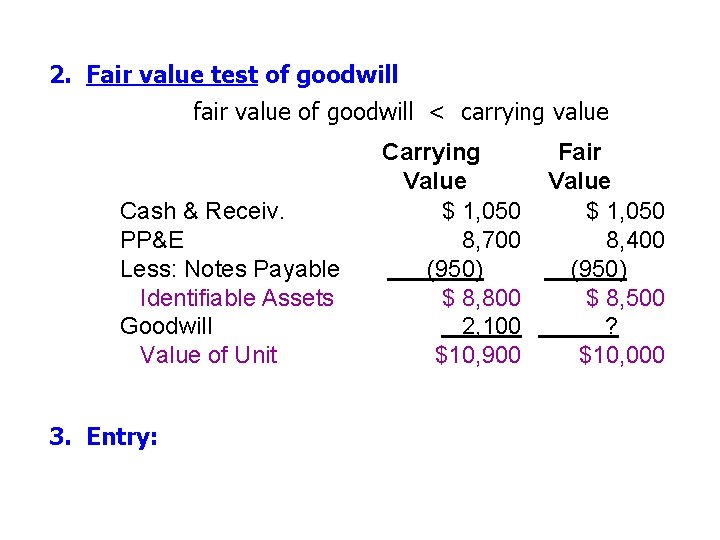
2. Fair value test of goodwill fair value of goodwill < carrying value Cash & Receiv. PP&E Less: Notes Payable Identifiable Assets Goodwill Value of Unit 3. Entry: Carrying Value $ 1, 050 8, 700 (950) $ 8, 800 2, 100 $10, 900 Fair Value $ 1, 050 8, 400 (950) $ 8, 500 ? $10, 000
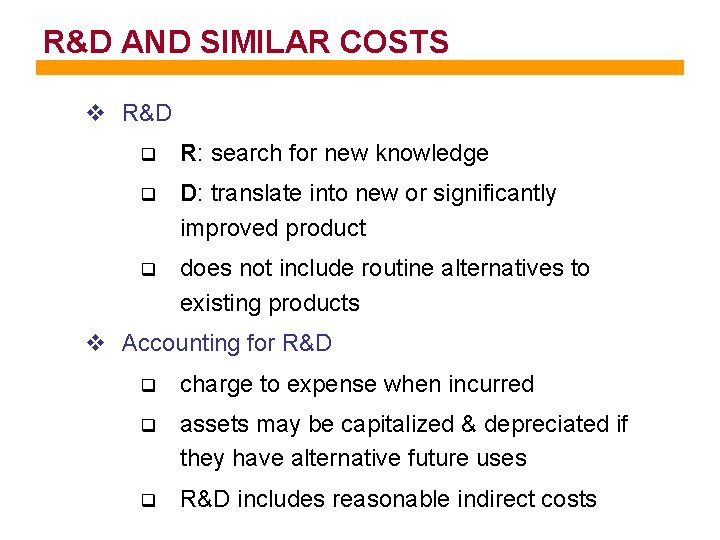
R&D AND SIMILAR COSTS v R&D q R: search for new knowledge q D: translate into new or significantly improved product q does not include routine alternatives to existing products v Accounting for R&D q charge to expense when incurred q assets may be capitalized & depreciated if they have alternative future uses q R&D includes reasonable indirect costs
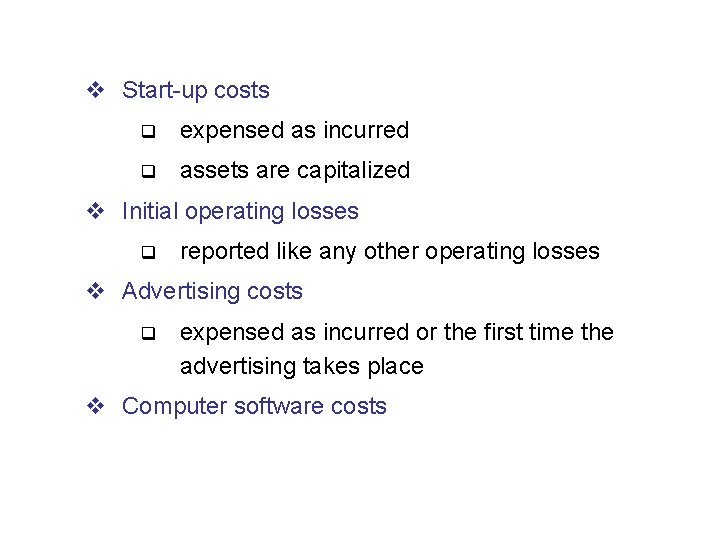
v Start-up costs q expensed as incurred q assets are capitalized v Initial operating losses q reported like any other operating losses v Advertising costs q expensed as incurred or the first time the advertising takes place v Computer software costs
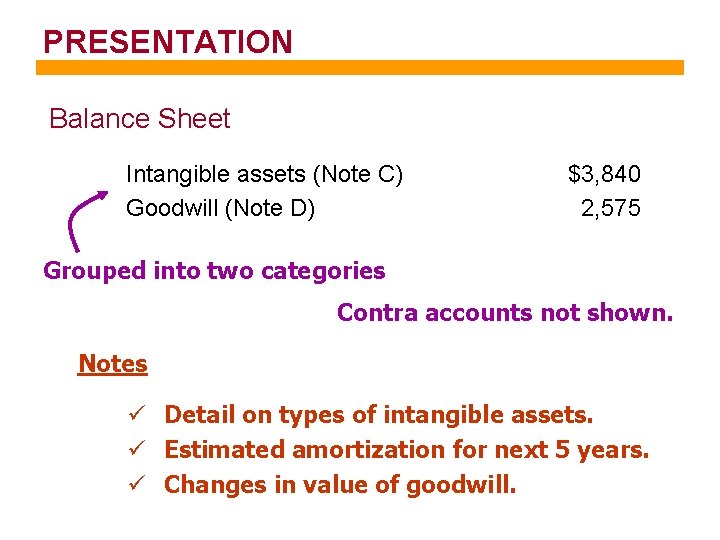
PRESENTATION Balance Sheet Intangible assets (Note C) Goodwill (Note D) $3, 840 2, 575 Grouped into two categories Contra accounts not shown. Notes ü Detail on types of intangible assets. ü Estimated amortization for next 5 years. ü Changes in value of goodwill.
Income Statement Included in continuing operations: R&D expenses (disclosed separately) Amortization expense Intangible impairment losses Goodwill impairment losses (unless the operating unit is discontinued. )
- Slides: 14