
What is globalization w The free flow of
What is globalization? w The free flow of goods, people, ideas, culture across international boundaries. Example: A Vizio flat panel TV is: w designed in a small office in California w assembled in Mexico w From w panels made in South Korea w electronic components made in China w microprocessors made in the U. S.
Thinking about the Vizio example on the last slide, come up with another item we buy and how it represents globalization. YES, you can use your phones to access the internet for this. Think of an item – Beats by Dre, for instance – and find out where the company is located that makes them and the factory is where they are made. You can do this for any item! We will share out after a few minutes.
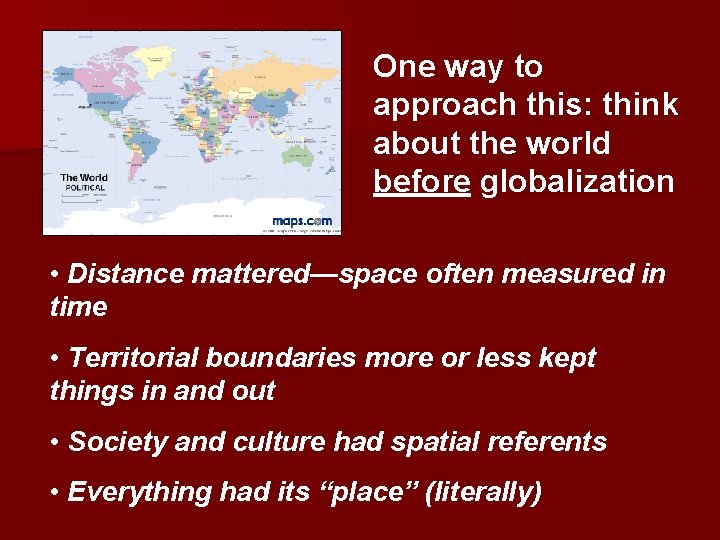
One way to approach this: think about the world before globalization • Distance mattered—space often measured in time • Territorial boundaries more or less kept things in and out • Society and culture had spatial referents • Everything had its “place” (literally)
In a world experiencing Globalization: • Distance becomes almost irrelevant (the end of distance) • Boundaries are increasingly permeable. • Groups and cultures increasingly don’t have a territorial basis • A new kind of non-physical “place” is emerging (i. e. the Internet) where boundaries do not matter
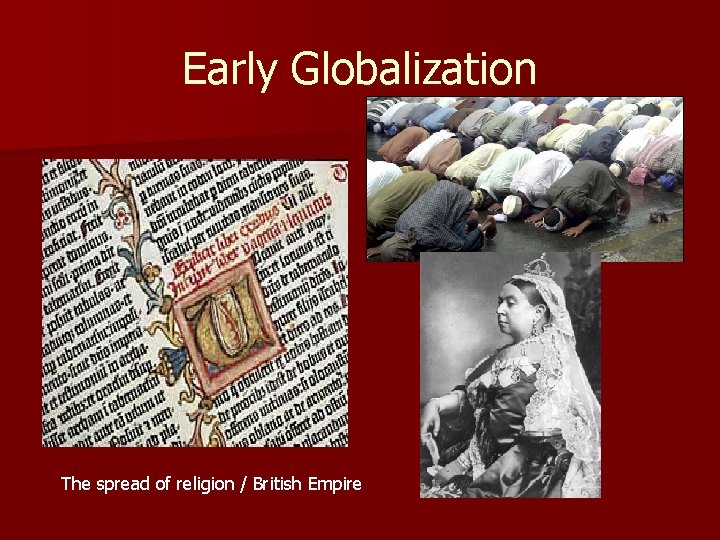
Early Globalization The spread of religion / British Empire
Think about the world prior to the year 1900. What is a way globalization could have been achieved? Write down your idea and how you think it impacted globalization. If you need to use your phone for research you can. We will share out in a few minutes.
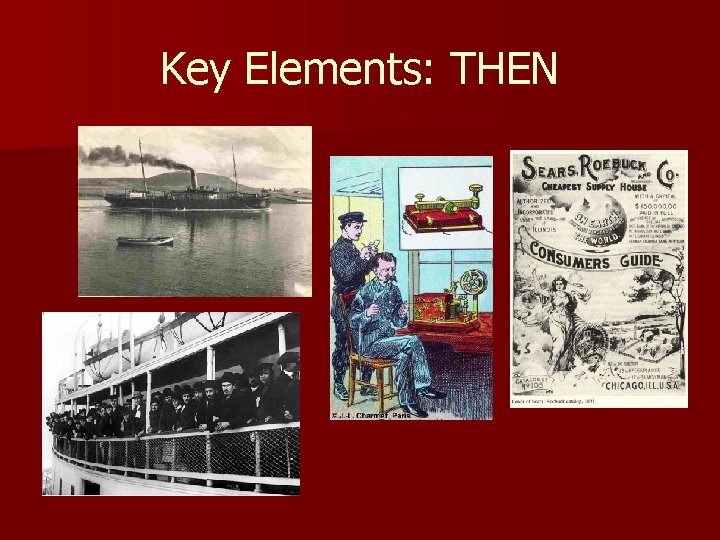
Key Elements: THEN
Think about the world today. What is a way globalization is currently being achieved? Write down your idea and how you think it impacts globalization. If you need to use your phone for research you can. We will share out in a few minutes.
Key Elements--NOW
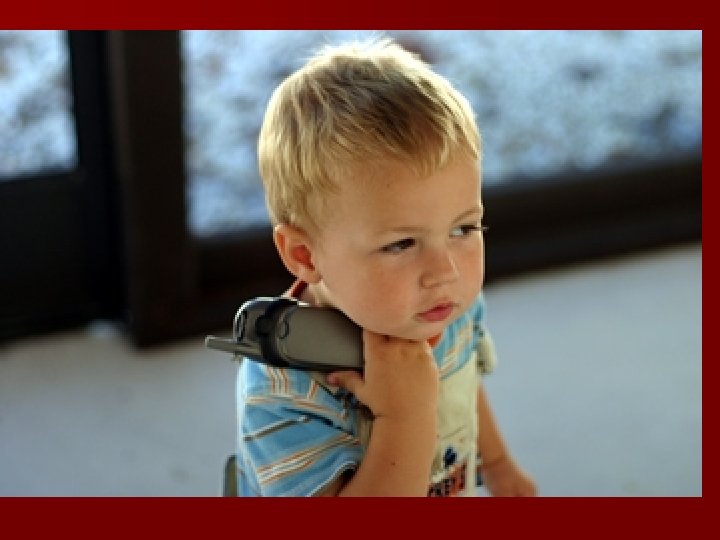
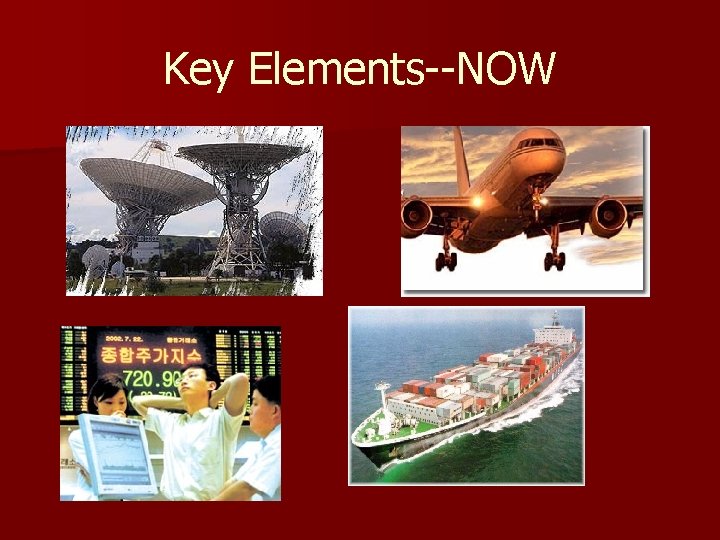
What are the Components? 1. n Broad Category: Technology n Instant, cheap Worldwide Communications —cell phone, www(availability at the individual level) n International (instant)financial and capital transfers n Increased scale and frequency of air transport n Container ships
Globalization of markets w In the past, each country had its own companies in many industries and its own products w I never saw Japanese media (and I saw little non-US media) in college
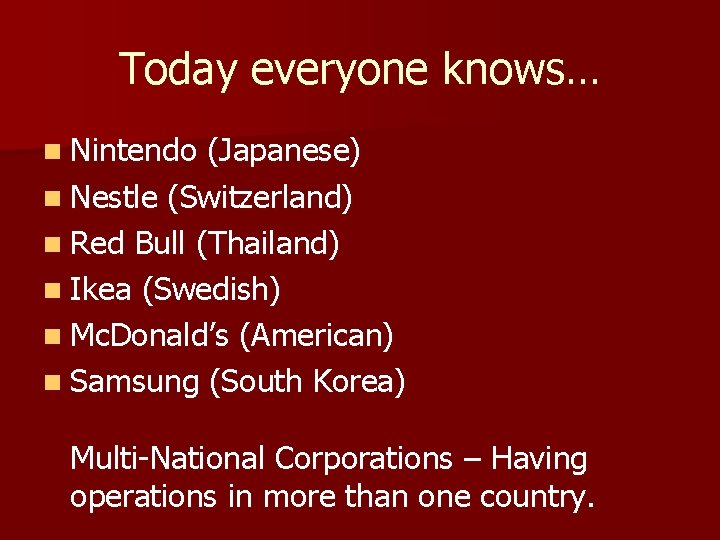
Today everyone knows… n Nintendo (Japanese) n Nestle (Switzerland) n Red Bull (Thailand) n Ikea (Swedish) n Mc. Donald’s (American) n Samsung (South Korea) Multi-National Corporations – Having operations in more than one country.
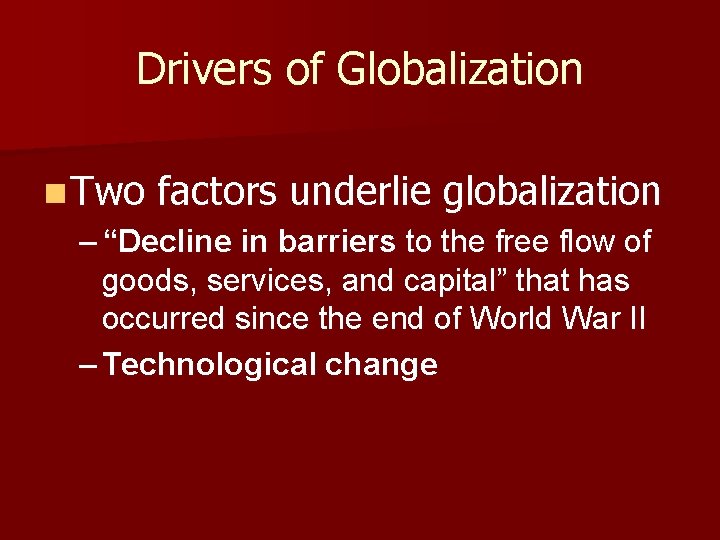
Drivers of Globalization n Two factors underlie globalization – “Decline in barriers to the free flow of goods, services, and capital” that has occurred since the end of World War II – Technological change
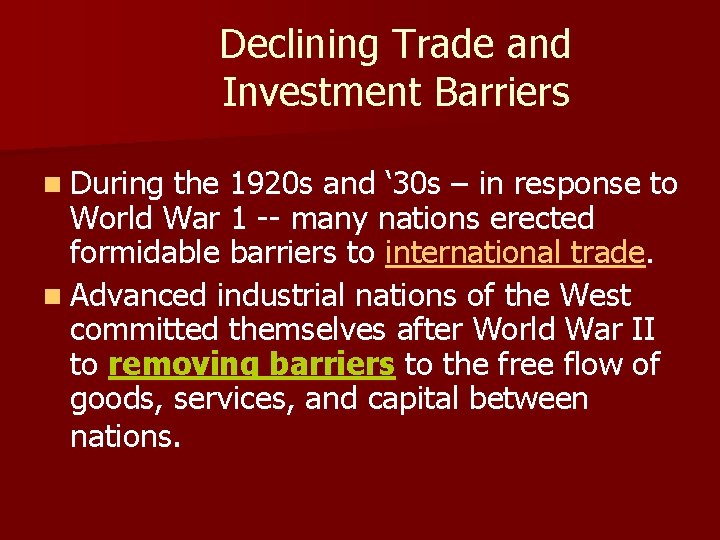
Declining Trade and Investment Barriers n During the 1920 s and ‘ 30 s – in response to World War 1 -- many nations erected formidable barriers to international trade. n Advanced industrial nations of the West committed themselves after World War II to removing barriers to the free flow of goods, services, and capital between nations.
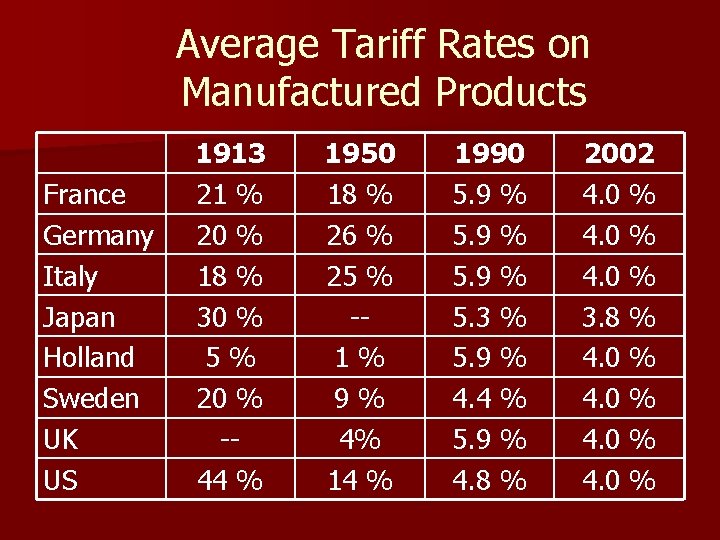
Average Tariff Rates on Manufactured Products France Germany Italy Japan Holland Sweden UK US 1913 21 % 20 % 18 % 30 % 5% 20 % -44 % 1950 18 % 26 % 25 % -1% 9% 4% 14 % 1990 5. 9 % 5. 3 % 5. 9 % 4. 4 % 5. 9 % 4. 8 % 2002 4. 0 % 3. 8 % 4. 0 %
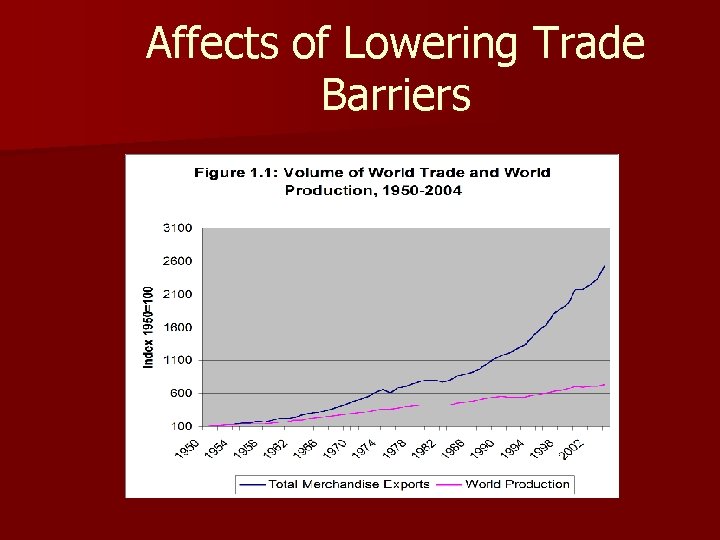
Affects of Lowering Trade Barriers
The Role of Technology Lowering of trade barriers made globalization possible; w Technology has made it a transforming movement w
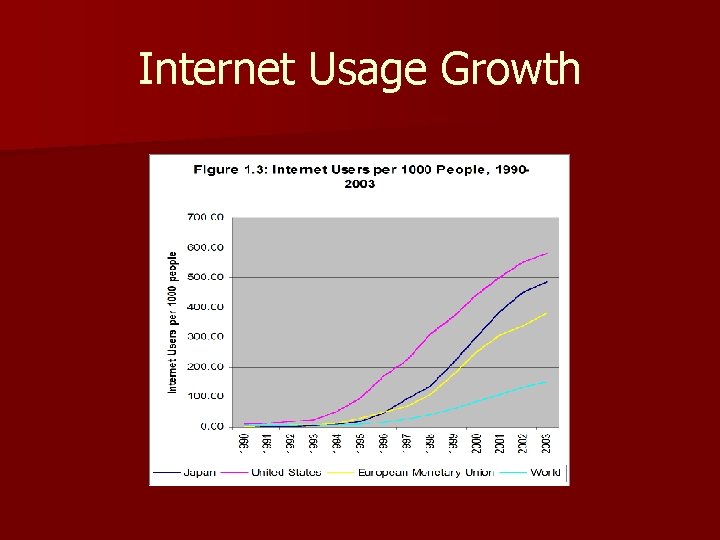
Internet Usage Growth
Globalization: The trends of the last 10, 000 years n People lived for 250, 000 years in hunter -gatherer bands n Rise of agriculture 10, 000 years ago led to rise of empires and nation-states n Science and ‘enlightenment’ after 1680 produced global trade and empires n Free trade and tech after 1980 produced globalization
Information n Broad Category: Information n Instant dispersal of news by satellite TV, www, fax (but what news and whose? ) n Competition is worldwide, not local or national n Very hard to keep a secret
Culture n Broad Category: Culture n Increasingly a “global village, ” but a Western one watching the same TV, music videos, news, soaps. Reaction to this? n Rise of a “global language. ” Why? Whose? n Smaller cultures may feel threatened n Cultures in Africa in danger – over 1000 cultures and languages, by 2050 less than 100 will still exist.
Environment & Health n Broad Category: Environment and Health n Global environmental problems (Ozone, global “warming, ” sea-level change n AIDS, Ebola, ? ? n Global plunder of common pool resources —ocean, forests…. .
Crime & Terrorism n Broad Category: Crime and Terrorism n “International” crime, Russian Mafia n Terrorists in caves in Afghanistan threaten lower Manhattan n International crime does not play by the rules of “states, ” and may be better organized than some, and “own” others.
Immigration Issues n. A global population? n The rich countries remain rich, and a declining proportion of world population n The poor countries remain poor, and a rapidly expanding part of the worlds population (95% of the growth) n Hence the pressure to move to the rich countries, legally or illegally
The Information Revolution n The Internet n The WWW n Instant Dispersal of News & Information n The Rise of a Global Media Village? n The Personalization of communications: the cell/mobile phone system, and its increasing capacity. n Twitter, facebook, snapchat, skype
Information: Downside? n But, what information is becoming global? But whose news is becoming global? n What is this doing to cultures and communities? n Does Globalization = Westernization =Americanization? Does it matter? n Are we evolving a global language? What are the consequences of this?
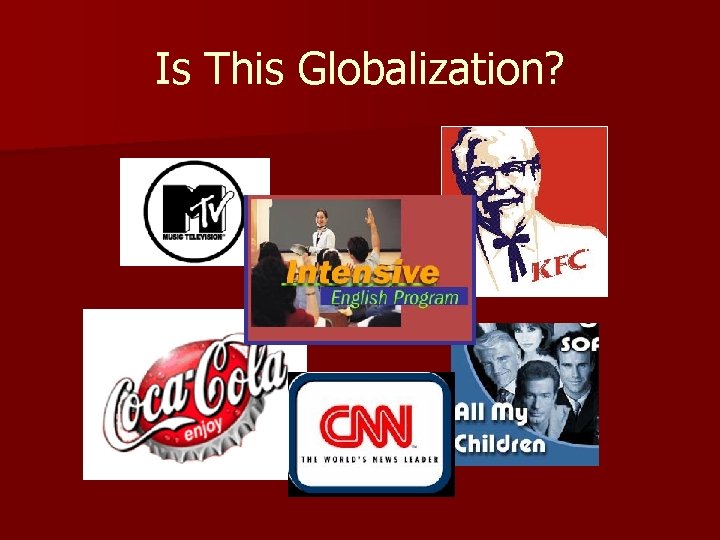
Is This Globalization?
Who Manages Globalization? n There is no world government, so who regulates and controls the process? Mostly UN agencies, but they require the compliance of all member states, and the UN does not make law. n Do states ever put the global priority ahead of their own? Plus, we have rich, strong states, and poor weak ones.
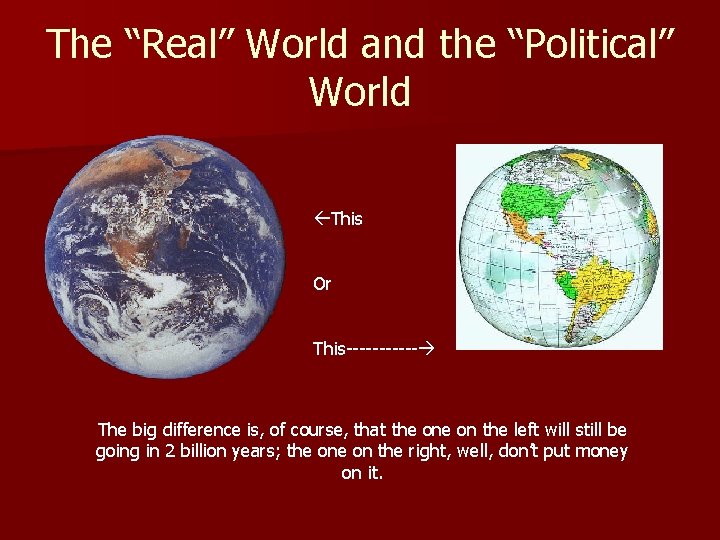
The “Real” World and the “Political” World This Or This------ The big difference is, of course, that the on the left will still be going in 2 billion years; the on the right, well, don’t put money on it.
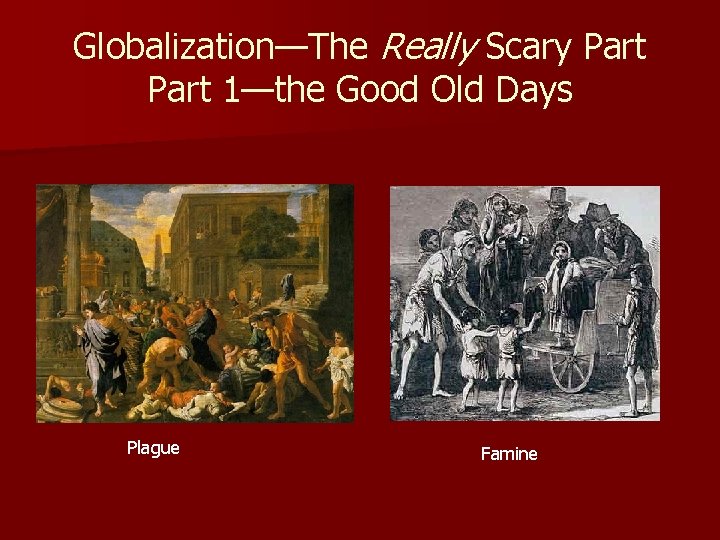
Globalization—The Really Scary Part 1—the Good Old Days Plague Famine
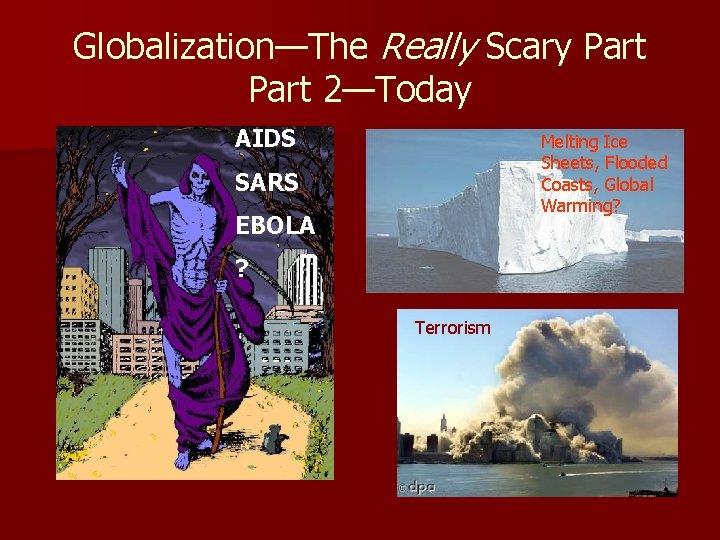
Globalization—The Really Scary Part 2—Today AIDS Melting Ice Sheets, Flooded Coasts, Global Warming? SARS EBOLA ? Terrorism
Scarier Still n We have global crime—financial, drugrelated etc. , perhaps the largest single element in international trade n A Man in a cave in Afghanistan can kill 3000 people in lower Manhattan n International crime does not play by the rules of states—or anyone else—and may be better-equipped.
The Emergence of Global Institutions Notable global institutions include w the World Trade Organization (WTO) which is responsible for policing the world trading system and ensuring that nations adhere to the rules established in WTO treaties w In 2008, 151 nations accounting for 97% of world trade were members of the WTO w the International Monetary Fund (IMF) which maintains order in the international monetary system
The Emergence of Global Institutions the World Bank which promotes economic development w the United Nations (UN) which maintains international peace and security, develops friendly relations among nations, cooperates in solving international problems and promotes respect for human rights, and is a center for harmonizing the actions of nations w * GDP – Overall production capacity (wealth) of an entire nation. * Per capita GDP – The average production capacity (wealth) of an individual citizen within a country.
The Changing Roles of Countries in the Global Economy In the 1960 s: w The U. S. dominated the world economy and the world trade picture w U. S. multinationals dominated the international business scene w About half the world-- the centrally planned economies of the communist world-- was off limits to Western international business Today, much of this has changed.
The Changing World Output and World Trade Picture In the early 1960 s, the U. S. was the world's dominant industrial power accounting for about 40. 3% of world manufacturing output w By 2007, the U. S. accounted for only 20. 7% w Other developed nations experienced a similar decline w
The Changing Nature of the Multinational Enterprise w Since the 1960 s, w there has been a rise in non-U. S. multinationals w there has been a rise in mini-multinationals
The Globalization Debate w Pro w Lower prices for goods and services w Economic growth w Increase in consumer income w Creates jobs (for many) w Countries specialize in production of goods and services that are produced most efficiently w Con w Destroys manufacturing jobs in wealthy nations w Wage rates of unskilled in advanced countries decline w Companies move to countries with fewer labor and environment regulations w Loss of sovereignty w Homogenized cultures
To Recap: Globalization n Is Driven by Technology n Is seen as threatening cultures because it is equated with Westernization n Increases the pace at which everything happens: capital transfers, spread of disease, change of culture… n May be changing our global environment, but can states manage the globe? n Who runs the world? ?
- Slides: 40