
What Is Geo Simulation Mark Birkin School of
What Is Geo. Simulation Mark Birkin School of Geography, University of Leeds
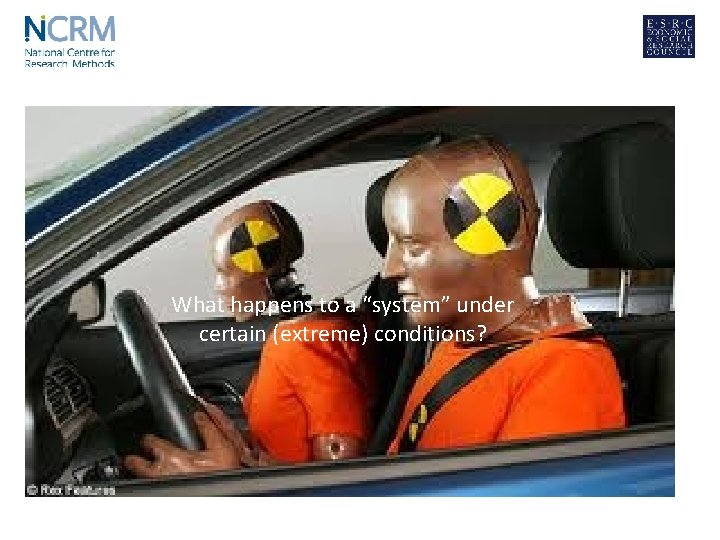
What happens to a “system” under certain (extreme) conditions?
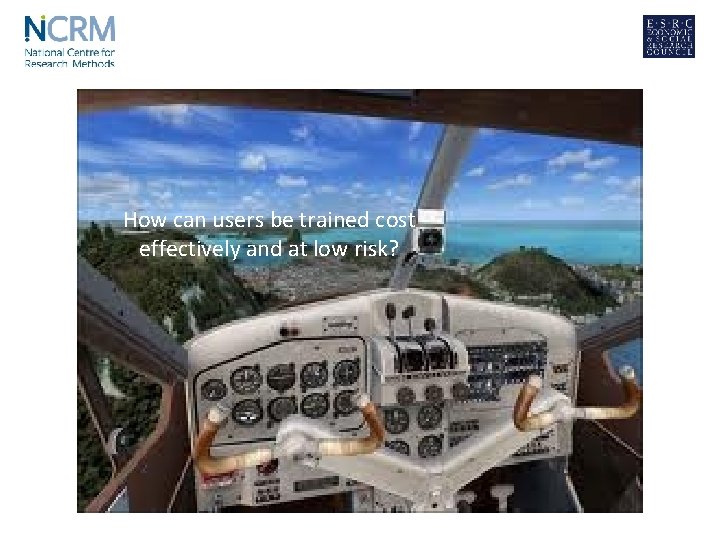
How can users be trained cost effectively and at low risk?
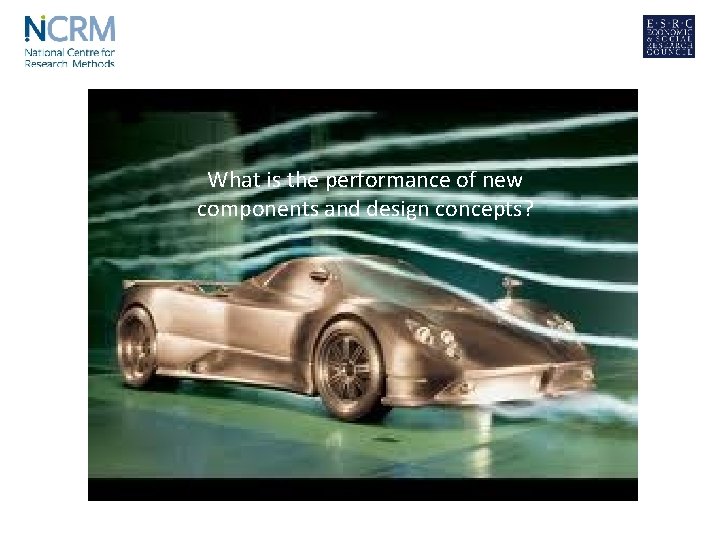
What is the performance of new components and design concepts?
Geo. Simulation • Attempts to achieve some of the same objectives as physical simulations through representation of a spatial social system (‘the city’) as a computational model • Possible goals: – Better understanding of how the system works and its most important features – Train the drivers of the system (e. g. planners) to make more effective decisions – Impact analysis: ‘what if? ’ scenarios

FOR REAL. . .
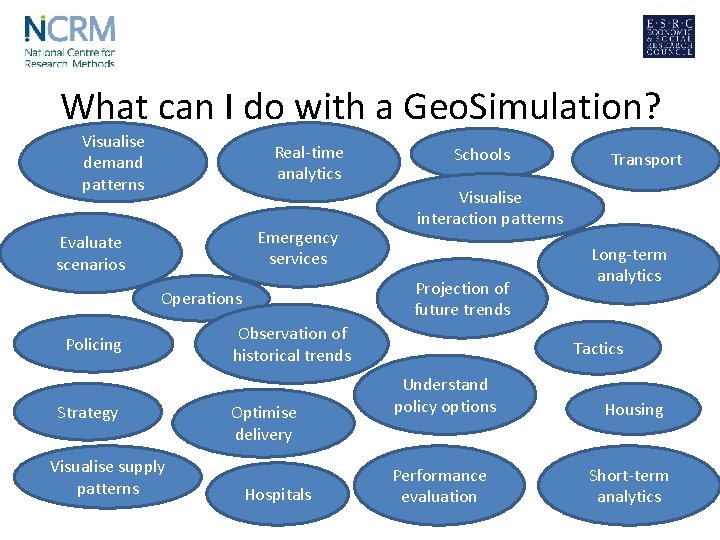
What can I do with a Geo. Simulation? Visualise demand patterns Real-time analytics Emergency services Evaluate scenarios Strategy Visualise supply patterns Observation of historical trends Optimise delivery Hospitals Transport Visualise interaction patterns Projection of future trends Operations Policing Schools Long-term analytics Tactics Understand policy options Performance evaluation Housing Short-term analytics
Examples of (simulation) models
Examples of (simulation) models
Examples of (simulation) models
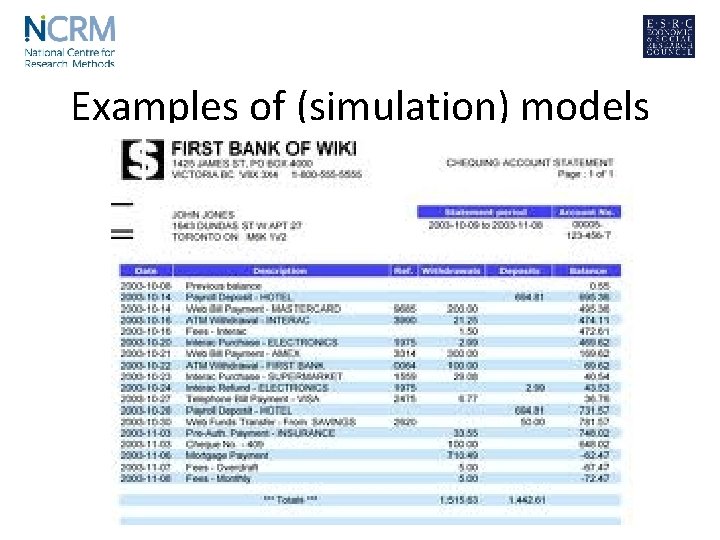
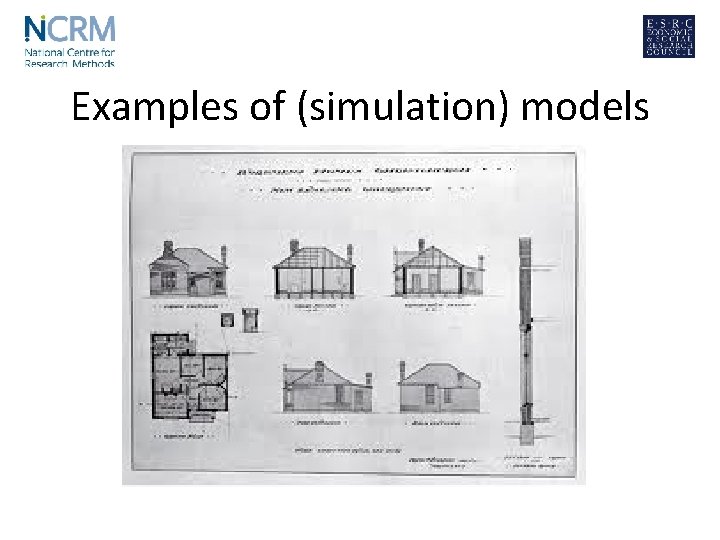
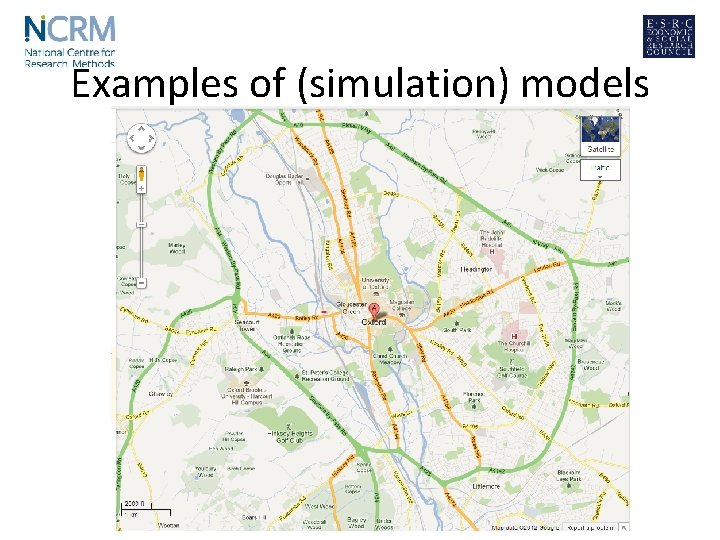
Examples of (simulation) models • Bank account? • Building plans? • Map! – A simplified and abstract representation of a ‘real‘ phenomenon – It can be manipulated in some useful way • Can I afford to go on holiday? • Will all the children fit into our new house? • What time should I set off to get to the match?
History of Geo. Simulation • Most migrants move only a short distance. • There is a process of absorption, whereby people immediately surrounding a rapidly growing town move into it and the gaps they leave are filled by migrants from more distant areas, and so on until the attractive force [pull factors] is spent. • There is a process of dispersion, which is the inverse of absorption. • Each migration flow produces a compensating counter-flow. • Long-distance migrants go to one of the great centers of commerce and industry. • Natives of towns are less migratory than those from rural areas. • Females are more migratory than males. • Economic factors are the main cause of migration. EG Ravenstein (1885) The Laws of Migration, Journal of the Royal Statistical Society, 48, 167 -227.
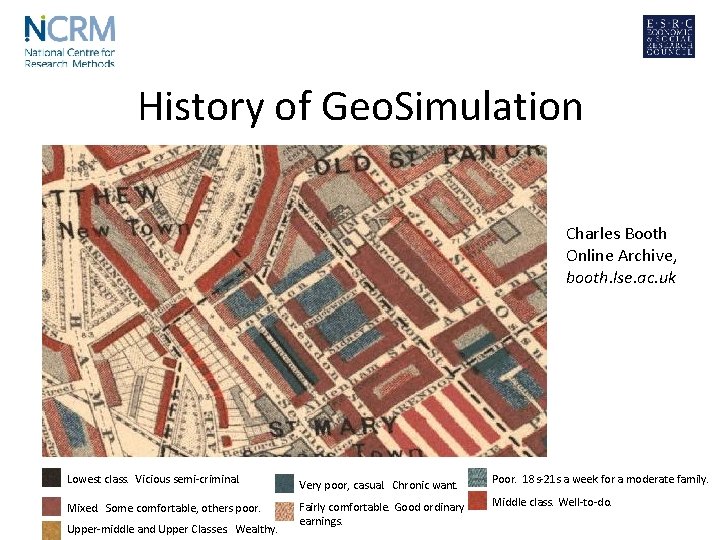
History of Geo. Simulation Charles Booth Online Archive, booth. lse. ac. uk Lowest class. Vicious semi-criminal. Very poor, casual. Chronic want. Poor. 18 s-21 s a week for a moderate family. Mixed. Some comfortable, others poor. Fairly comfortable. Good ordinary earnings. Middle class. Well-to-do. Upper-middle and Upper Classes. Wealthy.
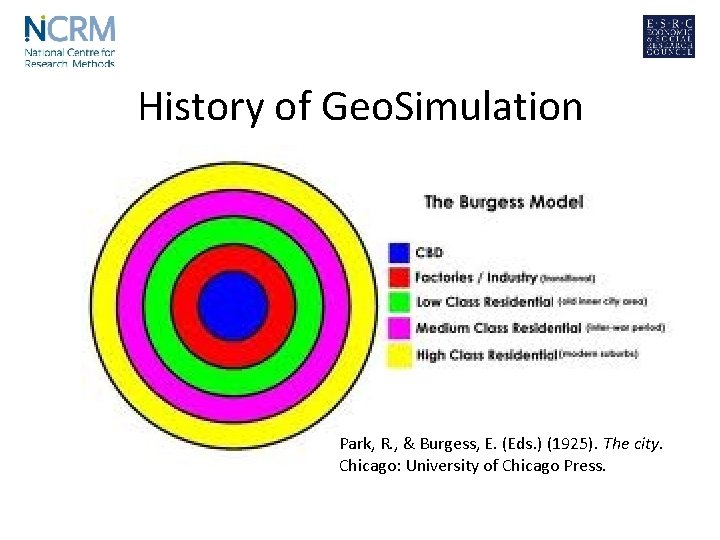
History of Geo. Simulation Park, R. , & Burgess, E. (Eds. ) (1925). The city. Chicago: University of Chicago Press.
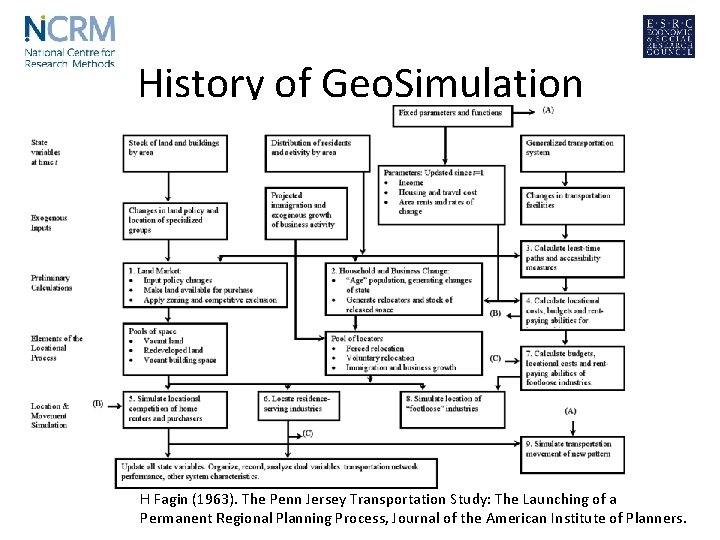
History of Geo. Simulation H Fagin (1963). The Penn Jersey Transportation Study: The Launching of a Permanent Regional Planning Process, Journal of the American Institute of Planners.
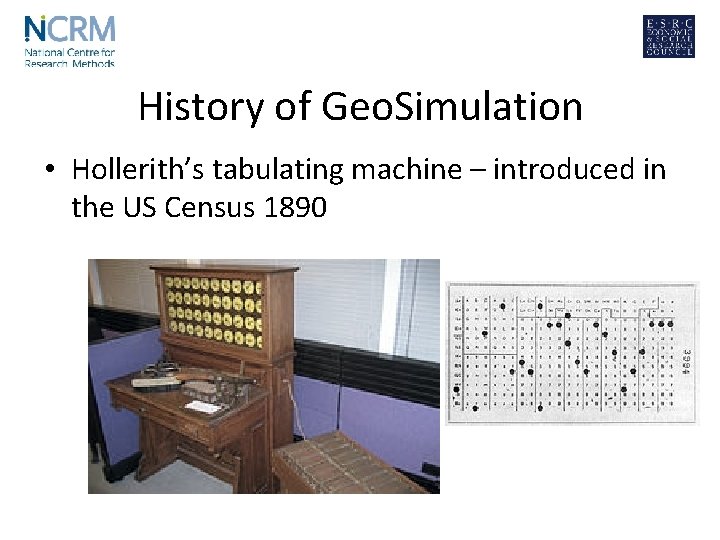
History of Geo. Simulation • Hollerith’s tabulating machine – introduced in the US Census 1890
Applications of Geo. Simulation • Critiques of the modelling approach: – Douglass Lee (1973) Requiem for Large Scale Urban Modelling – Andrew Sayer (1976) Understanding Models versus Understanding Cities – David Harvey (1973) Social Justice and the City • Provide a framework for: – articulating the scope and boundaries of the methods – prioritising development and evaluating progress
Applications of Geo. Simulation • Lee’s Seven Deadly Sins. . . – Hypercomprehensiveness – Complicatedness – Expensiveness – Hungriness – Wrong-headedness – Grossness – Mechanicalness Lee, D. B. (1973) Requiem for Large Scale Urban Models, Journal of the American Institute of Planners, 39, 3, 163 -178.
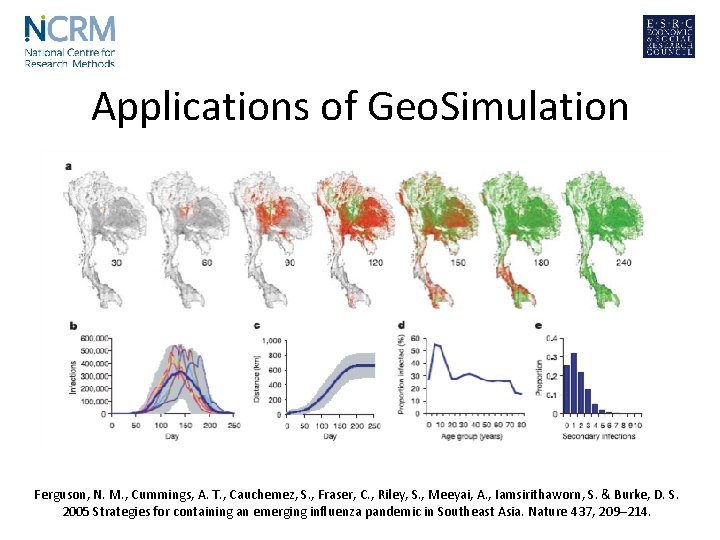
Applications of Geo. Simulation Ferguson, N. M. , Cummings, A. T. , Cauchemez, S. , Fraser, C. , Riley, S. , Meeyai, A. , Iamsirithaworn, S. & Burke, D. S. 2005 Strategies for containing an emerging influenza pandemic in Southeast Asia. Nature 437, 209– 214.
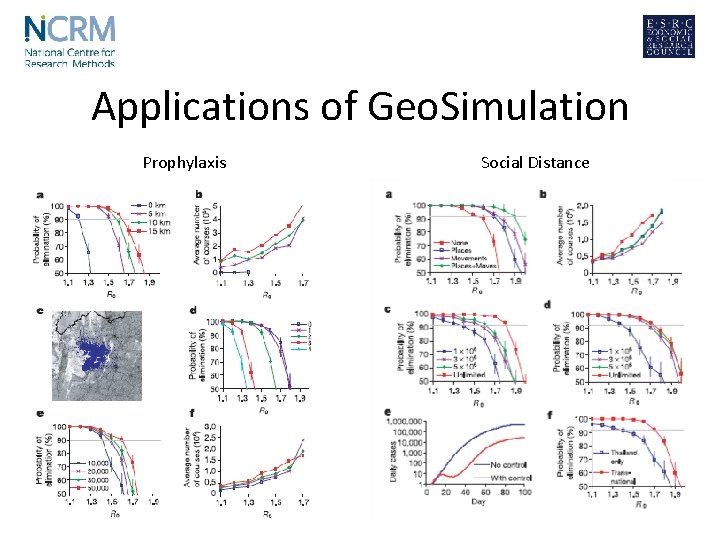
Applications of Geo. Simulation Prophylaxis Social Distance
Applications of Geo. Simulation • Ferguson – Challenge – investment (3 month sim) – Limitations – simplistic behavioural interactions? – Weaknesses: morphing of virus? Panic behaviour? • But power – strategic planning; assess merits of alternative interventions; a framework for policy action
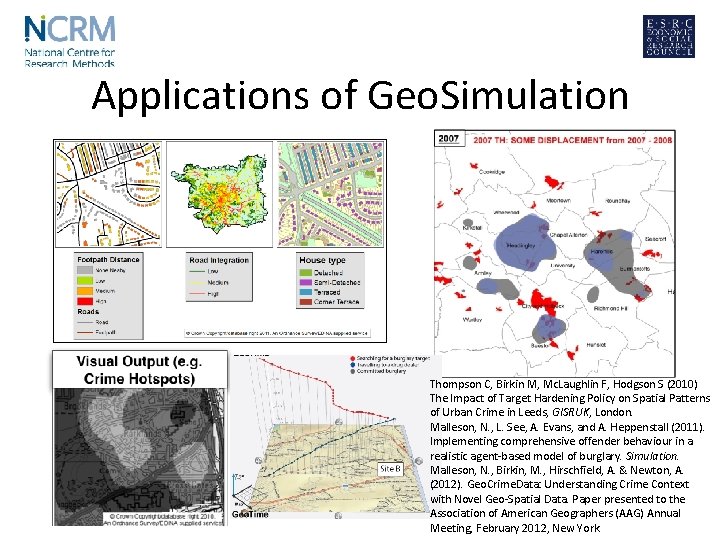
Applications of Geo. Simulation Thompson C, Birkin M, Mc. Laughlin F, Hodgson S (2010) The Impact of Target Hardening Policy on Spatial Patterns of Urban Crime in Leeds, GISRUK, London. Malleson, N. , L. See, A. Evans, and A. Heppenstall (2011). Implementing comprehensive offender behaviour in a realistic agent-based model of burglary. Simulation. Malleson, N. , Birkin, M. , Hirschfield, A. & Newton, A. (2012). Geo. Crime. Data: Understanding Crime Context with Novel Geo-Spatial Data. Paper presented to the Association of American Geographers (AAG) Annual Meeting, February 2012, New York.
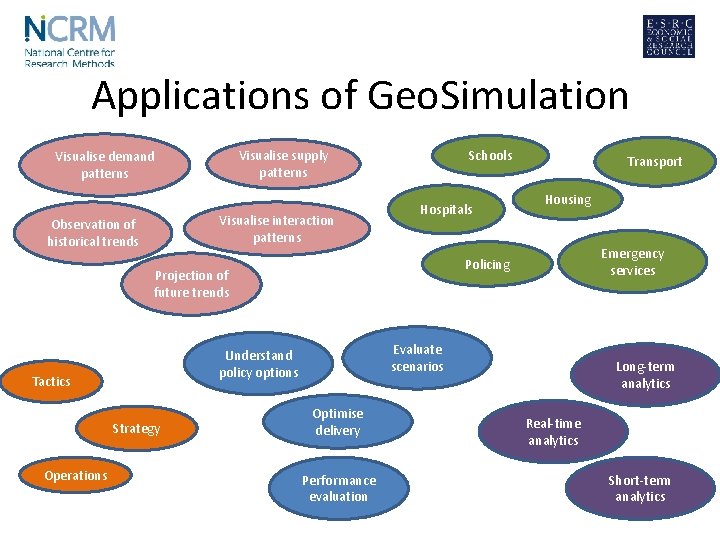
Applications of Geo. Simulation Visualise interaction patterns Observation of historical trends Schools Visualise supply patterns Visualise demand patterns Hospitals Operations Emergency services Evaluate scenarios Understand policy options Strategy Housing Policing Projection of future trends Tactics Transport Optimise delivery Performance evaluation Long-term analytics Real-time analytics Short-term analytics
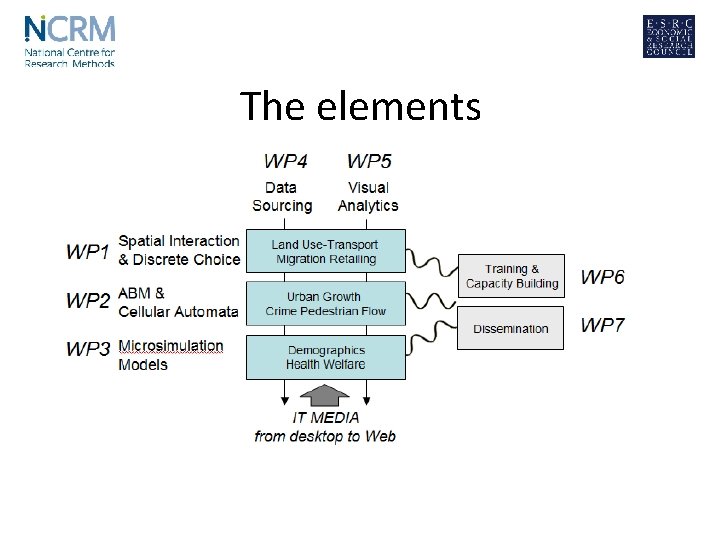
The elements • Moving towards Talisman – Data – Visualisation – Computation – Models – Training
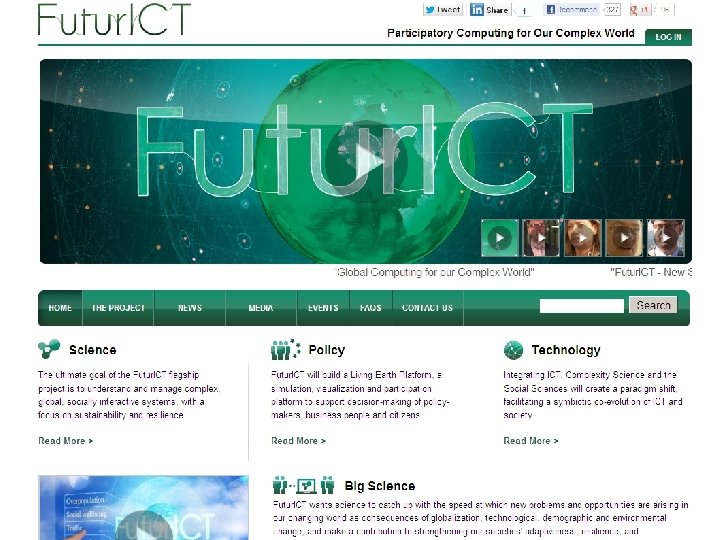
The elements • Futur. ICT
TALISMAN is a node of the NCRM and is based at the University of Leeds and University College London. TALISMAN’s key objectives are to: • Develop state-of-the-art geospatial models in the form of new data analysis techniques and simulation models. • Build new methods of data acquisition and visualisation. • Improve the uptake and dissemination of skills in spatial analysis through training and capacity-building activities. For further information about TALISMAN visit: www. geotalisman. org
- Slides: 26