
What is genetics Geneticsis the study of genes

- Slides: 4
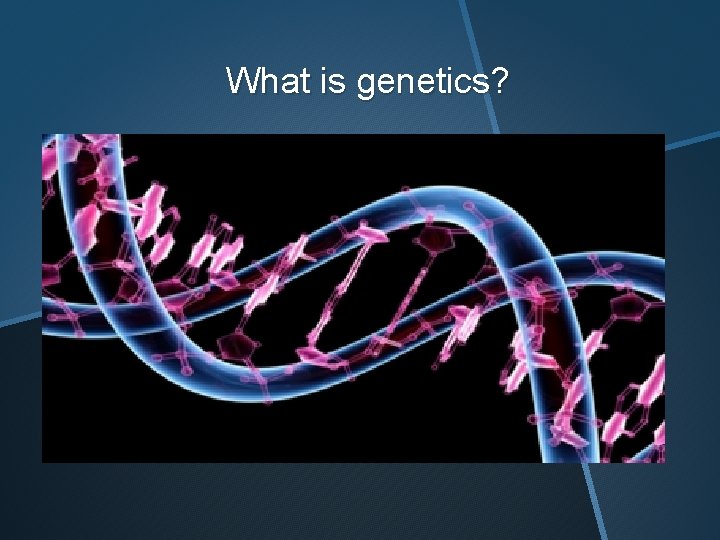
What is genetics?
Genetics-is the study of genes, genetic variation, and heredity in living organisms. It is generally considered a field of biology, but intersects frequently with many other life sciences and is strongly linked with the study of information systems.
HISTORY First of all, genetics studied the general laws of heredity and variation only on the basis of phenotypic data. Understanding the mechanisms of heredity, that is, the role of genes as the basic carrier of genetic information, the chromosomal theory of heredity, and so on. D. Has been made possible with the problem of heredity cytology techniques, molecular biology and other related disciplines. Today it is known that the genes do indeed exist and are specially marked sections of DNA or RNA - molecules in which the entire genetic information is encoded. In eukaryotic organisms, DNA is minimized in the chromosome and is located in the cell nucleus. Furthermore, there own DNA within the mitochondria and chloroplasts (in plants). In prokaryotes DNA, usually in closed ring (bacterial chromosom) and stored in the cytoplasm. Often present in prokaryotic cells smaller DNA - plasmid
GREGOR MENDEL In 1865, the monk Gregor Mendel (engaged in the study of hybridization of plants at the Augustinian monastery in Brunn (Brno), now in the Czech Republic) was announced at a meeting of the local society of naturalists, the results of studies on the transfer of inherited characteristics in the crossing of peas (work Experiments on plant hybrids was published in the proceedings of the society in 1866). Mendel showed that some hereditary factors do not blend but are passed from parents to offspring in the form of discrete (separate) units. Formulated the laws of inheritance, later called Mendel's laws. During his life his work was neglected and was perceived critical (the results of experiments on other plant, night beauty, at first glance, did not confirm the regularities, rather than willingly took the criticism of his observations).