
What is Gender The process by which individuals

What is Gender? “The process by which individuals who are born into the biological categories of ‘female’ or ‘male’ become the social categories of women and men through the acquisition of culturally defined attributes of masculinity and femininity as well as the resources and responsibilities which are associated with these categories”.

Sex and Gender SEX • Biological difference • Universal/Similar • Cannot be changed GENDER • Social relationship • Varies by socio-economic, historical and cultural context • Can be changed or atleast challenged Biological differences may Women and men are social contribute to gender products differences but they are mediated through interactions with our social environment

Gender Related Definitions Patriarchy • A system of male domination whereby men exercise authority over women and children. • At the informal level – it also operates at the level of household or familial relations • This system operates through formal avenues of power – such as politics, law and the state. • It operates through production of knowledge by using men’s experience and needs as the norm, while ignoring women’s voices and experiences
Gender Related Definitions Power • The quality of social relationships which enables some individuals and groups to control the material and psychological well-being of others. Operates through various channels. • Gender relations is about power relations

Gender Related Concepts Gender Based Division of Labour Society has allocated different roles, responsibilities and activities to women and men according to what is considered appropriate (central to understanding gender relations)

Gender Related Concepts Types of Work a) Reproductive – normally performed by women in child bearing, rearing, providing for food, fuel, fodder and other HH resources b) Productive – involves production of goods and services for consumption and trade and has an exchange value c) Community – involves collective community level activities such as festivals, group NR activities etc.
Gender Related Concepts Gender Roles and Responsibilities – are extensions of division of labour. How women and men should think, act and feel according to norms and traditions and is associated with their identities Gender Valuation of Work – refers to the values attached to different tasks and responsibilities of women and men
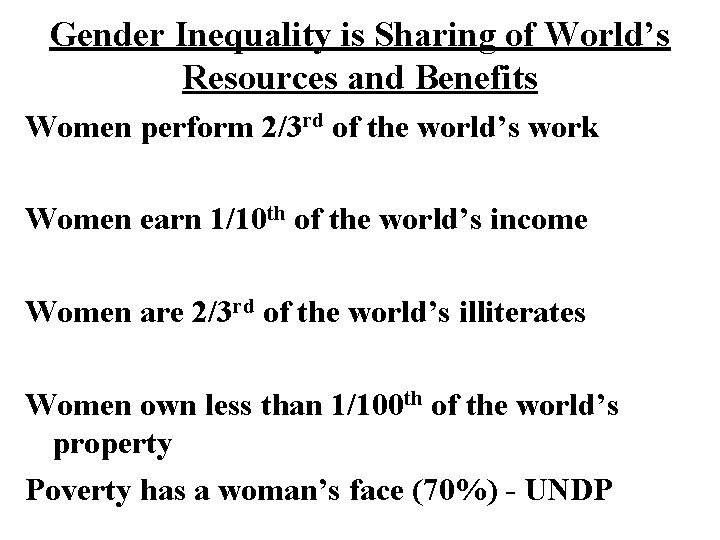
Gender Inequality is Sharing of World’s Resources and Benefits Women perform 2/3 rd of the world’s work Women earn 1/10 th of the world’s income Women are 2/3 rd of the world’s illiterates Women own less than 1/100 th of the world’s property Poverty has a woman’s face (70%) - UNDP
Why is Gender a Development Issue? • Gender difference/inequality – affects participation in the process of development • Impact of development – benefits etc. • Gender roles/responsibilities • Gender division of work/labour • Access to resources/opportunities • Difference in capabilities and skills
Cont’d • Dynamic concept - cuts across race, class, caste and age • Women are not a homogenous group • Gender issues – both women and men - focus is on women as they are the subordinate gender in the context is gender relations
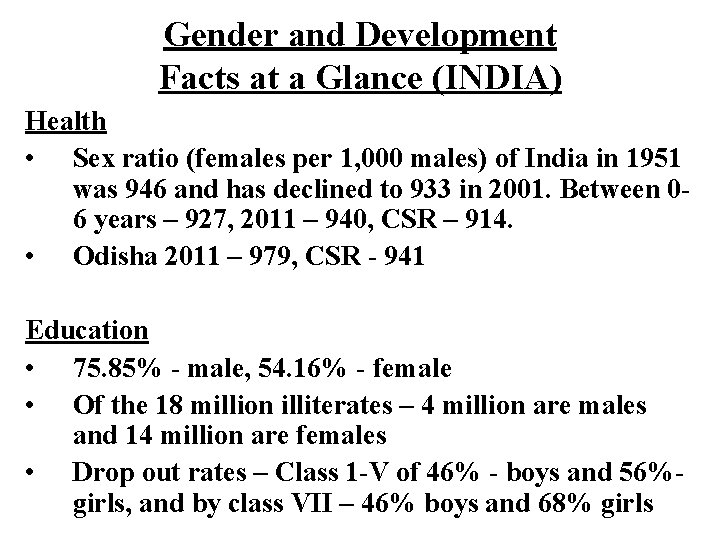
Gender and Development Facts at a Glance (INDIA) Health • Sex ratio (females per 1, 000 males) of India in 1951 was 946 and has declined to 933 in 2001. Between 06 years – 927, 2011 – 940, CSR – 914. • Odisha 2011 – 979, CSR - 941 Education • 75. 85% - male, 54. 16% - female • Of the 18 million illiterates – 4 million are males and 14 million are females • Drop out rates – Class 1 -V of 46% - boys and 56%girls, and by class VII – 46% boys and 68% girls
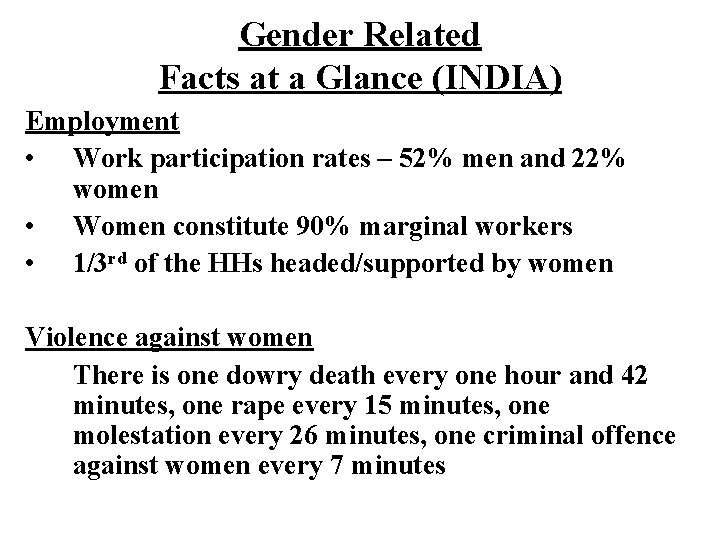
Gender Related Facts at a Glance (INDIA) Employment • Work participation rates – 52% men and 22% women • Women constitute 90% marginal workers • 1/3 rd of the HHs headed/supported by women Violence against women There is one dowry death every one hour and 42 minutes, one rape every 15 minutes, one molestation every 26 minutes, one criminal offence against women every 7 minutes
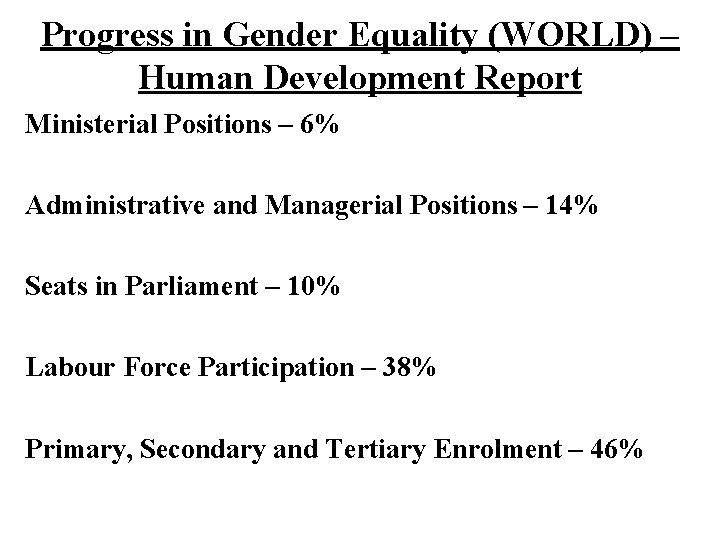
Progress in Gender Equality (WORLD) – Human Development Report Ministerial Positions – 6% Administrative and Managerial Positions – 14% Seats in Parliament – 10% Labour Force Participation – 38% Primary, Secondary and Tertiary Enrolment – 46%
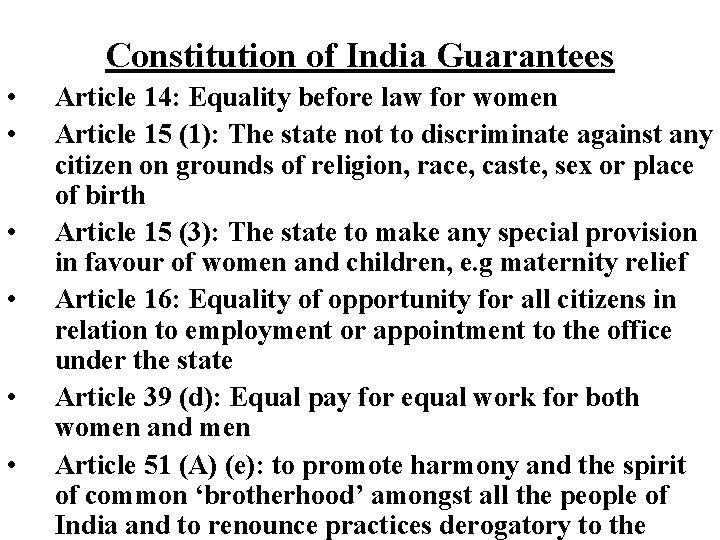
Constitution of India Guarantees • • • Article 14: Equality before law for women Article 15 (1): The state not to discriminate against any citizen on grounds of religion, race, caste, sex or place of birth Article 15 (3): The state to make any special provision in favour of women and children, e. g maternity relief Article 16: Equality of opportunity for all citizens in relation to employment or appointment to the office under the state Article 39 (d): Equal pay for equal work for both women and men Article 51 (A) (e): to promote harmony and the spirit of common ‘brotherhood’ amongst all the people of India and to renounce practices derogatory to the
- Slides: 14