
WHAT IS FORCE A force is a push

- Slides: 34
WHAT IS FORCE? A force is a push or a pull on an object. All forces have strength and direction. The strength of a force is measured in Newtons (N). A force results when two or more objects interact. When the objects stop interacting, there is no more force. • Objects do not have to physically touch each other to exert force on the other. • • Forces & Motion 1 © Stephanie Elkowitz
WHAT IS FORCE? • There are three important characteristics of all forces: 1. All forces have magnitude or strength. 2. All forces have direction. 3. All forces are measured in Newtons (N). Forces & Motion 2 © Stephanie Elkowitz
WHAT IS FORCE? • An object that exerts force repels or attracts other objects. • When we say an object repels another object, it is exerting a pushing force against the object. • When we say an object attracts another object, it is exerting a pulling force on that object Forces & Motion 3 © Stephanie Elkowitz
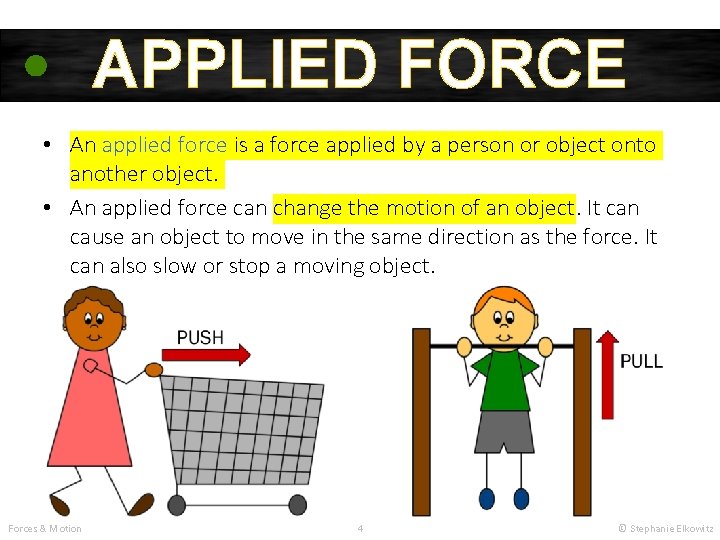
APPLIED FORCE • An applied force is a force applied by a person or object onto another object. • An applied force can change the motion of an object. It can cause an object to move in the same direction as the force. It can also slow or stop a moving object. Forces & Motion 4 © Stephanie Elkowitz
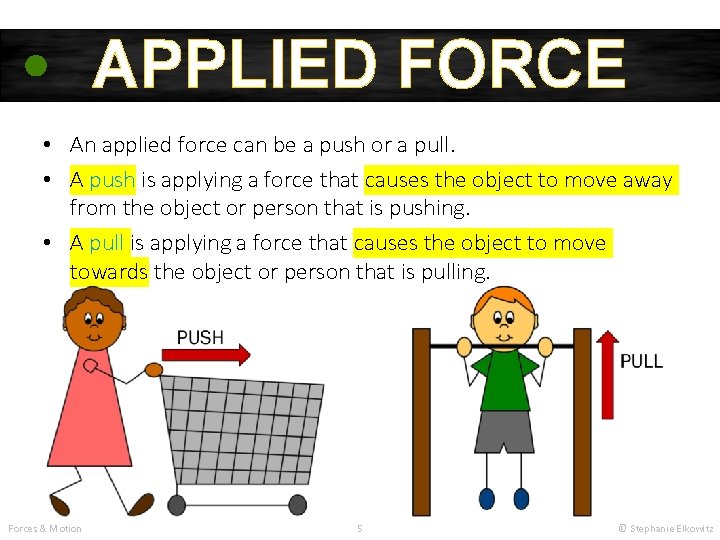
APPLIED FORCE • An applied force can be a push or a pull. • A push is applying a force that causes the object to move away from the object or person that is pushing. • A pull is applying a force that causes the object to move towards the object or person that is pulling. Forces & Motion 5 © Stephanie Elkowitz
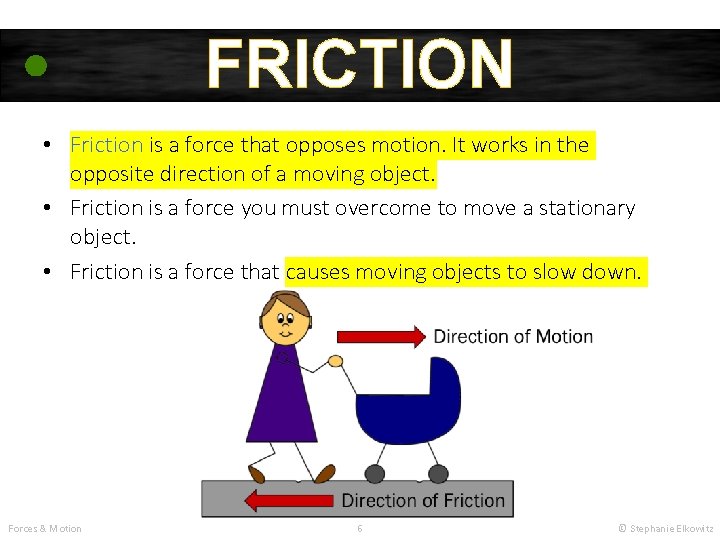
FRICTION • Friction is a force that opposes motion. It works in the opposite direction of a moving object. • Friction is a force you must overcome to move a stationary object. • Friction is a force that causes moving objects to slow down. Forces & Motion 6 © Stephanie Elkowitz
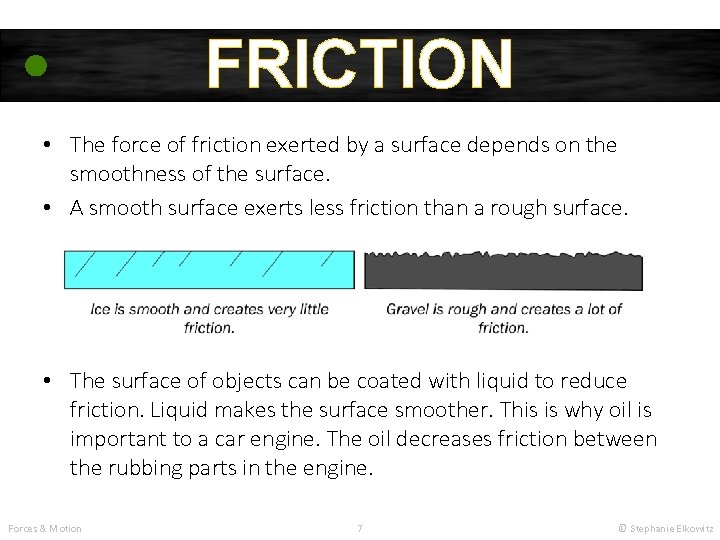
FRICTION • The force of friction exerted by a surface depends on the smoothness of the surface. • A smooth surface exerts less friction than a rough surface. • The surface of objects can be coated with liquid to reduce friction. Liquid makes the surface smoother. This is why oil is important to a car engine. The oil decreases friction between the rubbing parts in the engine. Forces & Motion 7 © Stephanie Elkowitz
NET FORCE • More than one force can act on an object at the same time. • The forces can act in the same or opposite directions. • The combined result of all forces acting on an object is called net force. Forces & Motion 8 © Stephanie Elkowitz
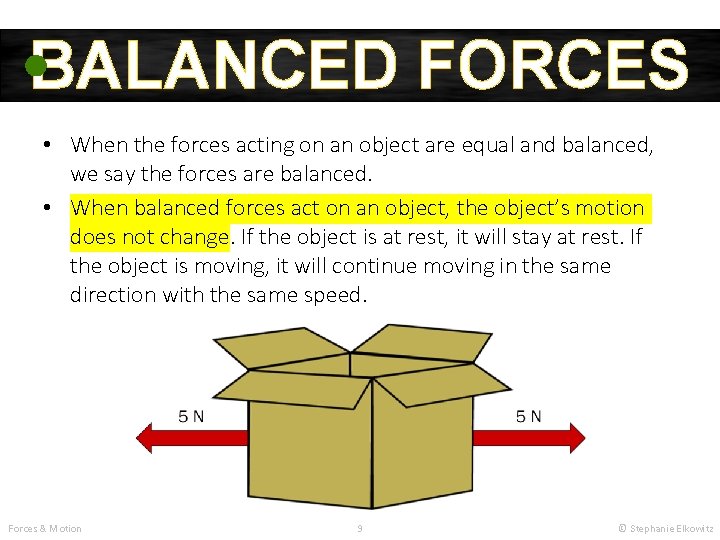
BALANCED FORCES • When the forces acting on an object are equal and balanced, we say the forces are balanced. • When balanced forces act on an object, the object’s motion does not change. If the object is at rest, it will stay at rest. If the object is moving, it will continue moving in the same direction with the same speed. Forces & Motion 9 © Stephanie Elkowitz
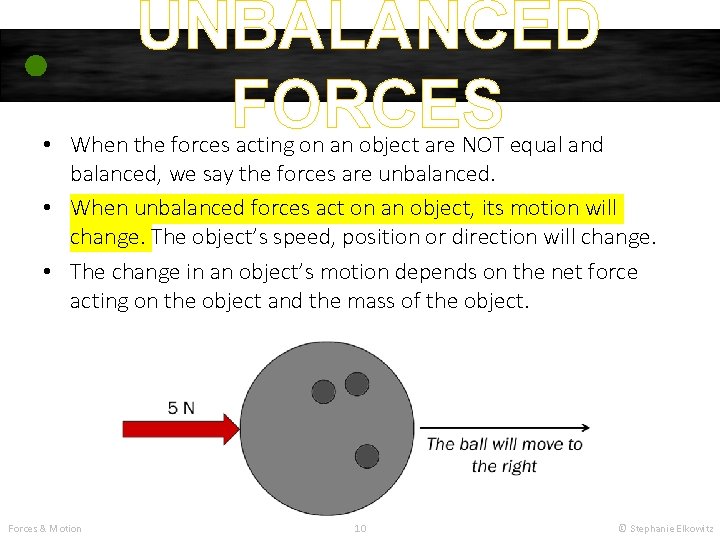
UNBALANCED FORCES • When the forces acting on an object are NOT equal and balanced, we say the forces are unbalanced. • When unbalanced forces act on an object, its motion will change. The object’s speed, position or direction will change. • The change in an object’s motion depends on the net force acting on the object and the mass of the object. Forces & Motion 10 © Stephanie Elkowitz
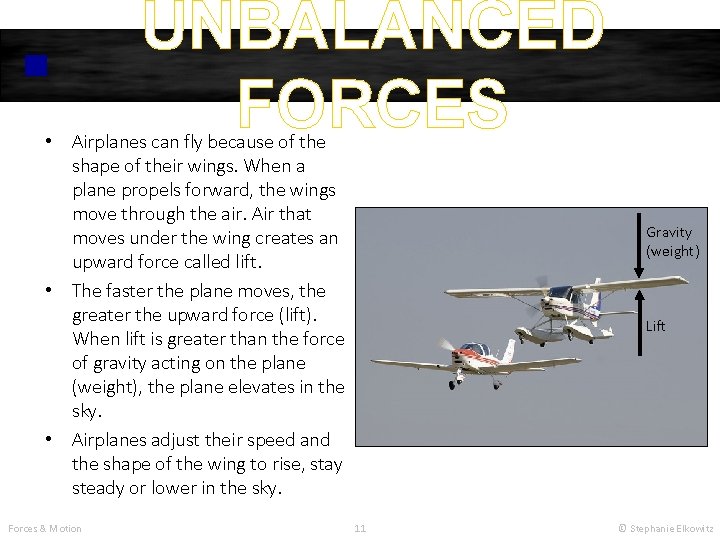
UNBALANCED FORCES • Airplanes can fly because of the shape of their wings. When a plane propels forward, the wings move through the air. Air that moves under the wing creates an upward force called lift. • The faster the plane moves, the greater the upward force (lift). When lift is greater than the force of gravity acting on the plane (weight), the plane elevates in the sky. • Airplanes adjust their speed and the shape of the wing to rise, stay steady or lower in the sky. Forces & Motion Gravity (weight) Lift 11 © Stephanie Elkowitz
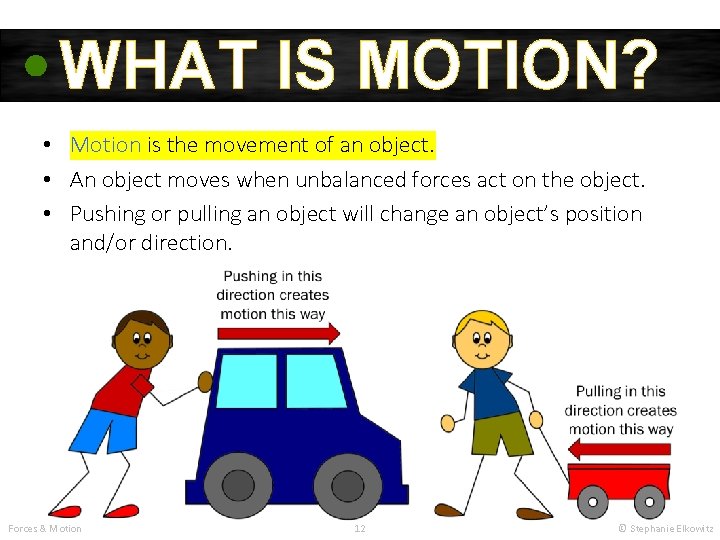
WHAT IS MOTION? • Motion is the movement of an object. • An object moves when unbalanced forces act on the object. • Pushing or pulling an object will change an object’s position and/or direction. Forces & Motion 12 © Stephanie Elkowitz
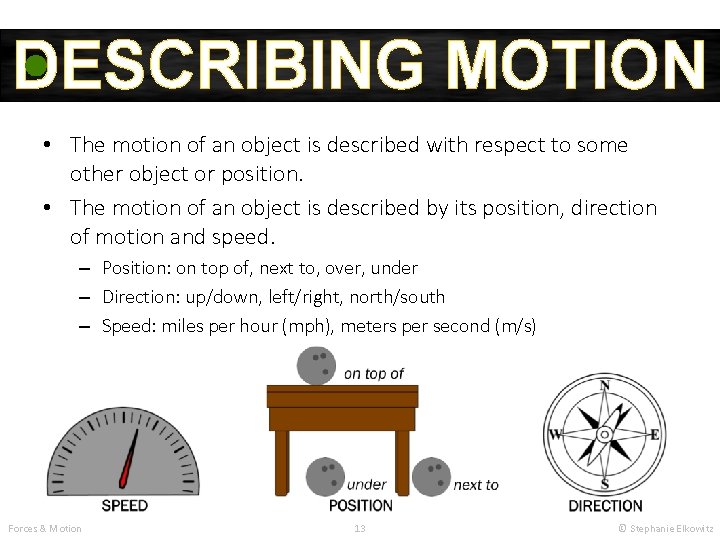
DESCRIBING MOTION • The motion of an object is described with respect to some other object or position. • The motion of an object is described by its position, direction of motion and speed. – Position: on top of, next to, over, under – Direction: up/down, left/right, north/south – Speed: miles per hour (mph), meters per second (m/s) Forces & Motion 13 © Stephanie Elkowitz
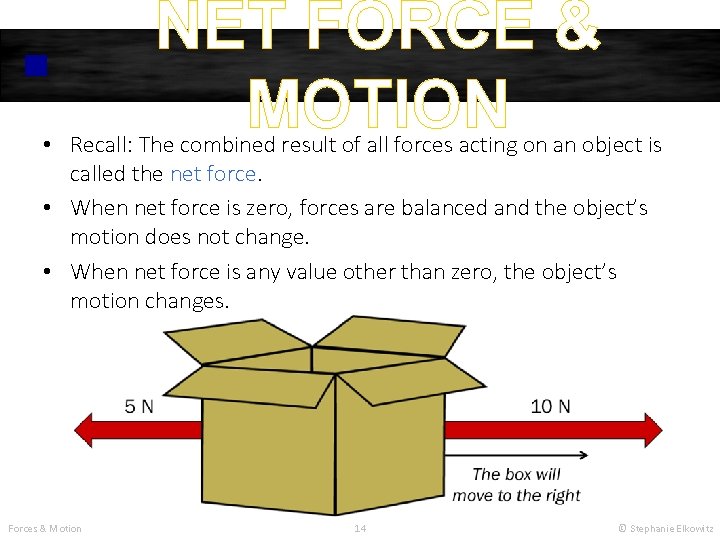
NET FORCE & MOTION • Recall: The combined result of all forces acting on an object is called the net force. • When net force is zero, forces are balanced and the object’s motion does not change. • When net force is any value other than zero, the object’s motion changes. Forces & Motion 14 © Stephanie Elkowitz
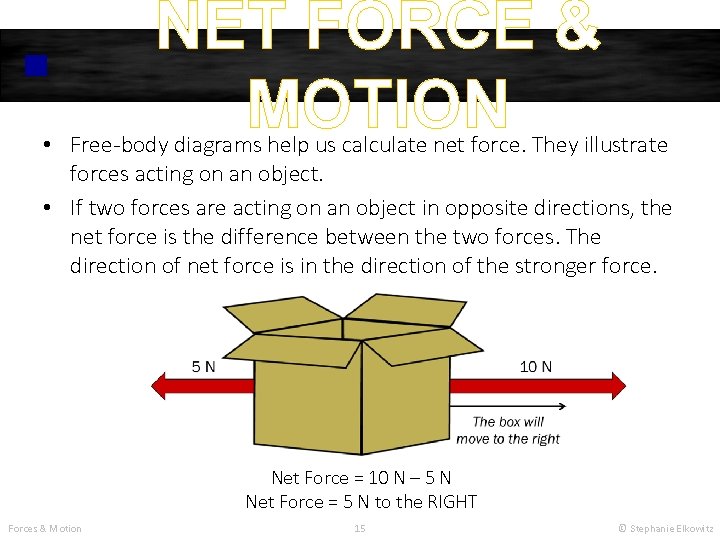
NET FORCE & MOTION • Free-body diagrams help us calculate net force. They illustrate forces acting on an object. • If two forces are acting on an object in opposite directions, the net force is the difference between the two forces. The direction of net force is in the direction of the stronger force. Net Force = 10 N – 5 N Net Force = 5 N to the RIGHT Forces & Motion 15 © Stephanie Elkowitz
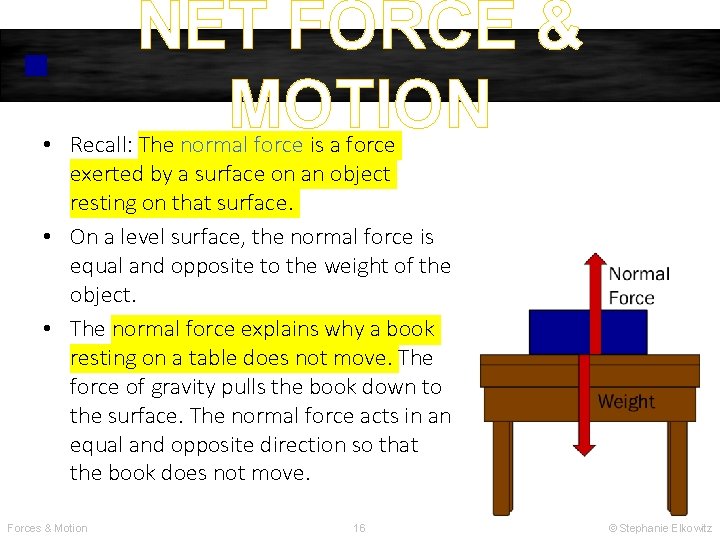
NET FORCE & MOTION • Recall: The normal force is a force exerted by a surface on an object resting on that surface. • On a level surface, the normal force is equal and opposite to the weight of the object. • The normal force explains why a book resting on a table does not move. The force of gravity pulls the book down to the surface. The normal force acts in an equal and opposite direction so that the book does not move. Forces & Motion 16 © Stephanie Elkowitz
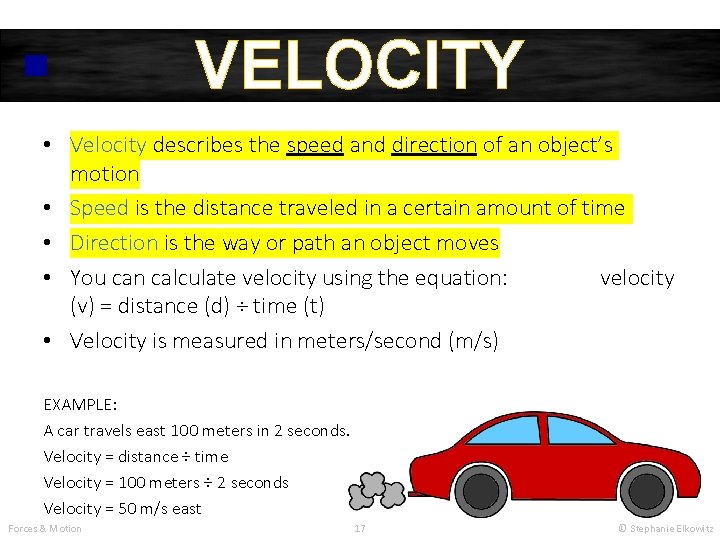
VELOCITY • Velocity describes the speed and direction of an object’s motion • Speed is the distance traveled in a certain amount of time • Direction is the way or path an object moves • You can calculate velocity using the equation: velocity (v) = distance (d) ÷ time (t) • Velocity is measured in meters/second (m/s) EXAMPLE: A car travels east 100 meters in 2 seconds. Velocity = distance ÷ time Velocity = 100 meters ÷ 2 seconds Velocity = 50 m/s east Forces & Motion 17 © Stephanie Elkowitz
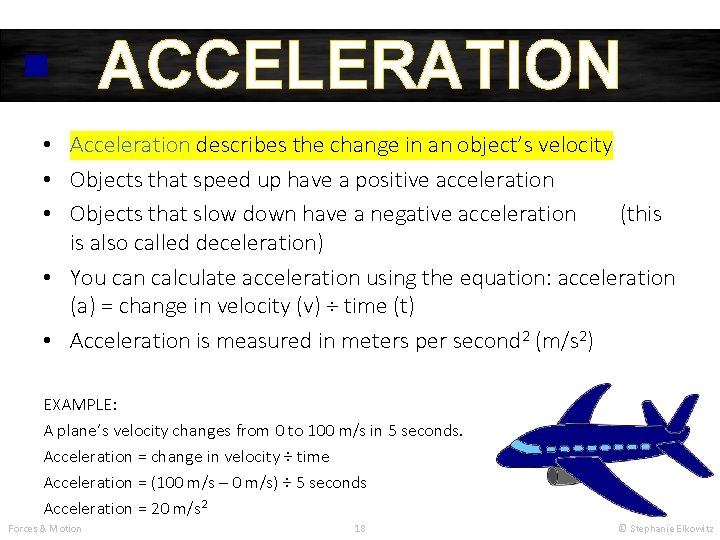
ACCELERATION • Acceleration describes the change in an object’s velocity • Objects that speed up have a positive acceleration • Objects that slow down have a negative acceleration (this is also called deceleration) • You can calculate acceleration using the equation: acceleration (a) = change in velocity (v) ÷ time (t) • Acceleration is measured in meters per second 2 (m/s 2) EXAMPLE: A plane’s velocity changes from 0 to 100 m/s in 5 seconds. Acceleration = change in velocity ÷ time Acceleration = (100 m/s – 0 m/s) ÷ 5 seconds Acceleration = 20 m/s 2 Forces & Motion 18 © Stephanie Elkowitz
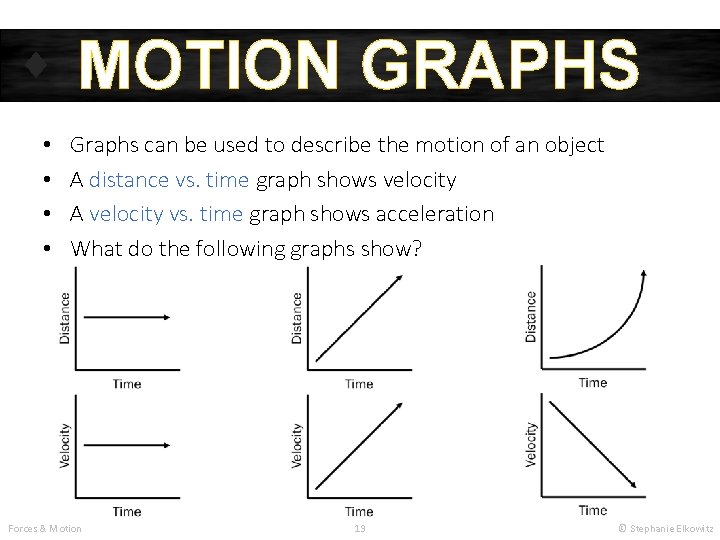
MOTION GRAPHS • • Graphs can be used to describe the motion of an object A distance vs. time graph shows velocity A velocity vs. time graph shows acceleration What do the following graphs show? Forces & Motion 19 © Stephanie Elkowitz
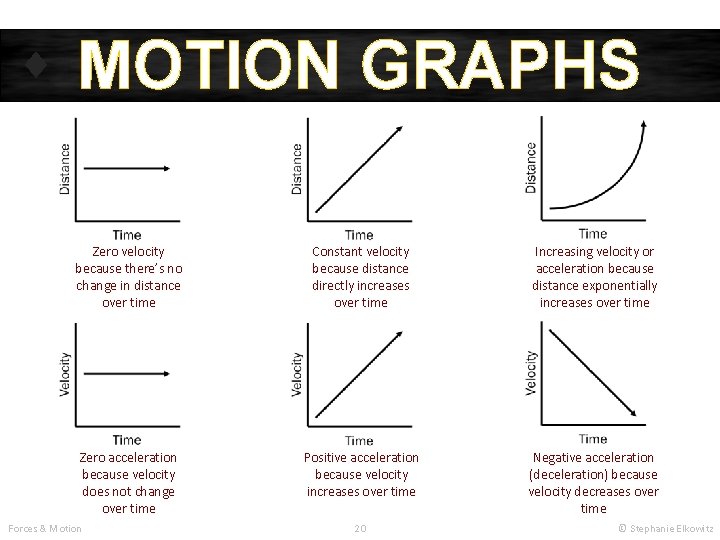
MOTION GRAPHS Zero velocity because there’s no change in distance over time Constant velocity because distance directly increases over time Increasing velocity or acceleration because distance exponentially increases over time Zero acceleration because velocity does not change over time Positive acceleration because velocity increases over time Negative acceleration (deceleration) because velocity decreases over time Forces & Motion 20 © Stephanie Elkowitz
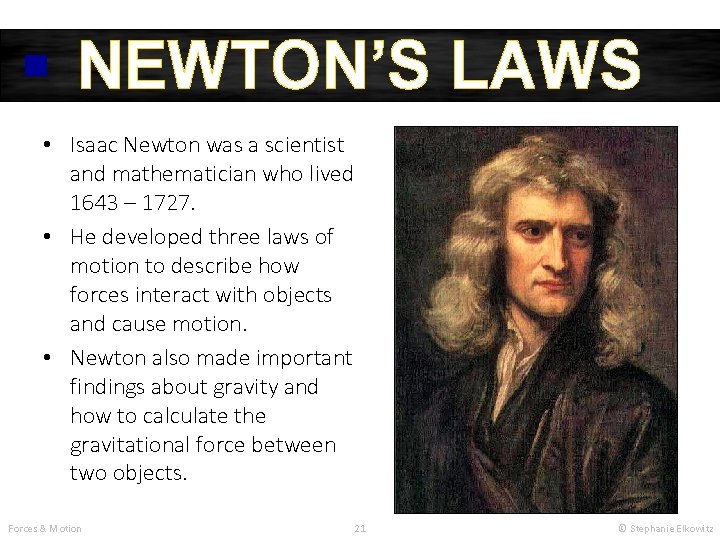
NEWTON’S LAWS • Isaac Newton was a scientist and mathematician who lived 1643 – 1727. • He developed three laws of motion to describe how forces interact with objects and cause motion. • Newton also made important findings about gravity and how to calculate the gravitational force between two objects. Forces & Motion 21 © Stephanie Elkowitz
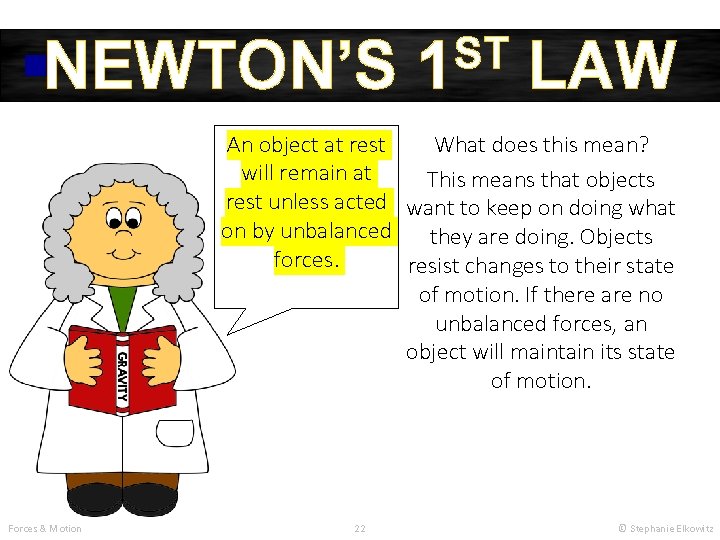
NEWTON’S ST 1 LAW An object at rest What does this mean? will remain at This means that objects rest unless acted want to keep on doing what on by unbalanced they are doing. Objects forces. resist changes to their state of motion. If there are no unbalanced forces, an object will maintain its state of motion. Forces & Motion 22 © Stephanie Elkowitz
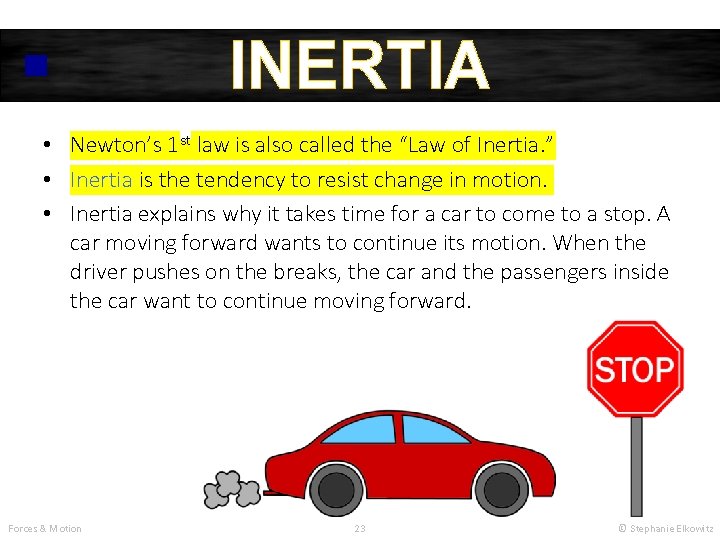
INERTIA • Newton’s 1 st law is also called the “Law of Inertia. ” • Inertia is the tendency to resist change in motion. • Inertia explains why it takes time for a car to come to a stop. A car moving forward wants to continue its motion. When the driver pushes on the breaks, the car and the passengers inside the car want to continue moving forward. Forces & Motion 23 © Stephanie Elkowitz
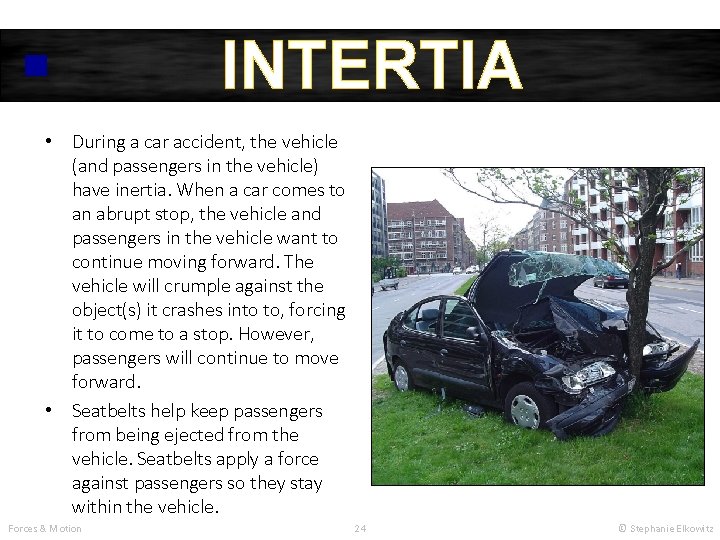
INTERTIA • During a car accident, the vehicle (and passengers in the vehicle) have inertia. When a car comes to an abrupt stop, the vehicle and passengers in the vehicle want to continue moving forward. The vehicle will crumple against the object(s) it crashes into to, forcing it to come to a stop. However, passengers will continue to move forward. • Seatbelts help keep passengers from being ejected from the vehicle. Seatbelts apply a force against passengers so they stay within the vehicle. Forces & Motion 24 © Stephanie Elkowitz
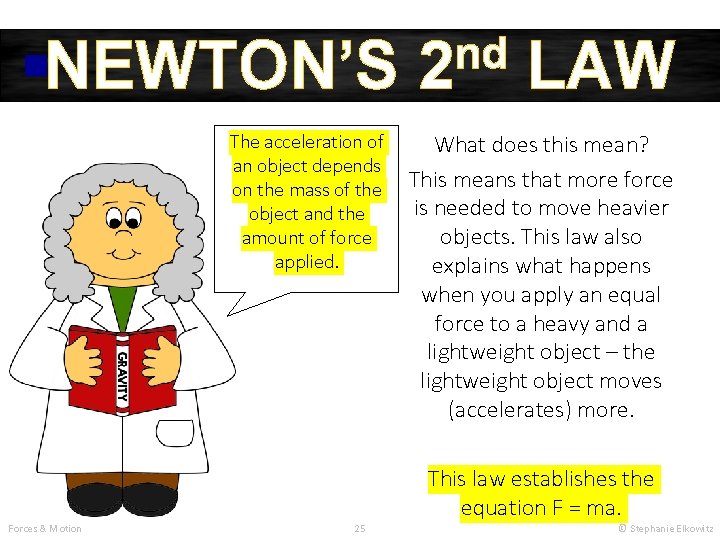
NEWTON’S The acceleration of an object depends on the mass of the object and the amount of force applied. nd 2 LAW What does this mean? This means that more force is needed to move heavier objects. This law also explains what happens when you apply an equal force to a heavy and a lightweight object – the lightweight object moves (accelerates) more. This law establishes the equation F = ma. Forces & Motion 25 © Stephanie Elkowitz
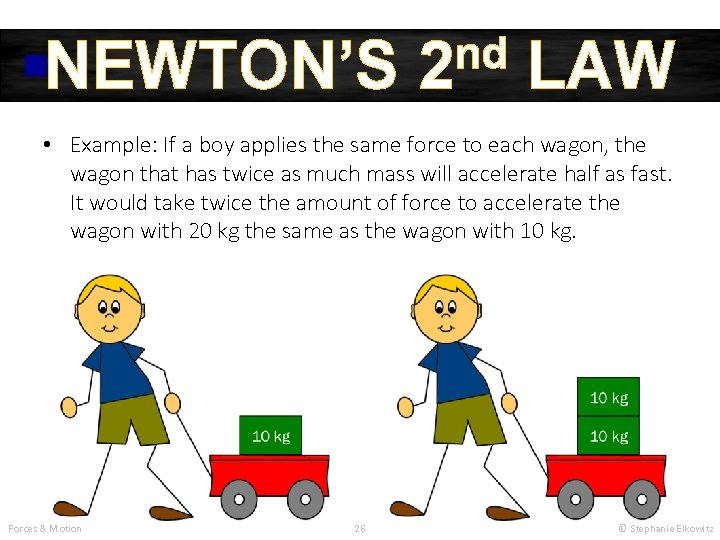
NEWTON’S nd 2 LAW • Example: If a boy applies the same force to each wagon, the wagon that has twice as much mass will accelerate half as fast. It would take twice the amount of force to accelerate the wagon with 20 kg the same as the wagon with 10 kg. Forces & Motion 26 © Stephanie Elkowitz
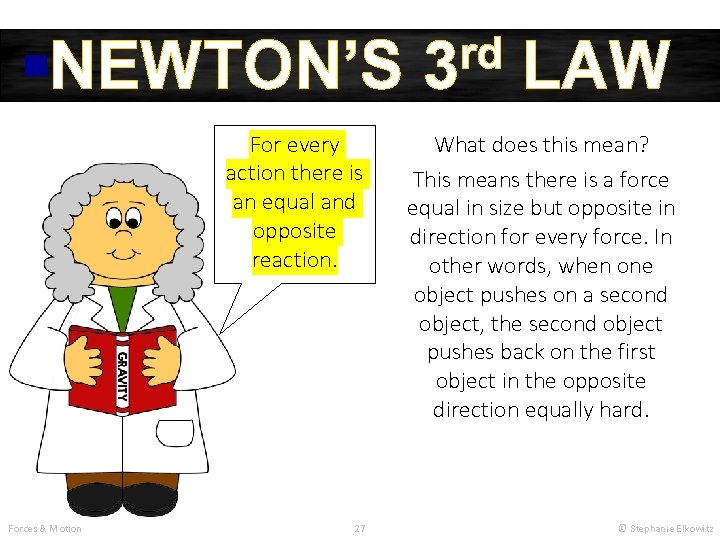
NEWTON’S For every action there is an equal and opposite reaction. Forces & Motion 27 rd 3 LAW What does this mean? This means there is a force equal in size but opposite in direction for every force. In other words, when one object pushes on a second object, the second object pushes back on the first object in the opposite direction equally hard. © Stephanie Elkowitz
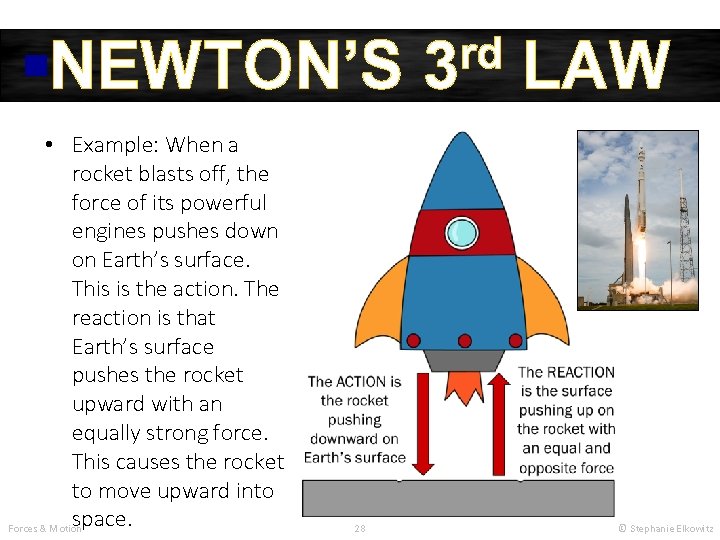
NEWTON’S • Example: When a rocket blasts off, the force of its powerful engines pushes down on Earth’s surface. This is the action. The reaction is that Earth’s surface pushes the rocket upward with an equally strong force. This causes the rocket to move upward into space. Forces & Motion 28 rd 3 LAW © Stephanie Elkowitz
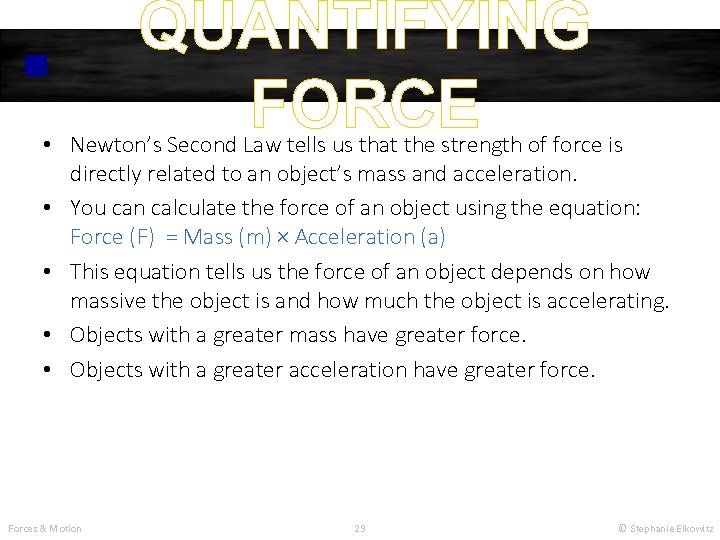
QUANTIFYING FORCE • Newton’s Second Law tells us that the strength of force is directly related to an object’s mass and acceleration. • You can calculate the force of an object using the equation: Force (F) = Mass (m) × Acceleration (a) • This equation tells us the force of an object depends on how massive the object is and how much the object is accelerating. • Objects with a greater mass have greater force. • Objects with a greater acceleration have greater force. Forces & Motion 29 © Stephanie Elkowitz
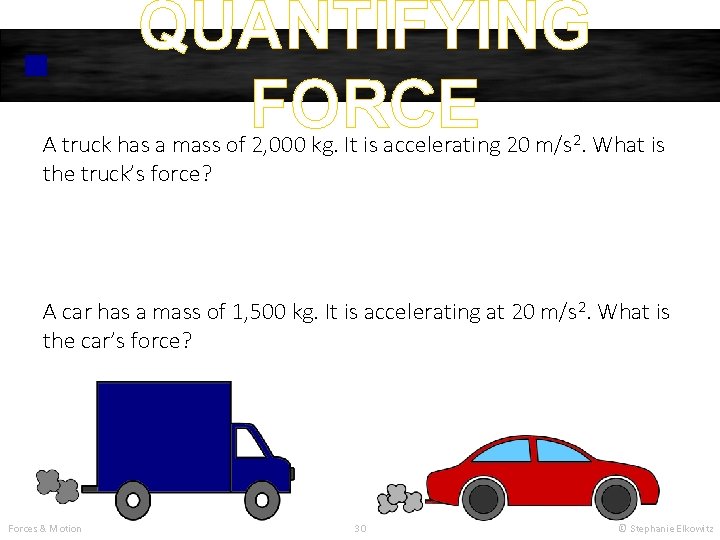
QUANTIFYING FORCE A truck has a mass of 2, 000 kg. It is accelerating 20 m/s 2. What is the truck’s force? A car has a mass of 1, 500 kg. It is accelerating at 20 m/s 2. What is the car’s force? Forces & Motion 30 © Stephanie Elkowitz
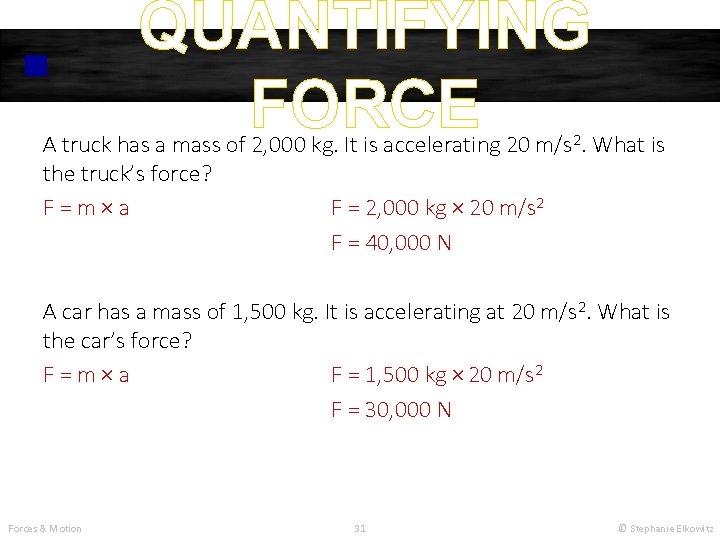
QUANTIFYING FORCE A truck has a mass of 2, 000 kg. It is accelerating 20 m/s 2. What is the truck’s force? F=m×a F = 2, 000 kg × 20 m/s 2 F = 40, 000 N A car has a mass of 1, 500 kg. It is accelerating at 20 m/s 2. What is the car’s force? F=m×a F = 1, 500 kg × 20 m/s 2 F = 30, 000 N Forces & Motion 31 © Stephanie Elkowitz
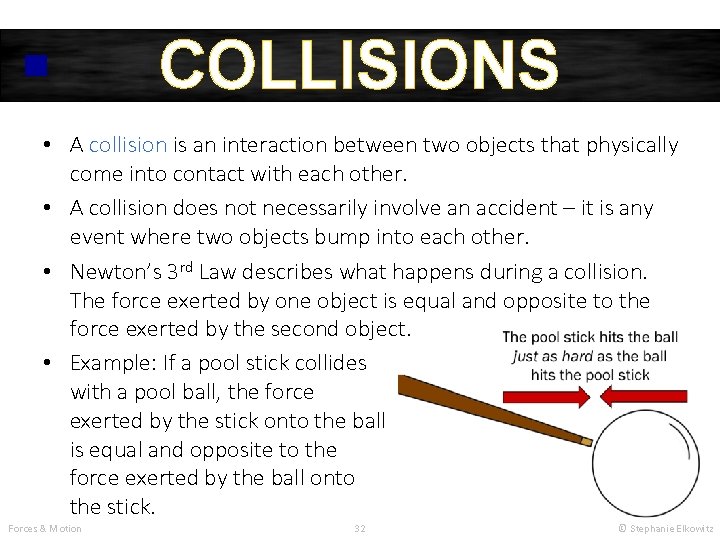
COLLISIONS • A collision is an interaction between two objects that physically come into contact with each other. • A collision does not necessarily involve an accident – it is any event where two objects bump into each other. • Newton’s 3 rd Law describes what happens during a collision. The force exerted by one object is equal and opposite to the force exerted by the second object. • Example: If a pool stick collides with a pool ball, the force exerted by the stick onto the ball is equal and opposite to the force exerted by the ball onto the stick. Forces & Motion 32 © Stephanie Elkowitz
COLLISIONS • Momentum is conserved during a collision. This means the total momentum of the two objects before the collision equals the total momentum of the two objects after the collision. • If the mass of each object stays the same, the velocity of the objects must change. This explains why the speed and/or direction of movement changes for one or both objects during a collision. Forces & Motion 33 Remember. . . The momentum of an object depends on mass and velocity. © Stephanie Elkowitz
PHOTO CREDITS • Images obtained from commons. wikimedia. org and the Public Domain • Clipart by: – Stephanie Elkowitz – www. mycutegraphics. com – www. mysweetclipart. com Atoms & Reactions 34 © Stephanie Elkowitz