
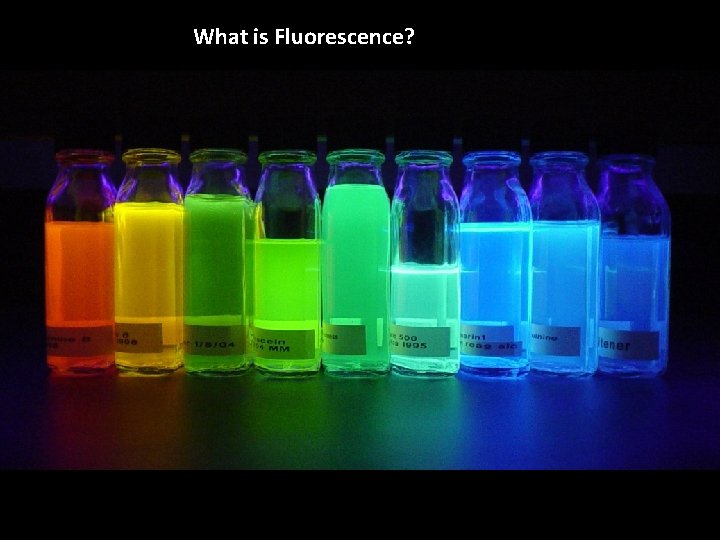
What is Fluorescence What is Fluorescence A type
- Slides: 9
What is Fluorescence?
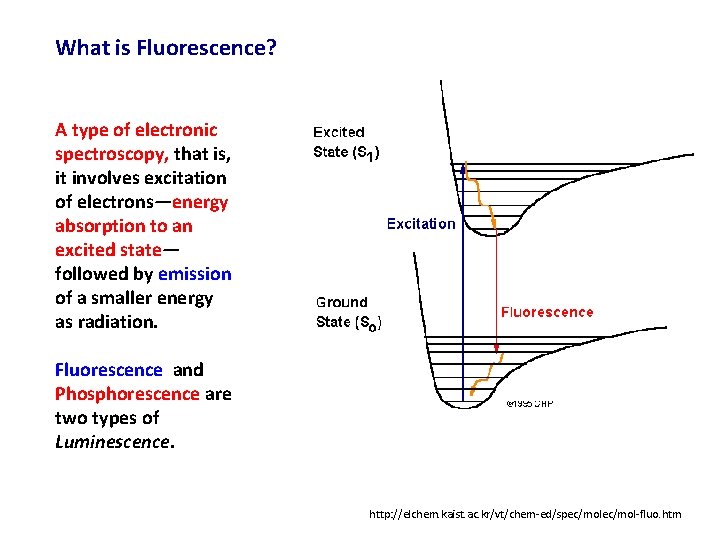
What is Fluorescence? A type of electronic spectroscopy, that is, it involves excitation of electrons—energy absorption to an excited state— followed by emission of a smaller energy as radiation. Fluorescence and Phosphorescence are two types of Luminescence. http: //elchem. kaist. ac. kr/vt/chem-ed/spec/mol-fluo. htm
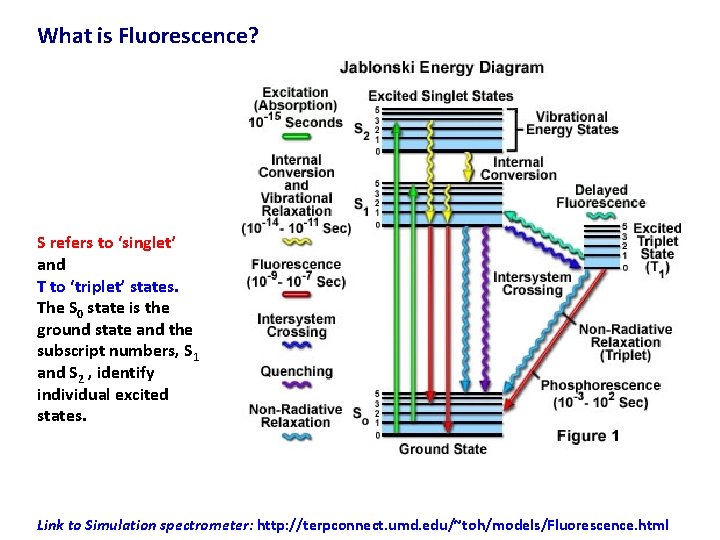
What is Fluorescence? S refers to ‘singlet’ and T to ‘triplet’ states. The S 0 state is the ground state and the subscript numbers, S 1 and S 2 , identify individual excited states. Link to Simulation spectrometer: http: //terpconnect. umd. edu/~toh/models/Fluorescence. html
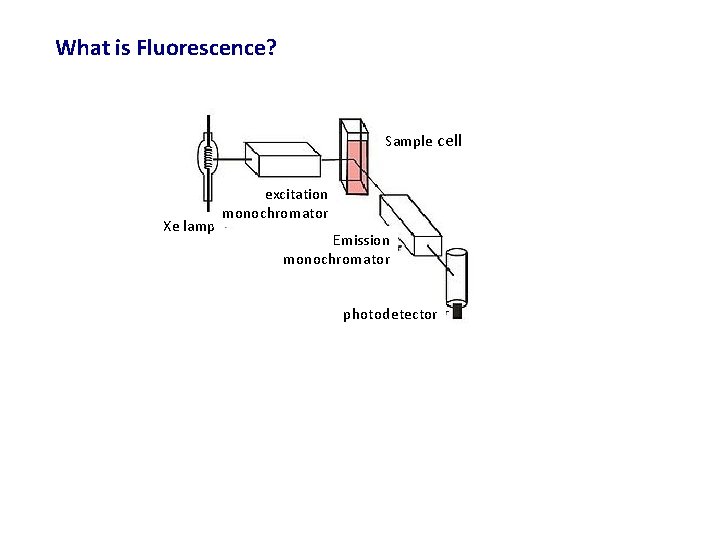
What is Fluorescence? Sample cell Xe lamp excitation monochromator Emission monochromator photodetector
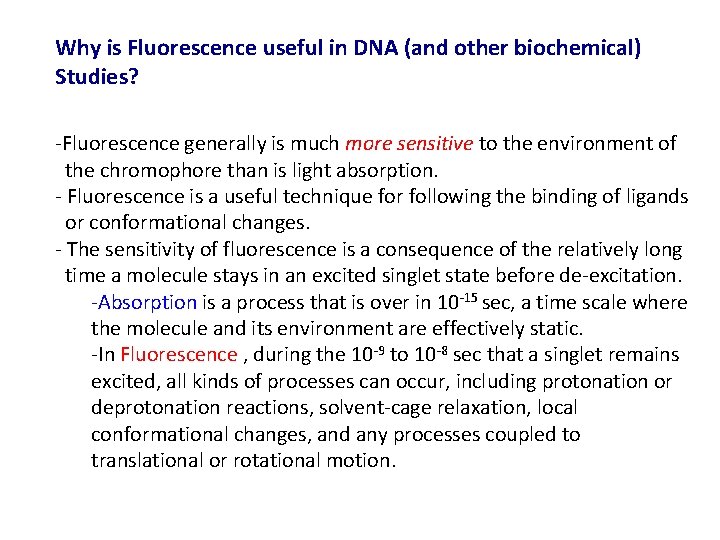
Why is Fluorescence useful in DNA (and other biochemical) Studies? -Fluorescence generally is much more sensitive to the environment of the chromophore than is light absorption. - Fluorescence is a useful technique for following the binding of ligands or conformational changes. - The sensitivity of fluorescence is a consequence of the relatively long time a molecule stays in an excited singlet state before de-excitation. -Absorption is a process that is over in 10 -15 sec, a time scale where the molecule and its environment are effectively static. -In Fluorescence , during the 10 -9 to 10 -8 sec that a singlet remains excited, all kinds of processes can occur, including protonation or deprotonation reactions, solvent-cage relaxation, local conformational changes, and any processes coupled to translational or rotational motion.
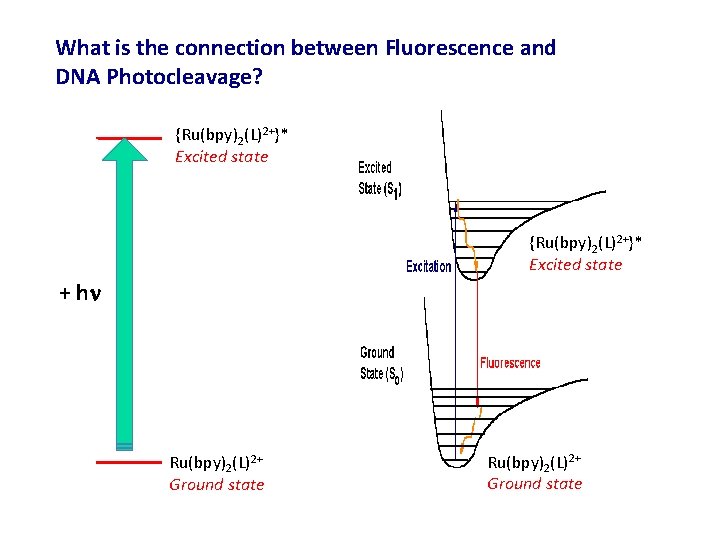
What is the connection between Fluorescence and DNA Photocleavage? {Ru(bpy)2(L)2+}* Excited state + hn Ru(bpy)2(L)2+ Ground state
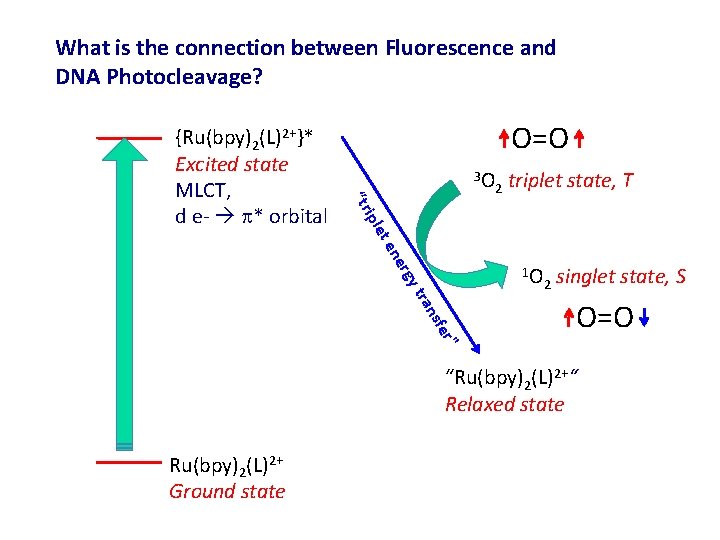
What is the connection between Fluorescence and DNA Photocleavage? O=O 3 O 2 triplet state, T e en et ipl “tr {Ru(bpy)2(L)2+}* Excited state MLCT, d e- p* orbital rgy 1 O nsf tra 2 singlet state, S er" O=O “Ru(bpy)2(L)2+“ Relaxed state Ru(bpy)2(L)2+ Ground state
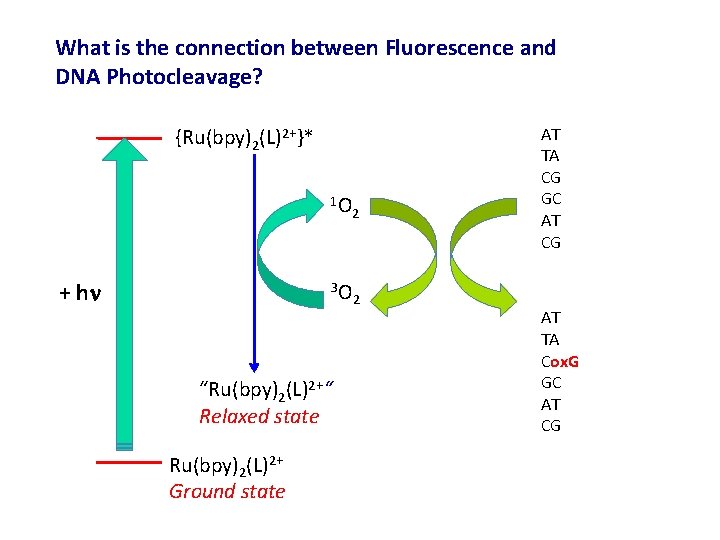
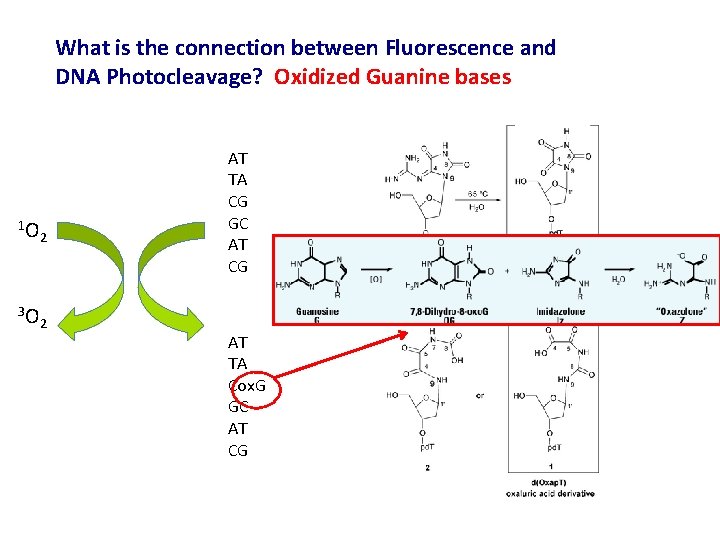
What is the connection between Fluorescence and DNA Photocleavage? {Ru(bpy)2(L)2+}* 1 O + hn 2 3 O “Ru(bpy)2(L)2+“ Relaxed state Ru(bpy)2(L)2+ Ground state 2 AT TA CG GC AT CG AT TA Cox. G GC AT CG
What is the connection between Fluorescence and DNA Photocleavage? Oxidized Guanine bases 1 O 2 3 O 2 AT TA CG GC AT CG AT TA Cox. G GC AT CG