
What is fast food doing to your body
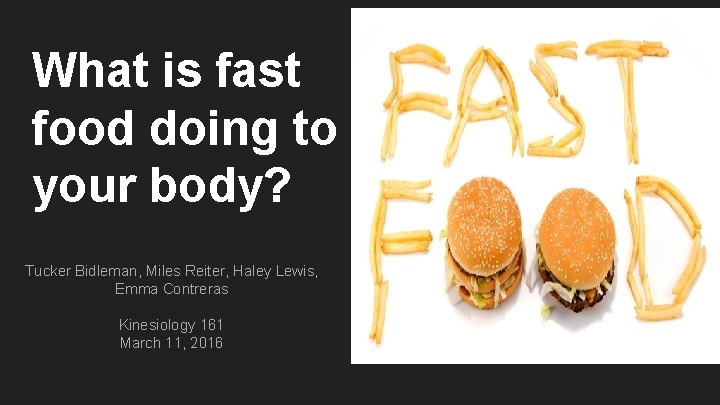
What is fast food doing to your body? Tucker Bidleman, Miles Reiter, Haley Lewis, Emma Contreras Kinesiology 161 March 11, 2016
What is fast food? Fast food is a type of food that is prepared and served very quickly, first popularized in the 1950 s in the United States. While any meal with low preparation time can be considered fast food, typically the term refers to food sold in a restaurant or store with preheated or precooked in redients, and served to the customer in a packaged form for take-out/take-away. Fast food restaurants are traditionally distinguished by their ability to serve food via a drive-through. The term "fast food" was recognized in a dictionary by Merriam–Webster in 1951. (Wikipedia) Though traditionally thought of as burgers and fries, American fast food is quite varied. Top 10 most successful fast food chains in America according to Business Insider for 2014: 1. Mc. Donald’s 2. Starbucks 3. Subway 4. Burger King 5. Wendy’s 6. Taco Bell 7. Dunkin’ Donuts 8. Chick-fil-A 9. Pizza Hut 10. Panera Bread
What does food do for us? Fats Provide Insulation, protection and energy Assist in digestion, absorption and transport of Vitamins A, D, E and K. Sugars n’ Salt Provides instant energy to muscles and the brain. Sugar like Glucose is important, it’s the main source of energy for our body Regulate leptin (Hunger hormone) 25 -35 g of Sugar is recommended 20 g Saturated Fats is recommended (meat, butter, milk) 80 g of Unsaturated Fats is recommended (fish, wheat, eggs, vegetable oils) Salt helps maintain proper nerve and muscle function by regulating electrical activity 6 g of Salt is recommended

Sugar n’ Salt in Fast Food Processed foods contains large amount of sugars, forcing the body to look elsewhere for nutrients Sugars create momentary rises and then significant falls in energy and craving more food. Sugar is added to improve taste High levels of salt in fast food can affect blood pressure A single Big Mac uses 2 g of Sodium and 9 g of Sugar (⅓ of recommended values)

Fats in Fast Food Many fast food items are rich in trans fats, especially fried foods and baked goods (pizza dough, crackers, french fries, etc. ). This is the worst type of fat we can consume from a health perspective. Trans fats raise bad (LDL) cholesterol and lower good (HDL) cholesterol, and also increases the risk of heart disease, diabetes, and stroke. Trans fats (also known as “partially hydrogenated oils”) are created in an industrial process which adds hydrogen to vegetable oils to make them more solid. It is cheap, long lasting, and gives food a desirable flavor/texture. They should be completely avoided if possible. Traditional fast food items such as cheeseburgers are also very high in saturated fats. 1 Double Whopper from Burger King contains 33 grams of saturated fats. The American Heart Association Recommends eating no more than 13 grams of saturated fat per day. Saturated fats are typically solid at room temperature, and like trans fats, increase your LDL cholesterol which increases the risk for heart disease and stroke.
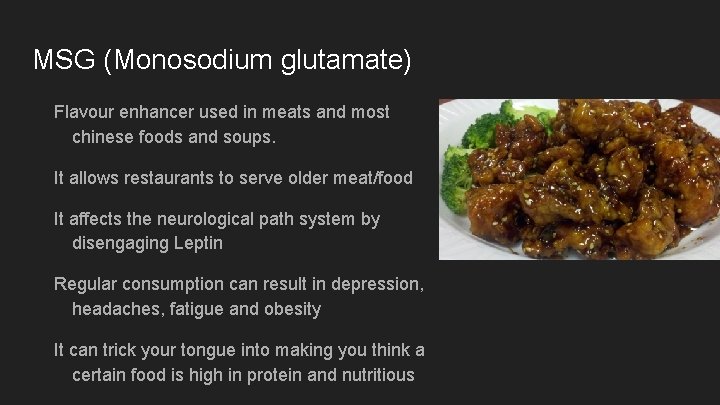
MSG (Monosodium glutamate) Flavour enhancer used in meats and most chinese foods and soups. It allows restaurants to serve older meat/food It affects the neurological path system by disengaging Leptin Regular consumption can result in depression, headaches, fatigue and obesity It can trick your tongue into making you think a certain food is high in protein and nutritious
Why do we like Fast food? Fast food’s combination of fats, sugars and salts targets the brain’s reward centre The orosensation and mouth-watering taste; both of which leave you craving more of the same guilty fast food pleasure. It’s very cheap and convenient. You can get a full meal for under $5 in less than five minutes. 28% of Americans can’t cook.
Health Issues http: //www. healthline. com/health/fast-food-effects-on-body • Americans get about 12% of their daily calories from fast food • Percent of adults age 20 years and over who are obese: 34% (2011 -2012) • Percent of adults age 20 years and over who are overweight, including obesity: 69% (2011 -2012) (source: CDC) Being overweight not associated with significantly increased health risk -Being obese (esp. BMI <40) doubles mortality
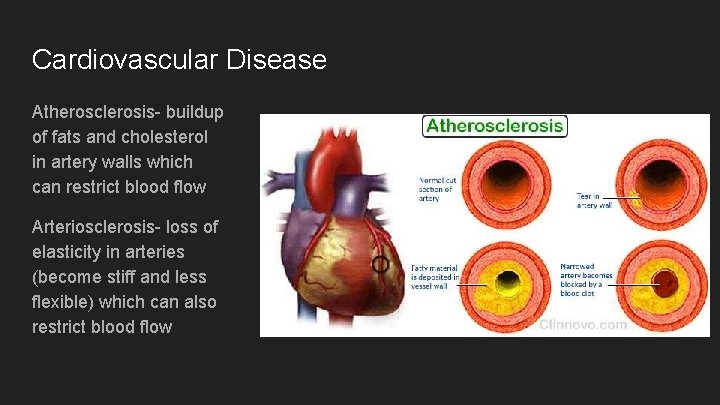
Cardiovascular Disease Atherosclerosis- buildup of fats and cholesterol in artery walls which can restrict blood flow Arteriosclerosis- loss of elasticity in arteries (become stiff and less flexible) which can also restrict blood flow  
Worst Restaurants Sonic 50 % of Sonic menu items have at least 1 gram of saturated fat. 10 of their burgers have more than 1, 100 calories. Jack-in-the-Box Although their food isn’t as high in calories as other restaurants, their saturated fat and sodium levels are just as high as other places. Carl’s Jr. Burgers are high in calories and contain insane amounts of saturated fat. Nearly a whole day’s worth of sodium. Best Restaurants Panera Delicious and healthy menu options. Food is made to order. Chipotle If you keep out the unhealthy options such as sour cream and a side of chips. Chipotle can be a great option. Subway Load up on the veggies, stay away from the sauces, and make smart choices when it comes to your bread and meats.
- Slides: 10