
What is Evidence Evidence concerns facts intended for
- Slides: 51
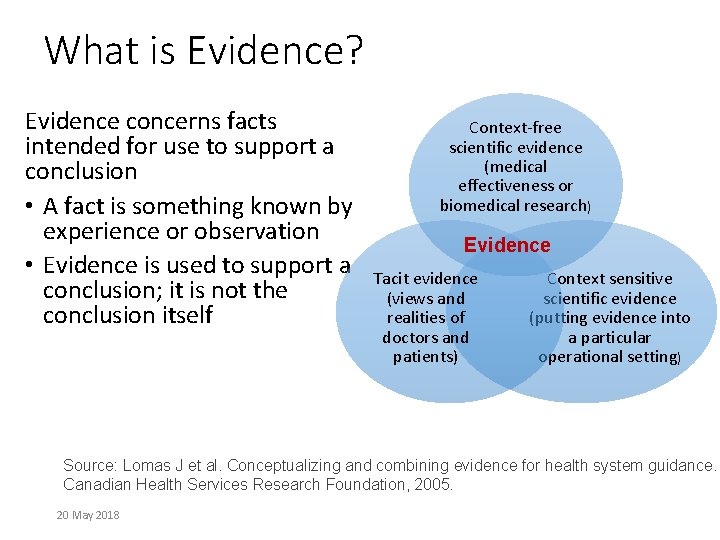
What is Evidence? Evidence concerns facts intended for use to support a conclusion • A fact is something known by experience or observation • Evidence is used to support a conclusion; it is not the conclusion itself Context-free scientific evidence (medical effectiveness or biomedical research) Evidence Tacit evidence (views and realities of doctors and patients) Context sensitive scientific evidence (putting evidence into a particular operational setting) Source: Lomas J et al. Conceptualizing and combining evidence for health system guidance. Canadian Health Services Research Foundation, 2005. 20 May 2018
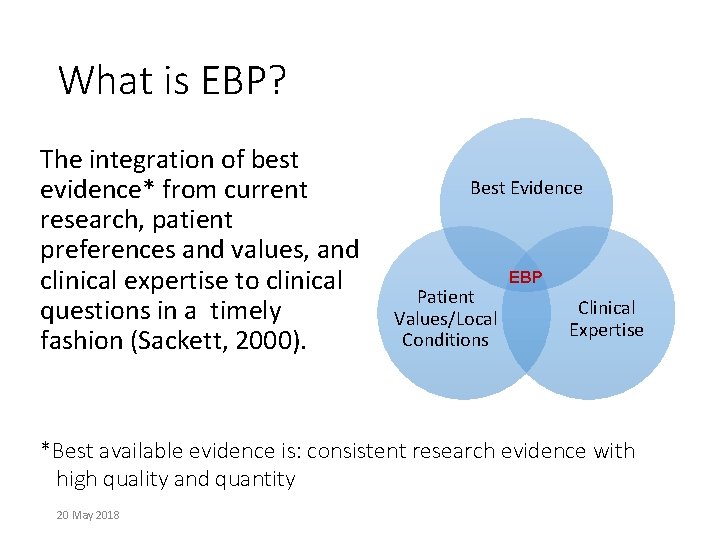
What is EBP? The integration of best evidence* from current research, patient preferences and values, and clinical expertise to clinical questions in a timely fashion (Sackett, 2000). Best Evidence Patient Values/Local Conditions EBP Clinical Expertise *Best available evidence is: consistent research evidence with high quality and quantity 20 May 2018
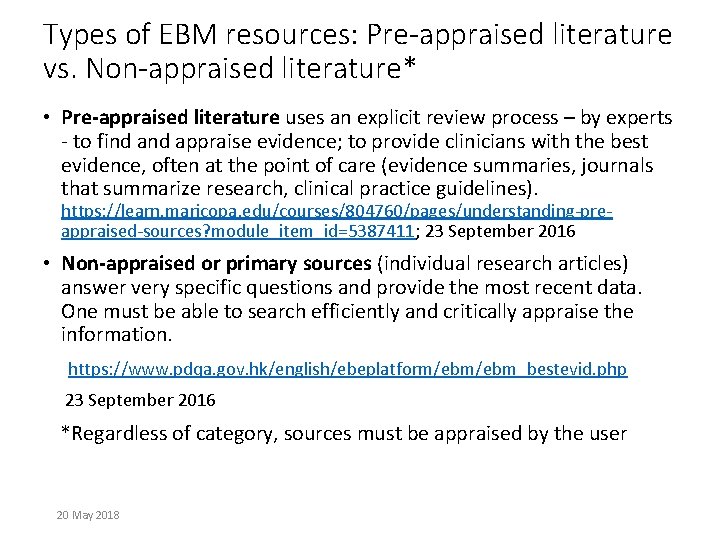
Types of EBM resources: Pre-appraised literature vs. Non-appraised literature* • Pre-appraised literature uses an explicit review process – by experts - to find appraise evidence; to provide clinicians with the best evidence, often at the point of care (evidence summaries, journals that summarize research, clinical practice guidelines). https: //learn. maricopa. edu/courses/804760/pages/understanding-preappraised-sources? module_item_id=5387411; 23 September 2016 • Non-appraised or primary sources (individual research articles) answer very specific questions and provide the most recent data. One must be able to search efficiently and critically appraise the information. https: //www. pdqa. gov. hk/english/ebeplatform/ebm_bestevid. php 23 September 2016 *Regardless of category, sources must be appraised by the user 20 May 2018
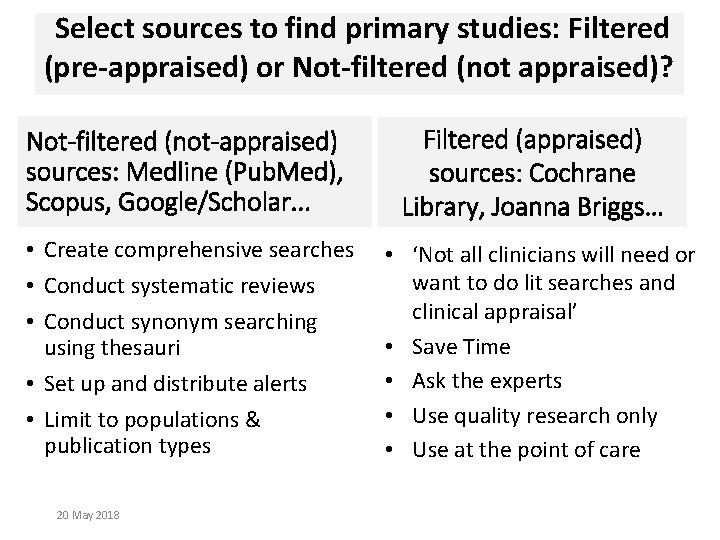
Select sources to find primary studies: Filtered (pre-appraised) or Not-filtered (not appraised)? Not-filtered (not-appraised) sources: Medline (Pub. Med), Scopus, Google/Scholar. . . • Create comprehensive searches • Conduct systematic reviews • Conduct synonym searching using thesauri • Set up and distribute alerts • Limit to populations & publication types 20 May 2018 Filtered (appraised) sources: Cochrane Library, Joanna Briggs… • ‘Not all clinicians will need or want to do lit searches and clinical appraisal’ • Save Time • Ask the experts • Use quality research only • Use at the point of care
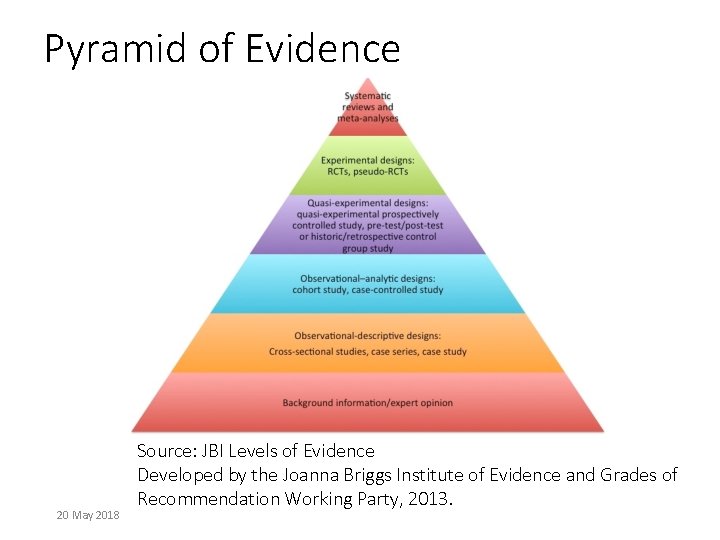
Pyramid of Evidence 20 May 2018 Source: JBI Levels of Evidence Developed by the Joanna Briggs Institute of Evidence and Grades of Recommendation Working Party, 2013.
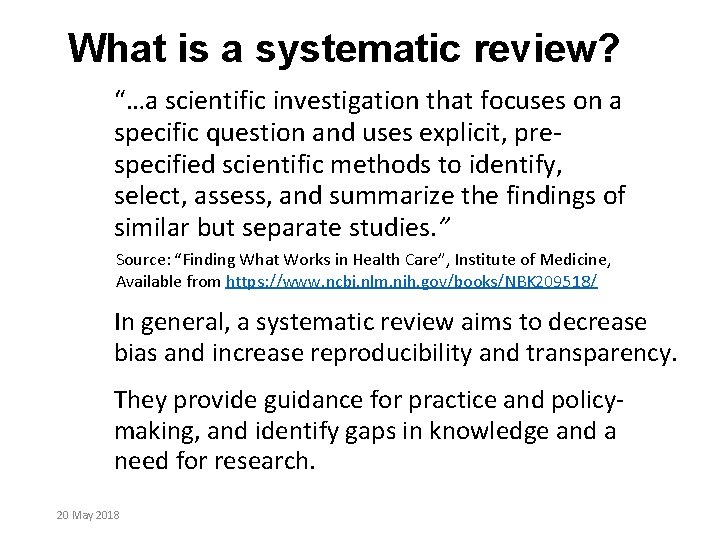
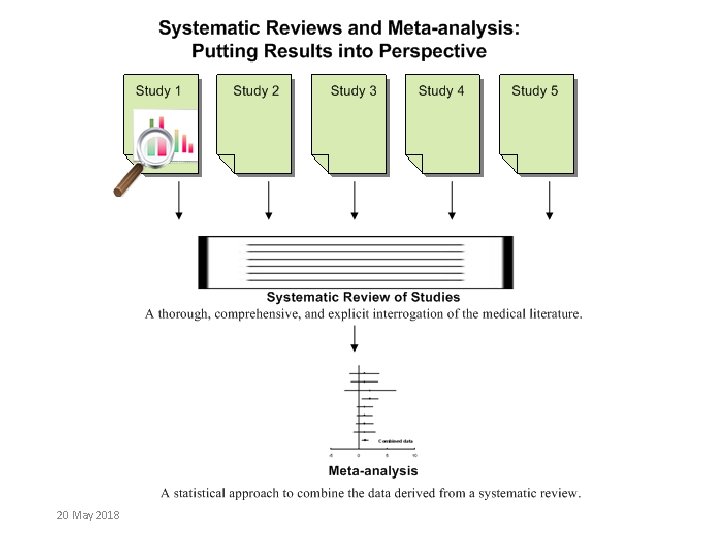
What is a systematic review? “…a scientific investigation that focuses on a specific question and uses explicit, prespecified scientific methods to identify, select, assess, and summarize the findings of similar but separate studies. ” Source: “Finding What Works in Health Care”, Institute of Medicine, Available from https: //www. ncbi. nlm. nih. gov/books/NBK 209518/ In general, a systematic review aims to decrease bias and increase reproducibility and transparency. They provide guidance for practice and policymaking, and identify gaps in knowledge and a need for research. 20 May 2018
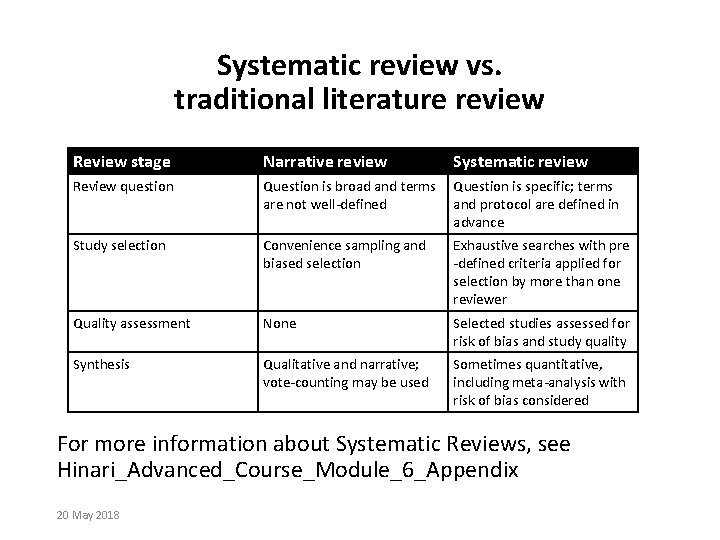
Systematic review vs. traditional literature review Review stage Narrative review Systematic review Review question Question is broad and terms are not well-defined Question is specific; terms and protocol are defined in advance Study selection Convenience sampling and biased selection Exhaustive searches with pre -defined criteria applied for selection by more than one reviewer Quality assessment None Selected studies assessed for risk of bias and study quality Synthesis Qualitative and narrative; vote-counting may be used Sometimes quantitative, including meta-analysis with risk of bias considered For more information about Systematic Reviews, see Hinari_Advanced_Course_Module_6_Appendix 20 May 2018
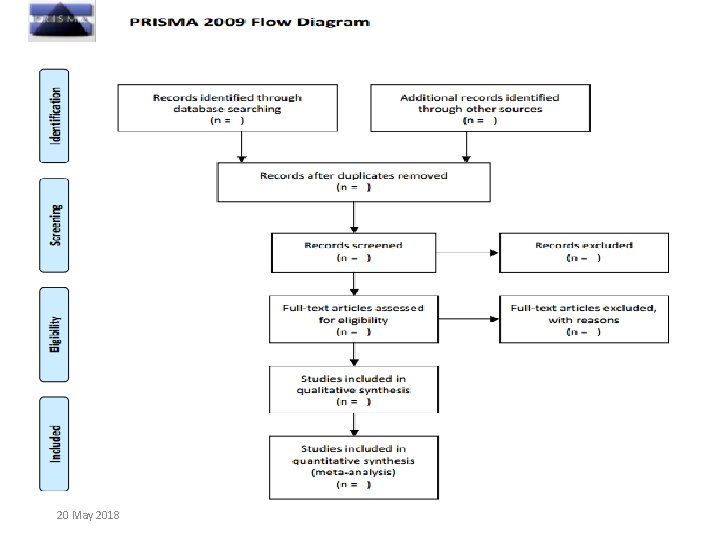
20 May 2018
20 May 2018
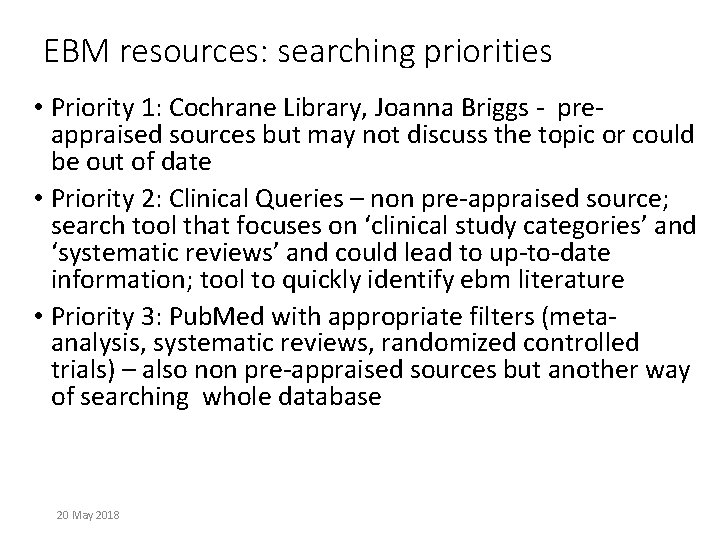
EBM resources: searching priorities • Priority 1: Cochrane Library, Joanna Briggs - preappraised sources but may not discuss the topic or could be out of date • Priority 2: Clinical Queries – non pre-appraised source; search tool that focuses on ‘clinical study categories’ and ‘systematic reviews’ and could lead to up-to-date information; tool to quickly identify ebm literature • Priority 3: Pub. Med with appropriate filters (metaanalysis, systematic reviews, randomized controlled trials) – also non pre-appraised sources but another way of searching whole database 20 May 2018
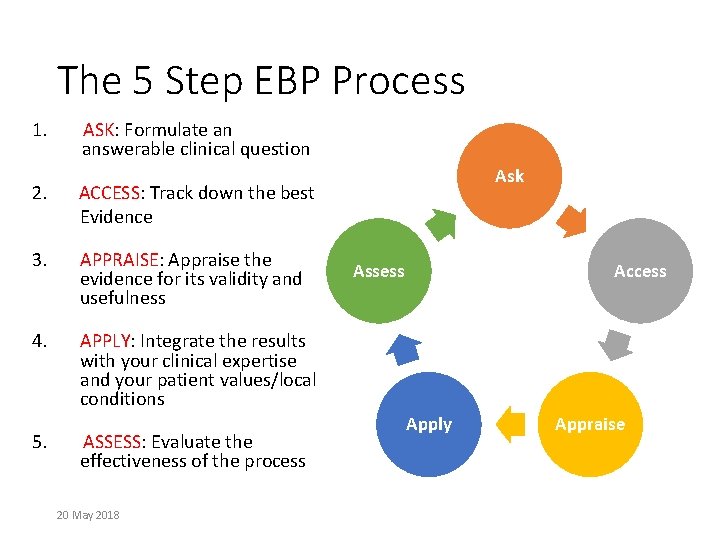
The 5 Step EBP Process 1. ASK: Formulate an answerable clinical question 2. ACCESS: Track down the best Evidence 3. APPRAISE: Appraise the evidence for its validity and usefulness 4. APPLY: Integrate the results with your clinical expertise and your patient values/local conditions 5. ASSESS: Evaluate the effectiveness of the process 20 May 2018 Ask Assess Access Apply Appraise
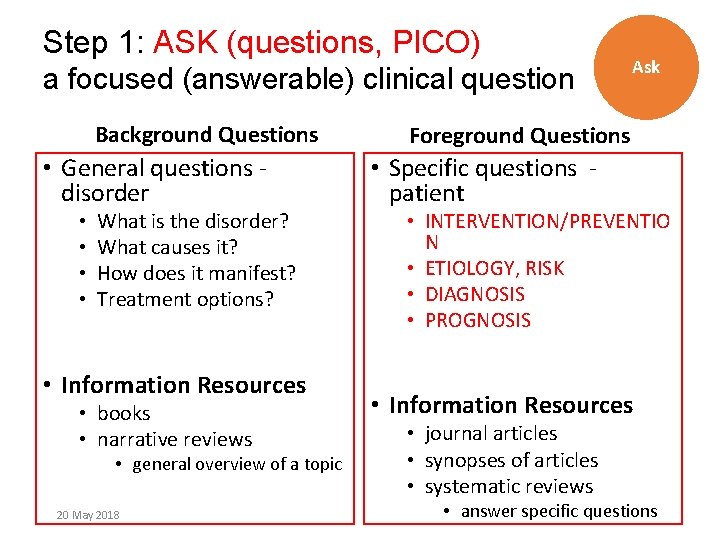
Step 1: ASK (questions, PICO) a focused (answerable) clinical question Background Questions • General questions disorder • • What is the disorder? What causes it? How does it manifest? Treatment options? • Information Resources • books • narrative reviews • general overview of a topic 20 May 2018 Ask Foreground Questions • Specific questions patient • INTERVENTION/PREVENTIO N • ETIOLOGY, RISK • DIAGNOSIS • PROGNOSIS • Information Resources • journal articles • synopses of articles • systematic reviews • answer specific questions
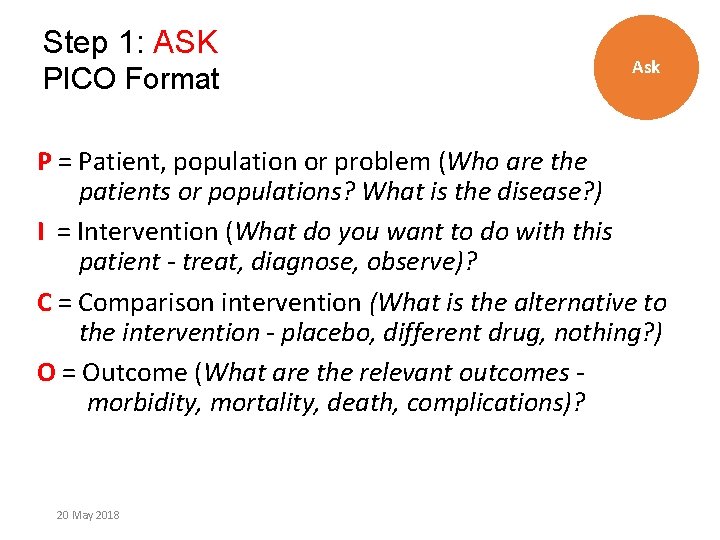
Step 1: ASK PICO Format Ask P = Patient, population or problem (Who are the patients or populations? What is the disease? ) I = Intervention (What do you want to do with this patient - treat, diagnose, observe)? C = Comparison intervention (What is the alternative to the intervention - placebo, different drug, nothing? ) O = Outcome (What are the relevant outcomes morbidity, mortality, death, complications)? 20 May 2018
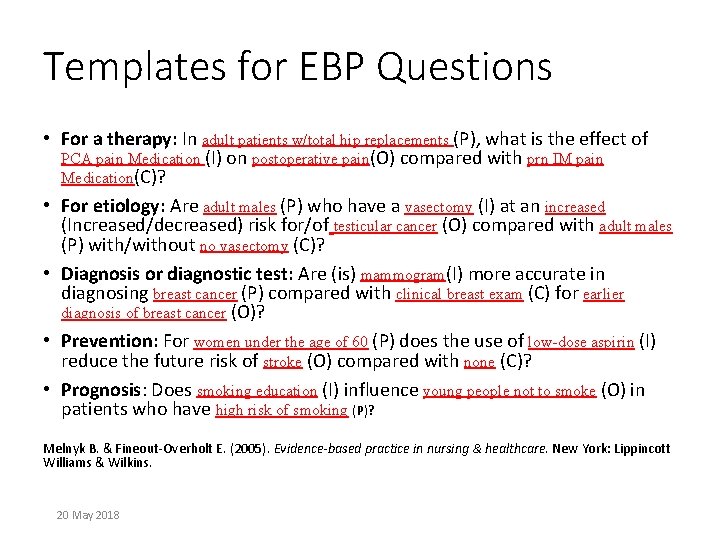
Templates for EBP Questions • For a therapy: In adult patients w/total hip replacements (P), what is the effect of PCA pain Medication (I) on postoperative pain(O) compared with prn IM pain Medication(C)? • For etiology: Are adult males (P) who have a vasectomy (I) at an increased (Increased/decreased) risk for/of testicular cancer (O) compared with adult males (P) with/without no vasectomy (C)? • Diagnosis or diagnostic test: Are (is) mammogram(I) more accurate in diagnosing breast cancer (P) compared with clinical breast exam (C) for earlier diagnosis of breast cancer (O)? • Prevention: For women under the age of 60 (P) does the use of low-dose aspirin (I) reduce the future risk of stroke (O) compared with none (C)? • Prognosis: Does smoking education (I) influence young people not to smoke (O) in patients who have high risk of smoking (P)? Melnyk B. & Fineout-Overholt E. (2005). Evidence-based practice in nursing & healthcare. New York: Lippincott Williams & Wilkins. 20 May 2018
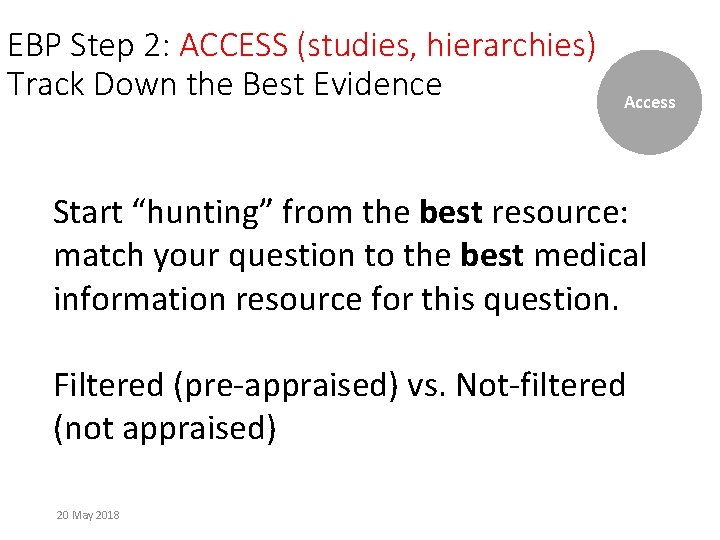
EBP Step 2: ACCESS (studies, hierarchies) Track Down the Best Evidence Access Start “hunting” from the best resource: match your question to the best medical information resource for this question. Filtered (pre-appraised) vs. Not-filtered (not appraised) 20 May 2018
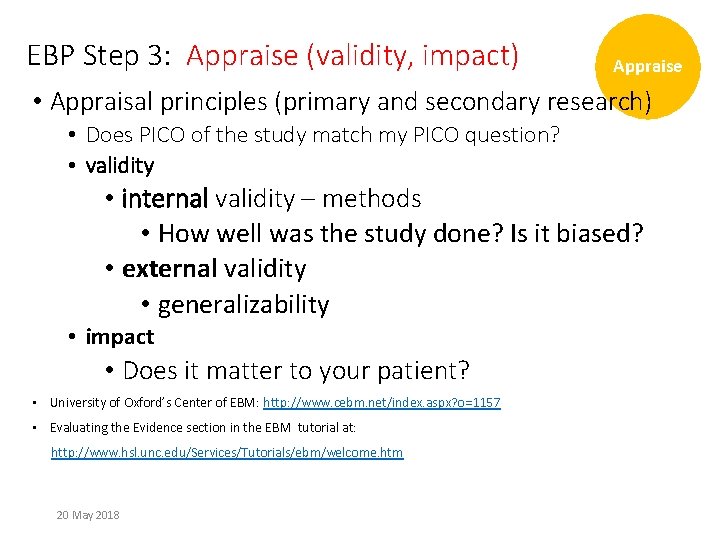
EBP Step 3: Appraise (validity, impact) Appraise • Appraisal principles (primary and secondary research) • Does PICO of the study match my PICO question? • validity • internal validity – methods • How well was the study done? Is it biased? • external validity • generalizability • impact • Does it matter to your patient? • University of Oxford’s Center of EBM: http: //www. cebm. net/index. aspx? o=1157 • Evaluating the Evidence section in the EBM tutorial at: http: //www. hsl. unc. edu/Services/Tutorials/ebm/welcome. htm 20 May 2018
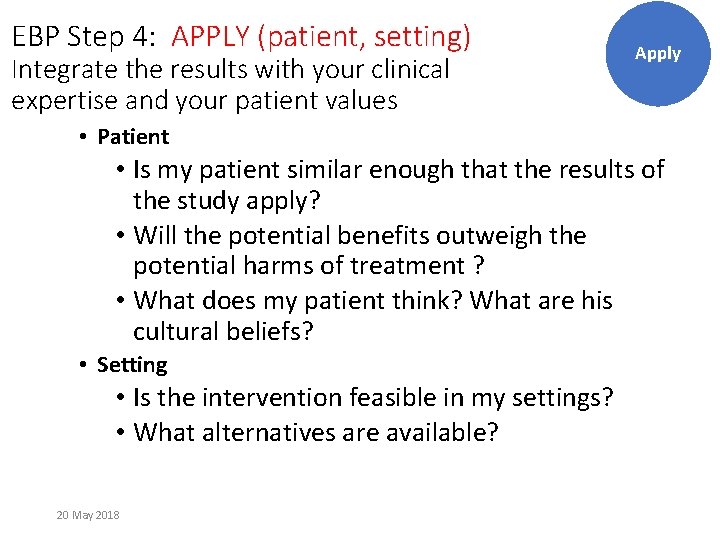
EBP Step 4: APPLY (patient, setting) Integrate the results with your clinical expertise and your patient values Apply • Patient • Is my patient similar enough that the results of the study apply? • Will the potential benefits outweigh the potential harms of treatment ? • What does my patient think? What are his cultural beliefs? • Setting • Is the intervention feasible in my settings? • What alternatives are available? 20 May 2018
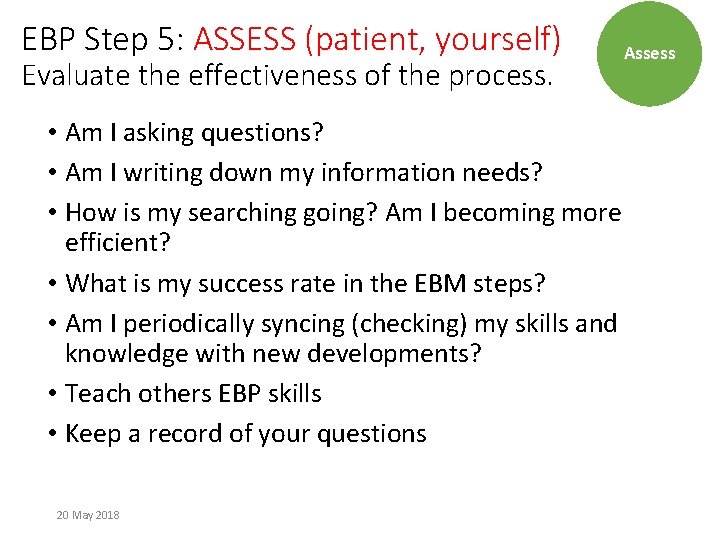
EBP Step 5: ASSESS (patient, yourself) Evaluate the effectiveness of the process. • Am I asking questions? • Am I writing down my information needs? • How is my searching going? Am I becoming more efficient? • What is my success rate in the EBM steps? • Am I periodically syncing (checking) my skills and knowledge with new developments? • Teach others EBP skills • Keep a record of your questions 20 May 2018 Assess
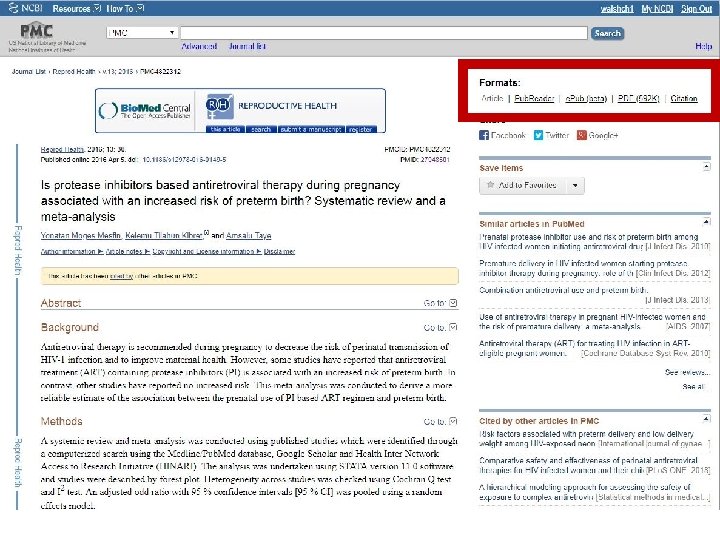
HINARI Resources • Cochrane Library – filtered • Joanna Briggs Institute - filtered • Pub. Med – unfiltered • Clinical Queries • Filters • HINARI EBM Journals 20 May 2018
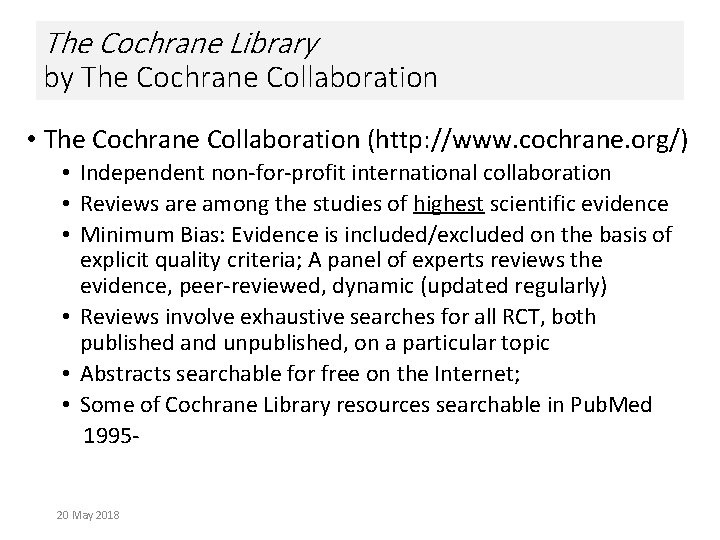
The Cochrane Library by The Cochrane Collaboration • The Cochrane Collaboration (http: //www. cochrane. org/) • Independent non-for-profit international collaboration • Reviews are among the studies of highest scientific evidence • Minimum Bias: Evidence is included/excluded on the basis of explicit quality criteria; A panel of experts reviews the evidence, peer-reviewed, dynamic (updated regularly) • Reviews involve exhaustive searches for all RCT, both published and unpublished, on a particular topic • Abstracts searchable for free on the Internet; • Some of Cochrane Library resources searchable in Pub. Med 199520 May 2018
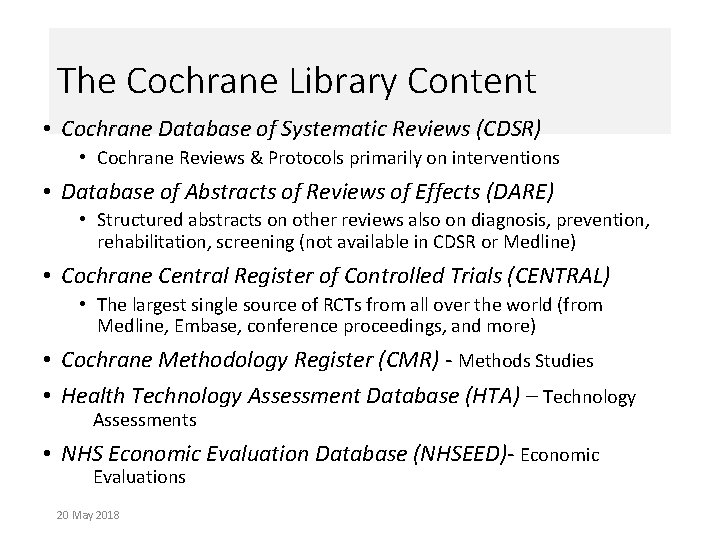
The Cochrane Library Content • Cochrane Database of Systematic Reviews (CDSR) • Cochrane Reviews & Protocols primarily on interventions • Database of Abstracts of Reviews of Effects (DARE) • Structured abstracts on other reviews also on diagnosis, prevention, rehabilitation, screening (not available in CDSR or Medline) • Cochrane Central Register of Controlled Trials (CENTRAL) • The largest single source of RCTs from all over the world (from Medline, Embase, conference proceedings, and more) • Cochrane Methodology Register (CMR) - Methods Studies • Health Technology Assessment Database (HTA) – Technology Assessments • NHS Economic Evaluation Database (NHSEED)- Economic Evaluations 20 May 2018
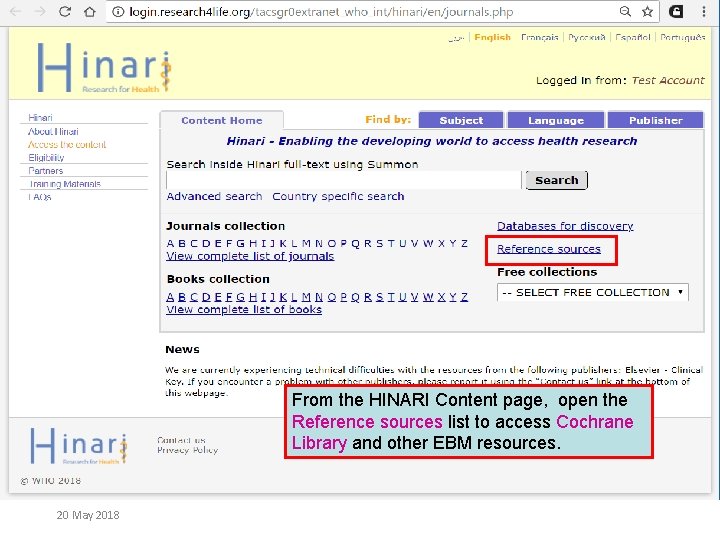
From the HINARI Content page, open the Reference sources list to access Cochrane Library and other EBM resources. 20 May 2018
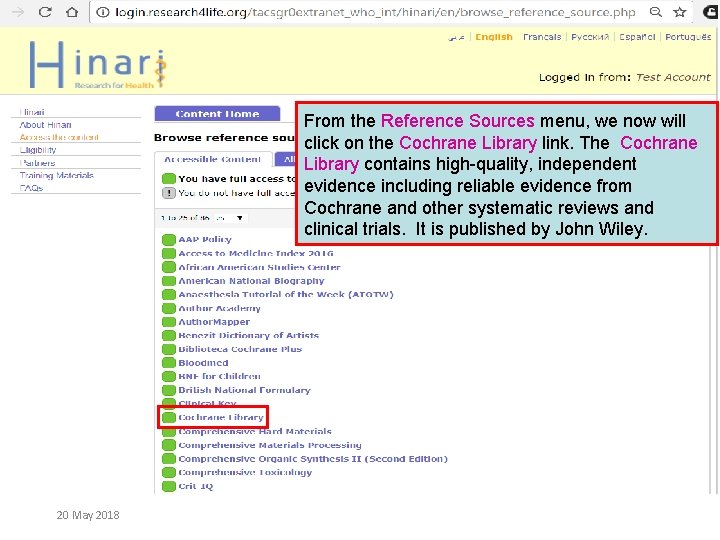
From the Reference Sources menu, we now will click on the Cochrane Library link. The Cochrane Library contains high-quality, independent evidence including reliable evidence from Cochrane and other systematic reviews and clinical trials. It is published by John Wiley. 20 May 2018
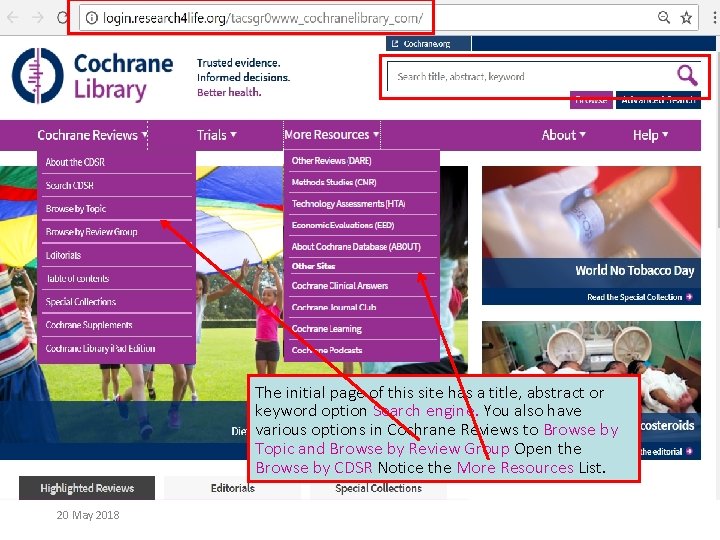
The initial page of this site has a title, abstract or keyword option Search engine. You also have various options in Cochrane Reviews to Browse by Topic and Browse by Review Group Open the Browse by CDSR Notice the More Resources List. 20 May 2018
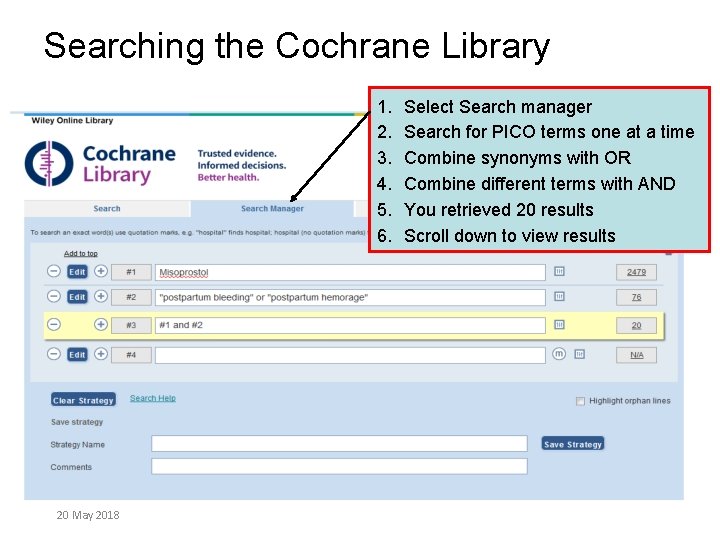
Searching the Cochrane Library 1. 2. 3. 4. 5. 6. 20 May 2018 Select Search manager 1. Select Search manager Search for PICO terms one at a time 2. Search for PICO terms one at a time Combine synonyms with OR 3. Combine synonyms with OR 4. Combine different terms with AND 5. You retrieved 20 results 6. Scroll down to view results
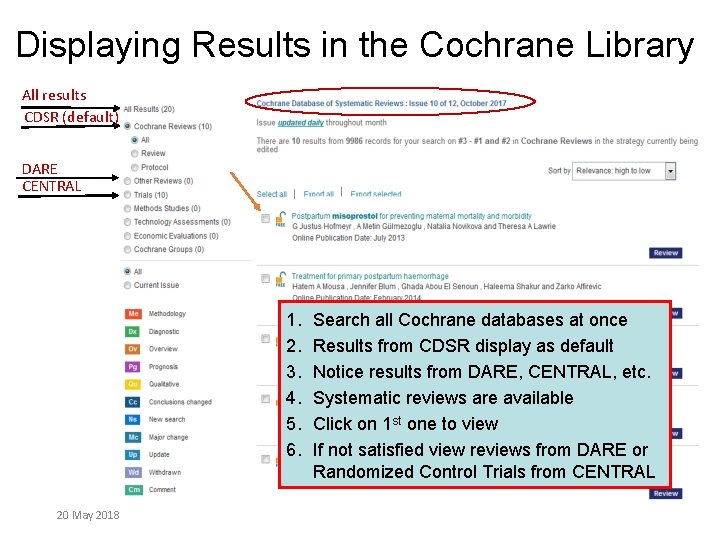
Displaying Results in the Cochrane Library All results CDSR (default) DARE CENTRAL 1. 2. 3. 4. 5. 6. 20 May 2018 Search all Cochrane databases at once Results from CDSR display as default Notice results from DARE, CENTRAL, etc. Systematic reviews are available Click on 1 st one to view If not satisfied view reviews from DARE or Randomized Control Trials from CENTRAL
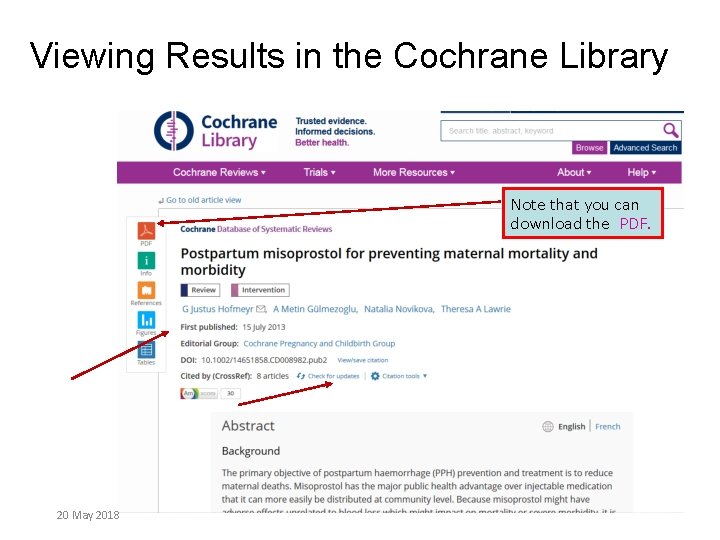
Viewing Results in the Cochrane Library Note that you can download the PDF. 20 May 2018
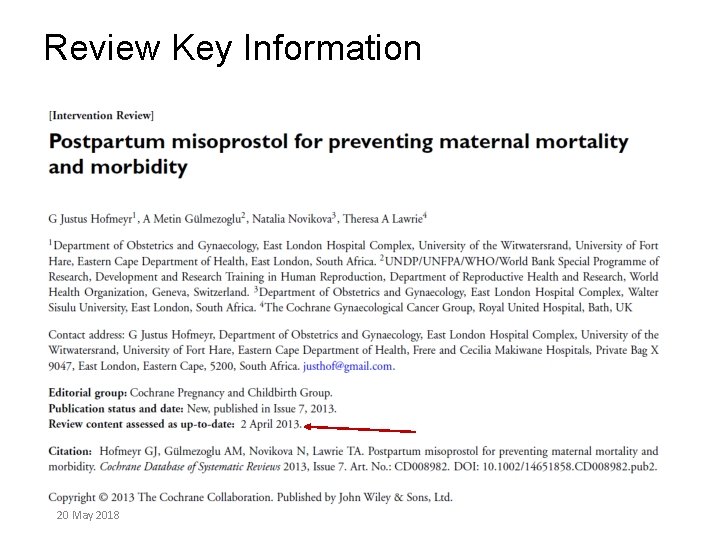
Review Key Information 20 May 2018
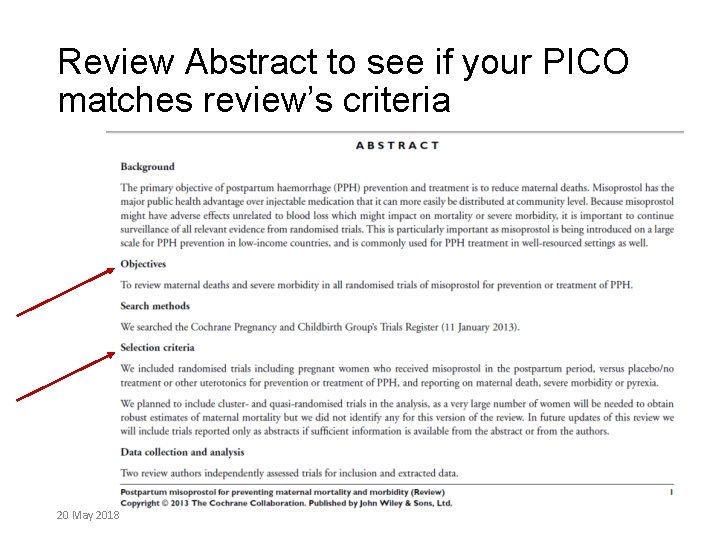
Review Abstract to see if your PICO matches review’s criteria 20 May 2018
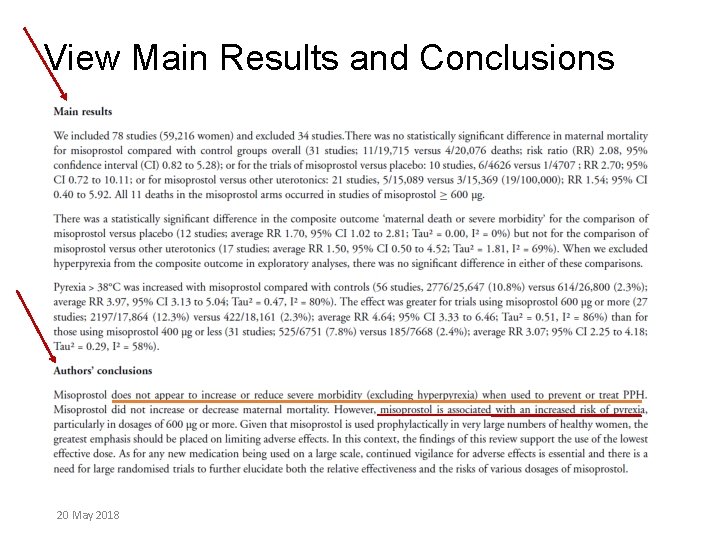
View Main Results and Conclusions 20 May 2018
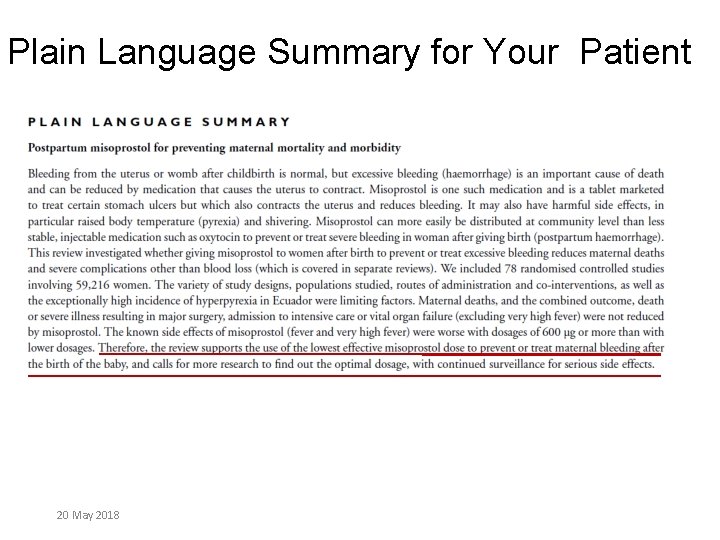
Plain Language Summary for Your Patient 20 May 2018
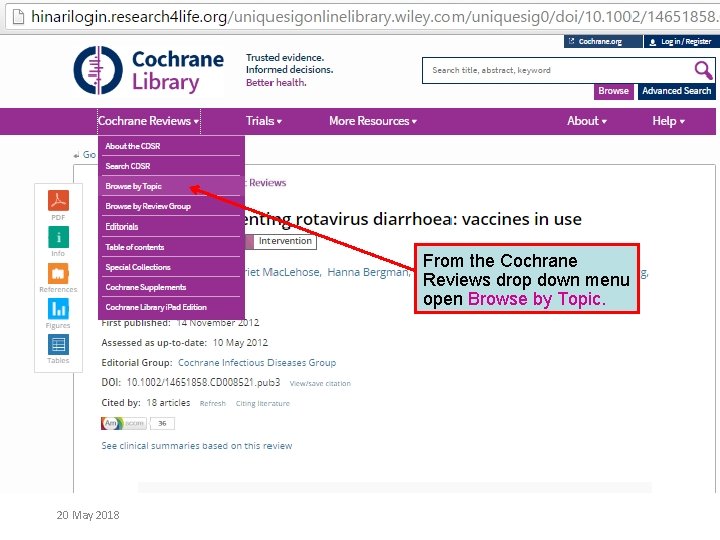
From the Cochrane Reviews drop down menu open Browse by Topic. 20 May 2018
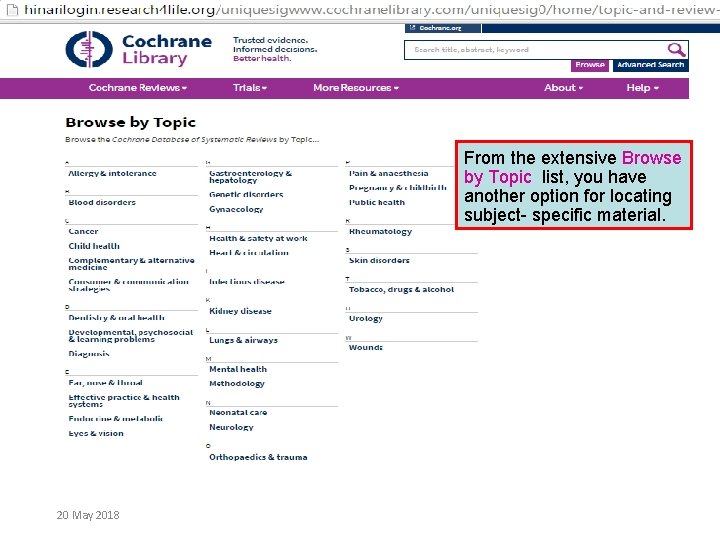
From the extensive Browse by Topic list, you have another option for locating subject- specific material. 20 May 2018
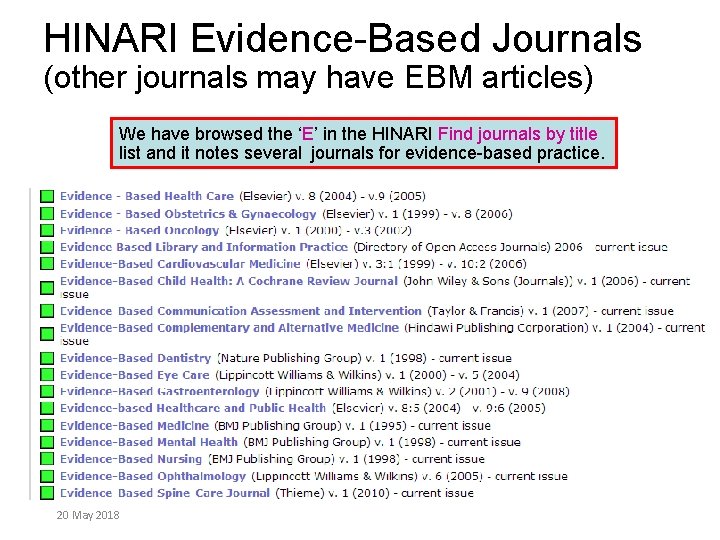
HINARI Evidence-Based Journals (other journals may have EBM articles) We have browsed the ‘E’ in the HINARI Find journals by title list and it notes several journals for evidence-based practice. 20 May 2018
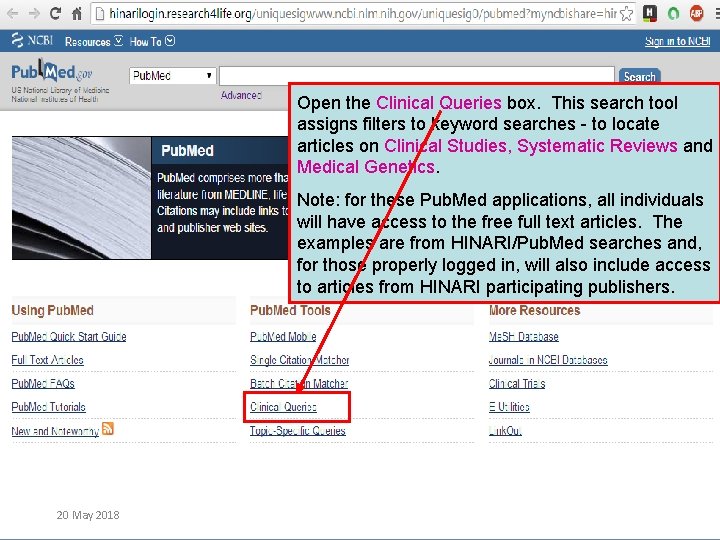
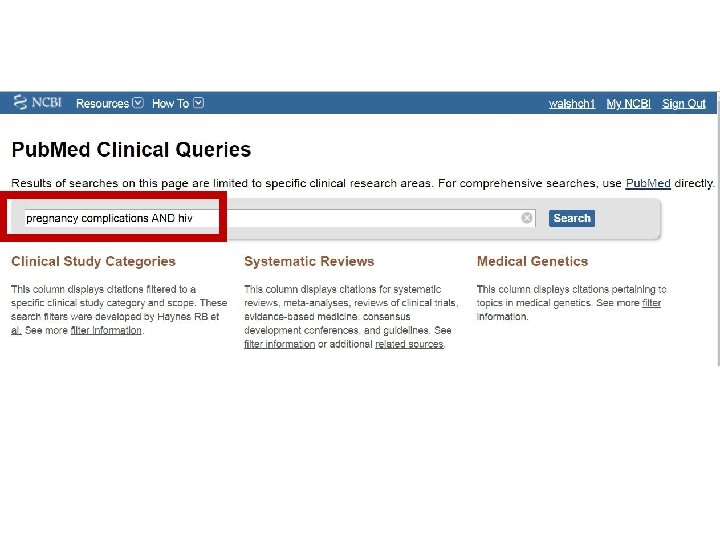
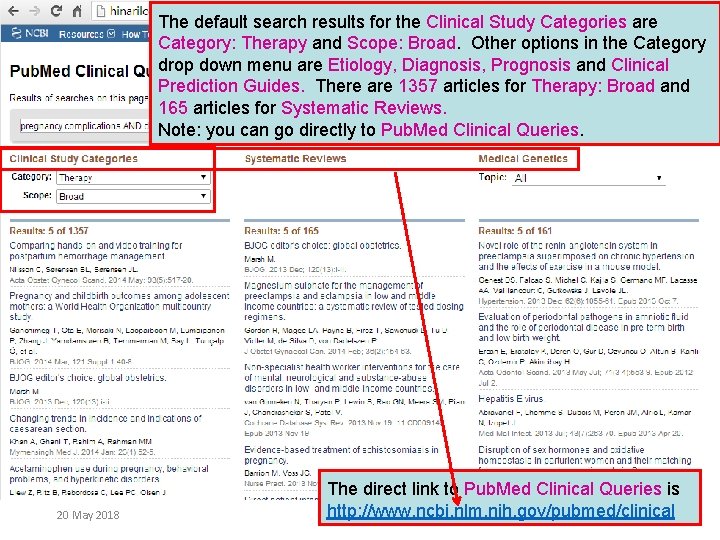
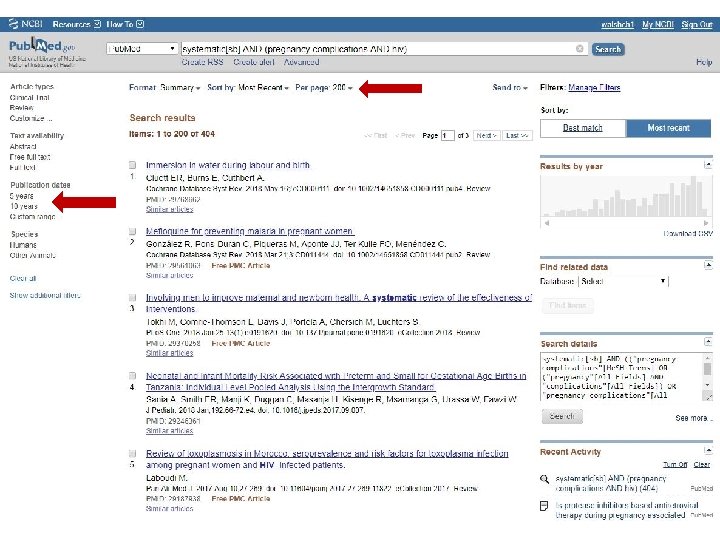
Open the Clinical Queries box. This search tool assigns filters to keyword searches - to locate articles on Clinical Studies, Systematic Reviews and Medical Genetics. Note: for these Pub. Med applications, all individuals will have access to the free full text articles. The examples are from HINARI/Pub. Med searches and, for those properly logged in, will also include access to articles from HINARI participating publishers. 20 May 2018
The default search results for the Clinical Study Categories are Category: Therapy and Scope: Broad. Other options in the Category drop down menu are Etiology, Diagnosis, Prognosis and Clinical Prediction Guides. There are 1357 articles for Therapy: Broad and 165 articles for Systematic Reviews. Note: you can go directly to Pub. Med Clinical Queries. 20 May 2018 The direct link to Pub. Med Clinical Queries is http: //www. ncbi. nlm. nih. gov/pubmed/clinical
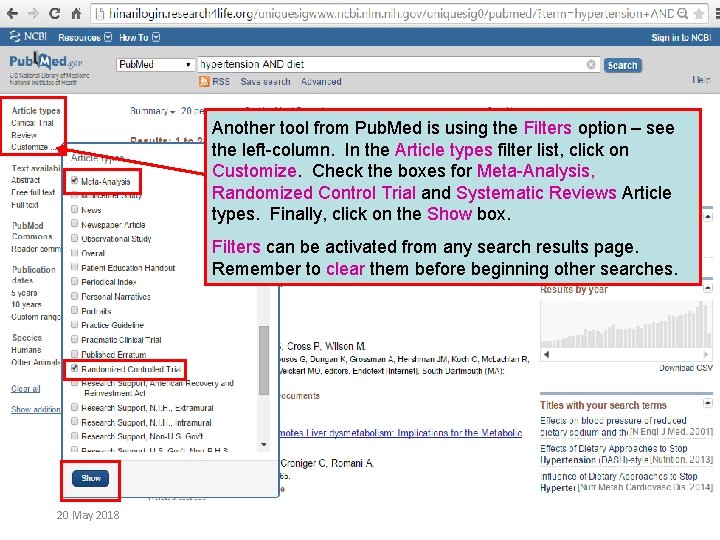
Another tool from Pub. Med is using the Filters option – see the left-column. In the Article types filter list, click on Customize. Check the boxes for Meta-Analysis, Randomized Control Trial and Systematic Reviews Article types. Finally, click on the Show box. Filters can be activated from any search results page. Remember to clear them before beginning other searches. 20 May 2018
Additional Evidence-based Health Resources continued • Trip Database – ‘a smart, fast tool for you to find high-quality clinical research evidence’ www. tripdatabase. com/ • Mc. Master PLUS (Premium Literature Service): ‘a database created by the Mc. Master Health Knowledge Refinery; articles… selected from current medical literature’ (HKR)hiru. mcmaster. ca/hiru/HIRU_Mc. Master_PL US_projects. aspx 20 May 2018
• Bandolier Knowledge - Oxford University – ‘premier source of evidence based healthcare information in the UK and worldwide for healthcare professionals’ http: //www. bandolier. org. uk/ • EBM Librarian – ‘site offers a place to: share teaching materials and class handouts discuss issues and ask advice from colleagues share useful information about teaching EBM https: //sites. google. com/site/ebmlibrarian/ 20 May 2018
• Open Clinical: Clinical Practice Guidelines – ‘a "one-stop shop" tracking developments on advanced knowledge management technologies for healthcare such as point-of-care decision support systems, "intelligent" guidelines and clinical workflow’ www. openclinical. org/guidelines. html • National Guidelines Clearinghouse - Agency for Healthcare Research and Quality: ‘a public resource for summaries of evidence-based clinical practice guidelines’ www. guideline. gov/ 20 May 2018
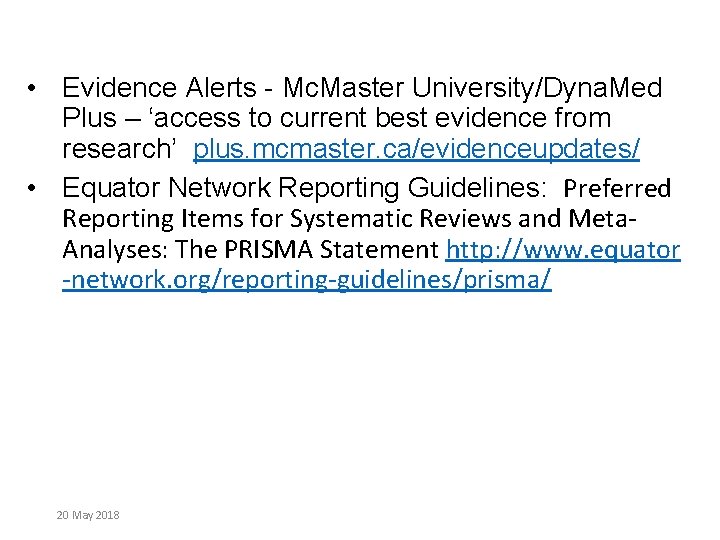
• Evidence Alerts - Mc. Master University/Dyna. Med Plus – ‘access to current best evidence from research’ plus. mcmaster. ca/evidenceupdates/ • Equator Network Reporting Guidelines: Preferred Reporting Items for Systematic Reviews and Meta. Analyses: The PRISMA Statement http: //www. equator -network. org/reporting-guidelines/prisma/ 20 May 2018
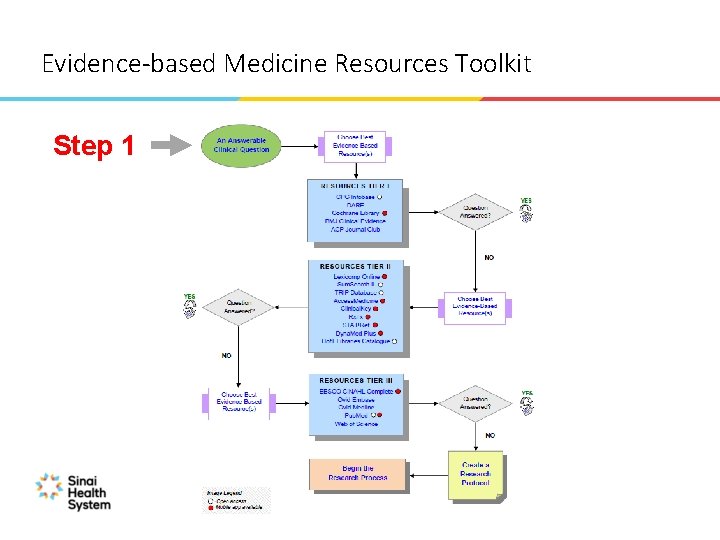
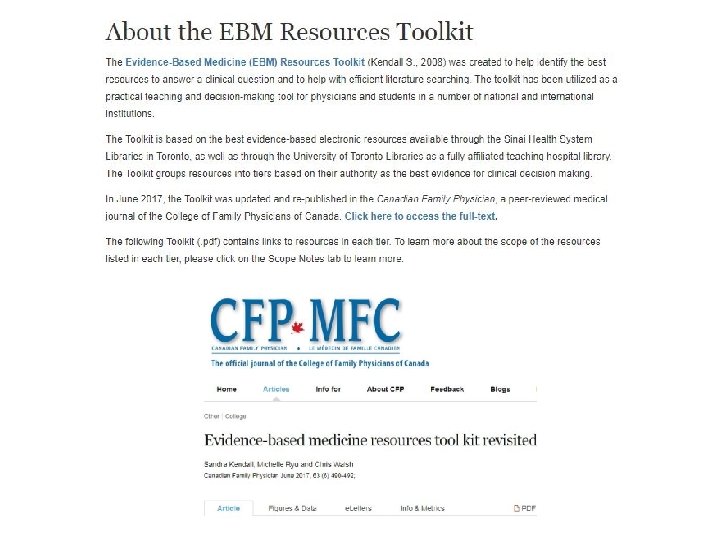
Evidence-based Medicine Resources Toolkit Step 1
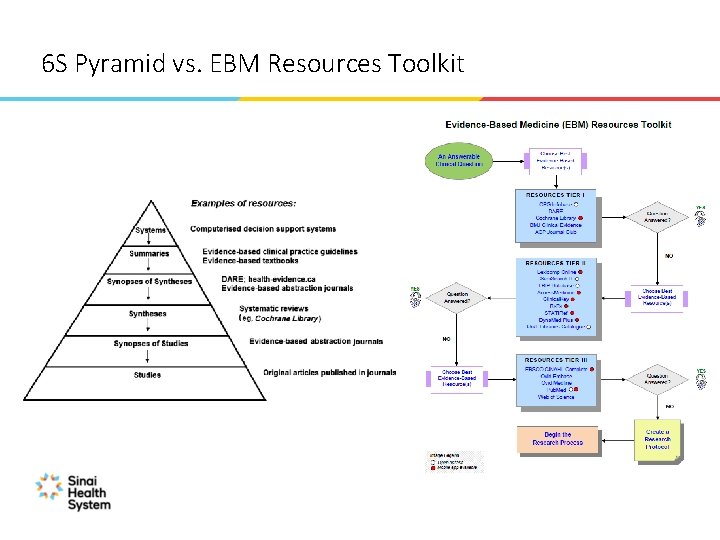
6 S Pyramid vs. EBM Resources Toolkit
A Few Caveats • Our algorithm works with the physician’s expertise. • EBM is a model/framework. • The challenge is that the algorithm will not work with all specialties (e. g. ICU, neonatalogy and drug therapy questions). • Literature search is a small component of physician’s decision making. 49
Looking Ahead • It’s a living toolkit – it will continue to evolve as new resources and technologies emerge. • Nursing and allied health edition coming soon. • Continued applications in other institutions (e. g. public libraries, academic libraries). • Invitation to adapt the toolkit.
Additional Clinical Practice Guidelines resources • National Guideline Clearinghouse (USA) www. guideline. gov/ • Open Clinical: Clinical Practice Guidelines www. openclinical. org/guidelines. html 20 May 2018