
What is ESSA New federal education law Dec

- Slides: 18
What is ESSA? • New federal education law (Dec. 10, 2015) • Purpose: To provide significant opportunity for all students to receive fair, equitable, and high -quality education • Replaces NCLB and Flexibility Waivers • Rolling implementation • Requires states to submit plan to U. S. Ed
Major Components • • • Stakeholder Engagement Assessment and Standards Accountability System School Improvement and Student Support Data and Reporting
Major Component: Stakeholder Engagement • • • SD started with four work groups (last spring) 1 st round of meetings: information sharing 2 nd round of meetings (now): solicit input Public hearing: Board of Education Board and Governor approval of plan Plan submitted September 2017
Major Component: Standards • States must have challenging academic standards • U. S. Ed cannot require specific standards • SD remains committed to high quality standards • ELA and math standards revision and review currently underway
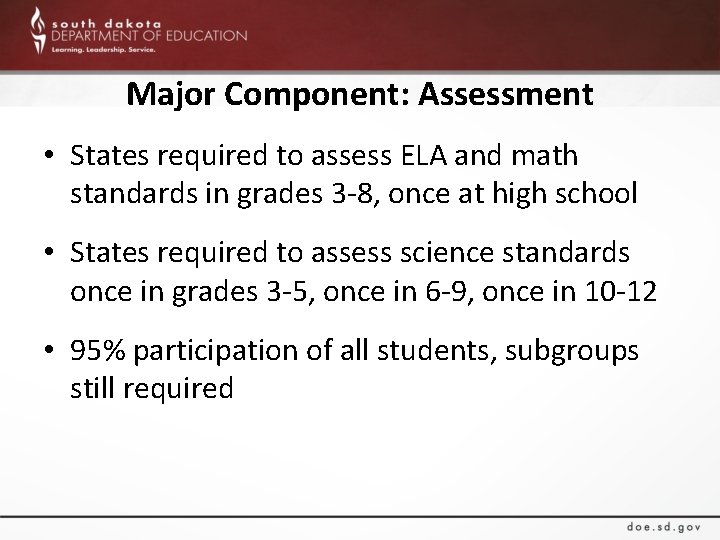
Major Component: Assessment • States required to assess ELA and math standards in grades 3 -8, once at high school • States required to assess science standards once in grades 3 -5, once in 6 -9, once in 10 -12 • 95% participation of all students, subgroups still required
Major Component: Accountability • Accountability system must be based on state standards and assessments • System must be consistent across schools • Indicators must differentiate among schools • System used to identify schools for state and district support; recognition
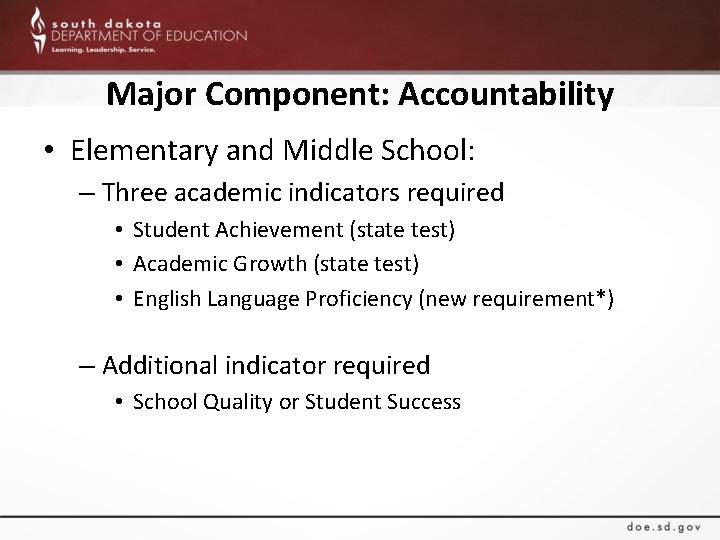
Major Component: Accountability • Elementary and Middle School: – Three academic indicators required • Student Achievement (state test) • Academic Growth (state test) • English Language Proficiency (new requirement*) – Additional indicator required • School Quality or Student Success
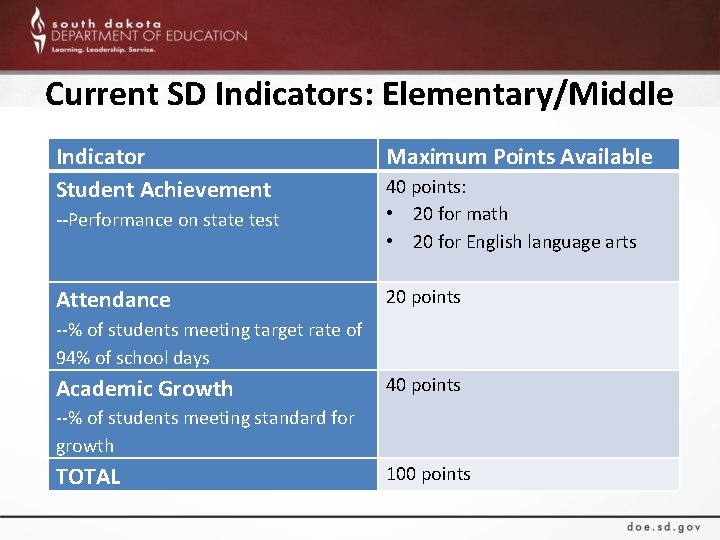
Current SD Indicators: Elementary/Middle Indicator Student Achievement Maximum Points Available --Performance on state test 40 points: • 20 for math • 20 for English language arts Attendance 20 points --% of students meeting target rate of 94% of school days Academic Growth 40 points --% of students meeting standard for growth TOTAL 100 points
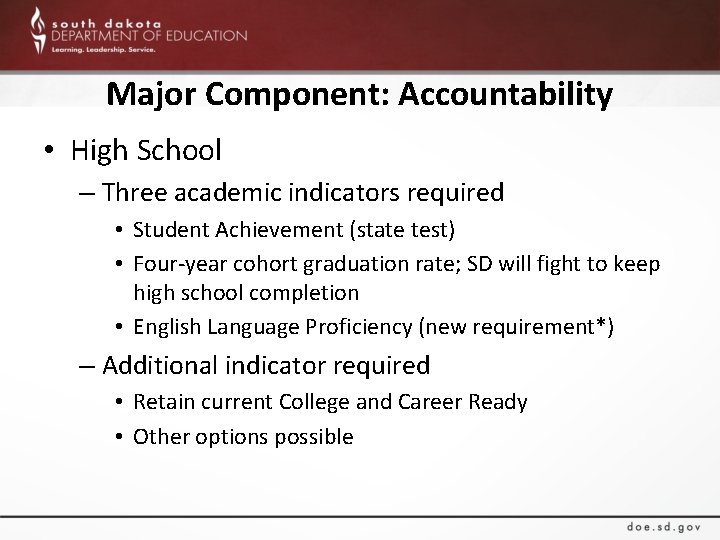
Major Component: Accountability • High School – Three academic indicators required • Student Achievement (state test) • Four-year cohort graduation rate; SD will fight to keep high school completion • English Language Proficiency (new requirement*) – Additional indicator required • Retain current College and Career Ready • Other options possible
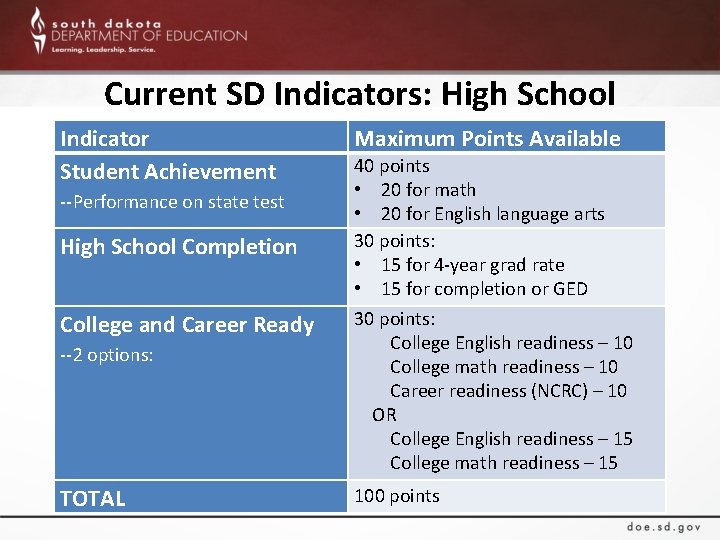
Current SD Indicators: High School Indicator Student Achievement --Performance on state test High School Completion College and Career Ready --2 options: TOTAL Maximum Points Available 40 points • 20 for math • 20 for English language arts 30 points: • 15 for 4 -year grad rate • 15 for completion or GED 30 points: College English readiness – 10 College math readiness – 10 Career readiness (NCRC) – 10 OR College English readiness – 15 College math readiness – 15 100 points
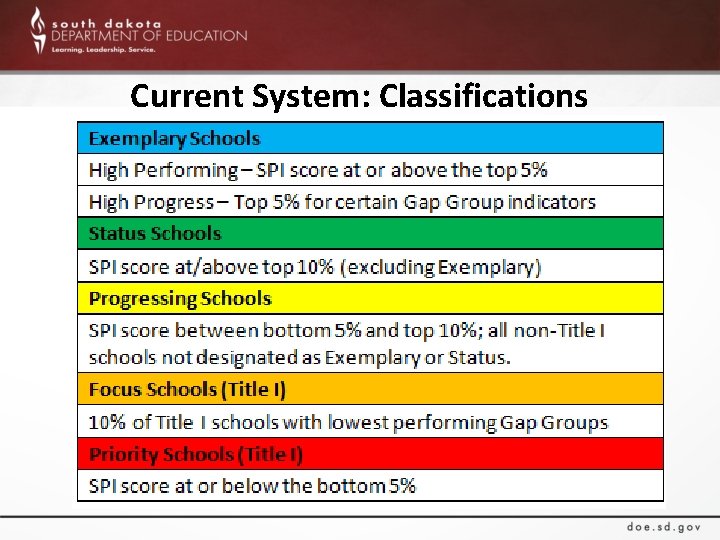
Current System: Classifications
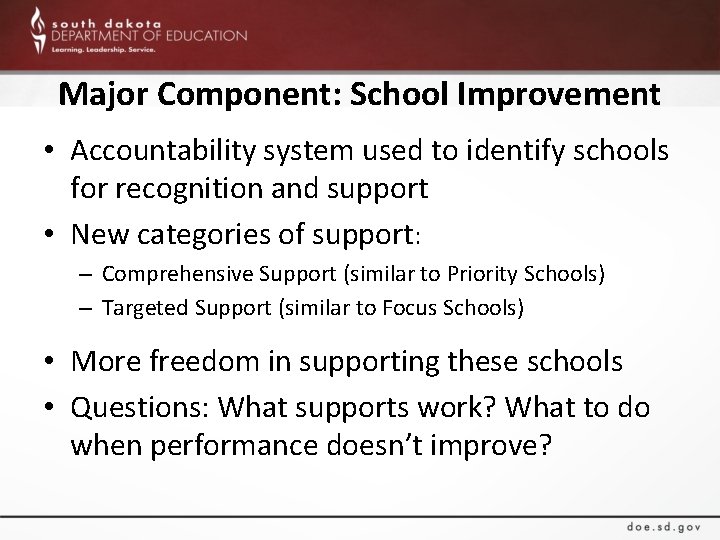
Major Component: School Improvement • Accountability system used to identify schools for recognition and support • New categories of support: – Comprehensive Support (similar to Priority Schools) – Targeted Support (similar to Focus Schools) • More freedom in supporting these schools • Questions: What supports work? What to do when performance doesn’t improve?
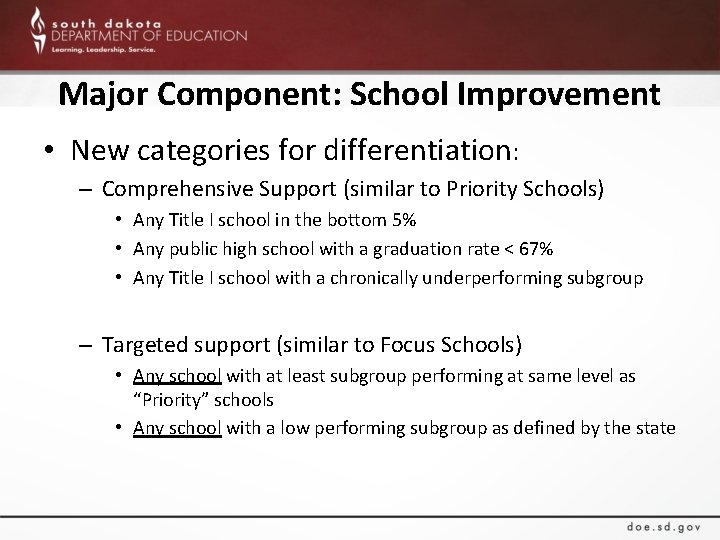
Major Component: School Improvement • New categories for differentiation: – Comprehensive Support (similar to Priority Schools) • Any Title I school in the bottom 5% • Any public high school with a graduation rate < 67% • Any Title I school with a chronically underperforming subgroup – Targeted support (similar to Focus Schools) • Any school with at least subgroup performing at same level as “Priority” schools • Any school with a low performing subgroup as defined by the state
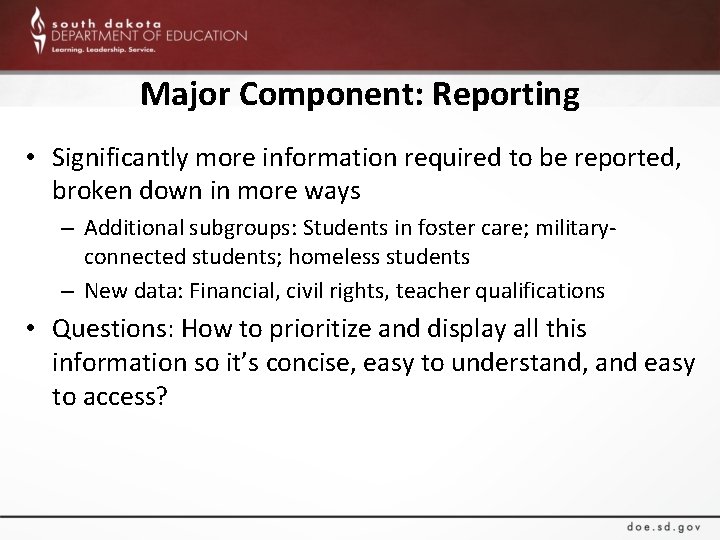
Major Component: Reporting • Significantly more information required to be reported, broken down in more ways – Additional subgroups: Students in foster care; militaryconnected students; homeless students – New data: Financial, civil rights, teacher qualifications • Questions: How to prioritize and display all this information so it’s concise, easy to understand, and easy to access?
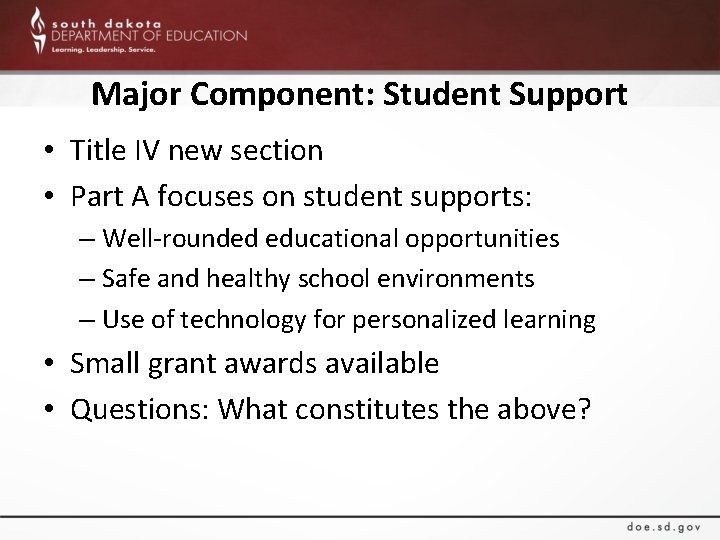
Major Component: Student Support • Title IV new section • Part A focuses on student supports: – Well-rounded educational opportunities – Safe and healthy school environments – Use of technology for personalized learning • Small grant awards available • Questions: What constitutes the above?
Next Steps • Continue consultations • Seek input from stakeholders, public • Formal public comment period • State plan submission goal: September 2017
Today • Table Talk Discussions on major components: – Accountability – School Improvement & Student Support – Data & Reporting • Questions for you to weigh in on • Discussions to inform development of state plan