
WHAT IS ENGINEERING Presented by Monica M Suter
WHAT IS ENGINEERING? Presented by: Monica M. Suter, P. E. , P. T. O. E. City of Santa Ana, CA Public Works Agency, Traffic & Transportation Engineering
What is Engineering? The application of: scientific & mathematical principles to obtain practical ends for the Design, Construction, or Operation of efficient, economical, & environmentally sound Structures, Equipment, or Systems for Just about EVERYTHING AROUND YOU! So, everything around you involves Engineering
What is Engineering? There Are Four Main Types of Engineers Civil - Buildings, bridges, transportation, traffic, water, soils, environmental, planning, tunnels, soils, seismic, airports, construction, surveying, foundations, ITS, retaining walls, sound walls, grading, transit, railroad & highways… Electrical - Computers (hardware/software), electronics, electrical designs for buildings, lighting, and transportation systems, systems design, & intelligent transportation systems (ITS)… Mechanical - Automobiles, engines, airplanes, space shuttles, design of heating & cooling systems & mechanical systems for buildings… Chemical - Chemistry related products, environmental, toxic waste, & petroleum related products…

What is Engineering? Where Does An Engineer Work? § § § § § Outdoors—”in-the-field” In an office At a factory or manufacturing plant In a lab At a research center At a university or college At a construction site For a governmental agency For a private consulting firm Or start your own business
What is Engineering? What is Infrastructure? All roads, structures, bridges, pipelines, channels, drainage & sewer/sanitary pipes, water lines, storm drains, and rail lines, etc. Our society depends on infrastructure for the transportation of people & products. WHO TYPICALLY DESIGNS INFRASTRUCTURE? Civil Engineers!!
What is Engineering? So You Want To Be An Engineer § § A Bachelor’s of Science Degree (4+ years) Pass the “Engineer-in-training” exam Accrue engineering experience Pass the professional engineer’s (P. E. ) exam NOTE: Once you pass the P. E. exam, you become a licensed engineer in the state you took the exam. Having a P. E. license allows a person to sign and approve (stamp) plans. It is a license which indicates a person is authorized to practice in engineering, kind of like how a doctor or lawyer is licensed to practice in their professions. THE P. E. = THE “BAR” OF ENGINEERING A P. E. is not required for certain areas of engineering, but it is almost always required when approving design plans.
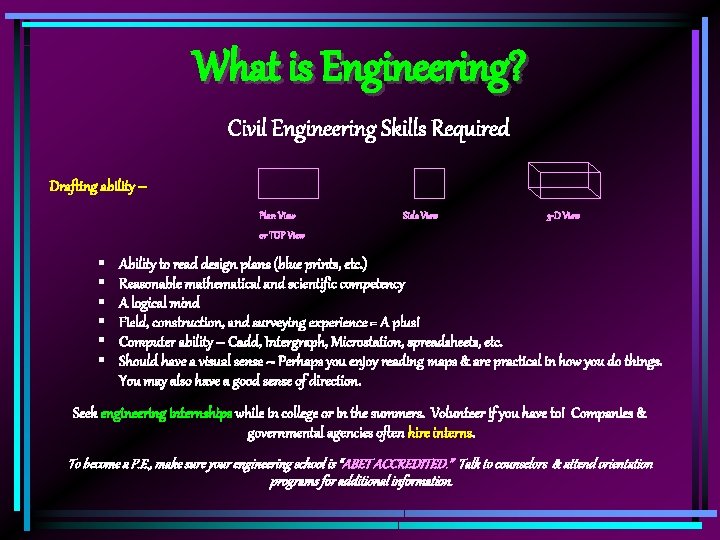
What is Engineering? Civil Engineering Skills Required Drafting ability -Plan View Side View 3 -D View or TOP View § § § Ability to read design plans (blue prints, etc. ) Reasonable mathematical and scientific competency A logical mind Field, construction, and surveying experience = A plus! Computer ability – Cadd, Intergraph, Microstation, spreadsheets, etc. Should have a visual sense – Perhaps you enjoy reading maps & are practical in how you do things. You may also have a good sense of direction. Seek engineering internships while in college or in the summers. Volunteer if you have to! Companies & governmental agencies often hire interns. To become a P. E. , make sure your engineering school is “ABET ACCREDITED. ” Talk to counselors & attend orientation programs for additional information.
What is Engineering? Common Engineering Phases For New Major Infrastructure To Finally Be Built? § § § § Planning Environmental studies EIS/EIR Conceptual design Preliminary engineering PSR, PR, preferred alternative studies Final design (PS&E phase), the plans used for construction Construction of the infrastructure As-built survey and plans to confirm what was actually built. SEISMIC DESIGN: Design of structures so that they will not collapse under an 8. 0 (richter scale) earthquake.
What is Engineering? Don’t Let Money Stop You! § § § Apply for scholarships and grants Take required college entrance exams, PSAT, ACT, etc… Work! It builds your resume and your character!!! Start at a junior college first if money is an issue and transfer for your last 2 years to an “ABET” school Good grades in high school can help lead to scholarships (talk to your counselor) Borrow if necessary –student loans are a great deal & pay off! Plan ahead and save now too! It’s worth it! Take drafting classes, etc. There’s also plenty of writing in engineering Stick with your math/science classes even when tough Good communicators are needed in Engineering! § GOOD LUCK & GO-FOR-IT!
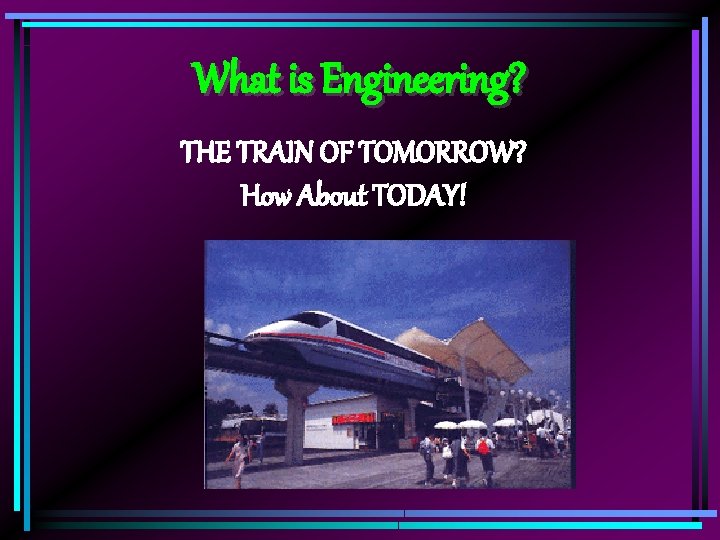
What is Engineering? THE TRAIN OF TOMORROW? How About TODAY!
- Slides: 11