
What is Energy Objective Learning about the different
What is Energy Objective: Learning about the different forms of energy. Explore mechanical energies and associated conservation principle. Key concepts: v Work and Energy v Kinetic energy v Gravitational potential energy v Conservation of energy v Power and Efficiency
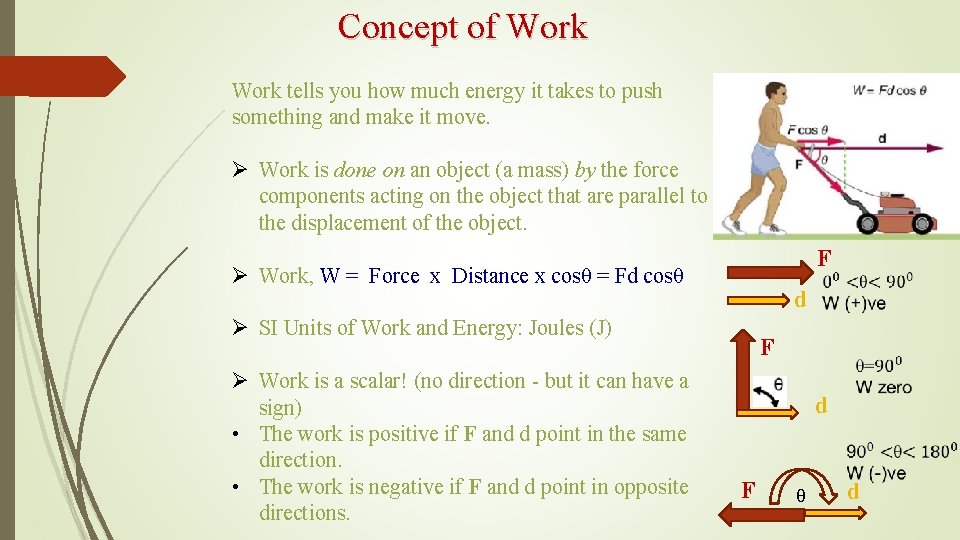
Concept of Work tells you how much energy it takes to push something and make it move. Ø Work is done on an object (a mass) by the force components acting on the object that are parallel to the displacement of the object. F Ø Work, W = Force x Distance x cosθ = Fd cosθ d Ø SI Units of Work and Energy: Joules (J) Ø Work is a scalar! (no direction - but it can have a sign) • The work is positive if F and d point in the same direction. • The work is negative if F and d point in opposite directions. F d F θ d
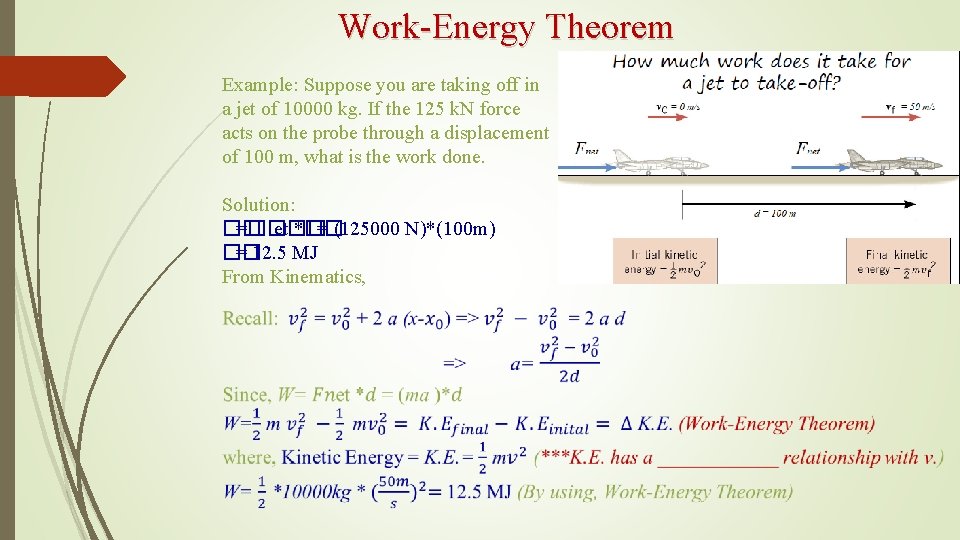
Work-Energy Theorem Example: Suppose you are taking off in a jet of 10000 kg. If the 125 k. N force acts on the probe through a displacement of 100 m, what is the work done. Solution: �� =���� et *�� = (125000 N)*(100 m) �� = 12. 5 MJ From Kinematics,
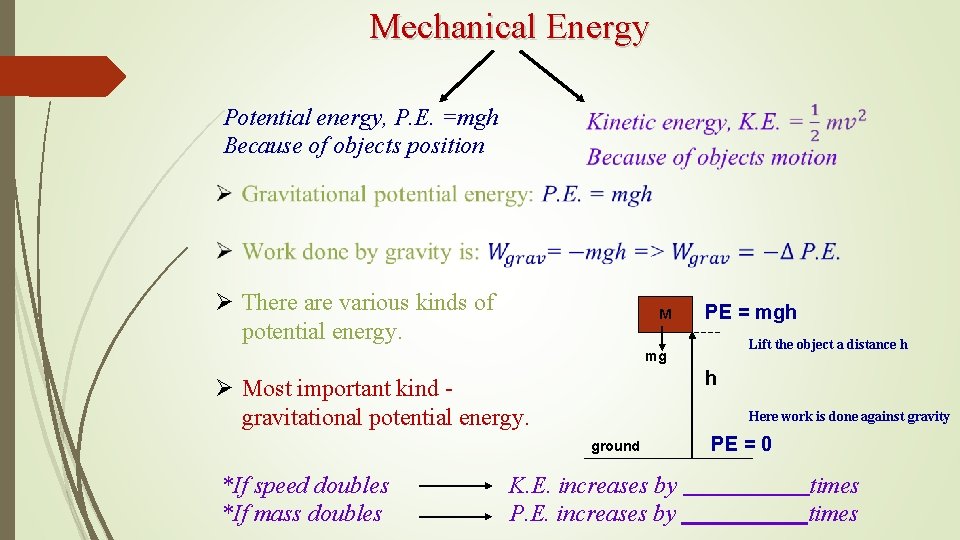
Mechanical Energy Potential energy, P. E. =mgh Because of objects position Ø There are various kinds of potential energy. M PE = mgh Lift the object a distance h mg h Ø Most important kind gravitational potential energy. Here work is done against gravity ground *If speed doubles *If mass doubles K. E. increases by PE = 0 times
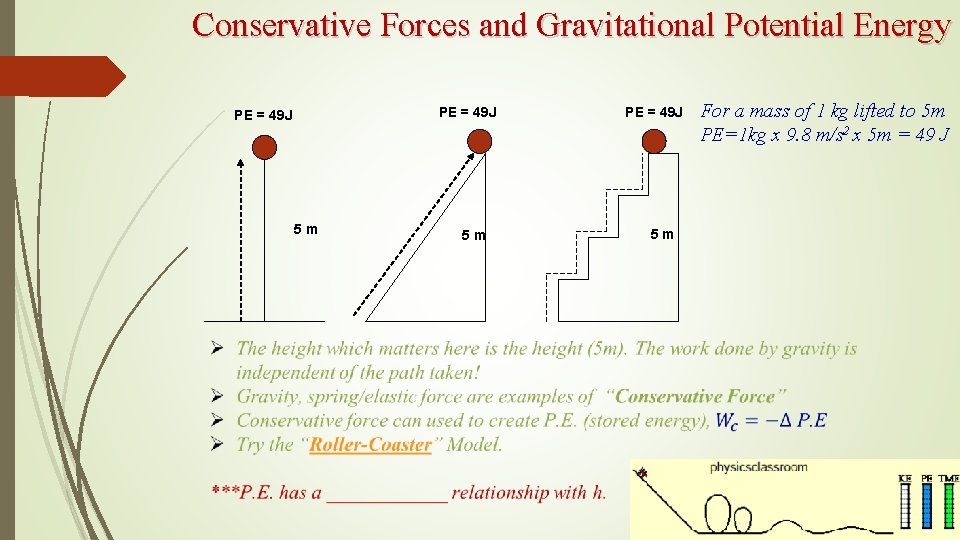
Conservative Forces and Gravitational Potential Energy PE = 49 J 5 m 5 m PE = 49 J 5 m For a mass of 1 kg lifted to 5 m PE=1 kg x 9. 8 m/s 2 x 5 m = 49 J
Different forms of Energy & Conservation of Energy Ø Kinetic Energy = Energy of motion Ø Potential Energy = Energy of position Ø Thermal Energy = Kinetic Energy of the random motion of molecules Ø Chemical Energy = Potential Energy of the bonds between atoms Ø Nuclear Energy = Potential Energy of the particles inside the atomic nucleus Conservation of Energy: Energy cannot be created or destroyed. It may be transformed from one form into another or transferred from one object to another, but the total amount of energy never changes.
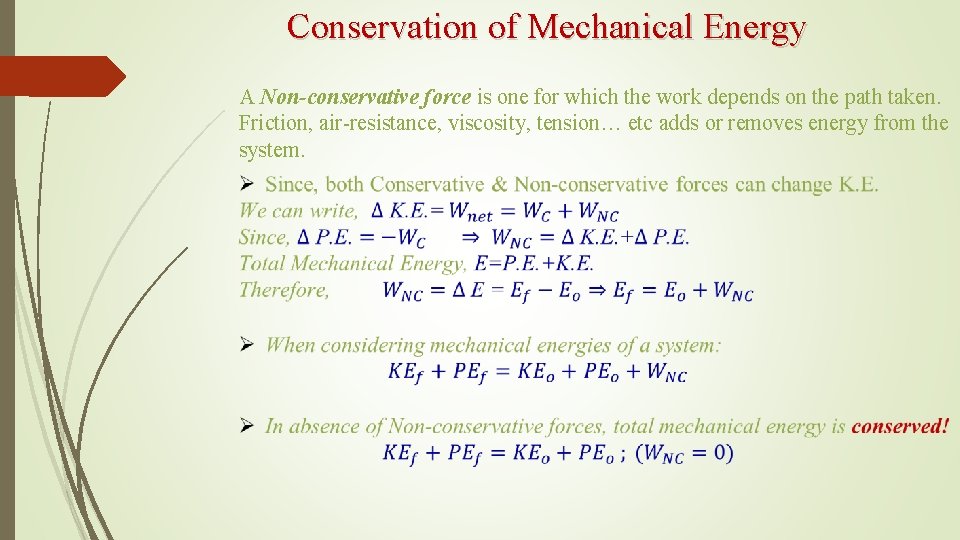
Conservation of Mechanical Energy A Non-conservative force is one for which the work depends on the path taken. Friction, air-resistance, viscosity, tension… etc adds or removes energy from the system.
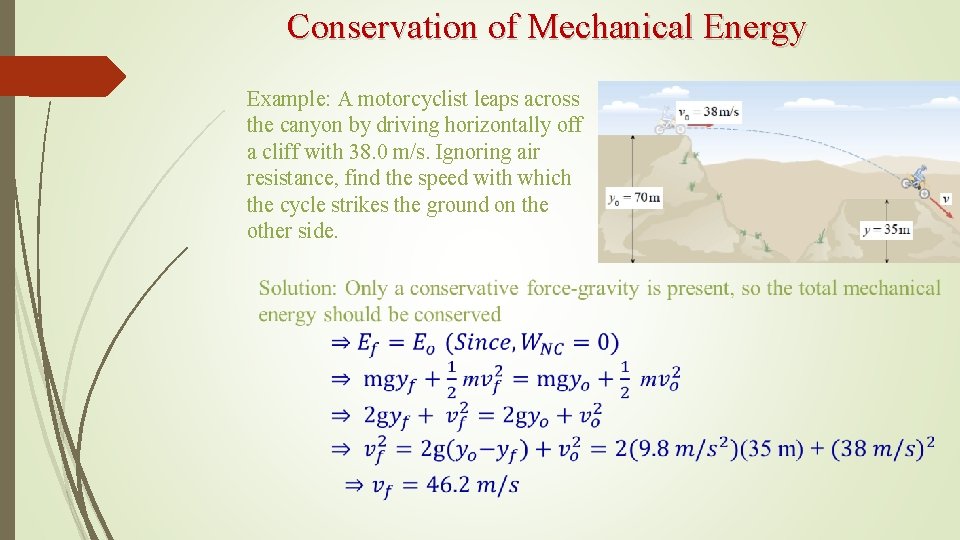
Conservation of Mechanical Energy Example: A motorcyclist leaps across the canyon by driving horizontally off a cliff with 38. 0 m/s. Ignoring air resistance, find the speed with which the cycle strikes the ground on the other side.
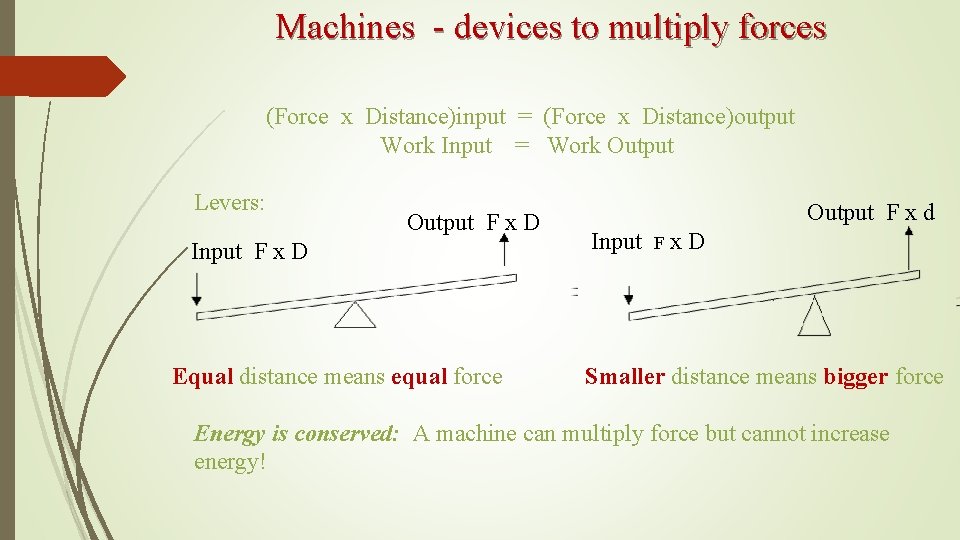
Machines - devices to multiply forces (Force x Distance)input = (Force x Distance)output Work Input = Work Output Levers: Output F x D Input F x D Equal distance means equal force Output F x d Input F x. D Smaller distance means bigger force Energy is conserved: A machine can multiply force but cannot increase energy!
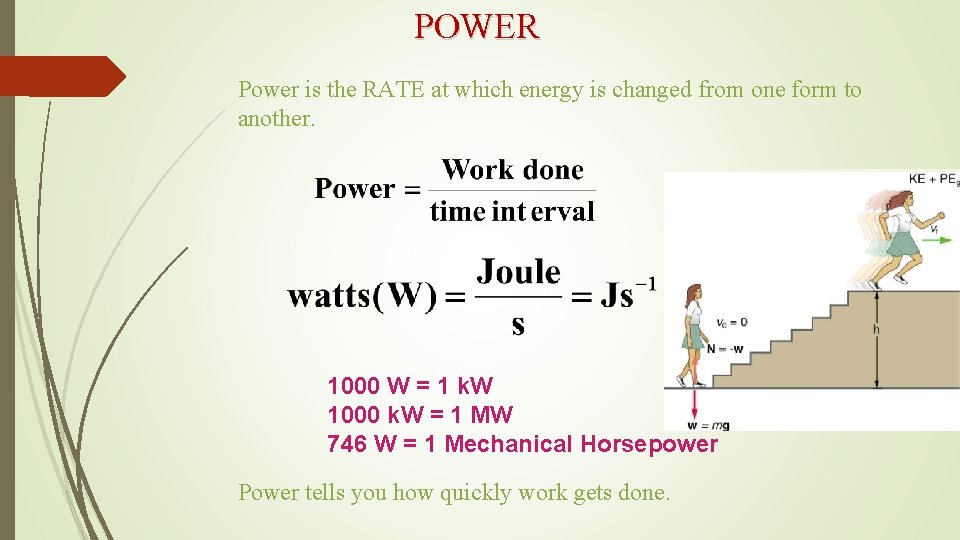
POWER Power is the RATE at which energy is changed from one form to another. 1000 W = 1 k. W 1000 k. W = 1 MW 746 W = 1 Mechanical Horsepower Power tells you how quickly work gets done.
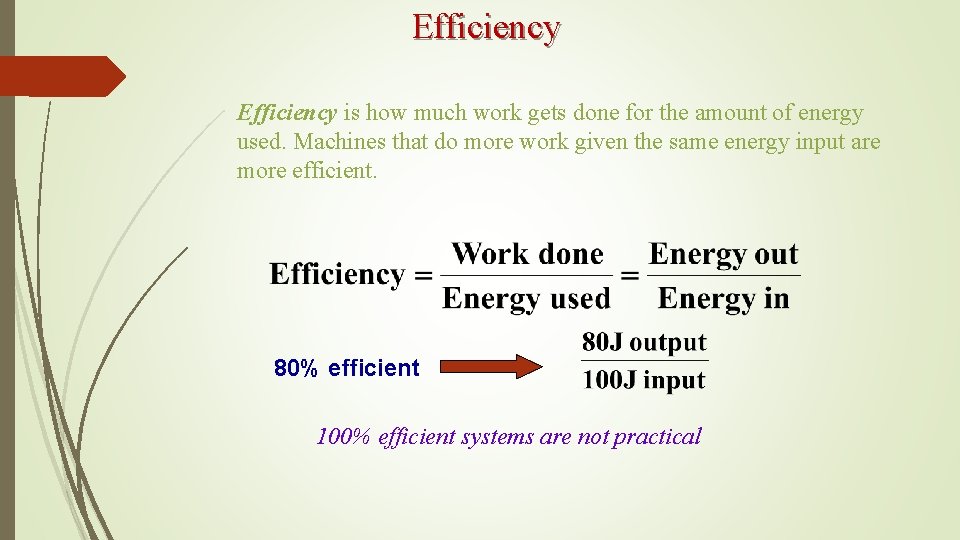
Efficiency is how much work gets done for the amount of energy used. Machines that do more work given the same energy input are more efficient. 80% efficient 100% efficient systems are not practical
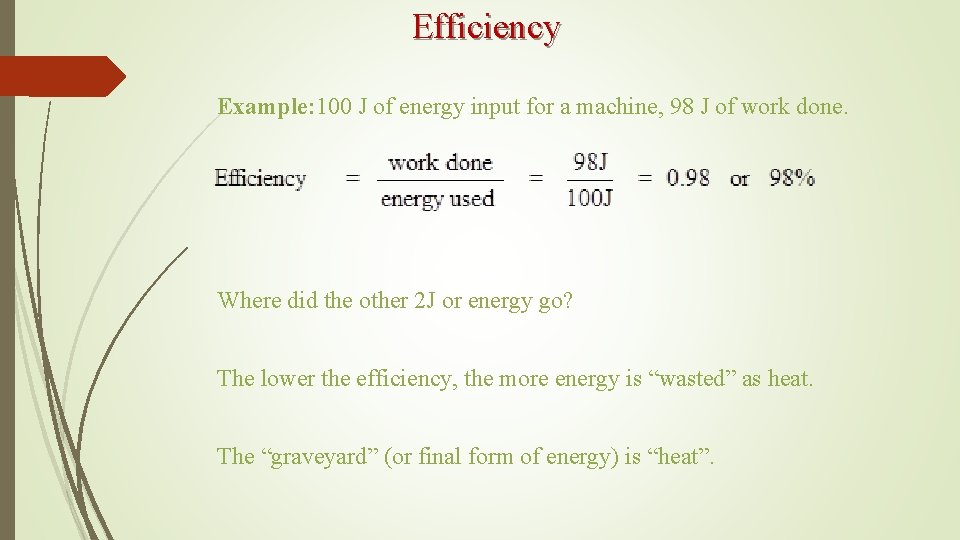
Efficiency Example: 100 J of energy input for a machine, 98 J of work done. Where did the other 2 J or energy go? The lower the efficiency, the more energy is “wasted” as heat. The “graveyard” (or final form of energy) is “heat”.

Energy Sources Sun - the most powerful energy source All natural power sources we have today originated from sun e. g. wind, hydro, thermal etc. Solar power – sunlight is directly transformed into electricity Wind power - turn into electricity using wind turbines Hydro power – water is used to turn turbines and produce electricity Nuclear power – stored energy in plutonium and uranium can be used to produce electricity Energy is needed for all living things
- Slides: 13