
What is Energy Grade 4 Big Idea 10
What is Energy? Grade 4 Big Idea 10: Forms of Energy
Benchmarks • SC. 4. P. 10. 1 Observe and describe some basic forms of energy, including light, heat, sound, electrical, and the energy of motion. • SC. 4. P. 10. 2 Investigate and describe that energy has the ability to cause motion or create change. • SC. 4. N. 1. 6 Keep records that describe observations made, carefully distinguishing actual observations from ideas and inferences about the observations. • SC. 4. N. 2. 1 Explain that science focuses solely on the natural world. Office of Academics - Department of Science
What do light, heat and motion have in common? They show Energy is all around us! – You can see energy as light from the sun or a lamp. – You can feel it as heat warms things up. – You can see motion energy every time you move.
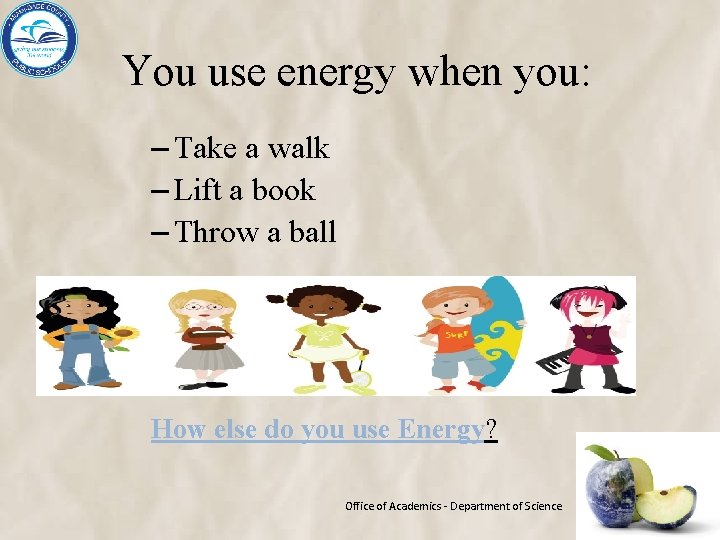
You use energy when you: – Take a walk – Lift a book – Throw a ball How else do you use Energy? Office of Academics - Department of Science
What is Energy? Energy makes things happen. Energy is the ability to cause a change. Energy can change an object’s Ø Motion Ø Shape Ø Temperature Ø Color Energy is the Ability to Do Work 5 Office of Academics - Department of Science
What is light ? • • Light is something that allows us to see objects. Light is a form of energy. Light is produced by the vibrations of electrically charged particles. Light travels in waves. Office of Academics - Department of Science
Following Light • Light bounces off or is reflected from some kinds of opaque objects. Angles of Reflection Office of Academics - Department of Science
Compare and Contrast Cardboard VS A Mirror Light does not pass through Ø opaque Ø Dull Ø Dark Ø Absorbs light Light does not pass through Ø opaque Ø shiny Ø Smooth Ø Reflects light Office of Academics - Department of Science
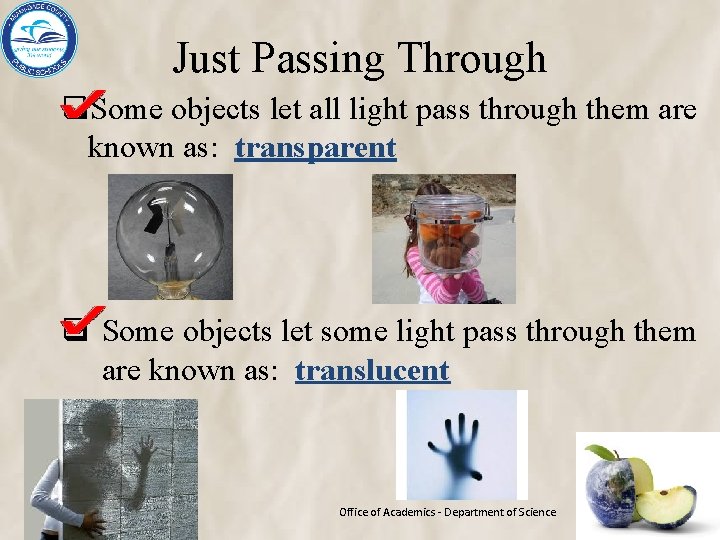
Just Passing Through q. Some objects let all light pass through them are known as: transparent q Some objects let some light pass through them are known as: translucent Office of Academics - Department of Science
Bending Light Lab Write down responses on your note page. § Problem: What does light do when it travels from one medium or state of matter (air) through another medium (water)? § Hypothesis: § Test and Observe: Follow steps from the lab sheet. § Conclusion: Office of Academics - Department of Science
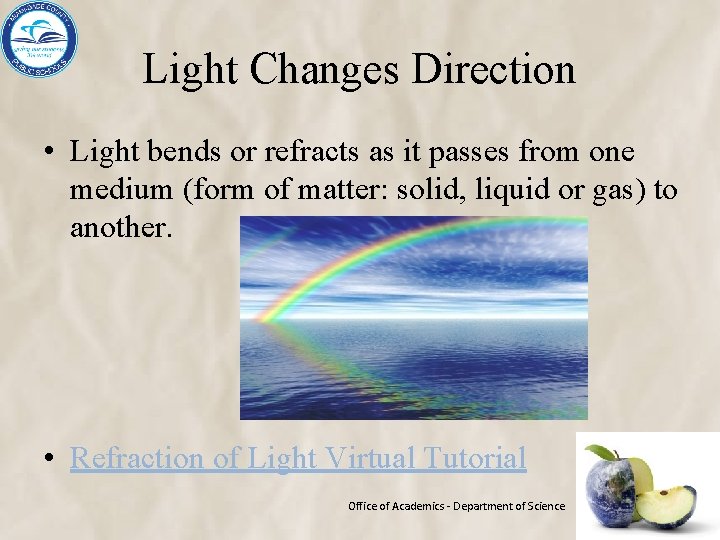
Light Changes Direction • Light bends or refracts as it passes from one medium (form of matter: solid, liquid or gas) to another. • Refraction of Light Virtual Tutorial Office of Academics - Department of Science
What Color is Light? Write down responses on your note page. § Problem: What happens when we shine a flashlight on a CD? § Hypothesis: § Test and Observe: § Conclusion: Office of Academics - Department of Science
TAG Reflections • Tell a fact you learned about light. • Ask a question about something you don’t understand about light. • Give another idea that was addressed in our study of energy.
Mechanical Energy • Mechanical energy is energy due to motion. • Energy of motion is also known as kinetic energy. Office of Academics - Department of Science
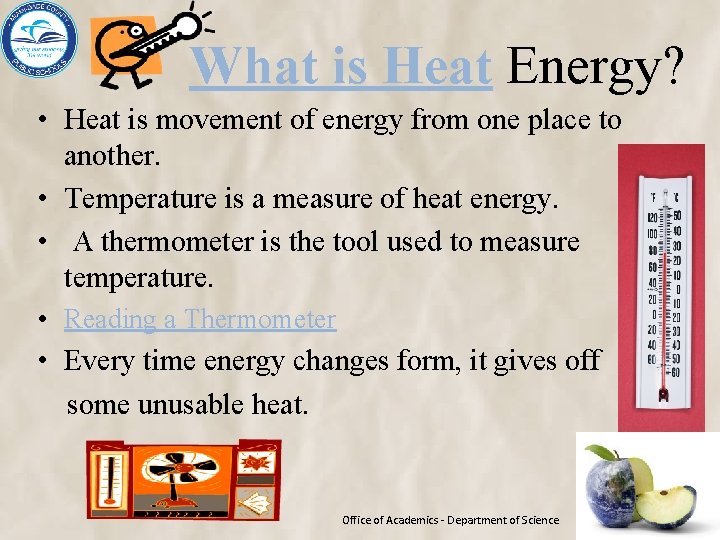
What is Heat Energy? • Heat is movement of energy from one place to another. • Temperature is a measure of heat energy. • A thermometer is the tool used to measure temperature. • Reading a Thermometer • Every time energy changes form, it gives off some unusable heat. Office of Academics - Department of Science
What happens in Heat/Thermal Energy ? • Energy is the movement of the atoms in an object. • Heat is the movement of energy from one place to another. • When any form of matter gets warmer, the kinetic energy of its atoms increases. • The object’s particles move faster, so its heat/thermal energy increases. • A change in thermal energy can lead to a change in phase or state of matter: - Ice melts from a solid to a liquid. - Liquid water changes to water vapor. Office of Academics - Department of Science
What is Electrical energy? • A form of energy that is produced when electrons move from one place to another. • Electrons are particles that are in the space around the nucleus of an atom. • The forces of attraction and repulsion make electrons move. • Try Exploring circuits. • Check out http: //www. energyquest. ca. gov/story/chapter 02. html • View Electricity Office of Academics - Department of Science
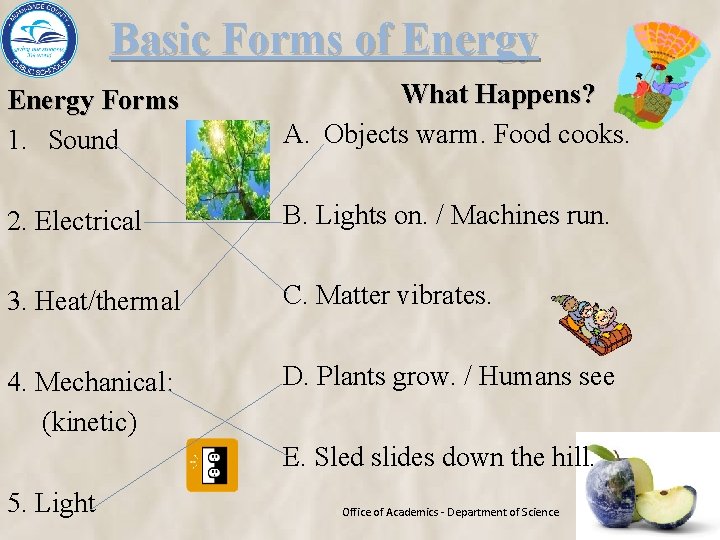
Basic Forms of Energy Forms 1. Sound What Happens? A. Objects warm. Food cooks. 2. Electrical B. Lights on. / Machines run. 3. Heat/thermal C. Matter vibrates. 4. Mechanical: (kinetic) D. Plants grow. / Humans see E. Sled slides down the hill. 5. Light Office of Academics - Department of Science
Concept Review: Forms of Energy 1. What is energy? Answer: Energy is the ability to cause motion, or make changes in an object. 2. What are the forms of energy? Answer: They are light, mechanical, sound, heat, and electricity. 3. What forms of energy can be observed using our senses? Answer: We can see energy when it is in the forms of motion and light. We can hear sound and we can feel heat.
Basic Forms of Energy Quiz Energy Forms ___1. Sound ___2. Electrical ___3. Heat/thermal ___4. Mechanical ___5. Light What Happens? Match – Up A. Objects warm. Food cooks. B. Lights on. / Machines run. C. Matter vibrates. D. Plants grow. / Humans see E. Sled slides down the hill.
List 5 forms of energy and give an example for each energy Energy Form 1. 2. 3. 4. 5. Example
Online Energy Videos and More q The Energy Story: http: //energyquest. ca. gov/story/index. html q Energy and the Environment: http: //www. childrensuniversity. manchester. ac. uk/interactives/science/en ergy q Mechanical Energy (animation) http: //app. discoveryeducation. com/player/? asset. Guid=2768797 e-a 7 a 045 f 5 -b 7 a 4812 cd 3422 f 7 d&from. My. De=0&is. Printer. Friendly=0&provider=&is. Lesson. Fro m. Health=0&productcode=DETB&is. Assigned=false&include. Header=YES&h omework. Guid= • Energy http: //www. energyeducation. tx. gov/energy/section_1/topics/index. htm • Kids and Energy http: //www. kids. esdb. bg/index. html • http: //www. acs. org/content/dam/acsorg/education/resources/k 8/science-activities/planetearth/air/heat-energy-extraordinaire. pdf
Discovery Ed. Resources • FUN-damental, Sound, Heat, and Light, to review heat • Exploration: Thermal Energy • Reading: Heat, a Form of Energy • https: //app. discoveryeducation. com/player/view/asset. Guid/FACCBA 9 C-F 31 F-477 F-8652 F 1611 DB 846 CA • Video: Heat Have each student record in a paragraph and draw a diagram of what happens to the molecules in matter when heat is added or is taken away.
- Slides: 23