
What is energy Energy is the capacity to

- Slides: 27
What is energy • Energy is the capacity to perform work, to bring about change, to make things happen. All cells use energy, such as growing or running human. • It can exist in many forms, such as chemical energy, light energy, electric energy, heat energy, nuclear energy and mechanical energy(potential and kinetic energy).
Activation energy • All reactions have a required energy of activation • All reactions have an energy barrier known as the energy of activation (EA) or activation energy. The energy barrier is the energy required to break the existing bonds and begin the reaction. • Therefore, Many chemical reactions need energy to start. This energy is called activation energy. Or Activation energy is required to initiate a chemical reactins.
Activation energy • Energy barrier in the cell is reduced with Some substances are called catalyst. It is special proteins called enzymes. • Enzyme lowers the activation energy for a reaction
• The biological catalysts in cells. • They regulate the rates of chemical reactions and affect the speed of a chemical reaction without being consumed by the reaction.
• The substance that an enzyme acts upon is called substrate.
ENZYME STRUCTURE According to their chemical composition, 1 -Simple enzyme 2 -Compound enzyme
Simple enzymes are composed of only protein. For ex: Pepsin.
• Compound enzymes are composed of protein and non protein components such as catalase, which has two subunits: • An apoenzyme • A non protein part, such as Coenzymes and Cofactors.
Apoenzyme • The protein component of a comlex enzyme is known as an apoenzyme. • It determines the direction of bichemical reactions which will be affected by the enzyme.
Cofactors • It is made up of inorganic molecules. For example minerals such as ca++, Mg++ and K+ ions. They participate in the structure of enzeymes. •
Coenzyme • It contains organic molecules. For examle, vitamines • Non protein groups (cofactors and coenzymes) are essential to the function of most enzymes and target the bonds of the substrate. The apoenzyme recognizes the substrate.
PROPERTIES OF ENZYMES • Enzymes never start the biochemical reactions. Enzymes speed up starting reaction rate • Enzymes decrease activation energy. • An enzyme can acts only one type of reaction. • For example: Amylases are group of enzymes which break down starch into sugar such as glucose Lipases, proteases……. .
PROPERTIES OF ENZYMES • As a result of reaction , Enzymes are not consumed or remain without changing • Enzymes can be used again and again. • Each enzyme works best at a certain p. H and temperature. • Enzymes are effective both inside and outside the cell • Generally, enzymes are named by adding ase at the end of the names of substrate.
PROPERTIES OF ENZYMES • Enzymes can works out of the cell. Enzymes are usually effective on the exterior of the substances. • For example: • V 1= An unbroken down liver part • V 2= Small broken down liver parts • V 3= Smallest broken down liver parts • How does occur speed order of them?
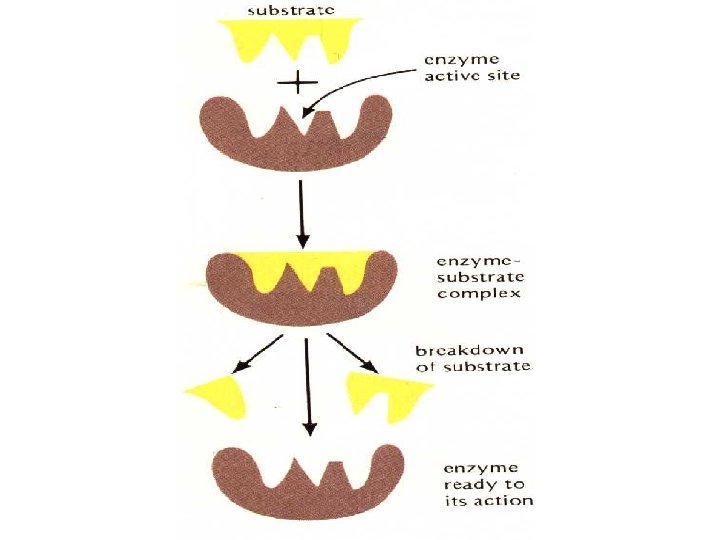
HOW ENZYMES WORK? • The theory of enzyme action is called LOCK and KEY MODEL ? ? ? • The Enzyme joins with substrate by its active site to form enzyme–substrate complex. • When the enzyme–substrate complex is formed, activation energy is lowered. • An enzyme can breakdown molecules and can join two molecules.
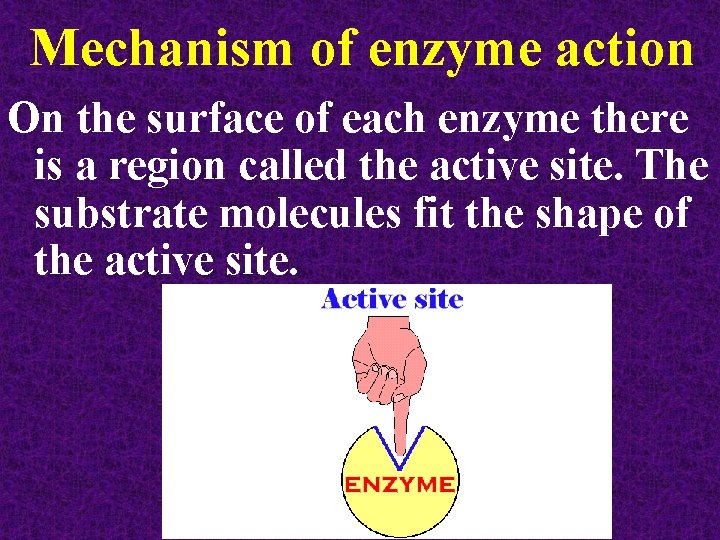
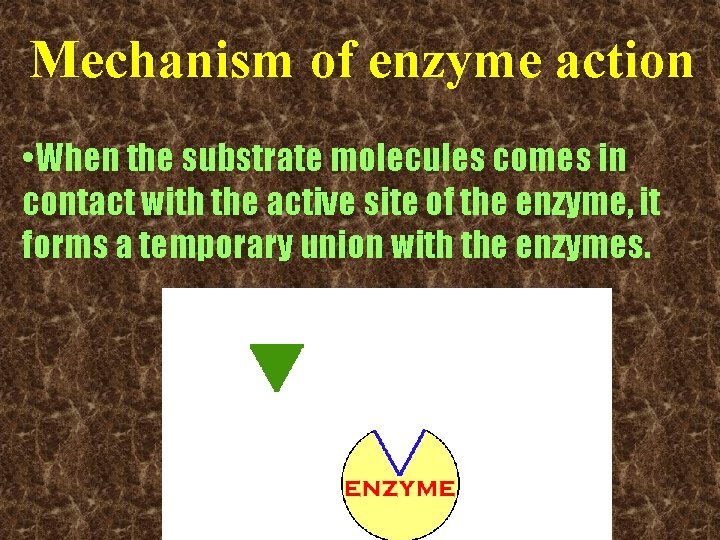
Mechanism of enzyme action On the surface of each enzyme there is a region called the active site. The substrate molecules fit the shape of the active site.
Mechanism of enzyme action • When the substrate molecules comes in contact with the active site of the enzyme, it forms a temporary union with the enzymes.
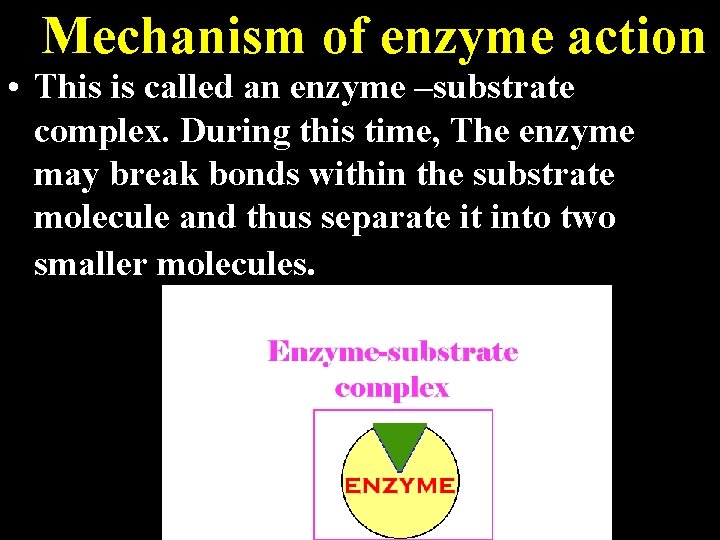
Mechanism of enzyme action • This is called an enzyme –substrate complex. During this time, The enzyme may break bonds within the substrate molecule and thus separate it into two smaller molecules.
The Factors which are Effective on the Speed of Enzyme Activity 1 - Enzyme Concentration 2 - Substrate Concentration 3 - Effect of PH 4 -Effect of Temperature 5 - Inhibitors
Effect of temperature on enzyme activity • The temperature which allows the highest enzyme activity is called the optimum temperature
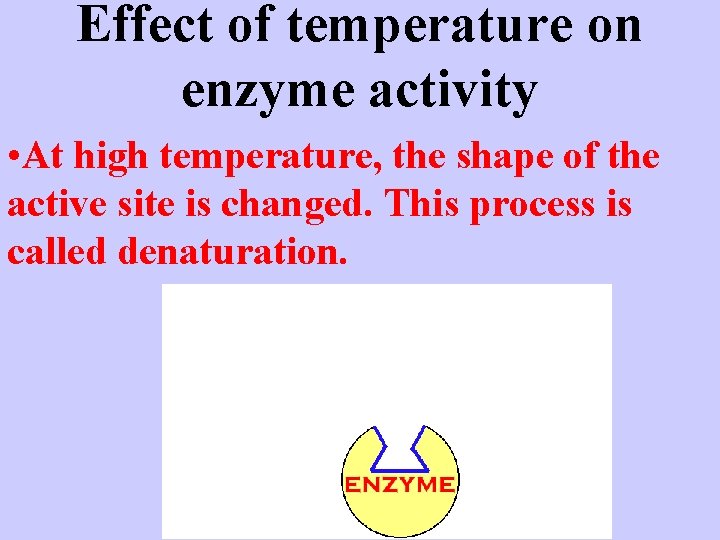
Effect of temperature on enzyme activity • At high temperature, the shape of the active site is changed. This process is called denaturation.
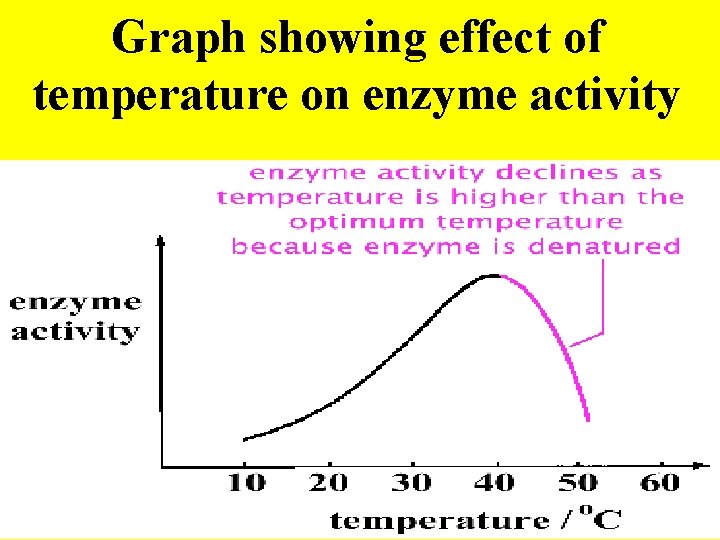
Graph showing effect of temperature on enzyme activity
Effect of temperature on enzyme activity • Different enzymes may have different optimum temperature. • The optimum temperature of many enzymes in human body is not 37 o. C, even though this is our body temperature!
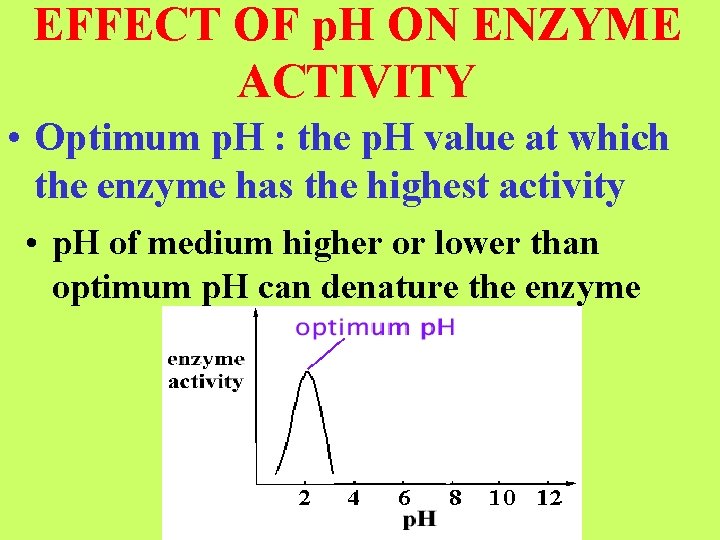
EFFECT OF p. H ON ENZYME ACTIVITY • Optimum p. H : the p. H value at which the enzyme has the highest activity • p. H of medium higher or lower than optimum p. H can denature the enzyme
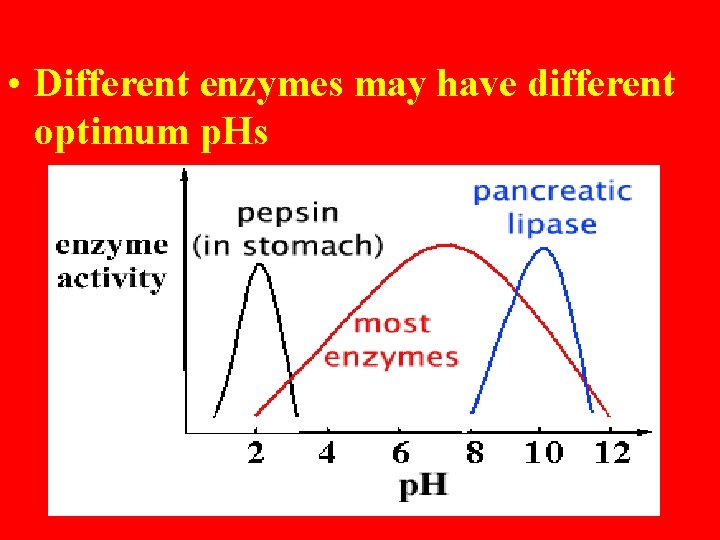
• Different enzymes may have different optimum p. Hs