
What is Emotion Emotion is a 4 part
- Slides: 50
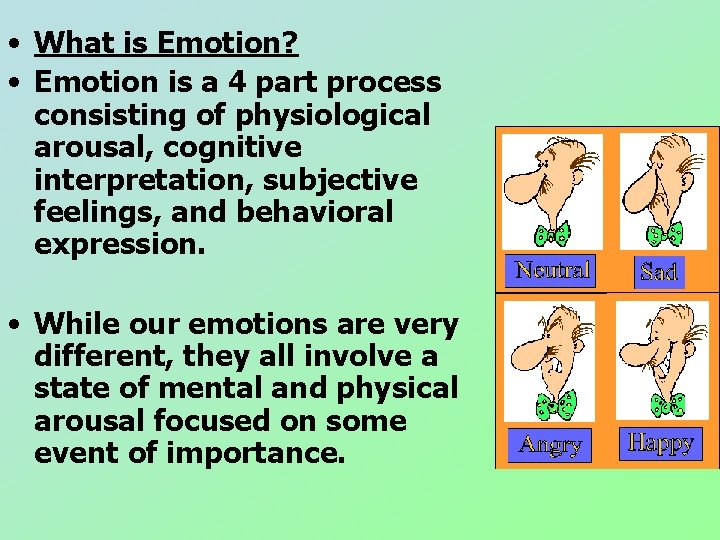
• What is Emotion? • Emotion is a 4 part process consisting of physiological arousal, cognitive interpretation, subjective feelings, and behavioral expression. • While our emotions are very different, they all involve a state of mental and physical arousal focused on some event of importance.
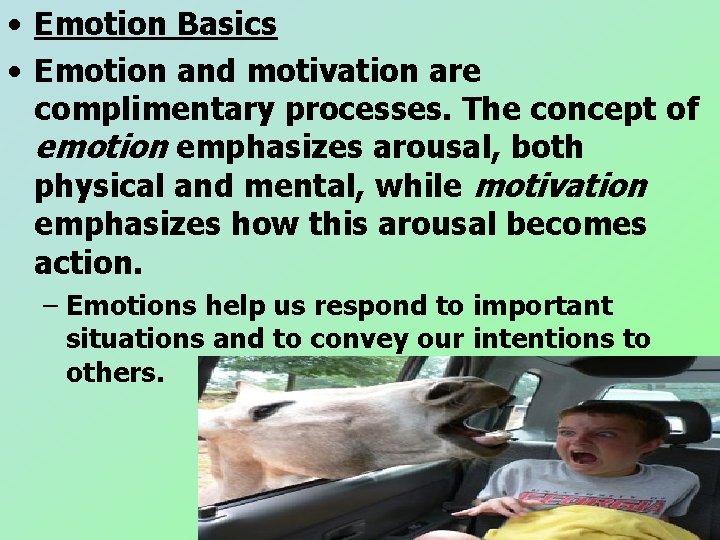
• Emotion Basics • Emotion and motivation are complimentary processes. The concept of emotion emphasizes arousal, both physical and mental, while motivation emphasizes how this arousal becomes action. – Emotions help us respond to important situations and to convey our intentions to others.
Why We Have Emotions – Emotions are the result of genetics and learning, especially early in life. • Emotions serve as arousal states that help organisms cope with important recurring situations. – Learned emotional responses, along with genetic predisposition are important components of many psychological disorders, including depression, panic attacks and phobias.
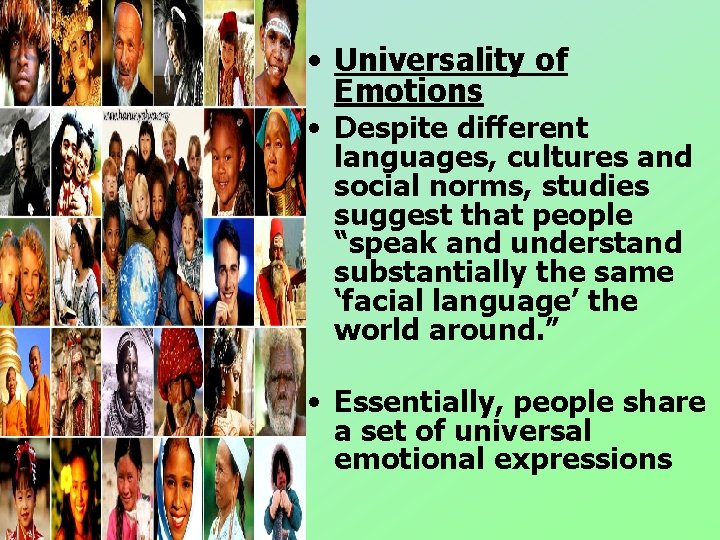
• Universality of Emotions • Despite different languages, cultures and social norms, studies suggest that people “speak and understand substantially the same ‘facial language’ the world around. ” • Essentially, people share a set of universal emotional expressions
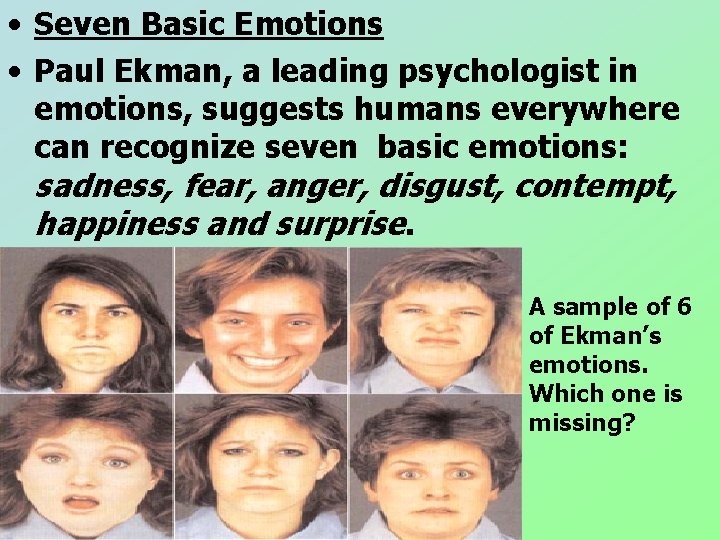
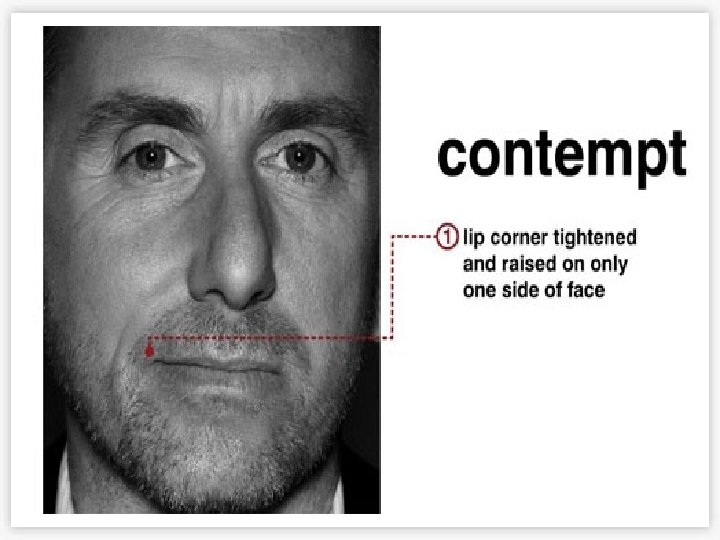
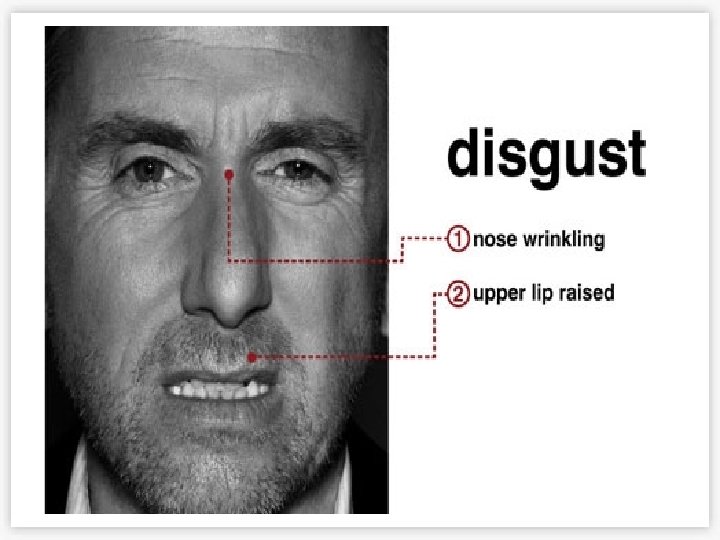
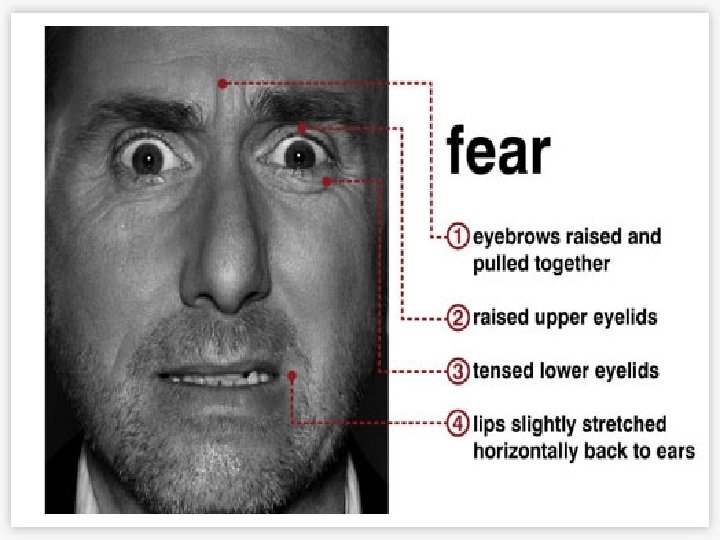
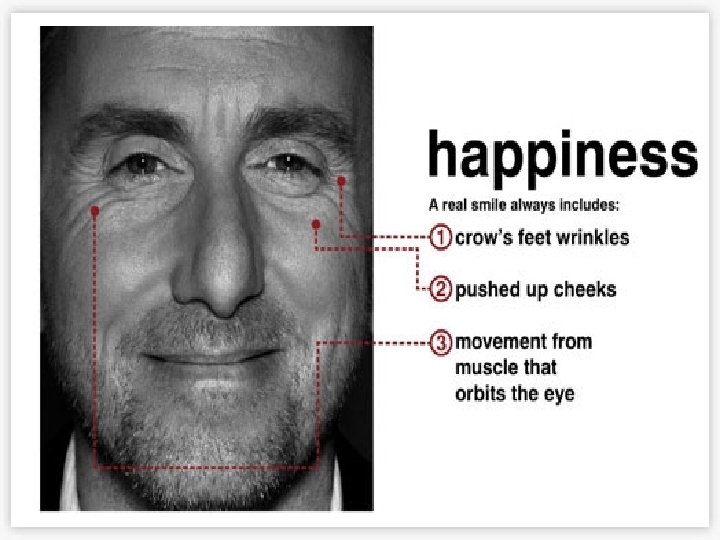
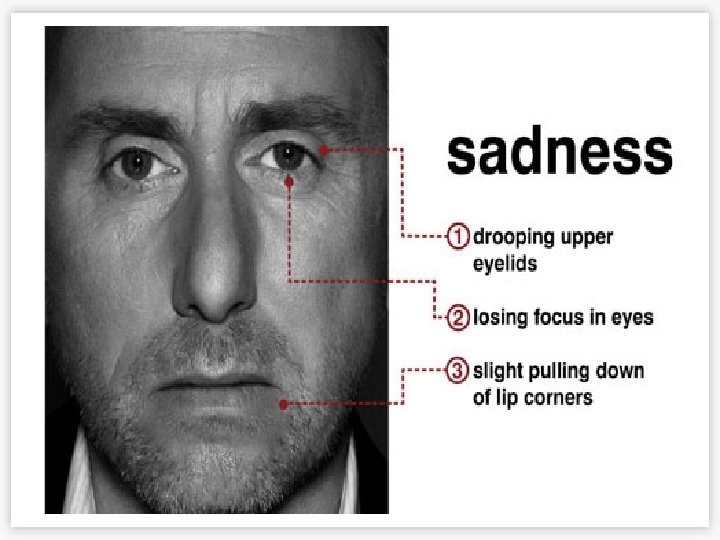
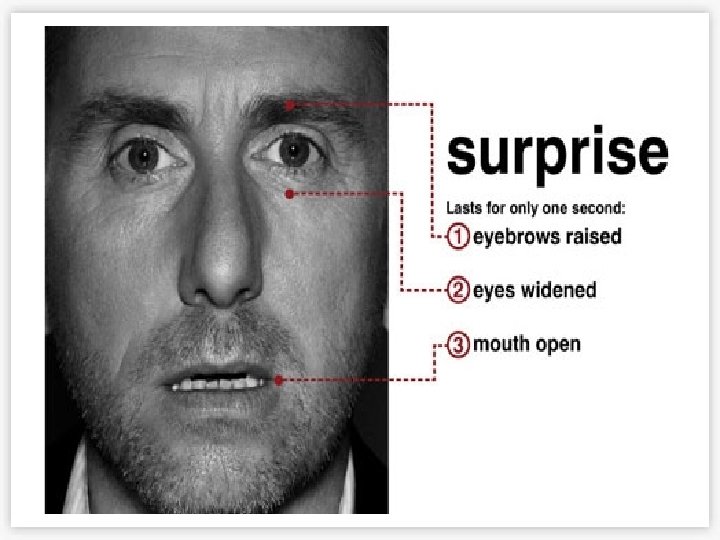
• Seven Basic Emotions • Paul Ekman, a leading psychologist in emotions, suggests humans everywhere can recognize seven basic emotions: sadness, fear, anger, disgust, contempt, happiness and surprise. A sample of 6 of Ekman’s emotions. Which one is missing?
• Display Rules • According to Ekman, the seven emotions are universal, but the display rules vary greatly, depending on the culture. • He defines display rules as the permissible ways of displaying emotions in a given society.
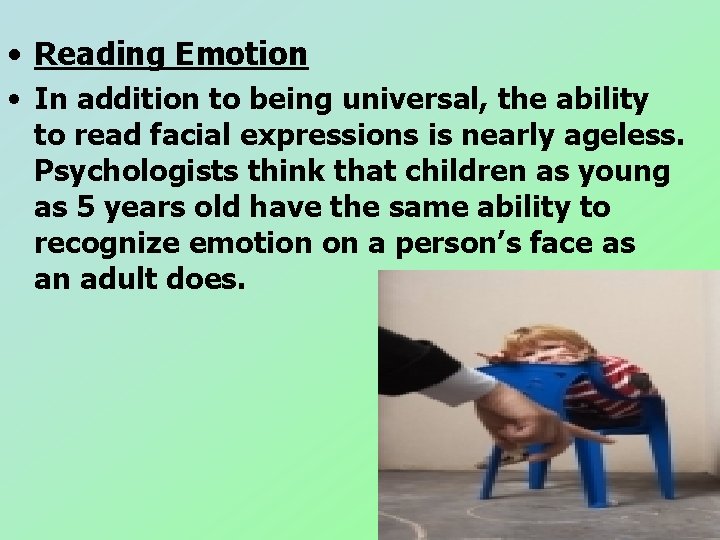
• Reading Emotion • In addition to being universal, the ability to read facial expressions is nearly ageless. Psychologists think that children as young as 5 years old have the same ability to recognize emotion on a person’s face as an adult does.
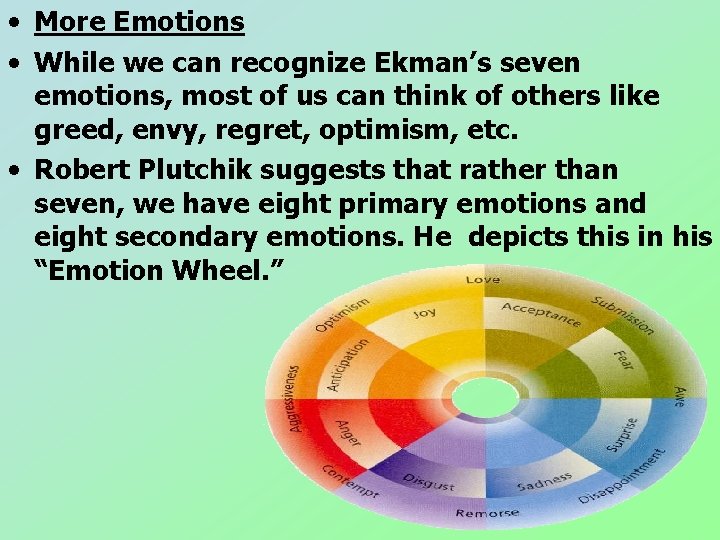
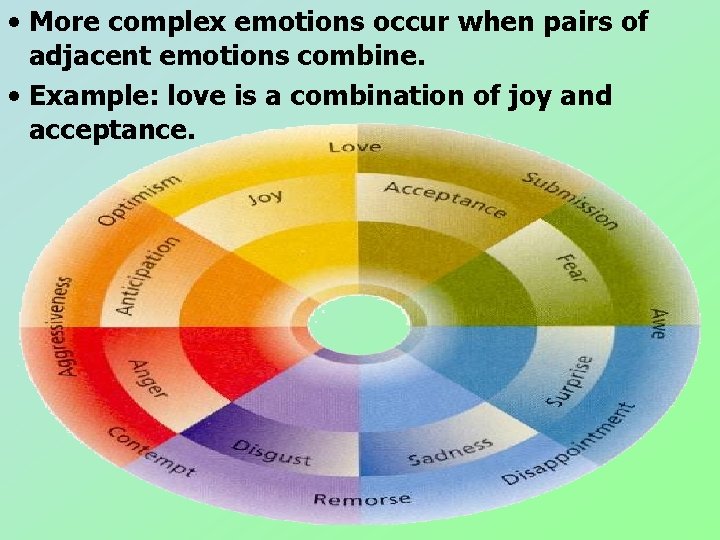
• More Emotions • While we can recognize Ekman’s seven emotions, most of us can think of others like greed, envy, regret, optimism, etc. • Robert Plutchik suggests that rather than seven, we have eight primary emotions and eight secondary emotions. He depicts this in his “Emotion Wheel. ”
• More complex emotions occur when pairs of adjacent emotions combine. • Example: love is a combination of joy and acceptance.
• Origins of Emotions • The biggest breakthrough in the study of emotions was the discovery of two distinct emotional pathways in the brain. – One of the pathways is fast, and operates mainly at an unconscious level where it screens incoming stimuli and helps us respond quickly to stimuli even before they reach consciousness. – These cues seem to have a built-in, innate sensitivity to certain cues – Explains why we have more fears of spiders, heights and lightening than cars or electricity.
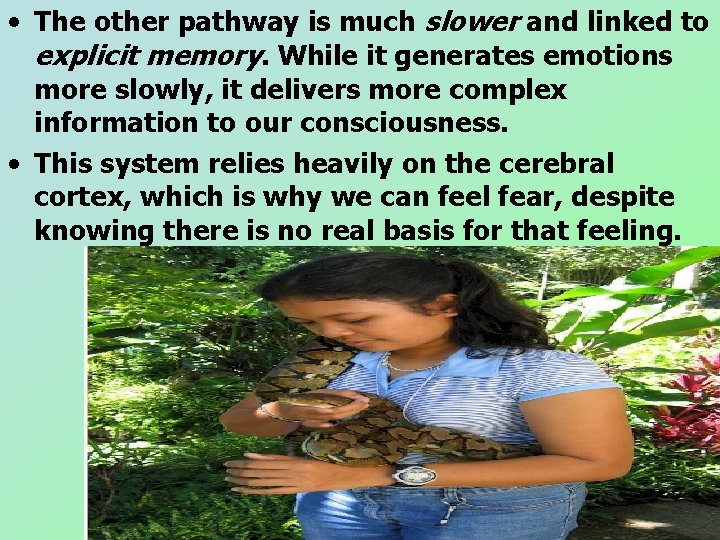
• The other pathway is much slower and linked to explicit memory. While it generates emotions more slowly, it delivers more complex information to our consciousness. • This system relies heavily on the cerebral cortex, which is why we can feel fear, despite knowing there is no real basis for that feeling.
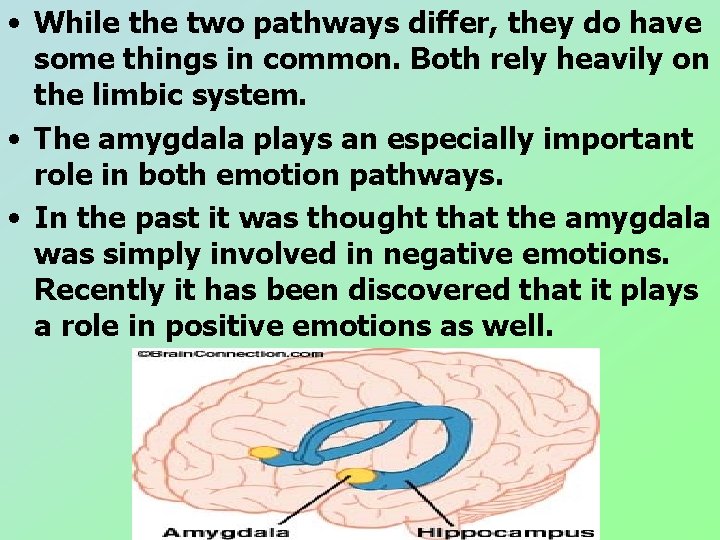
• While the two pathways differ, they do have some things in common. Both rely heavily on the limbic system. • The amygdala plays an especially important role in both emotion pathways. • In the past it was thought that the amygdala was simply involved in negative emotions. Recently it has been discovered that it plays a role in positive emotions as well.
• Emotion in Men and Women • In our culture, on average, women are viewed as far more emotional than men. This may be the result of two factors. • 1. Biology, and the genetic make-up of men and women do lead to women “having more emotion. ” • 2. Culture, may be the bigger of the two causes. Boys and girls learn different lessons about emotion and emotional control. Boys are largely taught to hide emotions that may be seen as weaknesses and are praised for emotions that show strength and dominance. Girls are taught the exact opposite.
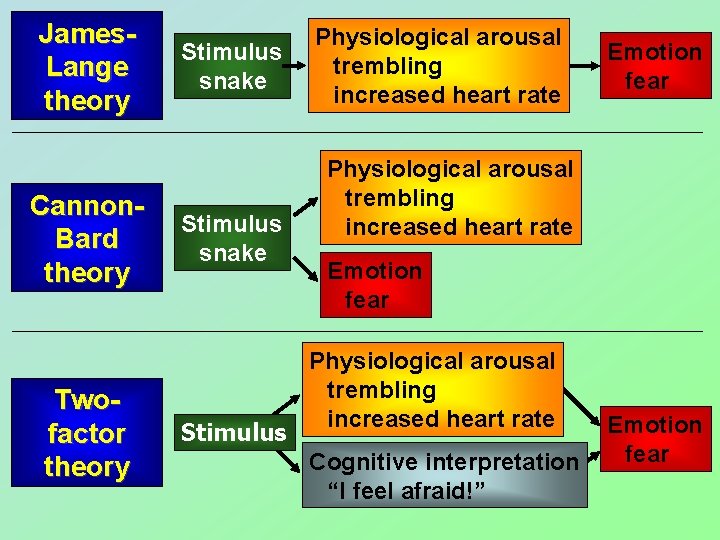
• Psychological Theories of Emotion • There are multiple theories on how our emotions affect out behavior and mental processes. • James-Lang Theory: An emotion-provoking stimulus which produces a physical response, that then leads to emotion. • Emotion follows behavior • “We feel sorry because we cry; angry because we strike; afraid because we tremble. ”-William James • Cannon-Bard Theory: A theory that an emotional feeling and an internal physiological response occur at the same time. • Emotion and behavior simultaneously
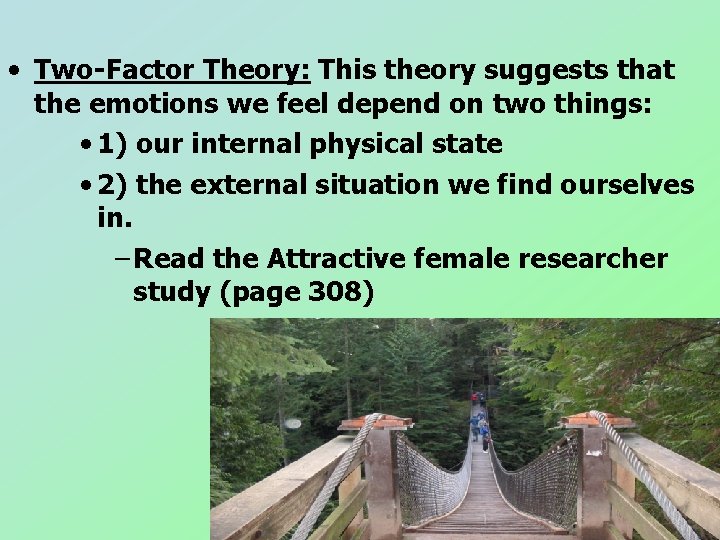
• Two-Factor Theory: This theory suggests that the emotions we feel depend on two things: • 1) our internal physical state • 2) the external situation we find ourselves in. – Read the Attractive female researcher study (page 308)
James. Lange theory Cannon. Bard theory Twofactor theory Stimulus snake Stimulus Physiological arousal trembling increased heart rate Emotion fear Physiological arousal trembling increased heart rate Cognitive interpretation “I feel afraid!” Emotion fear
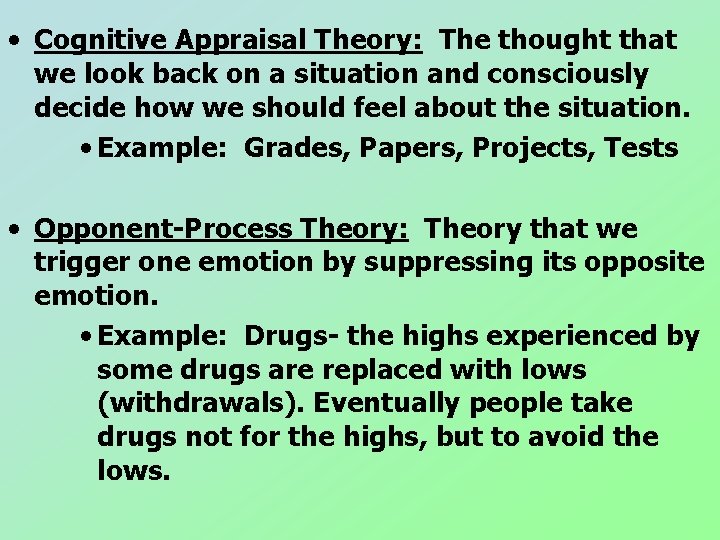
• Cognitive Appraisal Theory: The thought that we look back on a situation and consciously decide how we should feel about the situation. • Example: Grades, Papers, Projects, Tests • Opponent-Process Theory: Theory that we trigger one emotion by suppressing its opposite emotion. • Example: Drugs- the highs experienced by some drugs are replaced with lows (withdrawals). Eventually people take drugs not for the highs, but to avoid the lows.
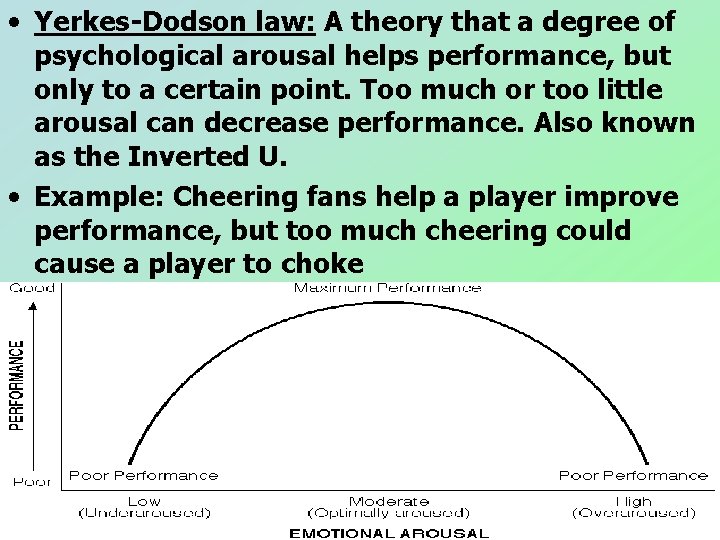
• Yerkes-Dodson law: A theory that a degree of psychological arousal helps performance, but only to a certain point. Too much or too little arousal can decrease performance. Also known as the Inverted U. • Example: Cheering fans help a player improve performance, but too much cheering could cause a player to choke
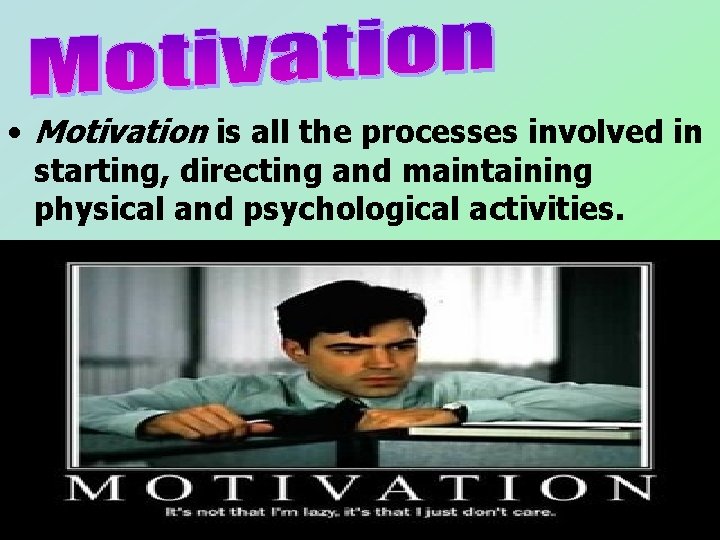
• Motivation is all the processes involved in starting, directing and maintaining physical and psychological activities.
• Motivation • Psychologists see motivation as being an important part of human nature: • 1. Motivation connects observable behavior to internal states • Example: When we see someone eating we may infer that a hunger drive is at work • However, eating can be caused by other things (stress, desire to gain weight, etc. ) • 2. Motivation accounts for variability in behavior • Example: the intensity may explain why someone plays tennis well one day, and poorly another
• 3. Motivation creates perseverance despite adversity • Example: Gets us to school or work on time even when we have faced difficult situations • 4. Motives relate biology to behavior • Example: Feeling thirsty motivates us to drink • Types of Motivation • Drive: Biologically instigated motivation. A state of tension is created, which humans will seek to correct. • Drinking water, eating • Motive: Motivational process that is learned. • Achievement
• Extrinsic vs. Intrinsic Motivation • Extrinsic Motivation: A desire to perform a behavior because of promised reward or threats of punishments. • Examples: • Money, grades, or praise • Intrinsic Motivation: A desire to perform a behavior for its own sake rather than for some external consequence or reward. • Examples: • Cycling, exercising, playing the guitar • So which type of motivation is better? Which produces more, positive results?
• Research indicates that intrinsic motivation has an edge over extrinsic motivation in most cases. • This does not mean that extrinsic motivation isn’t good or does not work. In many cases, the two work together. • For example, journalism students who wash cars as a fund raiser all spring and summer to pay for a trip to the national convention in St. Louis in the fall are working to make money…. extrinsic motivation. Their desire to go to the convention, however, is intrinsic motivation.
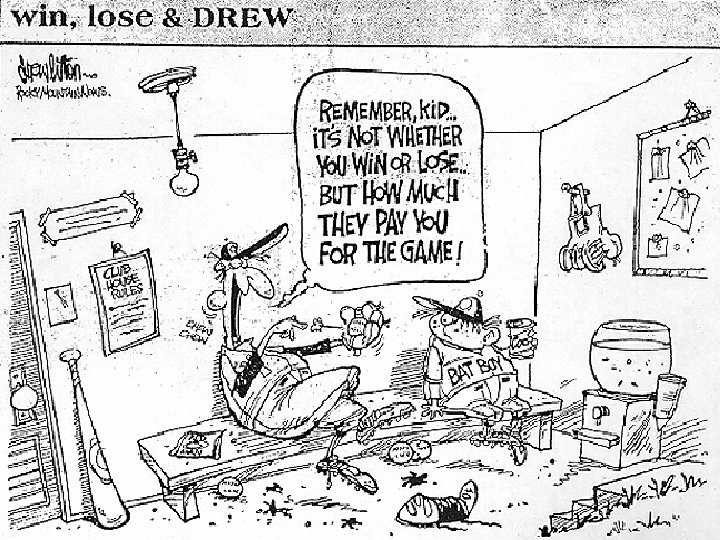
• Problems with Extrinsic Motivation • A primary concern about external rewards, however, is that behaviors maintained by extrinsic motivation alone may not be enough to be effectively sustained once the motivation is gone. – Example: Will a student’s grades go down if their parents stop giving them money for earning As and Bs? – Evidence suggests that the removal of an extrinsic motivation will result in behavior levels lower than before the rewards were given. – http: //www. youtube. com/watch? v=u 6 XAPn u. Fj. Jc
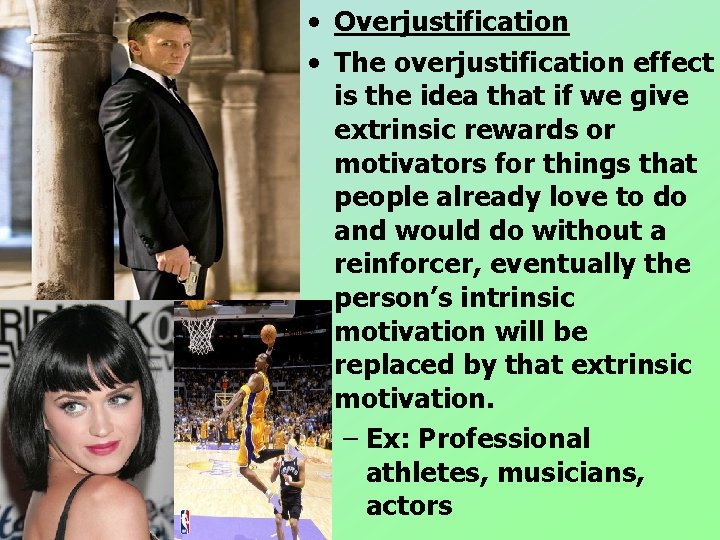
• Overjustification • The overjustification effect is the idea that if we give extrinsic rewards or motivators for things that people already love to do and would do without a reinforcer, eventually the person’s intrinsic motivation will be replaced by that extrinsic motivation. – Ex: Professional athletes, musicians, actors
• Theories of Motivation • Instinct Theory: The theory that all behaviors will be determined by innate factors and biologically based behaviors that generally lead to survival. – The term instinct was becoming overused, so the psychologist changed the phrase they use to fixed-action patterns. • Birds migrating, salmon returning to creeks to spawn – Why do you think this theory became outdated? – Does this theory really explain behavior?
• Drive Reduction Theory • Drive-Reduction Theory: The idea that a physiological need creates a state of tension (a drive) motivating and organism to satisfy their needs. – Drive-reduction theory states that a person will eat food as a result of a drive of hunger (a state of tension that humans seek to correct). – The theory aims for homeostasis, or biological balance Need Drive (food, water) (hunger, thirst) Drive-reducing behaviors (eating, drinking)
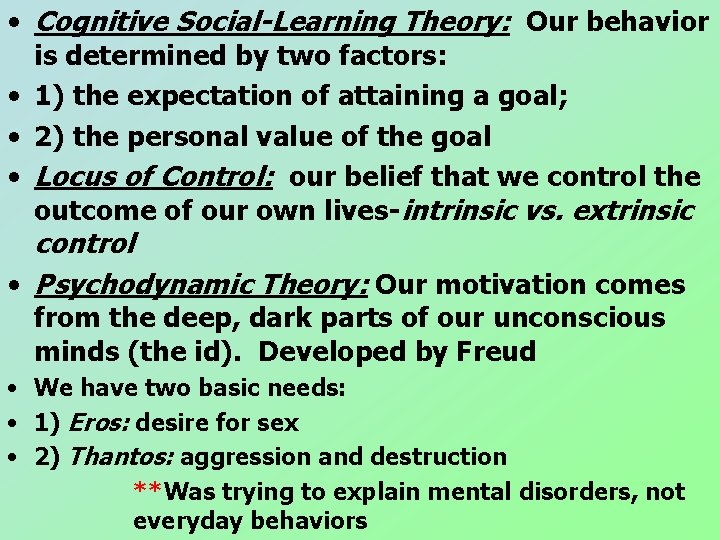
• Cognitive Social-Learning Theory: Our behavior is determined by two factors: • 1) the expectation of attaining a goal; • 2) the personal value of the goal • Locus of Control: our belief that we control the outcome of our own lives-intrinsic vs. extrinsic control • Psychodynamic Theory: Our motivation comes from the deep, dark parts of our unconscious minds (the id). Developed by Freud • We have two basic needs: • 1) Eros: desire for sex • 2) Thantos: aggression and destruction **Was trying to explain mental disorders, not everyday behaviors
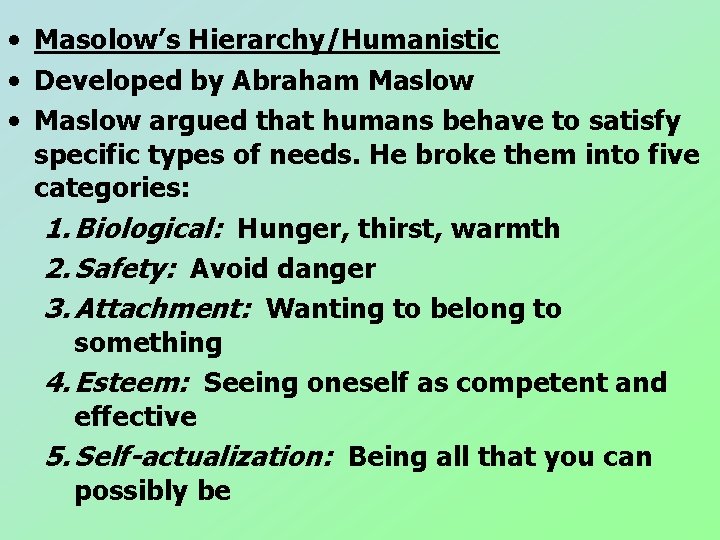
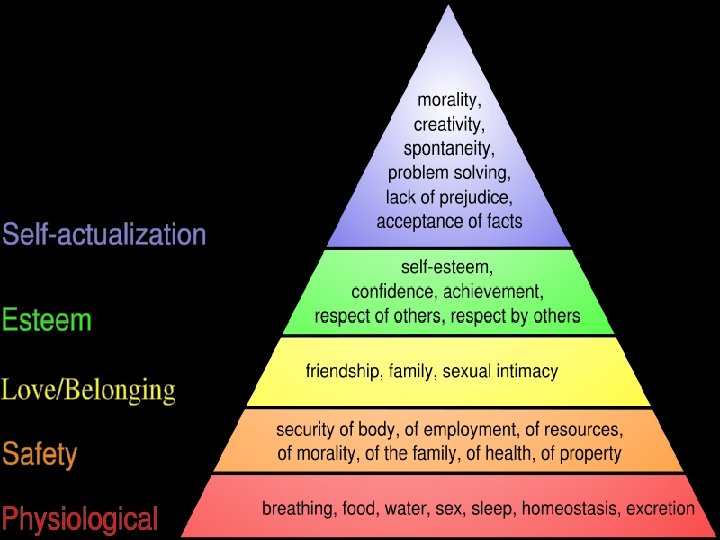
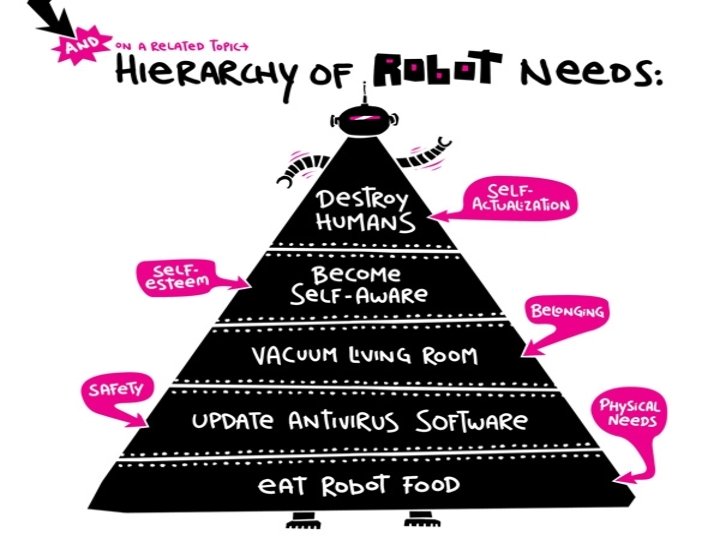
• Masolow’s Hierarchy/Humanistic • Developed by Abraham Maslow • Maslow argued that humans behave to satisfy specific types of needs. He broke them into five categories: 1. Biological: Hunger, thirst, warmth 2. Safety: Avoid danger 3. Attachment: Wanting to belong to something 4. Esteem: Seeing oneself as competent and effective 5. Self-actualization: Being all that you can possibly be
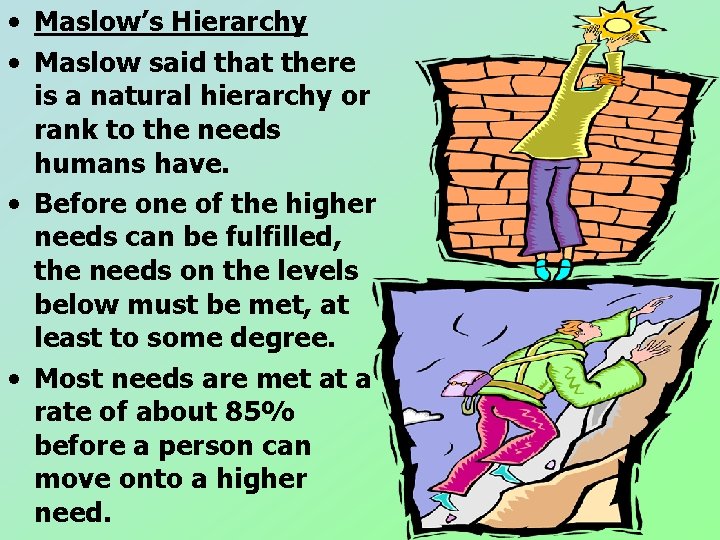
• Maslow’s Hierarchy • Maslow said that there is a natural hierarchy or rank to the needs humans have. • Before one of the higher needs can be fulfilled, the needs on the levels below must be met, at least to some degree. • Most needs are met at a rate of about 85% before a person can move onto a higher need.
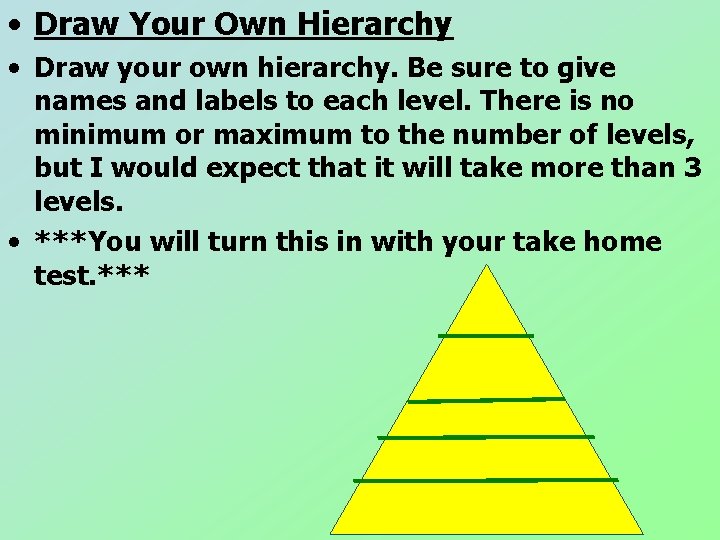
• Draw Your Own Hierarchy • Draw your own hierarchy. Be sure to give names and labels to each level. There is no minimum or maximum to the number of levels, but I would expect that it will take more than 3 levels. • ***You will turn this in with your take home test. ***
• Criticism of Maslow • Although critics will admit Maslow’s Hierarchy was the first real step toward a comprehensive theory of motivation, they say it isn’t complete. • People often neglect their basic biological needs for more social needs • Cross-cultural needs: individualistic vs. collectivist cultures see needs differently • Sensation seeking: Why would someone jump out of a plane for “fun? ” • Fails to explain the behavior of people who take their own lives
• Stress • In psychology, stress is not a situation, but a response. • Psychologists talk about stress and stressors a little different than you or I might: • Stress: A physical and mental response to a a challenging or threatening situation • Stressor: A stressful stimulus or situation demanding adaptation
• Traumatic Stressors • Certain events go beyond a “normal” stressor; examples would be the World Tsunami in 2004, 9/11, Columbine, Hurricane Katriana, 9/11, etc. • These are called traumatic stressors. To be considered a traumatic stressor, it must be a situation that threatens yours, or others’ physical safety and promotes a feeling of helplessness. • Human created catastrophes are always worse, why?
• Response to Traumatic Stressors • In the face of catastrophic situations, most people pass through five stages: 1)Psychic Numbness: shock, confusion, lack of understanding 2)Automatic Action: little awareness of the experience, poor memory/recall 3)Communal Effort: people work together, but with little planning 4)Letdown: the setting-in of the magnitude and impact of the situation 5)Recovery: survivors adapt to changes caused by the disaster
• Post Traumatic Stress Disorder: • Individuals who have undergone severe ordeals -rape, combat, beatings, torture-may experience a delayed pattern of stress symptoms that can appear as long as years after the event. – Victims of PTSD often have the following symptoms: • Distracted • Disorganized • Suffer memory difficulties • Experience psychic numbing • Feelings of alienation
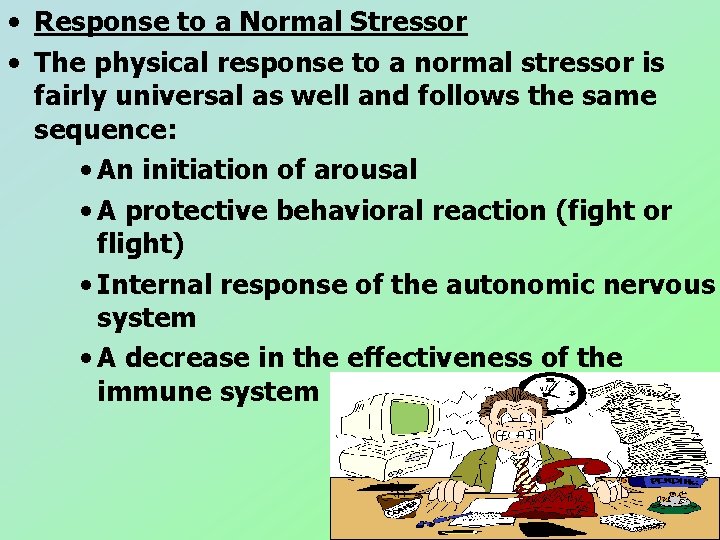
• Response to a Normal Stressor • The physical response to a normal stressor is fairly universal as well and follows the same sequence: • An initiation of arousal • A protective behavioral reaction (fight or flight) • Internal response of the autonomic nervous system • A decrease in the effectiveness of the immune system
• Types of Stress • Despite the bad name that stress has, it is actually a vital part of our lives, as long as it is controlled. • There are two main types of stress: – Acute Stress: A temporary pattern of stressoractivated arousal with a distinct onset, and limited duration » Short term stress – Chronic Stress: A continuous state of stressful arousal, persisting over time. » Long term stress
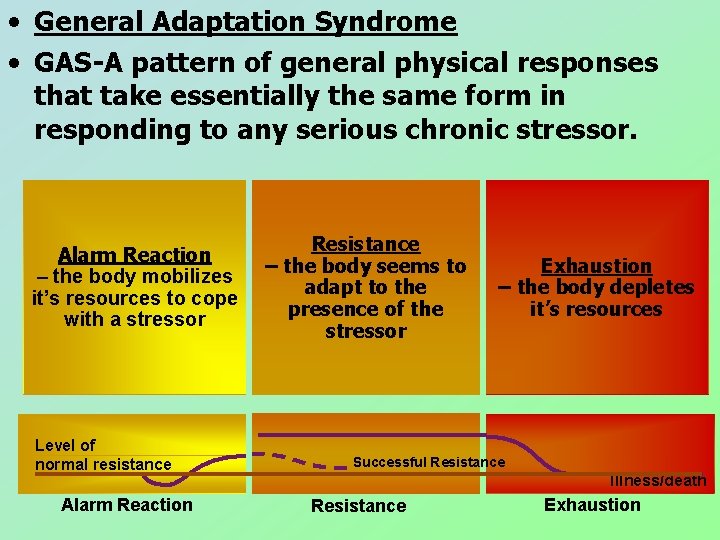
• General Adaptation Syndrome • GAS-A pattern of general physical responses that take essentially the same form in responding to any serious chronic stressor. Alarm Reaction – the body mobilizes it’s resources to cope with a stressor Level of normal resistance Alarm Reaction Resistance – the body seems to adapt to the presence of the stressor Exhaustion – the body depletes it’s resources Successful Resistance Illness/death Resistance Exhaustion