
What is electric current A flow of charged
- Slides: 14
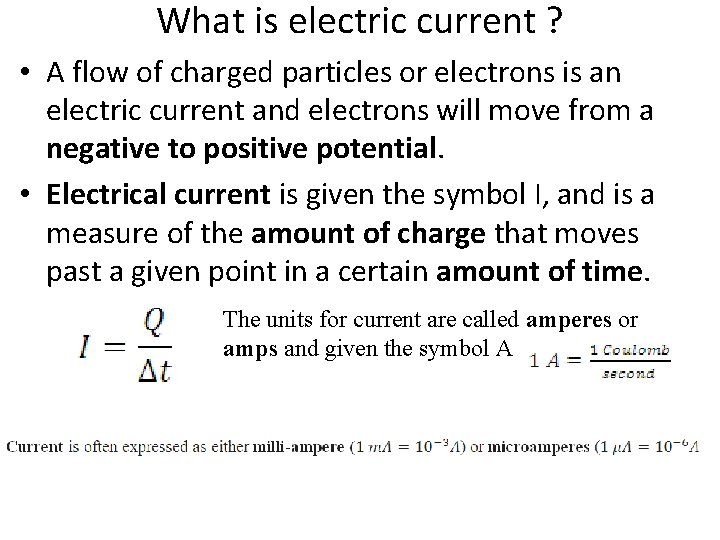
What is electric current ? • A flow of charged particles or electrons is an electric current and electrons will move from a negative to positive potential. • Electrical current is given the symbol I, and is a measure of the amount of charge that moves past a given point in a certain amount of time. The units for current are called amperes or amps and given the symbol A
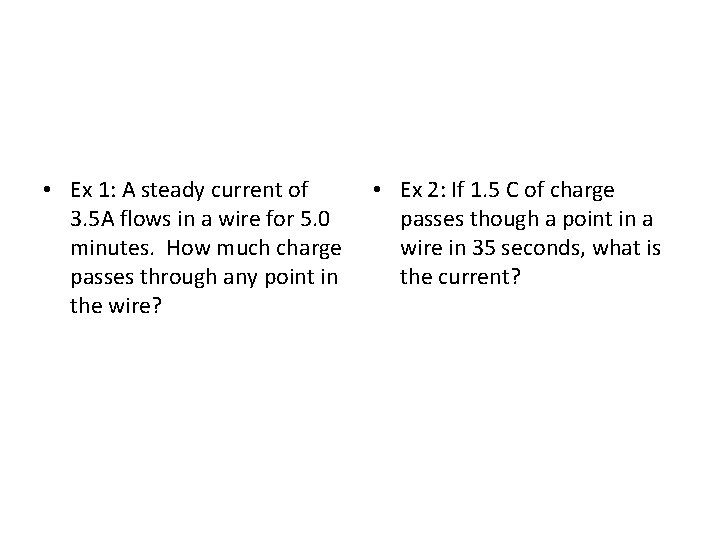
• Ex 1: A steady current of 3. 5 A flows in a wire for 5. 0 minutes. How much charge passes through any point in the wire? • Ex 2: If 1. 5 C of charge passes though a point in a wire in 35 seconds, what is the current?
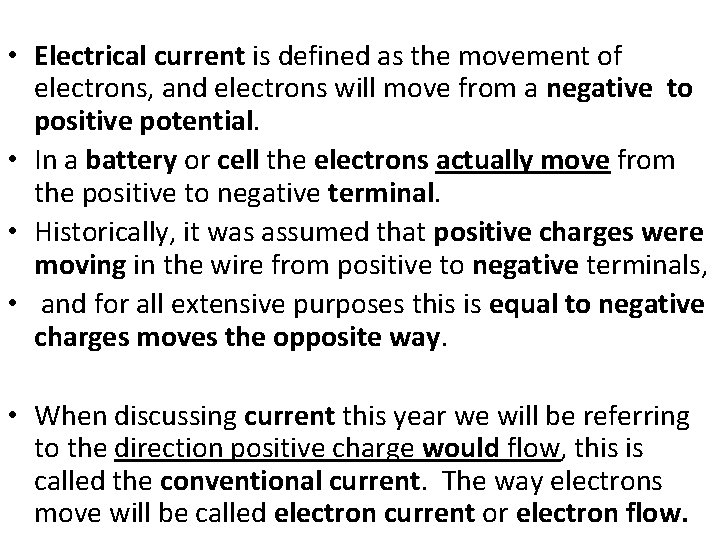
• Electrical current is defined as the movement of electrons, and electrons will move from a negative to positive potential. • In a battery or cell the electrons actually move from the positive to negative terminal. • Historically, it was assumed that positive charges were moving in the wire from positive to negative terminals, • and for all extensive purposes this is equal to negative charges moves the opposite way. • When discussing current this year we will be referring to the direction positive charge would flow, this is called the conventional current. The way electrons move will be called electron current or electron flow.
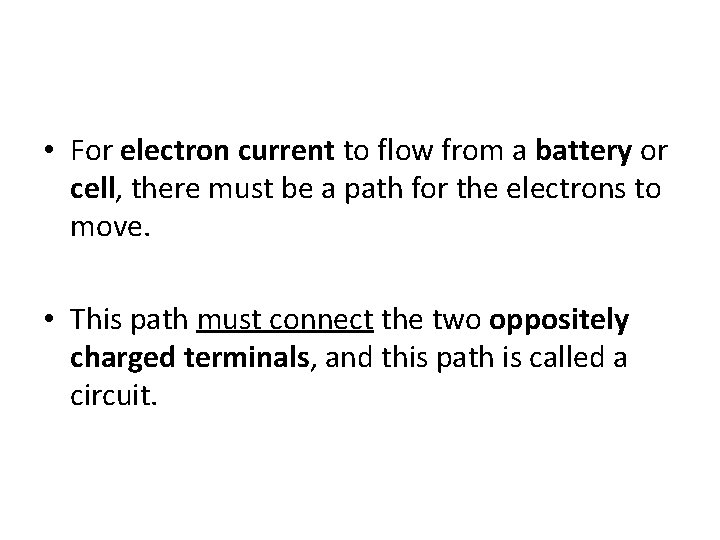
• For electron current to flow from a battery or cell, there must be a path for the electrons to move. • This path must connect the two oppositely charged terminals, and this path is called a circuit.
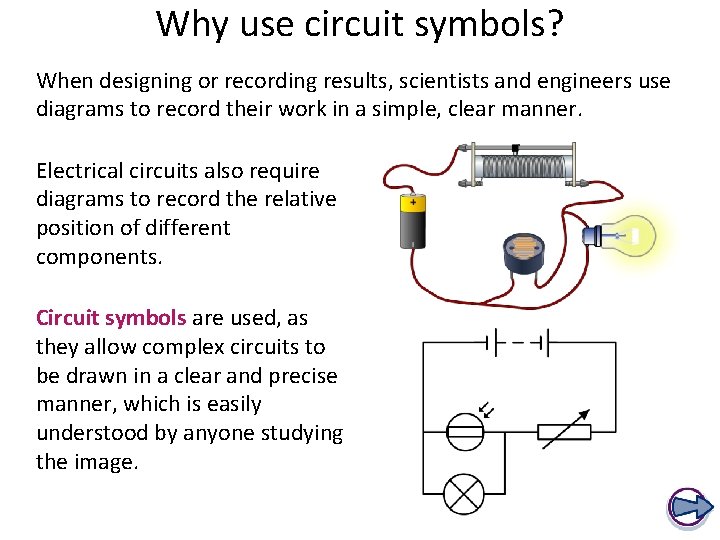
Why use circuit symbols? When designing or recording results, scientists and engineers use diagrams to record their work in a simple, clear manner. Electrical circuits also require diagrams to record the relative position of different components. Circuit symbols are used, as they allow complex circuits to be drawn in a clear and precise manner, which is easily understood by anyone studying the image.
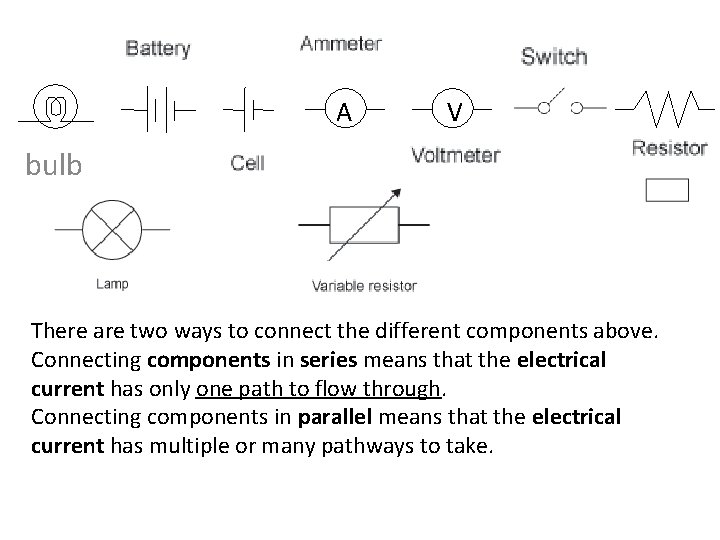
A V bulb There are two ways to connect the different components above. Connecting components in series means that the electrical current has only one path to flow through. Connecting components in parallel means that the electrical current has multiple or many pathways to take.
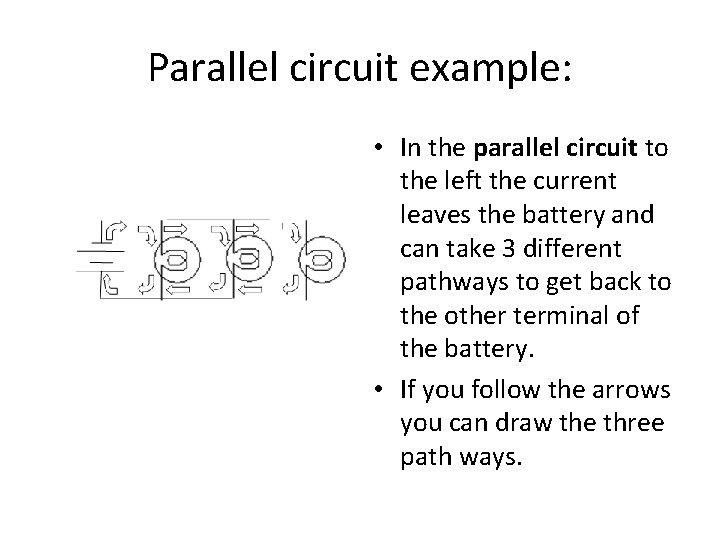
Parallel circuit example: • In the parallel circuit to the left the current leaves the battery and can take 3 different pathways to get back to the other terminal of the battery. • If you follow the arrows you can draw the three path ways.
Drawing circuits: Voltmeter Ammeter
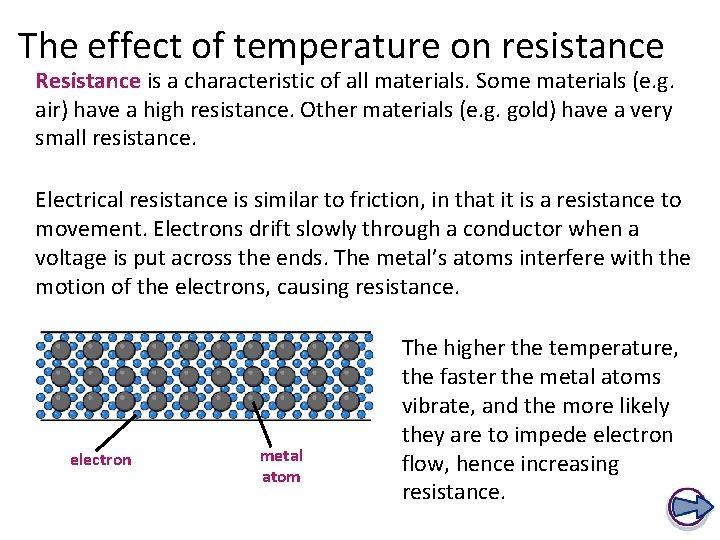
The effect of temperature on resistance Resistance is a characteristic of all materials. Some materials (e. g. air) have a high resistance. Other materials (e. g. gold) have a very small resistance. Electrical resistance is similar to friction, in that it is a resistance to movement. Electrons drift slowly through a conductor when a voltage is put across the ends. The metal’s atoms interfere with the motion of the electrons, causing resistance. electron metal atom The higher the temperature, the faster the metal atoms vibrate, and the more likely they are to impede electron flow, hence increasing resistance.
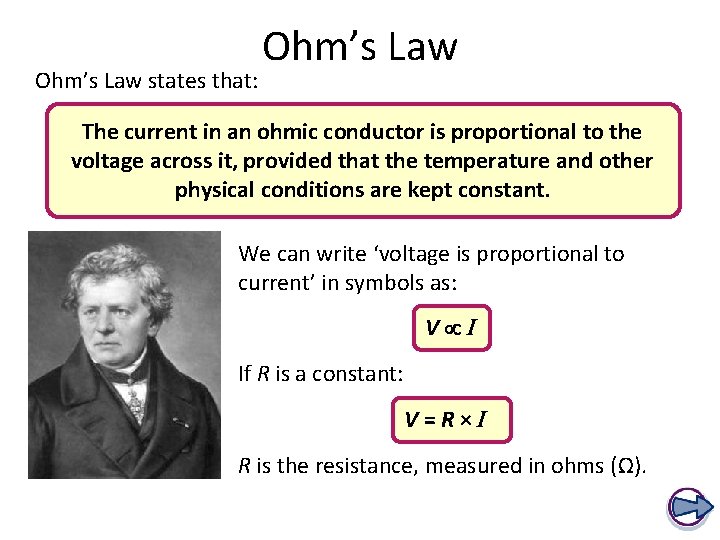
Ohm’s Law states that: Ohm’s Law The current in an ohmic conductor is proportional to the voltage across it, provided that the temperature and other physical conditions are kept constant. We can write ‘voltage is proportional to current’ in symbols as: V µ I If R is a constant: V = R × I R is the resistance, measured in ohms (Ω).
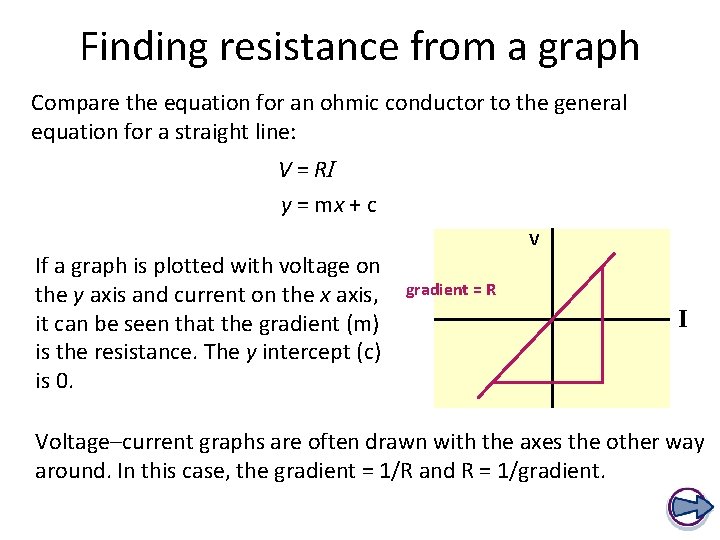
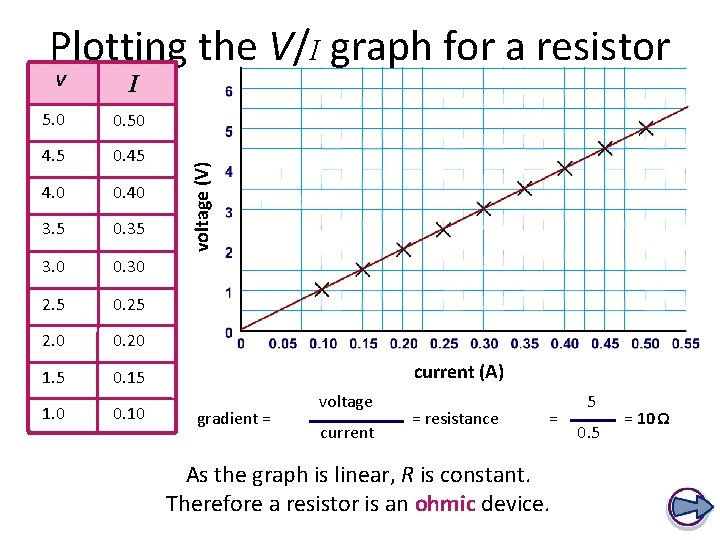
Finding resistance from a graph Compare the equation for an ohmic conductor to the general equation for a straight line: V = RI y = mx + c V If a graph is plotted with voltage on the y axis and current on the x axis, it can be seen that the gradient (m) is the resistance. The y intercept (c) is 0. gradient = R I Voltage–current graphs are often drawn with the axes the other way around. In this case, the gradient = 1/R and R = 1/gradient.
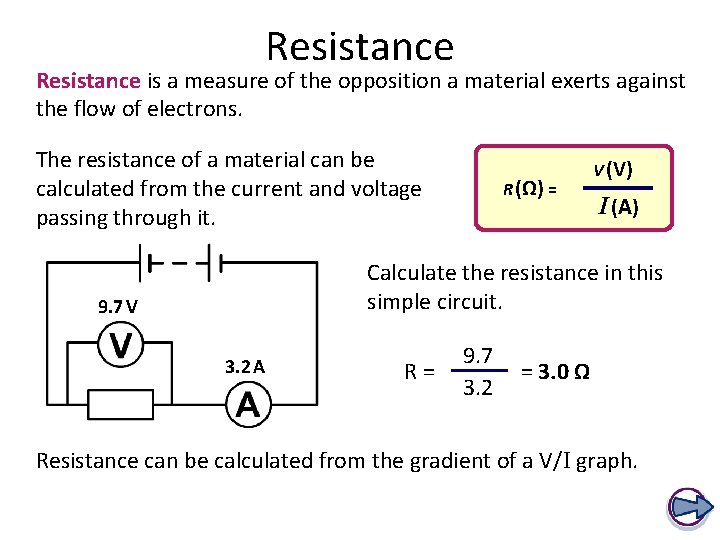
Resistance is a measure of the opposition a material exerts against the flow of electrons. The resistance of a material can be calculated from the current and voltage passing through it. R (Ω) = V (V) I (A ) Calculate the resistance in this simple circuit. 9. 7 V 3. 2 A R= 9. 7 3. 2 = 3. 0 Ω Resistance can be calculated from the gradient of a V/I graph.
Plotting the V/I graph for a resistor I 5. 0 0. 50 4. 5 0. 45 4. 0 0. 40 3. 5 0. 35 3. 0 0. 30 2. 5 0. 25 2. 0 0. 20 1. 5 0. 15 1. 0 0. 10 voltage (V) V current (A) gradient = voltage current = resistance = As the graph is linear, R is constant. Therefore a resistor is an ohmic device. 5 0. 5 = 10 Ω
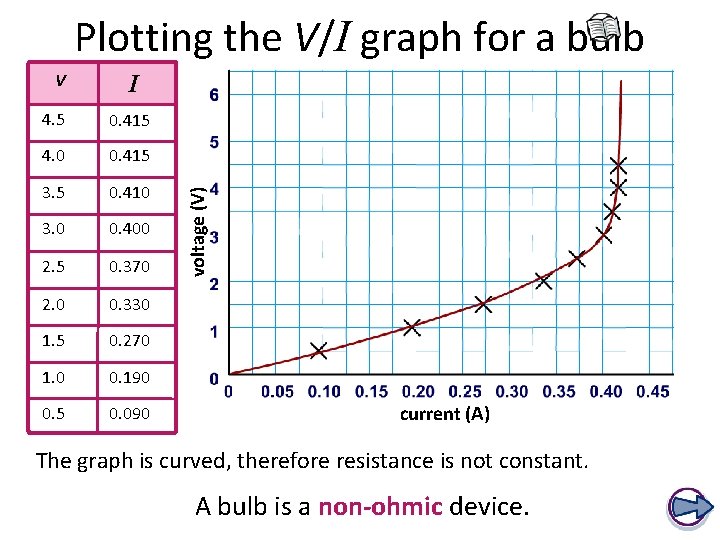
Plotting the V/I graph for a bulb I 4. 5 0. 415 4. 0 0. 415 3. 5 0. 410 3. 0 0. 400 2. 5 0. 370 2. 0 0. 330 1. 5 0. 270 1. 0 0. 190 0. 5 0. 090 voltage (V) V current (A) The graph is curved, therefore resistance is not constant. A bulb is a non-ohmic device.