
WHAT IS ECONOMICS THE STUDY OF TRADE OFFS
- Slides: 14
WHAT IS ECONOMICS ? * THE STUDY OF - TRADE OFFS
WHAT IS ECONOMICS ? The Study of SCARCITY !! * Due to LIMITS Limits of TIME and MONEY
WHAT IS ECONOMICS ? How do you want to use your time and money ? WORK v Video Games / Youtube PHONE v Food / clothing / Gas
Economics – The study of DECISION MAKING / TRADE OFFS based on RESOURCES * PEOPLE * BUSINESSES * GOVERNMENTS Due to : “SCARCITY”
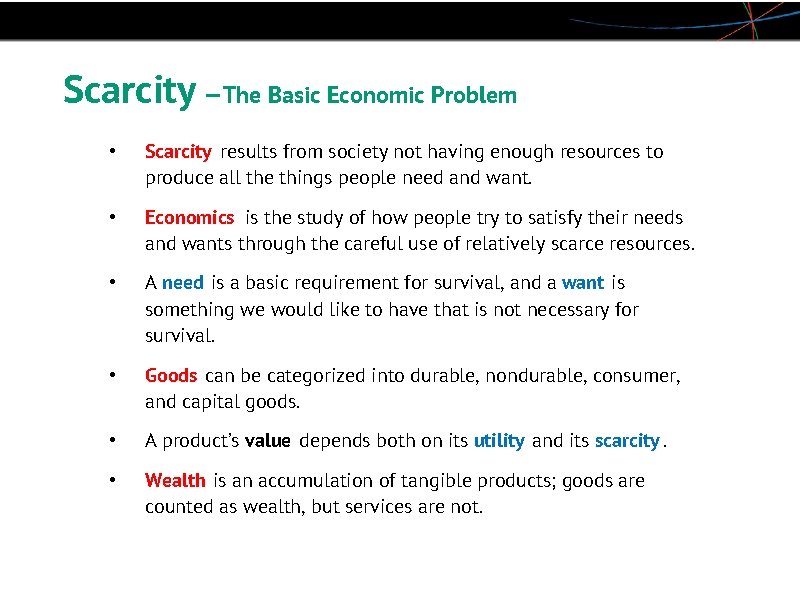
Scarcity —The Basic Economic Problem • Scarcity results from society not having enough resources to produce all the things people need and want. • Economics is the study of how people try to satisfy their needs and wants through the careful use of relatively scarce resources. • A need is a basic requirement for survival, and a want is something we would like to have that is not necessary for survival. • Goods can be categorized into durable, nondurable, consumer, and capital goods. • A product’s value depends both on its utility and its scarcity. • Wealth is an accumulation of tangible products; goods are counted as wealth, but services are not.
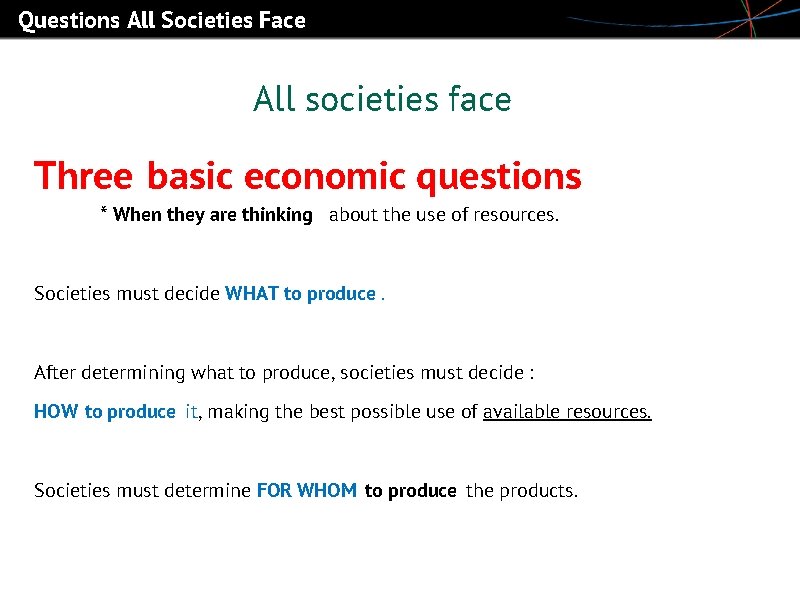
Questions All Societies Face All societies face Three basic economic questions * When they are thinking about the use of resources. Societies must decide WHAT to produce. After determining what to produce, societies must decide : HOW to produce it, making the best possible use of available resources. Societies must determine FOR WHOM to produce the products.
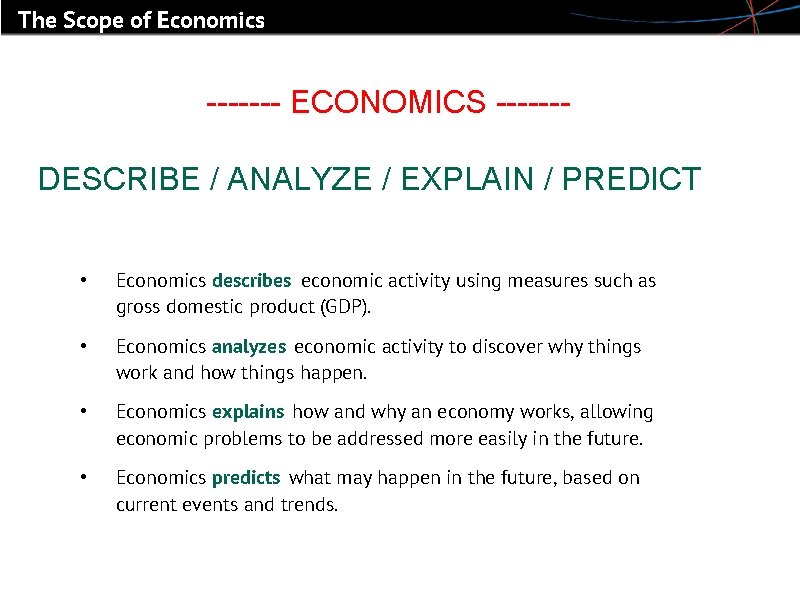
The Scope of Economics ------- ECONOMICS ------DESCRIBE / ANALYZE / EXPLAIN / PREDICT • Economics describes economic activity using measures such as gross domestic product (GDP). • Economics analyzes economic activity to discover why things work and how things happen. • Economics explains how and why an economy works, allowing economic problems to be addressed more easily in the future. • Economics predicts what may happen in the future, based on current events and trends.
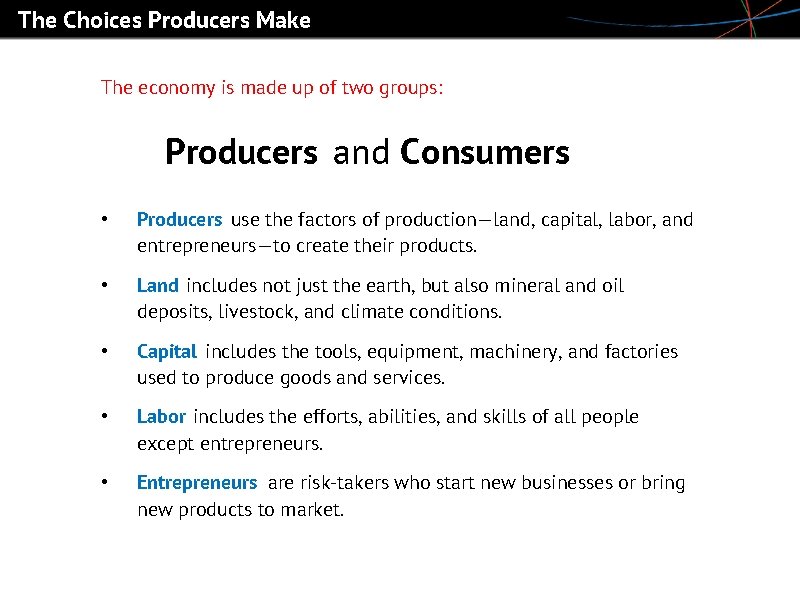
The Choices Producers Make The economy is made up of two groups: Producers and Consumers • Producers use the factors of production—land, capital, labor, and entrepreneurs—to create their products. • Land includes not just the earth, but also mineral and oil deposits, livestock, and climate conditions. • Capital includes the tools, equipment, machinery, and factories used to produce goods and services. • Labor includes the efforts, abilities, and skills of all people except entrepreneurs. • Entrepreneurs are risk-takers who start new businesses or bring new products to market.
Production Possibilities • Economists use a production possibilities curve to illustrate all possible combinations of economic output. • All points on the production possibilities curve represent maximum combinations of output when all resources are fully employed. • All economic or production decisions have an opportunity cost —the value of the next best alternative that was not taken. • When resources are not fully employed, a society cannot reach its maximum potential , resulting in an opportunity cost.
The Choices Consumers Make • Every decision we make has trade-offs , or alternative choices. • Opportunity costs apply to consumers as well as producers. • Consumerism was a social movement that resulted in a list of five consumer rights. • Consumers also have responsibilities , such as behaving ethically with producers and researching products fully before making a purchase. .
Economic Growth • Economic growth occurs when a nation’s total output of goods and services increases over time. • Investing in new physical or human resources involves risks and sacrifices today to increase future production. • When more products can be produced with the same amount of resources, productivity goes up. • Human capital provides a major contribution to productivity, so investing in education can have a substantial payoff in the future. • Division of labor , specialization , and interdependence can improve productivity and income as well as make the world a safer place.
Circular Flow of Economic Activity • A circular flow diagram is a model that shows how markets connect people and businesses in the economy. • The factors of production are bought and sold in factor markets. • Goods and services are bought and sold in product markets. • All people and businesses are connected by markets.
Thinking Like an Economist • Economics models reduce complex situations to their most basic elements so that they can be more easily understood. • All models are based on assumptions. • A cost-benefit analysis compares the benefits of an action or decision with its expected costs. • Taking small steps toward a final goal is wise, especially when we are unsure of the exact costs involved.
The Road Ahead • Studying economics gives people a better understanding of how a free enterprise economy works. • Many economic topics have a bearing on our standard of living. • Studying economics helps people become better decision makers , both personally and as voting citizens. • Economics provides a framework to analyze the complex world around us.