
What is Economics So what is it Economics


- Slides: 16
What is Economics?
So what is it…. Economics: is the study of how people make choices to satisfy their needs and wants. You For example: must choose how to spend your time. Businesses must choose how many people to hire. Though we may want to … we can’t have everything we want!
Needs and Wants What’s the difference? Why must we make choices at all?
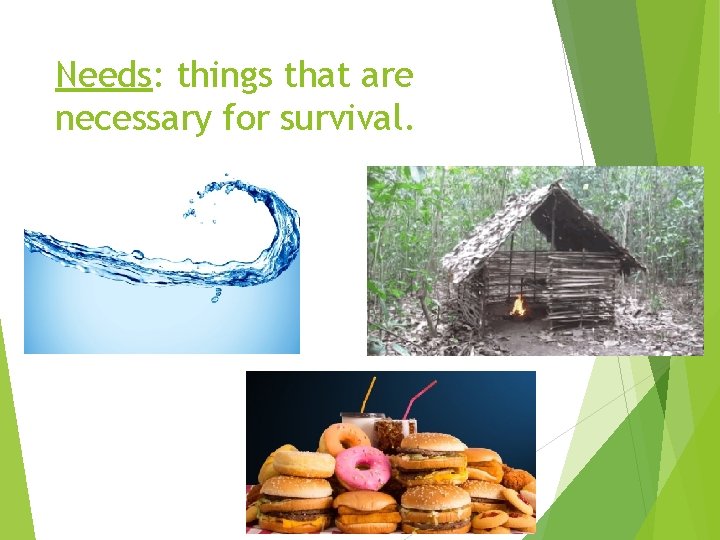
Needs: things that are necessary for survival.
Wants: goods and services that people desire.
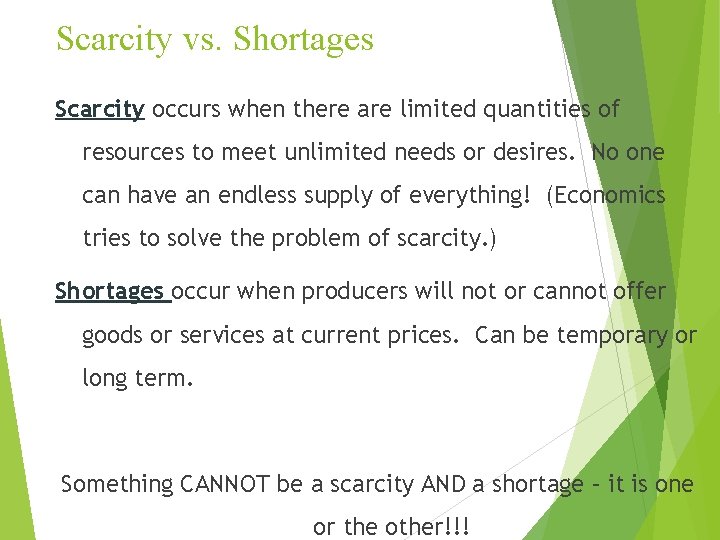
Scarcity vs. Shortages Scarcity occurs when there are limited quantities of resources to meet unlimited needs or desires. No one can have an endless supply of everything! (Economics tries to solve the problem of scarcity. ) Shortages occur when producers will not or cannot offer goods or services at current prices. Can be temporary or long term. Something CANNOT be a scarcity AND a shortage – it is one or the other!!!
What is the most scarce resource? TIME
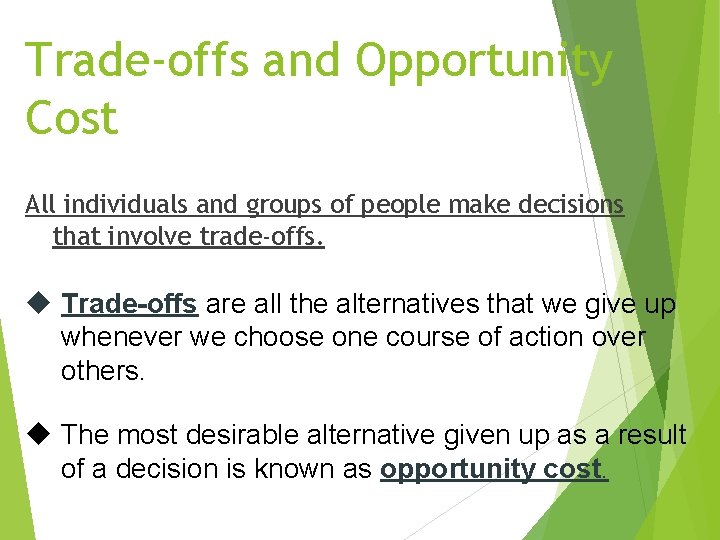
Trade-offs and Opportunity Cost All individuals and groups of people make decisions that involve trade-offs. Trade-offs are all the alternatives that we give up whenever we choose one course of action over others. The most desirable alternative given up as a result of a decision is known as opportunity cost.
Exit Card: Define: Economics What is the difference b/w a need and a want? Define: Shortage Define: Scarcity What is the most scarce resource?
Review!! Opportunity cost is (a) any alternative we sacrifice when we make a decision. (b) all of the alternatives we sacrifice when we make a decision. (c) the most desirable alternative given up as a result of a decision. (d) the least desirable alternative given up as a result of a decision
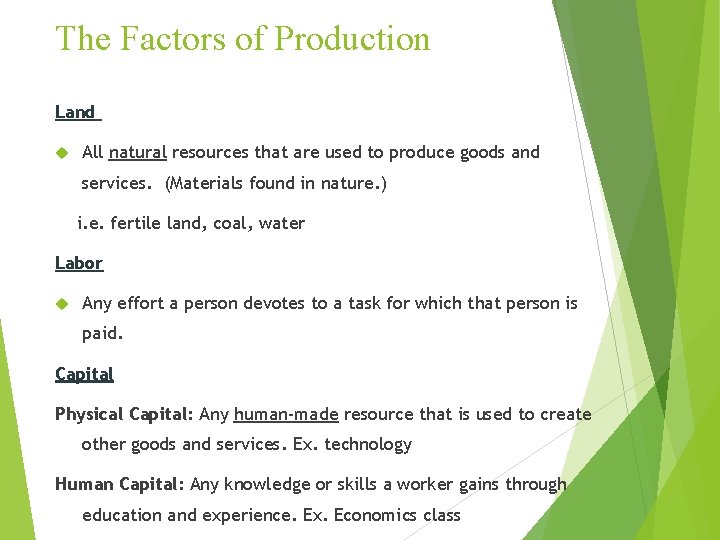
The Factors of Production Land All natural resources that are used to produce goods and services. (Materials found in nature. ) i. e. fertile land, coal, water Labor Any effort a person devotes to a task for which that person is paid. Capital Physical Capital: Any human-made resource that is used to create other goods and services. Ex. technology Human Capital: Any knowledge or skills a worker gains through education and experience. Ex. Economics class
Poo Pots (Factors of Production) https: //www. youtube. com/watch? v=6 JRv. TIKXWDk
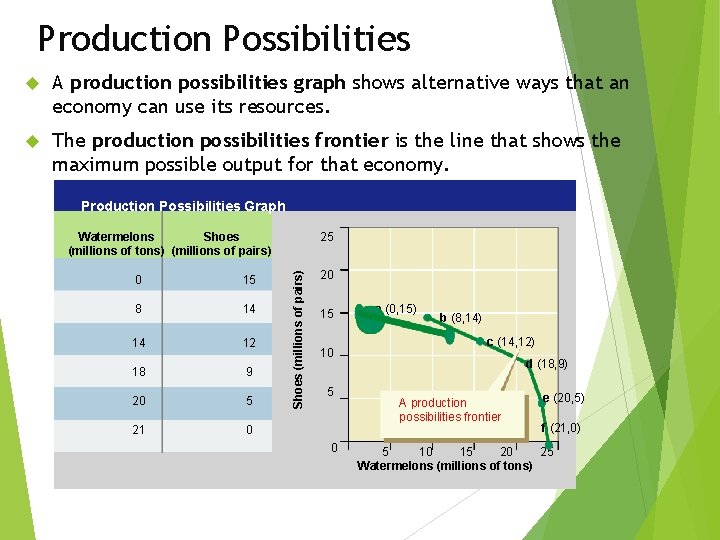
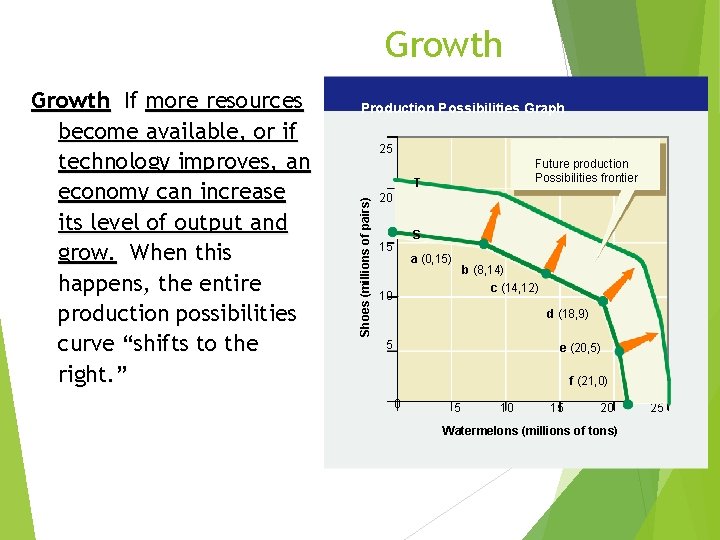
Production Possibilities A production possibilities graph shows alternative ways that an economy can use its resources. The production possibilities frontier is the line that shows the maximum possible output for that economy. Production Possibilities Graph 25 0 15 8 14 14 12 18 9 20 5 21 0 Shoes (millions of pairs) Watermelons Shoes (millions of tons) (millions of pairs) 20 15 10 5 0 a (0, 15) b (8, 14) c (14, 12) d (18, 9) A production possibilities frontier e (20, 5) f (21, 0) 5 10 15 20 25 Watermelons (millions of tons)
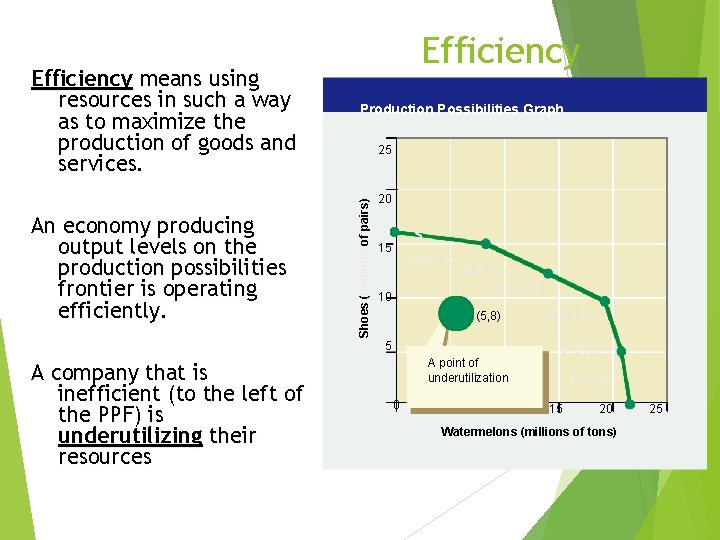
An economy producing output levels on the production possibilities frontier is operating efficiently. Production Possibilities Graph 25 Shoes (millions of pairs) Efficiency means using resources in such a way as to maximize the production of goods and services. Efficiency 20 S 15 a (0, 15) 10 b (8, 14) c (14, 12) g (5, 8) 5 A company that is inefficient (to the left of the PPF) is underutilizing their resources d (18, 9) e (20, 5) A point of underutilization 0 5 10 f (21, 0) 15 20 Watermelons (millions of tons) 25
Growth Production Possibilities Graph 25 Future production Possibilities frontier T Shoes (millions of pairs) Growth If more resources become available, or if technology improves, an economy can increase its level of output and grow. When this happens, the entire production possibilities curve “shifts to the right. ” 20 S 15 a (0, 15) b (8, 14) c (14, 12) 10 d (18, 9) 5 e (20, 5) f (21, 0) 0 5 10 15 20 Watermelons (millions of tons) 25
Section 3 Review 1. A production possibilities frontier shows (a) farm goods and factory goods produced by an economy. (b) the maximum possible output of an economy. (c) the minimum possible output of an economy. (d) underutilization of resources. 2. An economy that is using its resources to produce the maximum number of goods and services is described as (a) efficient. (b) underutilized. (c) growing. (d) trading off.