
What IS Economics n Economics is the study
- Slides: 35
What IS Economics?
n Economics is the study of how people seek to satisfy their needs and wants by making choices.
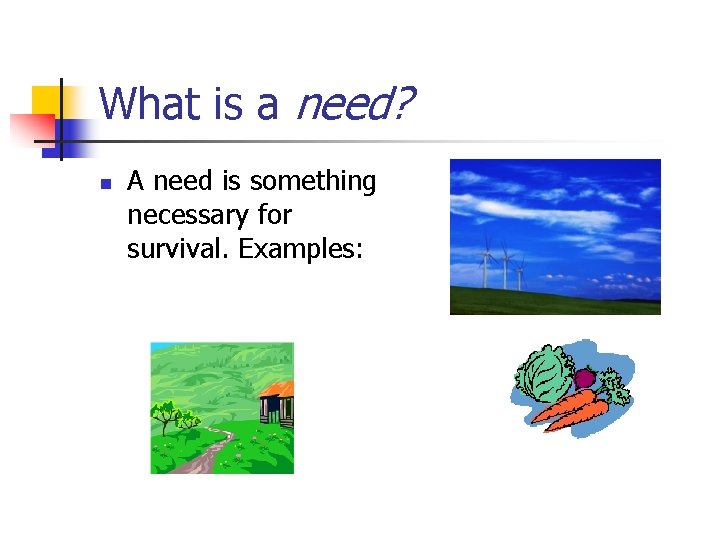
What is a need? n A need is something necessary for survival. Examples:
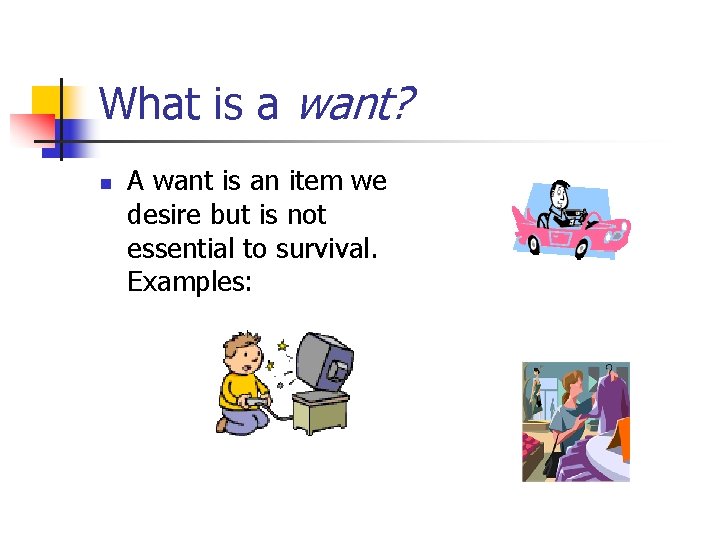
What is a want? n A want is an item we desire but is not essential to survival. Examples:
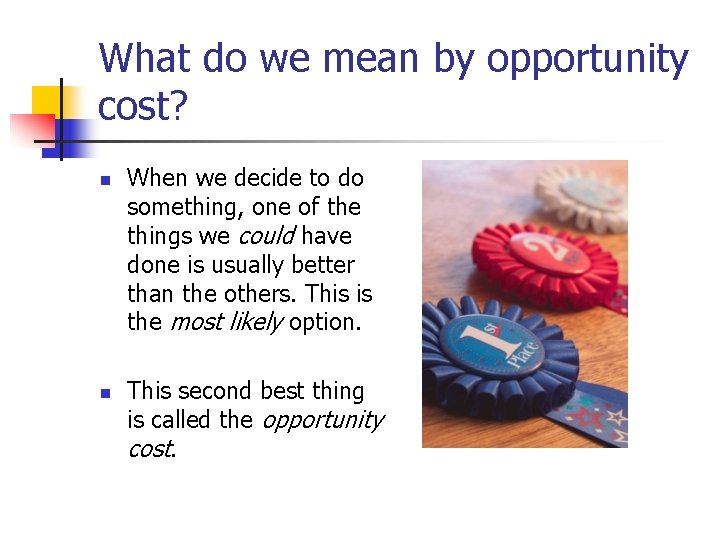
What do we mean by opportunity cost? n n When we decide to do something, one of the things we could have done is usually better than the others. This is the most likely option. This second best thing is called the opportunity cost.
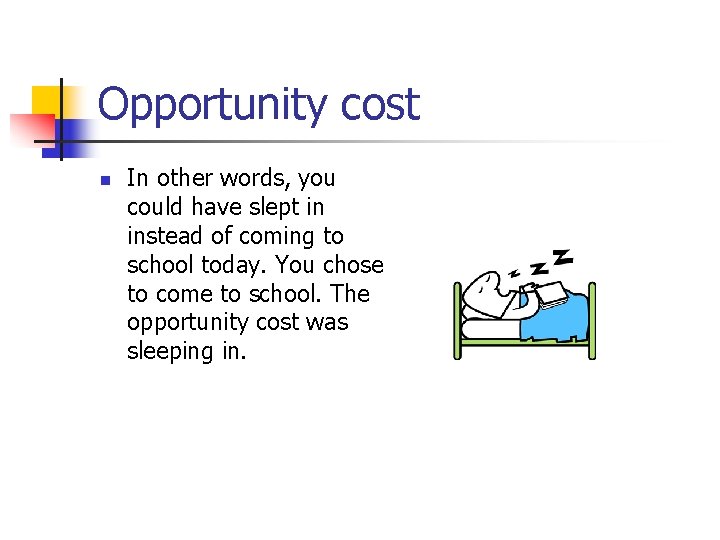
Opportunity cost n In other words, you could have slept in instead of coming to school today. You chose to come to school. The opportunity cost was sleeping in.
So if n n n economics is the study of how people seek to satisfy their needs and wants by making choices, why do people need to make choices at all? Scarcity
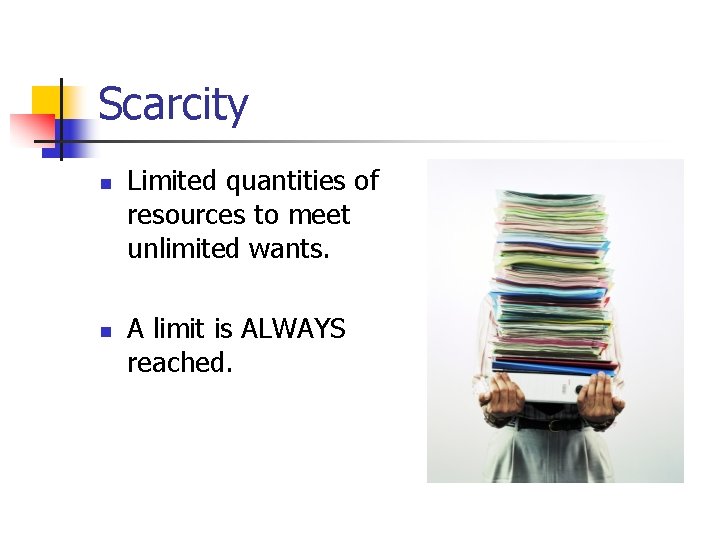
Scarcity n n Limited quantities of resources to meet unlimited wants. A limit is ALWAYS reached.
n Scarcity always exists because our needs and wants are always greater than our resources.
Scarcity is not the same as shortage. n A shortage is when producers cannot or will not offer goods or services at current prices n May be long term or short term, but will or can end
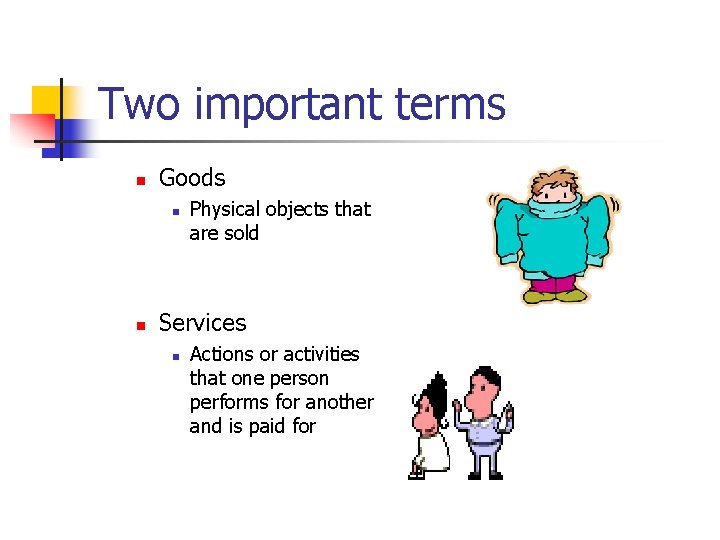
Two important terms n Goods n n Physical objects that are sold Services n Actions or activities that one person performs for another and is paid for
Resources –those things used to create goods and services n They are also called Factors of Production n Land Labor Capital n n Physical Human
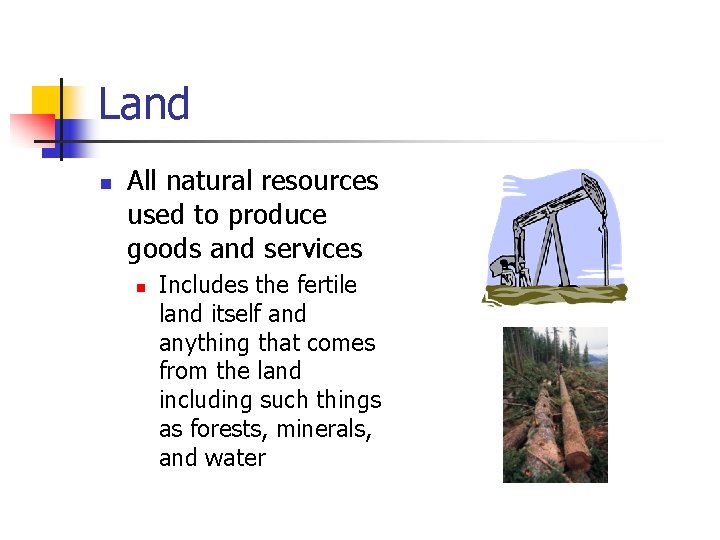
Land n All natural resources used to produce goods and services n Includes the fertile land itself and anything that comes from the land including such things as forests, minerals, and water
Labor n n n The effort a person devotes to a task for which he or she is paid This person works for someone else – a company Includes the people who are working or looking for work
Entrepreneur n Person who puts land, labor, and capital together, the factors of production, to create new goods and services
Physical Capital n n Also called capital goods - Inventory Buildings, equipment, and supplies needed to run a business
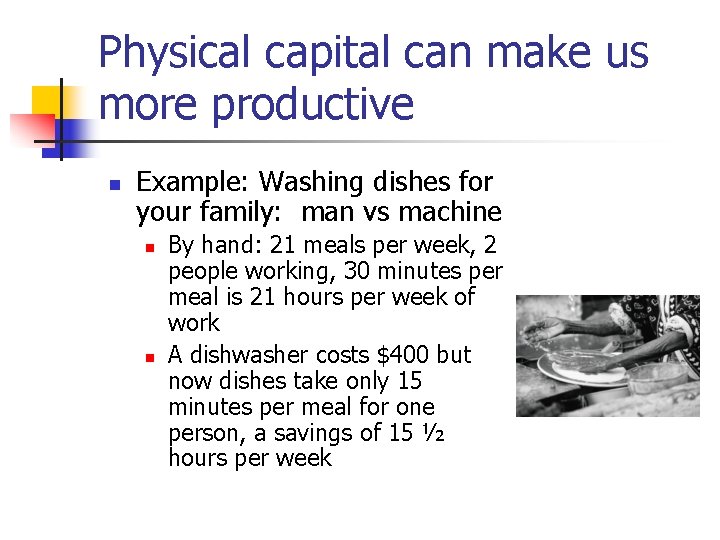
Physical capital can make us more productive n Example: Washing dishes for your family: man vs machine n n By hand: 21 meals per week, 2 people working, 30 minutes per meal is 21 hours per week of work A dishwasher costs $400 but now dishes take only 15 minutes per meal for one person, a savings of 15 ½ hours per week
Extra time 15 ½ hours per week for other activities More knowledge By learning to use a dishwasher family members become more able to use other appliances More productivity With extra time and knowledge they can do extra chores or activities that will help the family
Human capital n The knowledge and skills a worker gains through education and experience
n n Cost What it takes to get or do something (what you give up)
n n Benefit What is gained when a choice is made
n n Incentives Things that get people to do things
n n Can be monetary incentives Or non-monetary incentives
n n Consequence What happens when you make a choice
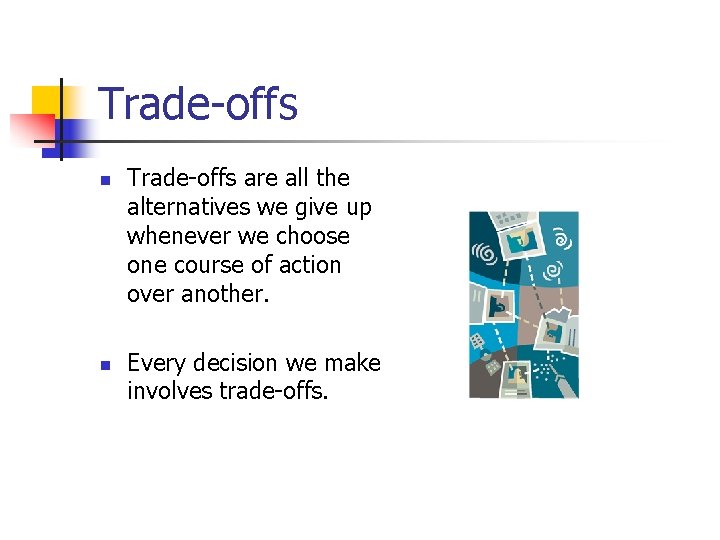
Trade-offs n n Trade-offs are all the alternatives we give up whenever we choose one course of action over another. Every decision we make involves trade-offs.
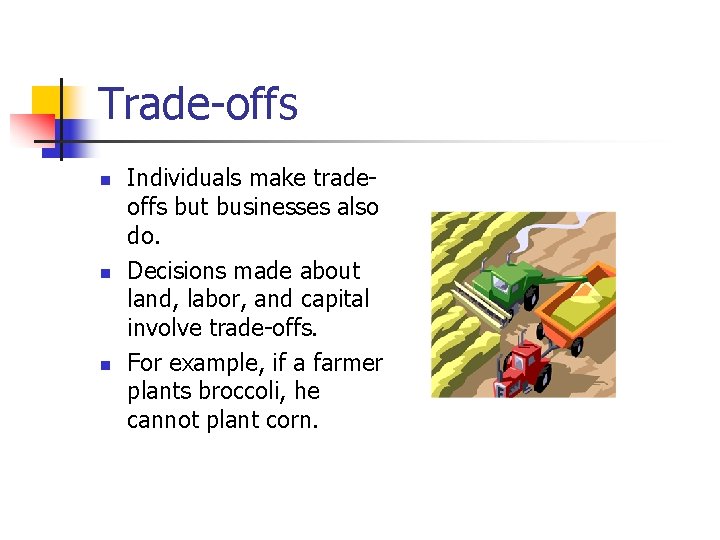
Trade-offs n n n Individuals make tradeoffs but businesses also do. Decisions made about land, labor, and capital involve trade-offs. For example, if a farmer plants broccoli, he cannot plant corn.
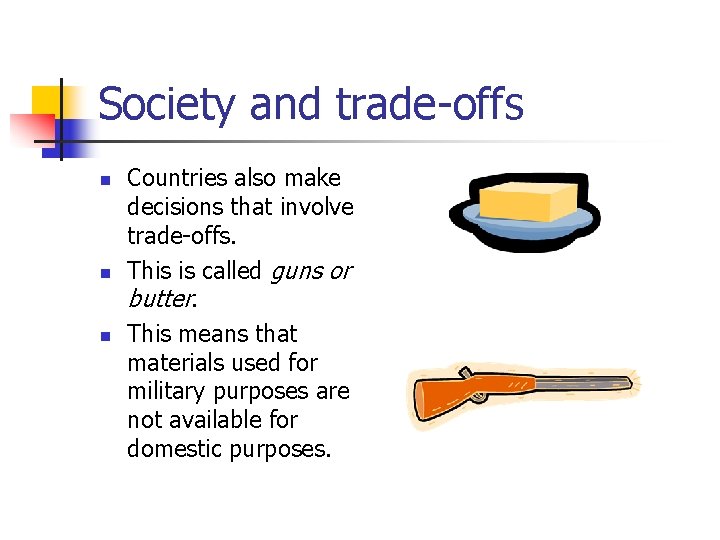
Society and trade-offs n n n Countries also make decisions that involve trade-offs. This is called guns or butter. This means that materials used for military purposes are not available for domestic purposes.
Opportunity cost n n Remember: When you make a decision, you give up something – this is the opportunity cost. Or as an economist might say, “Choosing is refusing. ”
Opportunity cost n Some decisions are easy but sometimes choosing between alternatives can be hard.
Margins n n n But is a decision always just all or nothing? Instead of sleeping all day and not coming to school at all, what if you wanted to sleep five more minutes? What about an extra half hour? This is called the margin.
Decision making at the margin n Comparing the opportunity cost and the benefits at the margin helps make good decisions. At what point do the costs outweigh the benefits? The margin is where you consider the cost of
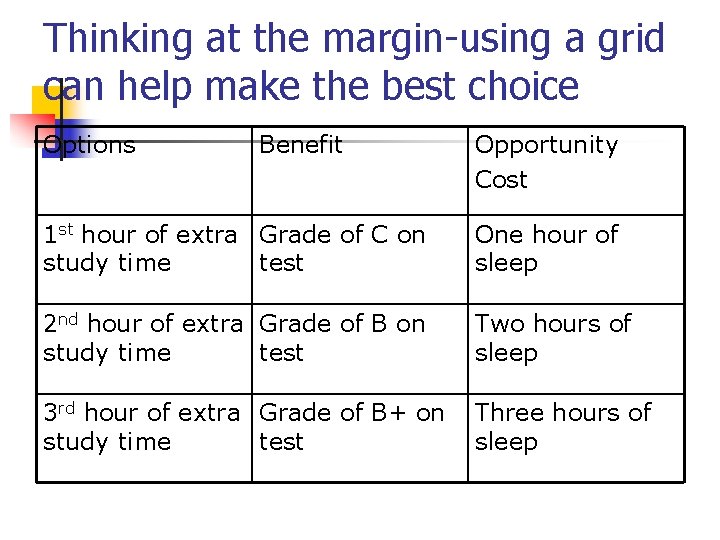
Thinking at the margin-using a grid can help make the best choice Options Benefit Opportunity Cost 1 st hour of extra Grade of C on study time test One hour of sleep 2 nd hour of extra Grade of B on study time test Two hours of sleep 3 rd hour of extra Grade of B+ on study time test Three hours of sleep
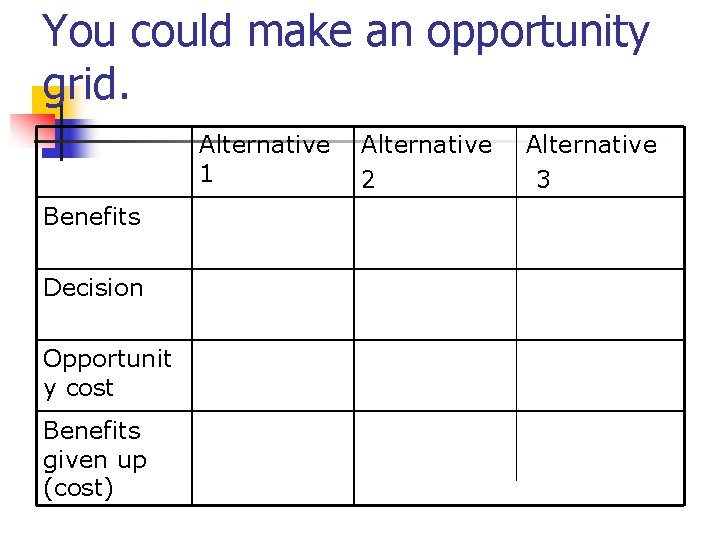
You could make an opportunity grid. Alternative 1 Benefits Decision Opportunit y cost Benefits given up (cost) Alternative 2 Alternative 3
Thinking at the margin n Deciding by thinking at the margin is like any other decision What will you sacrifice? What will you gain? When the opportunity cost outweighs the gain, it’s time to stop.
One more thing…. n n n TANSTAAFL There ain’t no such thing as a free lunch! Every choice has an opportunity cost!