
What is Economics Myth Economics is about Money
What is Economics? < Myth: Economics is about Money < Truth: Economics is about people, and how people (individuals, firms and societies) make decisions about scarce resources. < Money is technology that helps people trade with each other. < Money and monetary policy is only one of many areas that economists study. Challenge: find a single news item, unrelated to economics. © 2015 Pearson
Main goals of this course < ECON 101 and 102 are essential preparation for business and upper division economics courses. < Develop tools for making your own assessments of the economy. < Better understanding of the world and people. < Become a better informed citizen and voter. < Make better personal finance decisions. < Make better business decisions. © 2015 Pearson
How to do well in ECON 102? 1. Attendance. Attending all the classes on time is crucial. 2. Read the textbook in advance. Prepare for each class. 3. Review previous material before every class. 4. Homework. You must solve all the homework on My. Econ. Lab. 5. Ask me. Prepare questions in writing, and visit me during office hours. 6. Understand, not Memorize. © 2015 Pearson
Class discussion (critical thinking) < Give example of an issue or a problem in this world, that you care about. < Pose questions related to the issue, which you would like to investigate. < Example: Problem: crime. Questions: (1) why people commit crimes? (2) What is a more effective policy for crime prevention, longer sentences or higher probability of getting caught? (3) Is there racial difference in police use of force? © 2015 Pearson

1 You’re in school! Did you make the right decision? © 2015 Pearson
1 Getting Started CHAPTER CHECKLIST When you have completed your study of this chapter, you will be able to 1 Define economics and explain the kinds of questions that economists try to answer. 2 Explain the ideas that define the economic way of thinking. © 2015 Pearson
1. 1 DEFINITION AND QUESTIONS All economic questions and problems arise because human wants exceed the resources available to satisfy them. <Scarcity is the condition that arises because wants exceeds the ability of resources to satisfy them. Faced with scarcity, we must make choices—we must choose among the available alternatives. The choices we make depend on the incentives we face. © 2015 Pearson
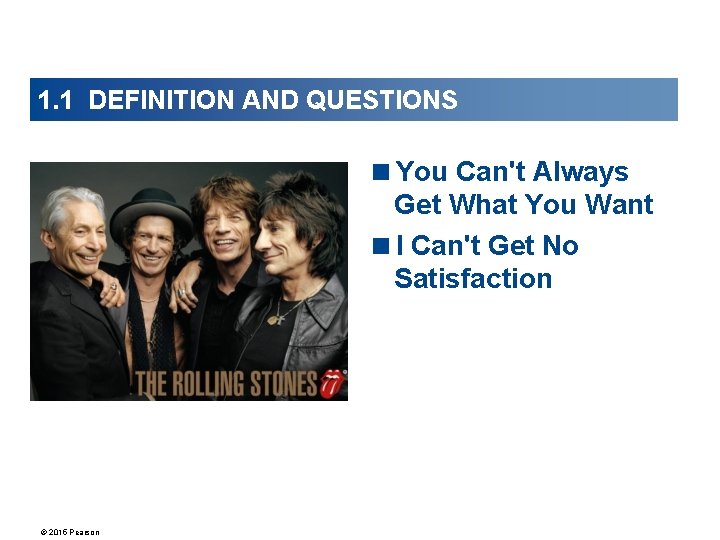
1. 1 DEFINITION AND QUESTIONS <You Can't Always Get What You Want <I Can't Get No Satisfaction © 2015 Pearson
1. 1 DEFINITION AND QUESTIONS © 2015 Pearson
1. 1 DEFINITION AND QUESTIONS <Economics Defined Economics is the social science that studies the choices that individuals, businesses, governments, and entire societies make as they cope with scarcity, the incentives that influence those choices, and the arrangements that coordinate them. © 2015 Pearson
1. 1 DEFINITION AND QUESTIONS Economics divides into two parts: Microeconomics: The study of the choices that individuals and businesses make and the way these choices interact and are influenced by governments. Macroeconomics: The study of the aggregate (or total) effects on the national economy and the global economy of the choices that individuals, businesses, and governments make. © 2015 Pearson
1. 1 DEFINITION AND QUESTIONS Two big economic questions: • How do choices determine what, how, and for whom goods and services get produced? • When do choices made in self-interest also promote the social interest? © 2015 Pearson
1. 1 DEFINITION AND QUESTIONS <What, How, and For Whom? Goods and services are the objects (goods) and actions (services) that people value and produce to satisfy human wants. What goods and services get produced and in what quantities? How are goods and services produced? For Whom are the various goods and services produced? © 2015 Pearson
1. 1 DEFINITION AND QUESTIONS <Can the Pursuit of Self-Interest Be in the Social Interest? The choices that are best for the individual who makes them are choices made in the pursuit of self -interest. The choices that are best for society as a whole are choices made in the social interest. © 2015 Pearson
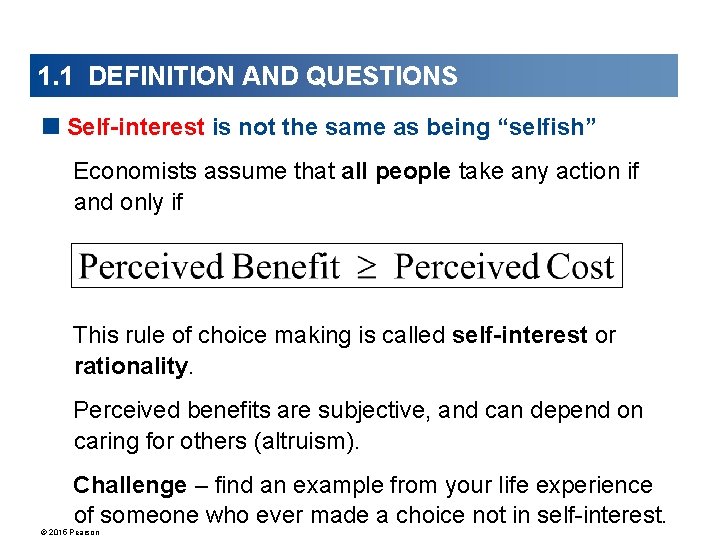
1. 1 DEFINITION AND QUESTIONS <Self-interest is not the same as being “selfish” Economists assume that all people take any action if and only if This rule of choice making is called self-interest or rationality. Perceived benefits are subjective, and can depend on caring for others (altruism). Challenge – find an example from your life experience of someone who ever made a choice not in self-interest. © 2015 Pearson
1. 1 DEFINITION AND QUESTIONS <Social interest Society consists of many individuals, and often choices by some conflict with interests of others. In other times, a choice made in self-interest benefits others. In general, economists define an improvement in social welfare if the choices lead to improvement in the welfare of all individuals in the society. © 2015 Pearson
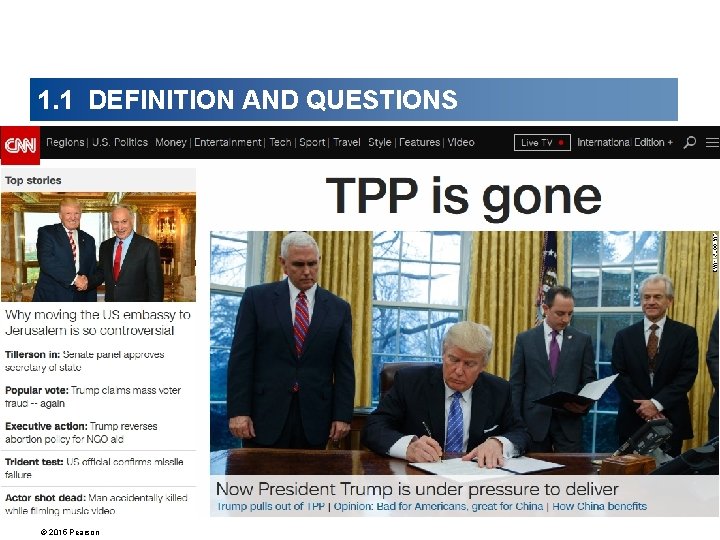
1. 1 DEFINITION AND QUESTIONS Can choices made in self-interest also serve the social interest? Let’s illustrate with four topics: 1 Globalization—the expansion of international trade and the production of components and services by firms in other countries—has been going on for centuries. © 2015 Pearson
1. 1 DEFINITION AND QUESTIONS But in recent years, its pace accelerated. Microchips, satellites, and fiber-optic cables have lowered the cost of communication. This explosion of communication has globalized production decisions. For example, Nike produces shoes in Malaysia; Toyota produces cars in the United States. Globalization is in the interest of the owners of multinational firms that profit, but is it in the social interest? © 2015 Pearson
1. 1 DEFINITION AND QUESTIONS © 2015 Pearson
1. 1 DEFINITION AND QUESTIONS 2 The “Information Age” Makers of computer chips and programs developed products in their self-interest, but did they develop their products in the social interest? 3 Climate Change The choices we make concerning how to produce and use energy are made in our selfinterest, but do they serve the social interest? © 2015 Pearson
1. 1 DEFINITION AND QUESTIONS 4 Government Budget Deficit and Debt Every year since 2001, the U. S. government has run a budget deficit─on average, $1. 6 billion a day. The government’s debt has increased each day by that amount. Over the 12 year period from 2002 to 2013, government debt increased by $6. 85 trillion. Your personal share of this debt is $22, 000. This large deficit and debt is just the beginning of an even bigger problem. © 2015 Pearson
1. 1 DEFINITION AND QUESTIONS From about 2020 onwards, the retirement and healthcare benefits to which older Americans are entitled are going to cost increasingly more than taxes can cover. With no changes in tax or benefit rates, the budget deficit will increase and the debt will swell ever higher. Debts must be repaid. Who will repay them? When we make our voter choices, we pursue our selfinterest. Do our choices serve the social interest? Do the choices made by politicians promote the social interest, or do they serve their self-interests? © 2015 Pearson
1. 2 THE ECONOMIC WAY OF THINKING <Economic Ideas: Six ideas define the economic way of thinking: • Choice is a tradeoff • Cost is what you must give up to get something • Benefit is what you gain from something • People make rational choices by comparing benefits and costs • Most choices are “how much” choices made at the margin • Choices respond to incentives © 2015 Pearson
1. 2 THE ECONOMIC WAY OF THINKING <A Choice Is a Tradeoff Because we face scarcity we must make choices. To make a choice we select from alternatives. Whatever choice you make, you could have chosen something else. You can think about your choices as tradeoffs. A tradeoff is an exchange—giving up one thing to get something else. © 2015 Pearson
1. 2 THE ECONOMIC WAY OF THINKING <Cost: What You Must Give Up Opportunity cost is the best thing that you must give up to get something—the highest-valued alternative forgone. <Benefit: What You Gain Benefit is the gain or pleasure that something brings. Benefit is measured by what you are willing to give up. © 2015 Pearson
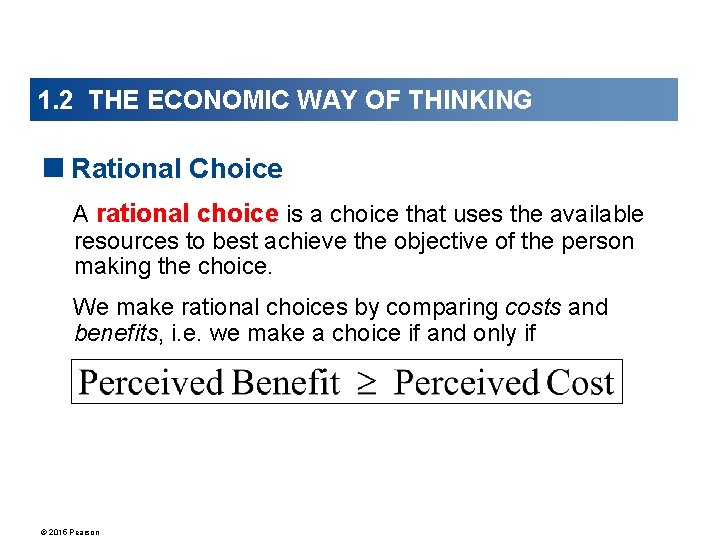
1. 2 THE ECONOMIC WAY OF THINKING <Rational Choice A rational choice is a choice that uses the available resources to best achieve the objective of the person making the choice. We make rational choices by comparing costs and benefits, i. e. we make a choice if and only if © 2015 Pearson
1. 2 THE ECONOMIC WAY OF THINKING <How Much? Choosing at the Margin A choice made at the margin is a choice made by comparing all the relevant alternatives systematically and incrementally. © 2015 Pearson
1. 2 THE ECONOMIC WAY OF THINKING Marginal Cost Marginal cost is the opportunity cost of a one-unit increase in an activity. The marginal cost of something is what you must give up to get one additional unit of it. Marginal Benefit Marginal benefit is what you gain when you get one more unit of something. The marginal benefit of something is measured by what you are willing to give up to get one additional unit of it. © 2015 Pearson
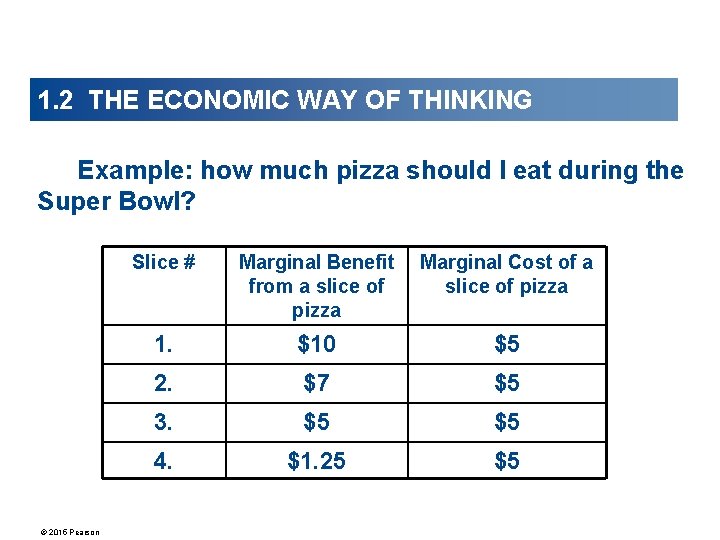
1. 2 THE ECONOMIC WAY OF THINKING Example: how much pizza should I eat during the Super Bowl? © 2015 Pearson Slice # Marginal Benefit from a slice of pizza Marginal Cost of a slice of pizza 1. $10 $5 2. $7 $5 3. $5 $5 4. $1. 25 $5
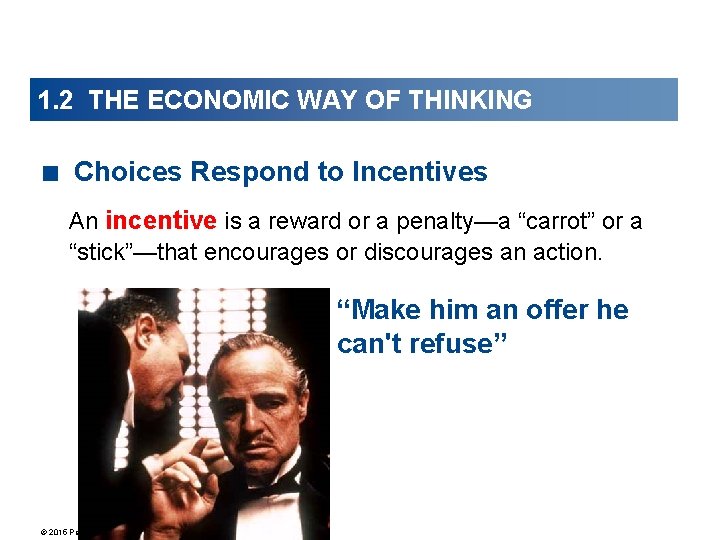
1. 2 THE ECONOMIC WAY OF THINKING < Choices Respond to Incentives An incentive is a reward or a penalty—a “carrot” or a “stick”—that encourages or discourages an action. “Make him an offer he can't refuse” © 2015 Pearson
1. 2 THE ECONOMIC WAY OF THINKING <Economics as Social Science Economists try to understand predict the effects of economic forces by using the scientific method first developed by physicists. The scientific method is a common sense way of systematically checking what works and what doesn’t work. An economist begins with a question or a puzzle about cause and effect arising from some observed facts. © 2015 Pearson
1. 2 THE ECONOMIC WAY OF THINKING Economic Models An economist’s second step is to build a model that provides a possible answer to the question of interest. An economic model is a description of some feature of the economic world that includes only those features assumed necessary to explain the observed facts. Check Models Against Facts An economist’s third step is to check the proposed model against the facts. © 2015 Pearson
1. 2 THE ECONOMIC WAY OF THINKING To check an economic model against the facts, economists use • Natural experiments • Statistical investigations • Economic (Lab) experiments Natural experiments: A situation that arises in the ordinary course of economic life in which the one factor of interest is different and other things are equal. An economic experiment puts people in a decisionmaking situation and varies the influence of one factor at a time to discover how they respond. © 2015 Pearson
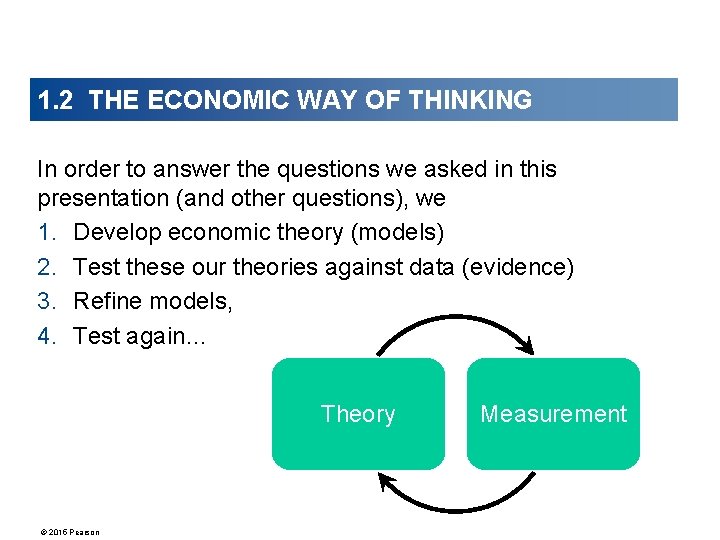
1. 2 THE ECONOMIC WAY OF THINKING In order to answer the questions we asked in this presentation (and other questions), we 1. Develop economic theory (models) 2. Test these our theories against data (evidence) 3. Refine models, 4. Test again… Theory © 2015 Pearson Measurement
1. 2 THE ECONOMIC WAY OF THINKING A statistical investigation looks for a correlation. Correlation is the tendency for the values of two variables to move together in a predictable and related way. © 2015 Pearson
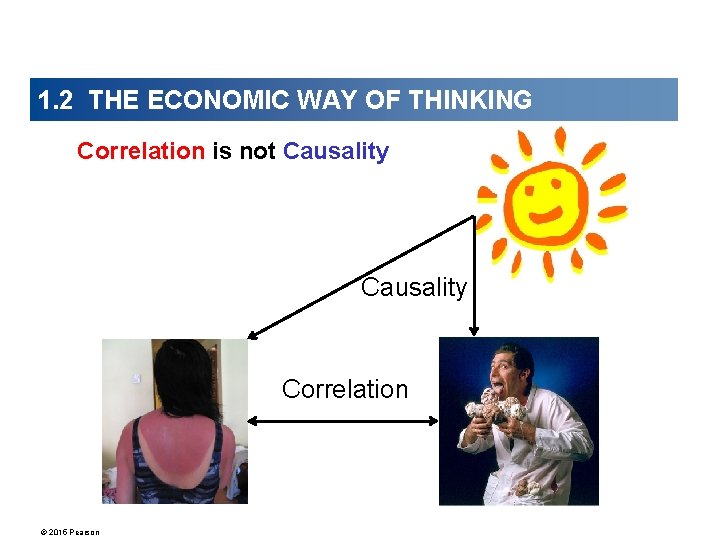
1. 2 THE ECONOMIC WAY OF THINKING Correlation is not Causality Correlation © 2015 Pearson
1. 2 THE ECONOMIC WAY OF THINKING Disagreement: Normative versus Positive Economists sometimes disagree about assumptions and models and also about what policy to use. Some disagreements can be settled by appealing to further facts, but others cannot. Disagreements that can’t be settled by facts are normative statements—statements about what ought to be. Disagreements that can be settled by facts are positive statements—statements about what is. © 2015 Pearson
1. 2 THE ECONOMIC WAY OF THINKING <Economics as Policy Tool Economics provides a way of approaching problems in all aspects of our lives: • Personal • Business • Government Should you take out a student loan? Is Kevin Durant worth $26. 5 million? How can the government balance its budget? © 2015 Pearson

Course Map © 2015 Pearson
EYE on the BENEFIT and COST of SCHOOL Does school provide a big enough benefit to justify its cost? The benefits of being in school include the present enjoyment of student life and a higher future income. The costs of being in school for a full-time student include tuition, books, other study costs, and forgone earnings. Is school always best? The costs are incurred now, but the benefits accrue over a working lifetime. For most people, the net benefit is big! © 2015 Pearson
Is school always best? Bill Gates quit Harvard; Mick Jagger quit the London School of Economics; Clayton Kershaw turned down a scholarship at Texas A & M! All three expected the benefit from school to be less than the opportunity cost of being in school. © 2015 Pearson
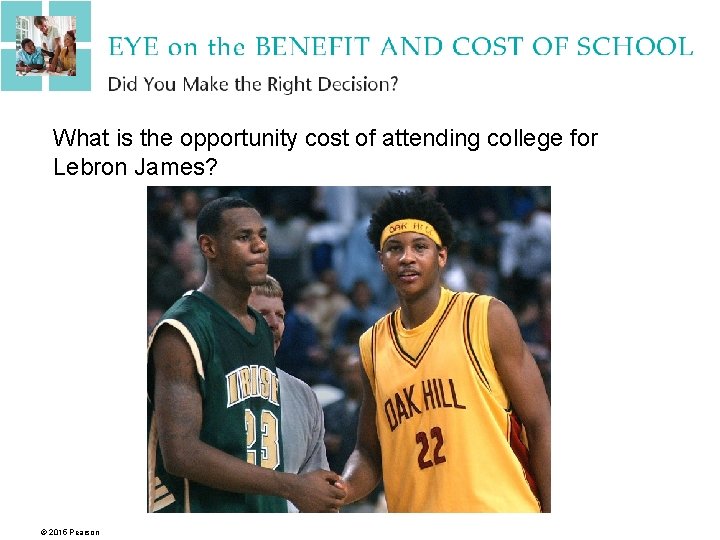
What is the opportunity cost of attending college for Lebron James? © 2015 Pearson
Other non-monetary benefits of college 1. Statistically not as likely to be hit by unemployment during rough economy 9. 7% versus 5. 2% for H. S. and Bachelor degree unemployment in 2009 2. College-grad jobs may have better hours, better working conditions 3. Sense of accomplishment 4. Education leads to positive externalities (benefits to others) © 2015 Pearson
Salaries by major: http: //www. payscale. com/college-salaryreport/majors-that-pay-you-back/bachelors © 2015 Pearson
Conclusions <Economists ask, and answer, big questions about life. <Decisions about education, healthcare, laws, freedom, inequality, environment, discrimination, family – are all studied by economists. <Economics is about people - this is what makes the study of economics so fascinating, and also very challenging. <Once you learn a few key principles and practice them, you can learn the basics of economics. © 2015 Pearson
Questions What can be said about scarcity? A. Scarcity forces us to make choices. B. Scarcity doesn’t affect the super-wealthy. C. Scarcity only affects commodities such as oil. D. Scarcity generally doesn’t affect our day-to-day living. © 2015 Pearson
Questions Which of the following situations illustrates an incentive? A. Dave snacks all afternoon and isn’t hungry for dinner. B. Dirk’s children misbehave during dinner. C. Lee gives his children candy if they behave during dinner. D. Jaime goes to a restaurant for dinner. © 2015 Pearson
Questions The opportunity cost of buying a good is A. the sum of values of all the other goods you could have purchased. B. the value of the next-best alternative you could have purchased. C. irrelevant since you will purchase your highestvalued good. D. the average of values of all the other goods you could have purchased. © 2015 Pearson
Questions With regards to marginal thinking, an individual will do an action if A. the probability of success is greater than 50%. B. the action has positive benefits. C. the costs of the action are small. D. perceived benefits >= perceived costs. © 2015 Pearson
Questions The governor decides to increase funding for education. However, this will mean decreasing funding for infrastructure. This situation illustrates A. trade-offs. B. comparative advantage. C. incentives. D. markets. © 2015 Pearson
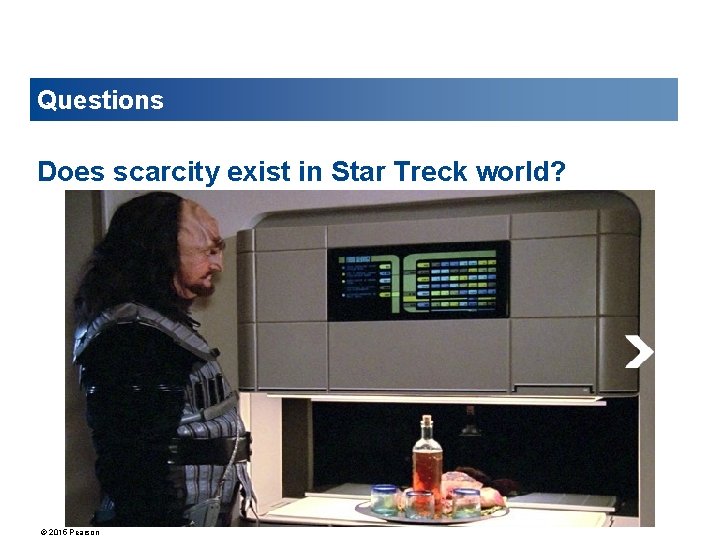
Questions Does scarcity exist in Star Treck world? © 2015 Pearson
- Slides: 51