
What Is Economics ESSENTIAL QUESTIONS Why and how
- Slides: 16
What Is Economics? ESSENTIAL QUESTIONS Why and how do people make economic choices? How do economic systems influence societies?
Our Wants and Resources • Wants are desires that people have that can be met by getting a product or a service. • We must decide how to use our limited amount of money to satisfy our wants. (We must make choices. )
Unlimited Wants are unlimited. • 2 groups. 1. goods - includes things that we can touch or hold. 2. services and includes work that is done for us. Services include the health care provided by a doctor, the haircut by a hairstylist, or advice about money provided by a banker.
Limited Resources If resources are limited, and if wants are unlimited, then we have to make choices. Economics is the study of how people choose to use their limited resources to satisfy their unlimited wants. Resources are all the things that can be used in making products or services that people want.
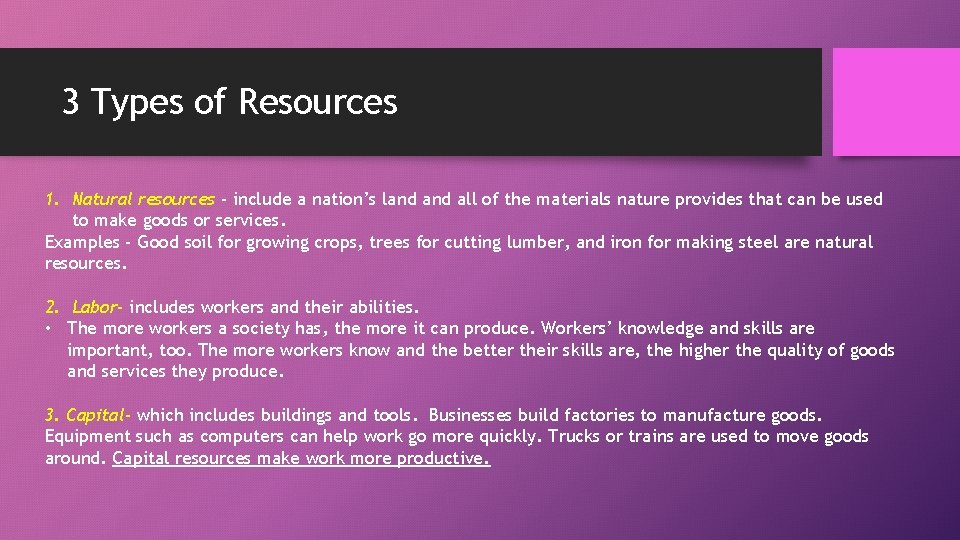
3 Types of Resources 1. Natural resources - include a nation’s land all of the materials nature provides that can be used to make goods or services. Examples - Good soil for growing crops, trees for cutting lumber, and iron for making steel are natural resources. 2. Labor- includes workers and their abilities. • The more workers a society has, the more it can produce. Workers’ knowledge and skills are important, too. The more workers know and the better their skills are, the higher the quality of goods and services they produce. 3. Capital- which includes buildings and tools. Businesses build factories to manufacture goods. Equipment such as computers can help work go more quickly. Trucks or trains are used to move goods around. Capital resources make work more productive.
The Basic Economic Problem Scarcity occurs whenever we do not have enough resources to produce all of the things we would like to have. -No country has all of the resources it needs, or would like to have. Because of this, scarcity is the basic economic problem.
Societies and Economic Choices (Don’t Write) Just as individuals make economic choices, so do entire countries. Scarcity is an economic problem in every nation. Will a society use its limited resources for education or for health care? Will a nation focus on helping businesses grow so they can create more jobs? Or will it spend money on training people for new jobs? Will it spend money on defense or on cleaning up the environment?
Three Basic Economic Questions
Question 1 - What goods and services will be produced? Each country or society has to decide what goods and services it will produce to meet its people’s needs and wants. -societies consider the natural, human, and capital resources they have. Examples - A nation with plenty of land, fertile soil, and a long growing season is likely to use its land to grow crops. A country that has large reserves of oil might decide to produce oil.
Question 2 - How will they be produced? After deciding what to produce, members of a society must decide how to produce these goods and services. Should they encourage businesses to build factories for large–scale manufacturing of products such as automobiles or shoes? Or should they promote small businesses and individual craftsmanship instead?
Question 3 - Who will consume, or use, them? After goods and services are produced, a society must decide who gets the goods and services. -Societies have different ways of distributing goods. -The choices they make for distributing goods affect how the goods are consumed. For example, should new housing units be reserved for low–income people, or should they be rented to anyone who can afford them? Should new cars be given to public officials, or should they be sold to the highest bidder?
Economic Systems Each country has its own economic system, or way of producing the things people need and want. -The way that a society decides the three basic economic questions determines the type of economic system the society has.
Traditional Economy traditional economy-an economic system in which the decisions of what, how, and for whom to produce are based on custom or habit For example, if you were born into a family of farmers, you would grow up to be a farmer. You would also farm in the same way your parents and grandparents did. These economies generally are not very productive. They are not likely to change much over time.
Market Economy market economy- an economic system in which individuals and businesses own all resources and make economic decisions on the basis of price They answer the three economic questions on the basis of profit and price. -Each person and each business makes choices based on a desire to find the most profit from using their resources. -They then sell the things they produce. -They use the money they receive to buy other things they want. Prices play an important role in the market economy.
Command Economy command economy- an economic system in which the major economic decisions are made by the central government They decide what will be produced, for example whether the society will produce machines or consumer goods. -They also decide how these goods will be produced and to whom they will be made available. -Individuals and businesses in a command economy do not have much say in how the economy works. Government planners command the actions that producers must follow.
The American Economy The United States is based on a market economy. -businesses are free to compete for profit with little interference from the government. -Individuals and businesses can choose how to use their resources. -They choose what to produce and how to produce it. -Individuals and businesses use prices to determine who will receive the goods and services that are produced. However – We have a mixed market economy, as our government does regulate what is produced.