
What is economics ECON 101 Standards Standard 1
- Slides: 32
What is economics? ECON 101
Standards • Standard 1: Students will understand that: Productive resources are limited. Therefore, people cannot have all the goods and services they want; as a result, they must choose some things and give up others. • Standard 2: Students will understand that: Effective decision making requires comparing the additional benefits. Most choices involve doing a little more or a little less of something; few choices are all-or-nothing decisions
What does that mean? • Because there is not enough of everything – and we want everything! People have to make choices – there is a trade-off • Resources are scarce • Need – something necessary for survival ie. food • Want – something we desire ie. A cd player • In order to make the best decision we need data
• GOODS- Physical objects that can be purchased • SERVICES- actions or activities that are performed for a fee (lawyers, plumbers, etc. )
Incentives • Economists always think about incentives. They believe that people respond to incentives that they weigh the costs and benefits rationally.
So what is economics? ? Economics is the making of choices to satisfy our needs and wants But! Needs and wants are unlimited So we are forced to make choices Making choices is called trade-offs We use money to determine our choices More money = more opportunities Life is better if you have opportunities Then only way to improve your economic opportunities is by gaining more qualifications!
What is your worth? Assets – Liabilities = Net Worth (Equity) Net Worth = value of things you own: Cash (liquid) stocks, real estate Liabilities = what you owe: debts Asset = an economic resource You are a VERY expensive proposition 18 years ($30, 000) $540, 000! + college Your only asset is your potentiality Breeding is expensive
Think of something that you get for free. How is this free good or service actually paid for? TINSTAAFL- “There’s no such thing as a free lunch”- someone has to pay for a supposedly “free” good.
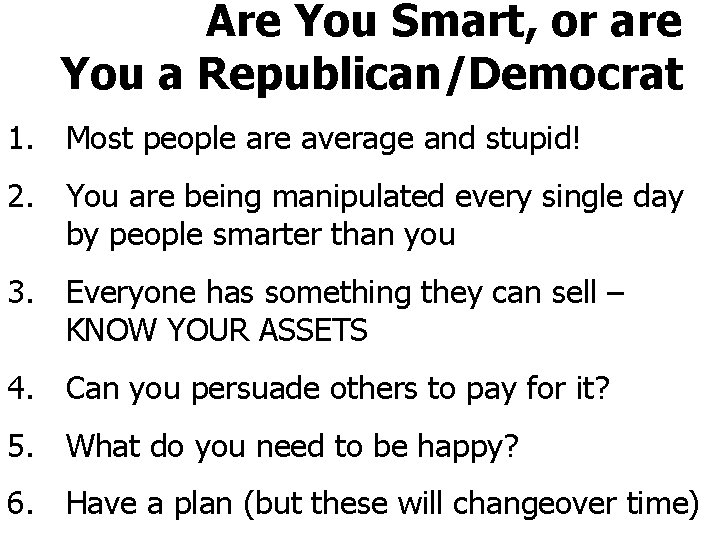
Are You Smart, or are You a Republican/Democrat 1. Most people are average and stupid! 2. You are being manipulated every single day by people smarter than you 3. Everyone has something they can sell – KNOW YOUR ASSETS 4. Can you persuade others to pay for it? 5. What do you need to be happy? 6. Have a plan (but these will changeover time)
Scarcity Chap 1. 1
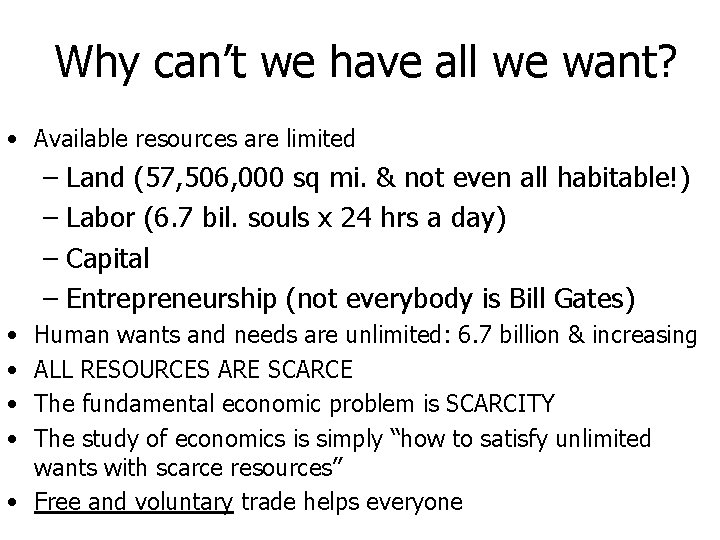
Why can’t we have all we want? • Available resources are limited – Land (57, 506, 000 sq mi. & not even all habitable!) – Labor (6. 7 bil. souls x 24 hrs a day) – Capital – Entrepreneurship (not everybody is Bill Gates) • • Human wants and needs are unlimited: 6. 7 billion & increasing ALL RESOURCES ARE SCARCE The fundamental economic problem is SCARCITY The study of economics is simply “how to satisfy unlimited wants with scarce resources” • Free and voluntary trade helps everyone
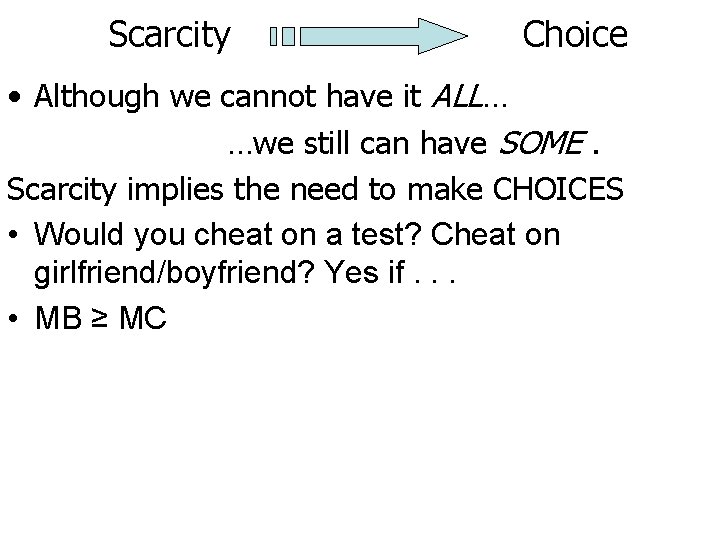
Scarcity Choice • Although we cannot have it ALL… …we still can have SOME. Scarcity implies the need to make CHOICES • Would you cheat on a test? Cheat on girlfriend/boyfriend? Yes if. . . • MB ≥ MC
Productive Resources • Resource- anything people use to make or obtain what they need/want • Factors of Production- (4) resources that can be used to produce goods and services
• Land includes all the natural resources found in nature. An acre of land, mineral deposits, and water in a stream are all considered land. • Labor refers to the physical and mental talents that people contribute to the production of goods and services. • Capital (physical and human capital) is the produced goods that can be used as resources for further production. Factories, machines, and farm tractors are capital. • *Entrepreneurship is the special talent that some people have for searching out and taking advantage of new business opportunities and for developing new products and new ways of doing things.
Human Capital – skills and knowledge gained by a worker Physical Capital – human-made goods to produce goods and services ie. tools – Technology- use of technical knowledge and methods to create new products or make existing products more efficiently
Entrepreneurs • Factors of production are great but you need ideas • Ideas come from entrepreneurs • Bill Gates is an entrepreneur • He creates ideas from what people want
What will competition do to an invention? • • • Improve upon it… Make (ever lower) profits on it… Help spread it… Maybe even make it obsolete… PEOPLE WILL FOCUS ON SOMETHING IF THERE IS A POSSIBILITY OF MAKING MONEY
Opportunity Costs Chap 1. 2
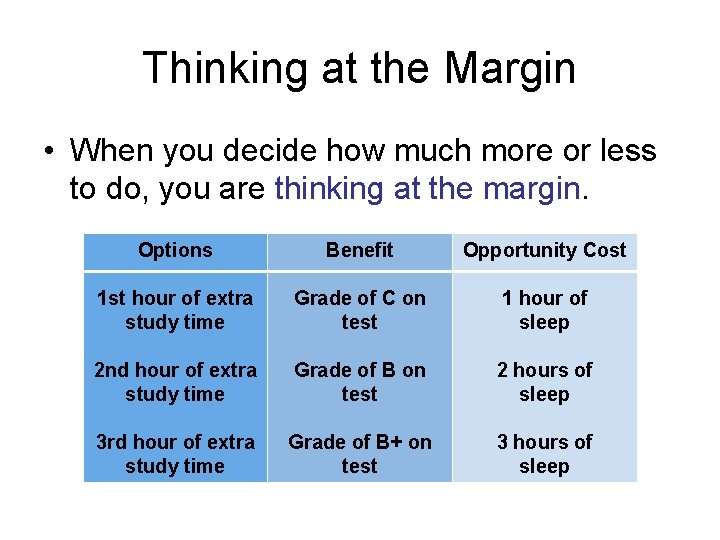
Opportunity Costs • All decisions involve trade-offs – the thing we sacrifice to get what we want • When countries make trade-offs they often use the “guns or butter” example • The most desirable alternative is called opportunity costs ie. Study or sleep • Most decisions involve adding or subtracting one more ie. Hiring another worker • This is called thinking at the margin • Economists use opportunity costs to make decisions at the margin • The cost of adding one more unit is called the marginal benefit
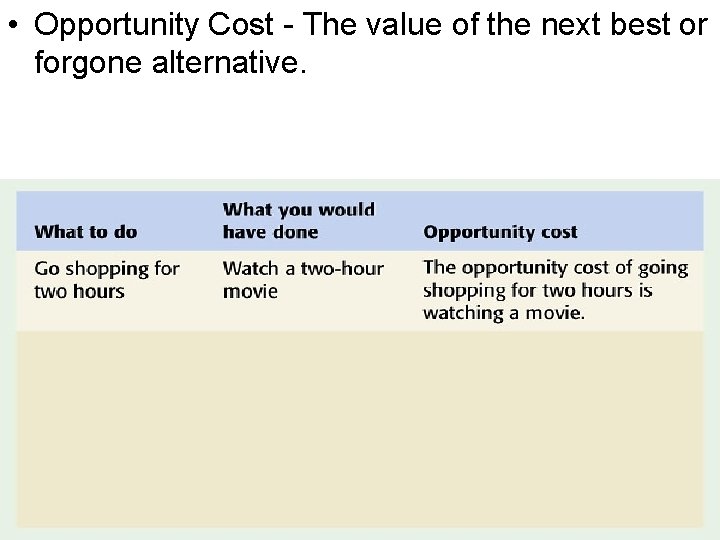
• Opportunity Cost - The value of the next best or forgone alternative.
Thinking at the Margin • When you decide how much more or less to do, you are thinking at the margin. Options Benefit Opportunity Cost 1 st hour of extra study time Grade of C on test 1 hour of sleep 2 nd hour of extra study time Grade of B on test 2 hours of sleep 3 rd hour of extra study time Grade of B+ on test 3 hours of sleep
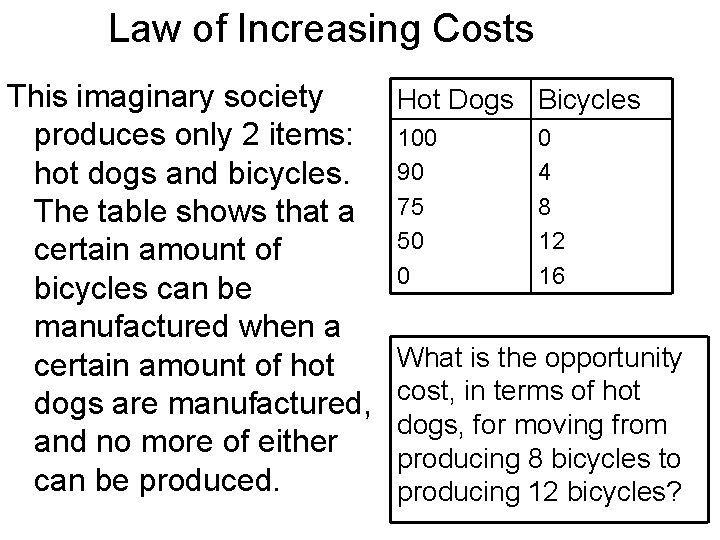
Law of Increasing Costs This imaginary society produces only 2 items: hot dogs and bicycles. The table shows that a certain amount of bicycles can be manufactured when a certain amount of hot dogs are manufactured, and no more of either can be produced. Hot Dogs Bicycles 100 90 75 50 0 0 4 8 12 16 What is the opportunity cost, in terms of hot dogs, for moving from producing 8 bicycles to producing 12 bicycles?
• Economists refer to cost (the alternative we give up) • The law of increasing costs – as production switches from A to B, more resources are needed to increase production • In other words, opportunity costs increase • The cost increases because not all resources are suitable ie. Think poor farm land
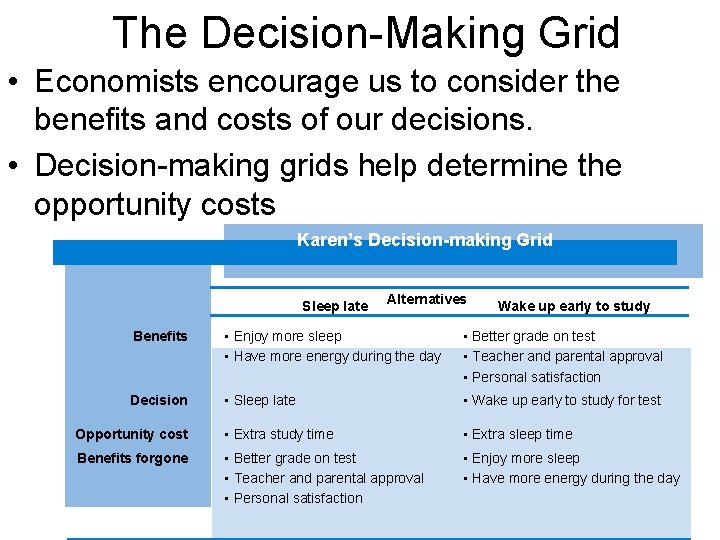
The Decision-Making Grid • Economists encourage us to consider the benefits and costs of our decisions. • Decision-making grids help determine the opportunity costs Karen’s Decision-making Grid Sleep late Alternatives Wake up early to study Benefits • Enjoy more sleep • Have more energy during the day • Better grade on test • Teacher and parental approval • Personal satisfaction Decision • Sleep late • Wake up early to study for test Opportunity cost • Extra study time • Extra sleep time Benefits forgone • Better grade on test • Teacher and parental approval • Personal satisfaction • Enjoy more sleep • Have more energy during the day
Production Possibility Frontier (PPF) Chap 1. 3
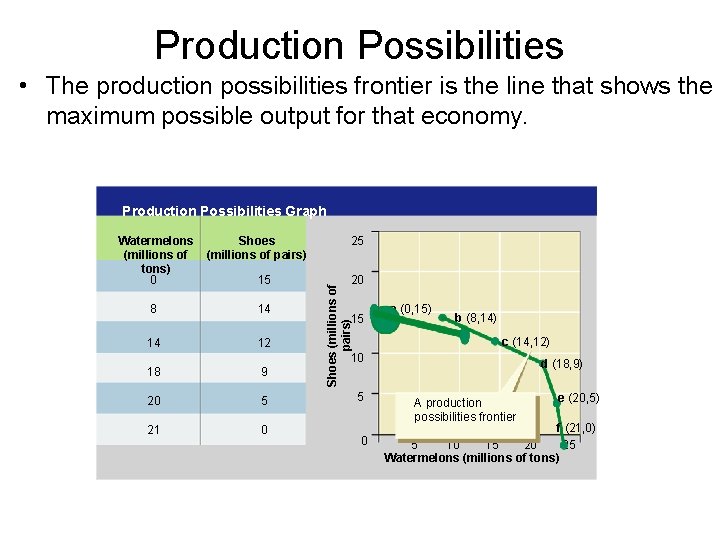
Production Possibilities Graph • Economists LOVE graphs! • A production possibilities frontier (PPF) shows alternative ways to use resources – no judgment involved • A country’s production possibilities curve depends on technology and resources • The axes will have the two categories of goods or services (guns or butter)
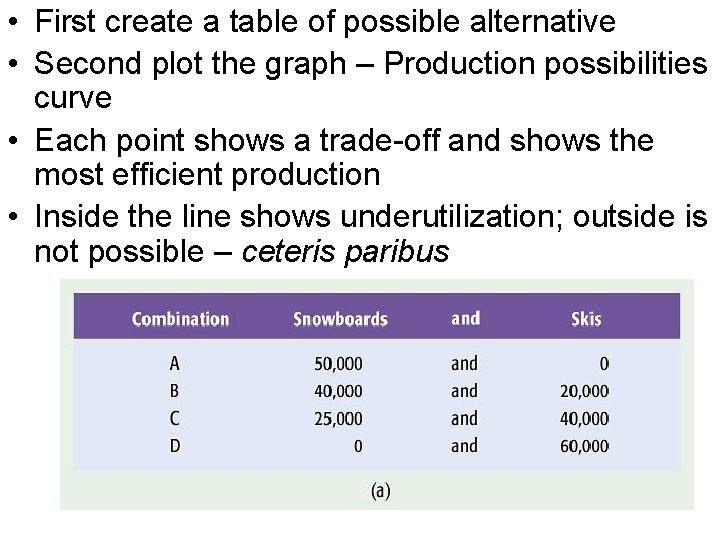
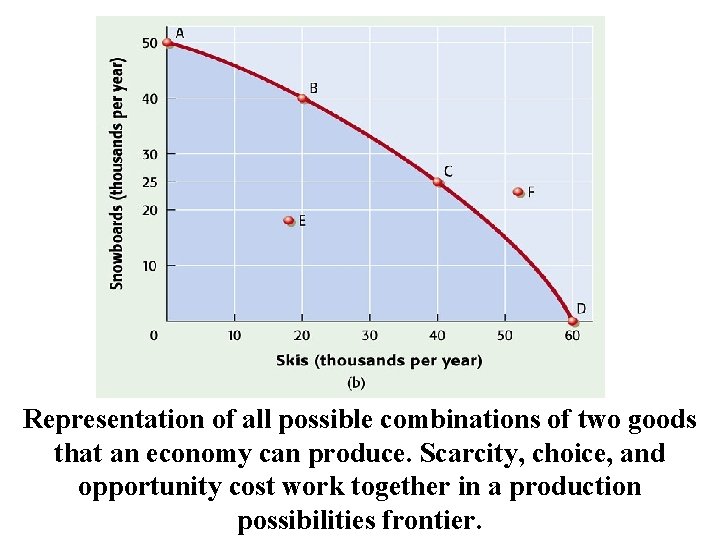
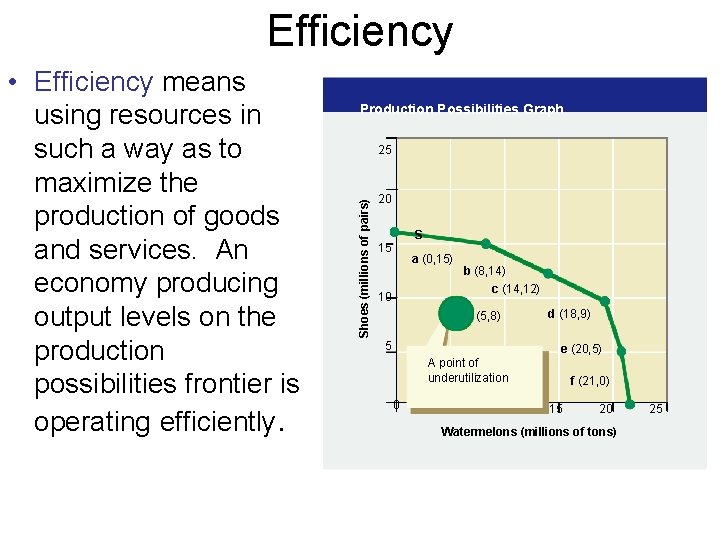
• First create a table of possible alternative • Second plot the graph – Production possibilities curve • Each point shows a trade-off and shows the most efficient production • Inside the line shows underutilization; outside is not possible – ceteris paribus
Representation of all possible combinations of two goods that an economy can produce. Scarcity, choice, and opportunity cost work together in a production possibilities frontier.
Production Possibilities • The production possibilities frontier is the line that shows the maximum possible output for that economy. Production Possibilities Graph Shoes (millions of pairs) 15 8 14 14 12 25 20 Shoes (millions of pairs) Watermelons (millions of tons) 0 15 a (0, 15) b (8, 14) c (14, 12) 10 18 9 20 5 21 0 5 0 d (18, 9) A production possibilities frontier e (20, 5) f (21, 0) 5 10 15 20 25 Watermelons (millions of tons)
Efficiency Production Possibilities Graph 25 Shoes (millions of pairs) • Efficiency means using resources in such a way as to maximize the production of goods and services. An economy producing output levels on the production possibilities frontier is operating efficiently. 20 S 15 a (0, 15) 10 b (8, 14) c (14, 12) g (5, 8) 5 d (18, 9) e (20, 5) A point of underutilization 0 5 10 f (21, 0) 15 20 Watermelons (millions of tons) 25
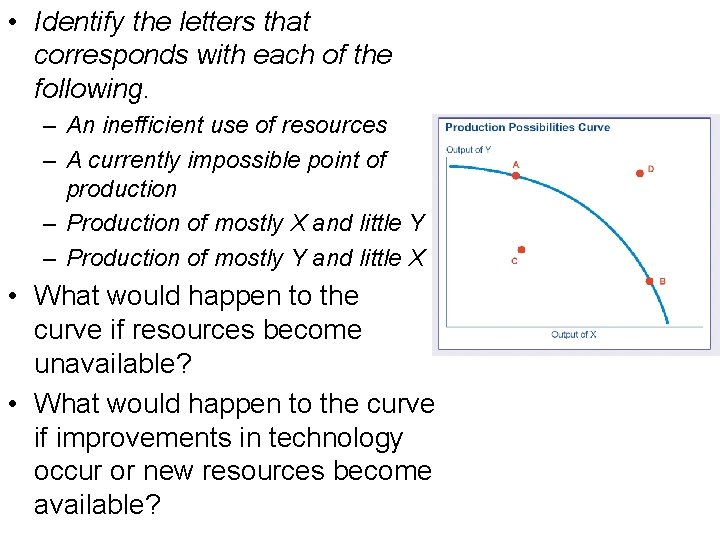
• Identify the letters that corresponds with each of the following. – An inefficient use of resources – A currently impossible point of production – Production of mostly X and little Y – Production of mostly Y and little X • What would happen to the curve if resources become unavailable? • What would happen to the curve if improvements in technology occur or new resources become available?
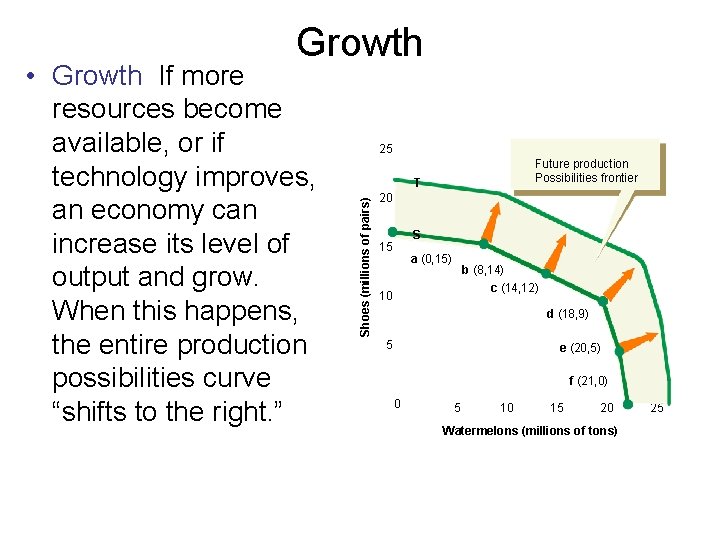
Growth Production Possibilities Graph 25 Future production Possibilities frontier T Shoes (millions of pairs) • Growth If more resources become available, or if technology improves, an economy can increase its level of output and grow. When this happens, the entire production possibilities curve “shifts to the right. ” 20 S 15 a (0, 15) b (8, 14) c (14, 12) 10 d (18, 9) 5 e (20, 5) f (21, 0) 0 5 10 15 20 Watermelons (millions of tons) 25