
What is Economics Chapter 1 Notes The Ordinary

- Slides: 22
What is Economics? Chapter 1 Notes
The “Ordinary Business of Life” Economist Alfred Marshall stated that economics is about the “ordinary business of life. ” Ordinary business is how people choose to satisfy their wants. Choice-making is fundamental in economics whether it involves a personal choice, a choice made by a business or a choice made by government. Making good choices is important to becoming a contributing, active & successful citizen
What is Economics? Economics is a social science that studies how people, acting individually or in groups, decide how to use scarce resources to satisfy their wants. It involves the study of people It is scientific because it uses many tools of analysis to explain how the economy works
The Fundamental Economic Problem: Scarcity People want more than their resources can provide. Scarcity is an inequality that exists between wants and the resources available to satisfy them. Scarcity = wants > available resources Scarcity forces individuals and groups to make choices about how to use resources, all of which have alternative uses. How people choose to satisfy their wants and why they make the decisions they do is an ongoing concern of economics.
Needs vs. Wants A need is a basic requirement necessary for survival There are 4 basic needs that are necessary for survival: food, water, shelter and clothing Wants are desires or luxuries Wants are not necessary for survival Physical vs. psychological wants Physical needs & wants change as we mature Psychological wants are not necessary for existence but make us feel better & even happier
The Want-Satisfaction Chain Trying to satisfy people’s wants is a complex process In an economy, millions of people work in thousands of businesses to produce & distribute goods & services to satisfy people’s wants. Turn to Figure 1 -1 on page 3
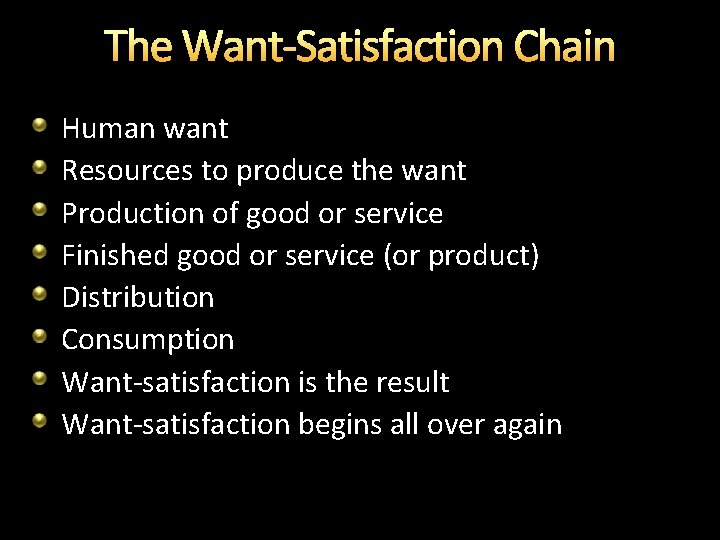
The Want-Satisfaction Chain Human want Resources to produce the want Production of good or service Finished good or service (or product) Distribution Consumption Want-satisfaction is the result Want-satisfaction begins all over again
Scarcity & Opportunity Cost Scarcity is the fundamental problem in economics Scarcity = wants > available resources Not all scarce resources have always been scarce. For example, oil. A resource is not scarce simply because there is little of it in existence. It is scarce when there isn’t enough of it to meet the need for it.
4 Types of Productive Resources 1. Natural resources (land)- unaltered gifts of nature (soil, minerals, timber, water, etc) 2. Human resources (or labor) – the physical & mental efforts people use to create goods & services 3. Capital resources (capital) – buildings, tools, machines people create & use to produce final goods & services 4. Entrepreneurship – is the imagination, innovative thinking & management skill needed to start & operate a business
4 Types of Productive Resources ü Resources are important to the success of a business & to the U. S. economy
Opportunity Cost Scarcity forces us to think about our alternatives We do not have enough time, money or resources to be able to have or do everything that we want so we have to choose An opportunity cost is the highest valued alternative given up as a result of making a choice
Opportunity Cost & Trade-offs A trade-off is something given up when a choice is made Choices involve making trade-offs Economics is primarily concerned with how to get the most benefit from a limited amount of resources
The Economic Way of Thinking John Maynard Keynes said economics “…is a method…an apparatus of the mind, a technique of thinking. ” Key Ideas: 1. Scarcity forces people to choose 2. All choices involve alternatives 3. People try to make good choices
The Economic Way of Thinking 4. People respond to incentives (remember “there is no such thing as a free lunch” TINSTAAFL) and disincentives 5. People gain when they trade voluntarily 6. Choices are future-oriented 7. Our choices are influenced by the choices of others 8. Applying the economic way of thinking
Thinking at the Marginal simply means the extra benefit or additional costs or benefits of a decision Every choice involves benefits and costs As long as a decision has more benefit than the costs, it is worth it to continue
Choice-making by Businesses The profit motive is an incentive for a business The business must sell enough of its product to exceed costs Profit = Total Sales > Total Costs Business people think at the margin (As long as the benefit or profit exceeds the costs, they will continue to produce)
Market Economy – an economy that relies on voluntary trade as the primary means of organizing & coordinating production A market is an arrangement that allows buyers & sellers to trade with one another The U. S. actually has a mixed market economy (because of government regulation)
The 3 Basic Economic Decisions 1. What goods & services to produce? 2. How should goods & services be produced? 3. For whom will goods & services be produced?
Two Branches of Economics Macroeconomics is the study of the economy as a whole 1. Examines the “big picture. ” 2. Macroeconomic topics: Unemployment, production level of a country, inflation, poverty, long-term economic growth
Two Branches of Economics Microeconomics is the study of individual consumers & businesses 1. Examines the choices that individuals, families & businesses make 2. Topics studied include: How much to charge for an event, employee wages, advertising campaign, etc. ,
Goods & Services Goods – physical products that businesses produce Services – an action that a person does for someone else (intangible; “can’t touch these”)
Utility refers to the usefulness or satisfaction of something People have different utilities for different items and it affects how much they are willing to pay for goods & services