
WHAT IS ECONOMICS 1 CHAPTER WHY DO WE






- Slides: 45
WHAT IS ECONOMICS? 1 CHAPTER
WHY DO WE STUDY ECONOMICS? ?
BAHRAIN STOCK MARKET
Swine Flu & Economics
UNSOLD CARS & ECONOMICS
WHY STUDY ECONOMICS n n n Among TOP TEN REASONS …. . Economists can supply it on demand. You can talk about money without ever having to make any. When you are in the unemployment line, at least you will know why you are there. So that you know more than the most world leaders about what is actually going on.
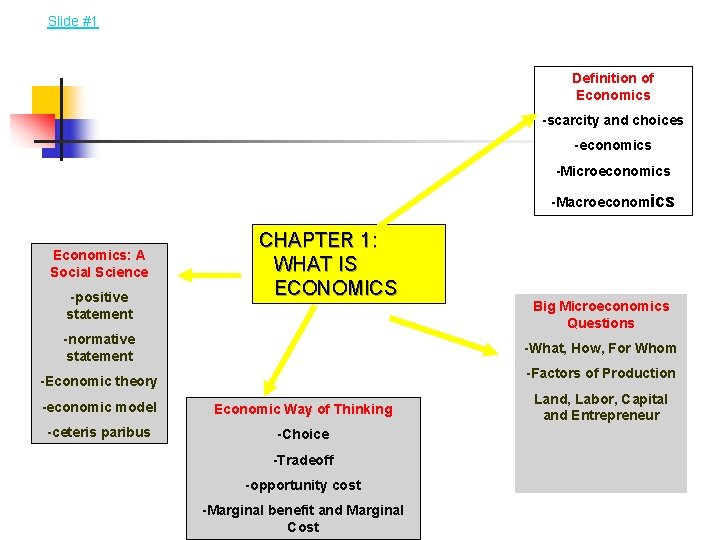
Slide #1 Definition of Economics -scarcity and choices -economics -Microeconomics -Macroeconomics Economics: A Social Science -positive statement CHAPTER 1: WHAT IS ECONOMICS -normative statement Big Microeconomics Questions -What, How, For Whom -Factors of Production -Economic theory -economic model Economic Way of Thinking -ceteris paribus -Choice -Tradeoff -opportunity cost -Marginal benefit and Marginal Cost Land, Labor, Capital and Entrepreneur
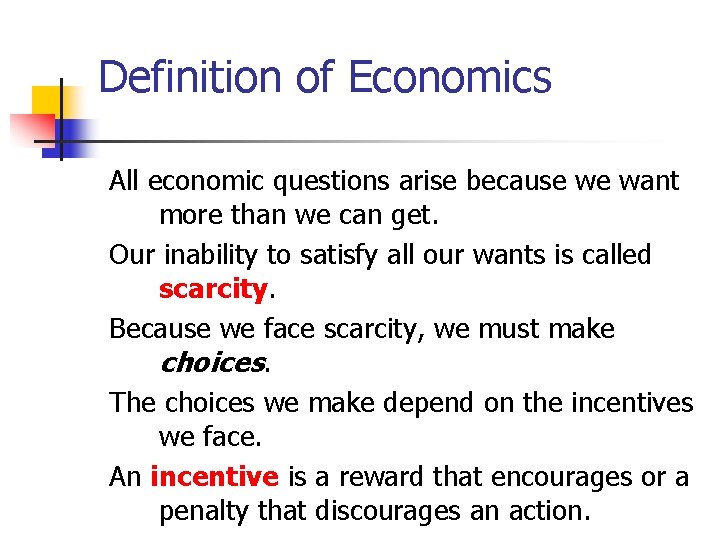
Definition of Economics All economic questions arise because we want more than we can get. Our inability to satisfy all our wants is called scarcity. Because we face scarcity, we must make choices. The choices we make depend on the incentives we face. An incentive is a reward that encourages or a penalty that discourages an action.
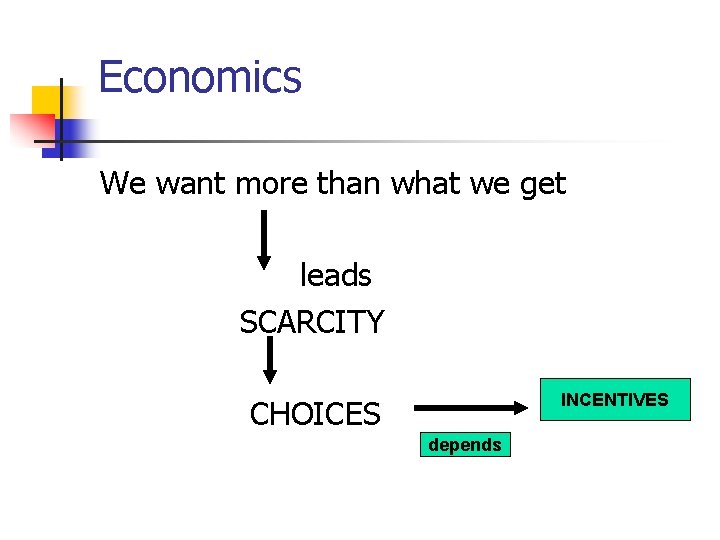
Economics We want more than what we get leads SCARCITY INCENTIVES CHOICES depends
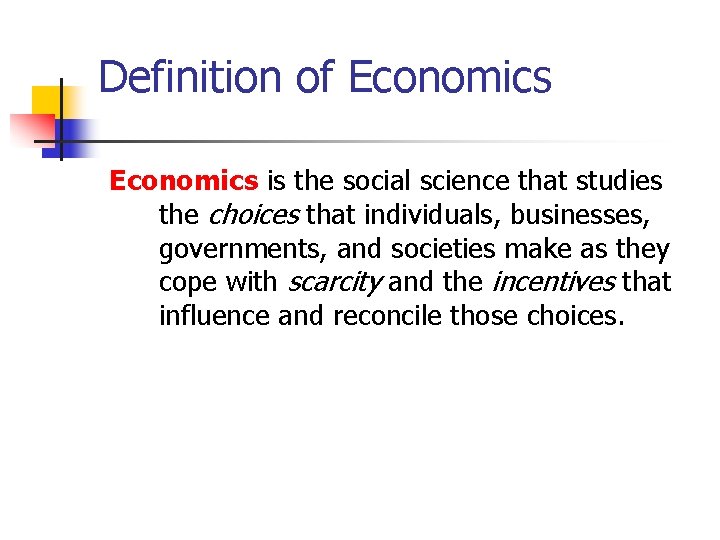
Definition of Economics is the social science that studies the choices that individuals, businesses, governments, and societies make as they cope with scarcity and the incentives that influence and reconcile those choices.
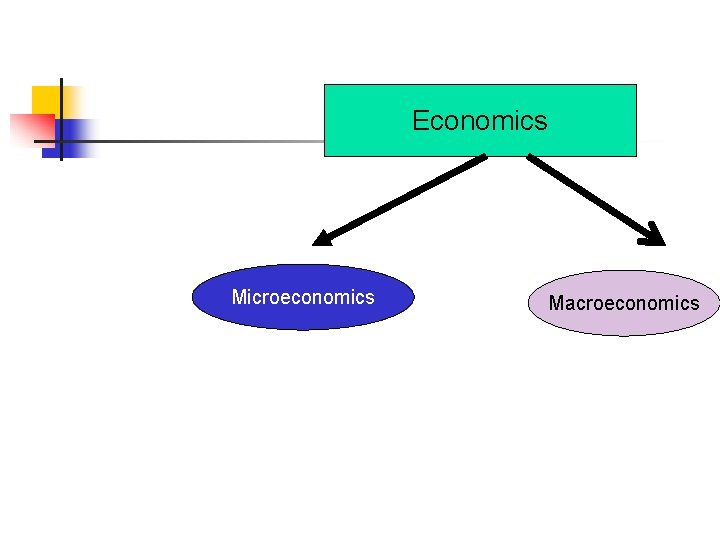
Economics Microeconomics Macroeconomics
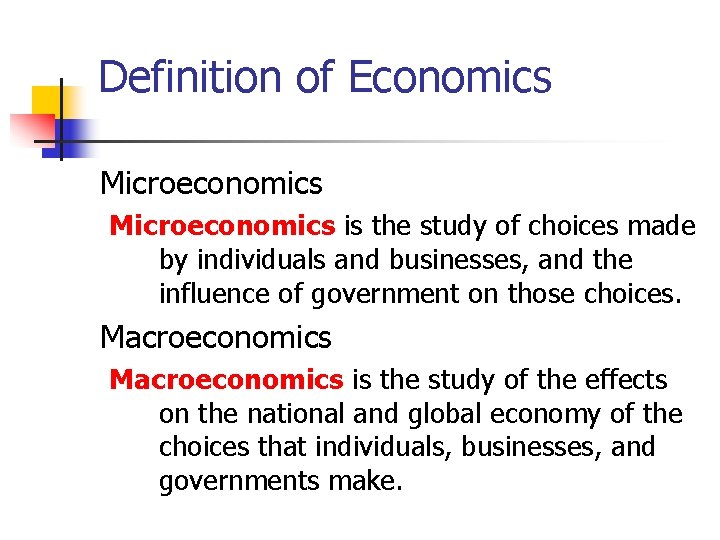
Definition of Economics Microeconomics is the study of choices made by individuals and businesses, and the influence of government on those choices. Macroeconomics is the study of the effects on the national and global economy of the choices that individuals, businesses, and governments make.
TWO BIG ECONOMIC QUESTIONS
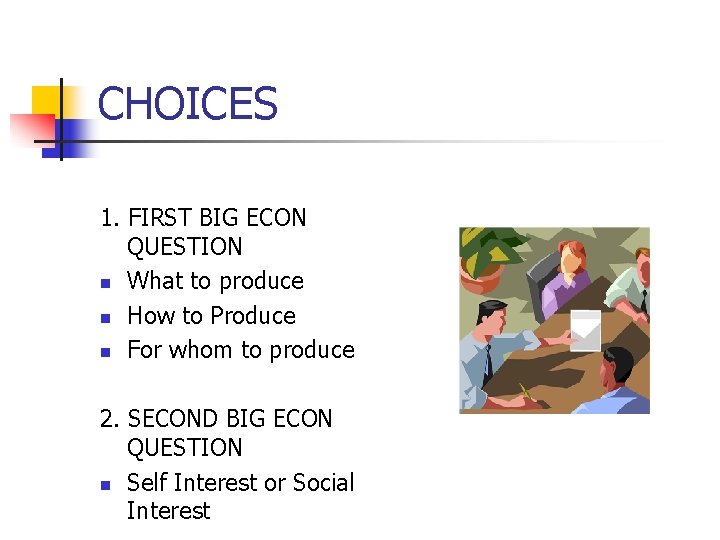
CHOICES 1. FIRST BIG ECON QUESTION n What to produce n How to Produce n For whom to produce 2. SECOND BIG ECON QUESTION n Self Interest or Social Interest
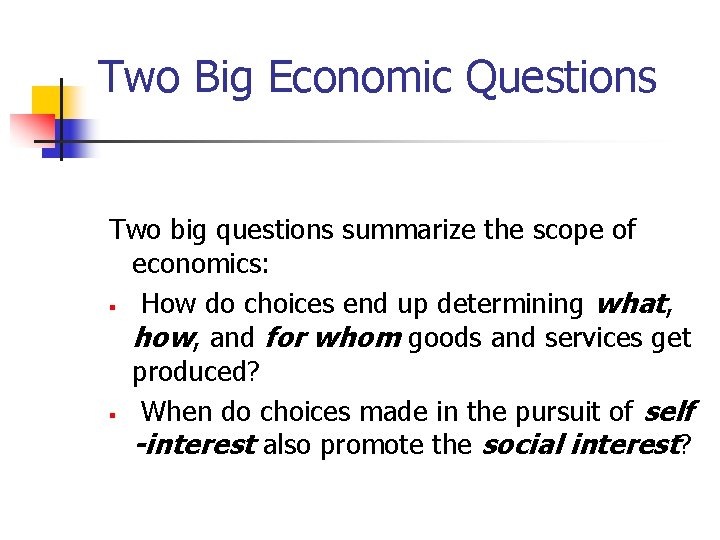
Two Big Economic Questions Two big questions summarize the scope of economics: § How do choices end up determining what, how, and for whom goods and services get produced? § When do choices made in the pursuit of self -interest also promote the social interest?
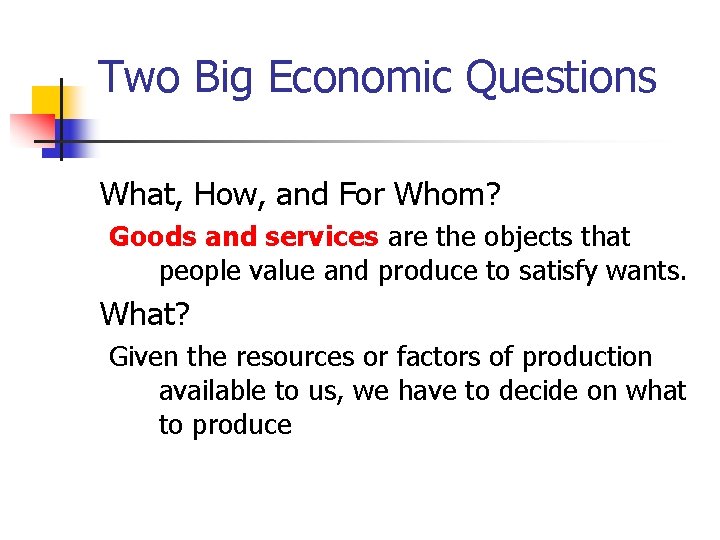
Two Big Economic Questions What, How, and For Whom? Goods and services are the objects that people value and produce to satisfy wants. What? Given the resources or factors of production available to us, we have to decide on what to produce
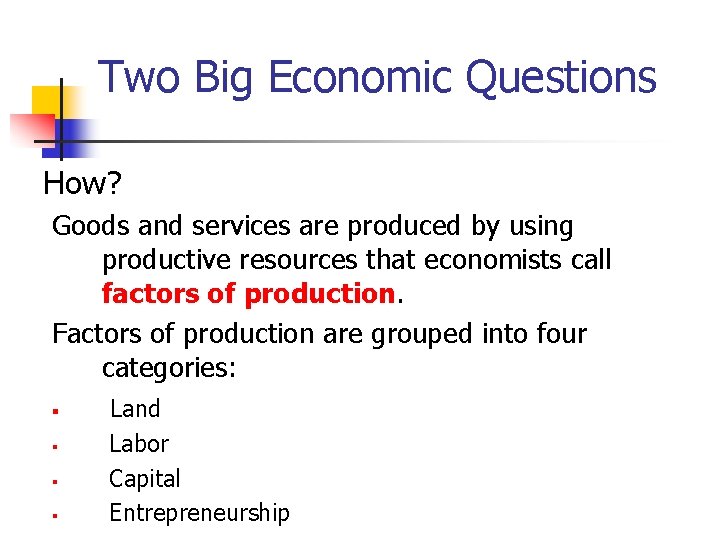
Two Big Economic Questions How? Goods and services are produced by using productive resources that economists call factors of production. Factors of production are grouped into four categories: § § Land Labor Capital Entrepreneurship
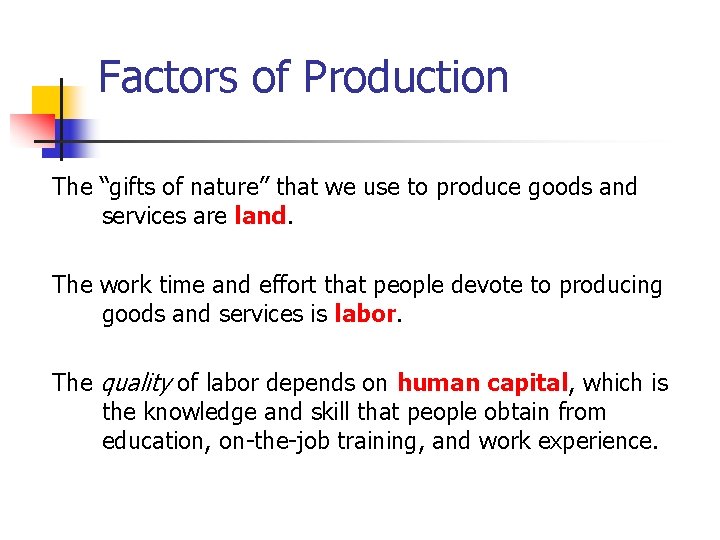
Factors of Production The “gifts of nature” that we use to produce goods and services are land. The work time and effort that people devote to producing goods and services is labor. The quality of labor depends on human capital, which is the knowledge and skill that people obtain from education, on-the-job training, and work experience.
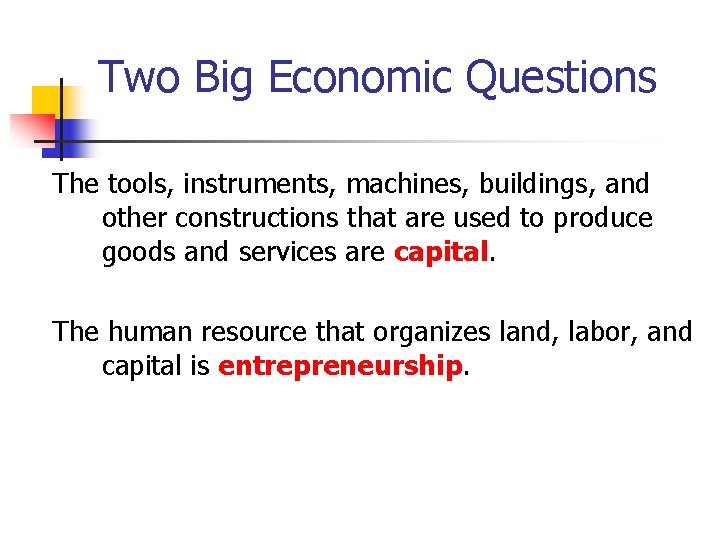
Two Big Economic Questions The tools, instruments, machines, buildings, and other constructions that are used to produce goods and services are capital. The human resource that organizes land, labor, and capital is entrepreneurship.
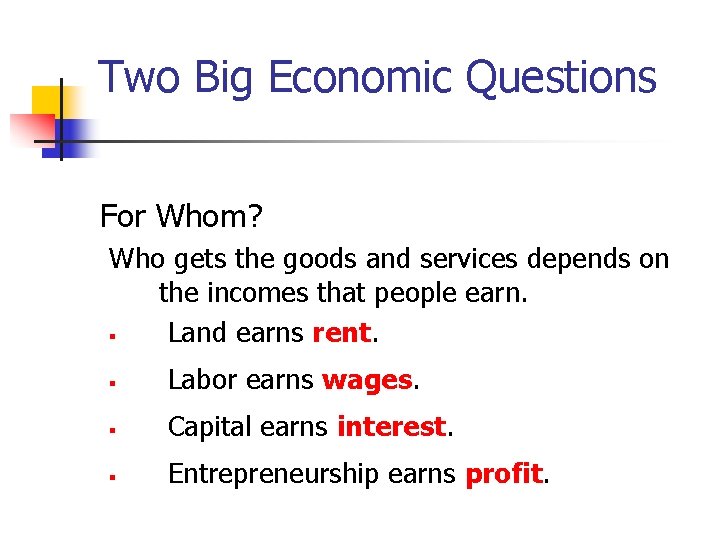
Two Big Economic Questions For Whom? Who gets the goods and services depends on the incomes that people earn. § Land earns rent. § Labor earns wages. § Capital earns interest. § Entrepreneurship earns profit.
Two Big Economic Questions When is the Pursuit of Self-Interest in the Social Interest? Every day, 6. 3 billion people make economic choices that result in “What, ” “How, ” and “For Whom” goods and services get produced. § § § Do we produce the right things in the right quantities? Do we use our factors of production in the best way? Do the goods and services go the those who benefit most from them?
Two Big Economic Questions You make choices that are in your selfinterest—choices that you think are best for you. Choices that are best for society as a whole are said to be in the social interest. Is it possible that when each one of us makes choices that are in our self-interest, it also turns out that these choices are also in the social interest?
n n n B. The second big question is “When is the pursuit of selfinterest also in the social interest? ” 1. People make choices in their own self-interest—they make choices they think are best for their own well-being. a) The incentives surrounding an individual’s choice amongst available alternatives influence the tradeoffs involved in making that choice. b) The choice made by one individual changes the incentives surrounding the tradeoffs facing other individuals, which influences their choices. c) In this way, many self-interested individuals making choices in society will bring about change to the incentive surrounding all decisions to be made by individuals in the economy.
n n n 2. When people make self-interested choices that are the best for society, they make choices that are considered in the social interest. a) In 1776 Adam Smith published The Wealth of Nations describing how a market based system can theoretically motivate self-interested individuals to make choices that promote the social interest. b) Economists try to identify those characteristics of a market system that successfully promote selfinterested individuals to make choices that coincide with the social interest
n n n 3. We can examine a number of current events to determine whether selfinterested individuals made choices in the social interest: a) Privatization: The fall of socialism and the rise of capitalism in Europe b) Globalization: The local impact of growing international trade c) The “New” Economy: Workers adjusting to changing technologies d) The post 9 -11 economy: Terror changes vacation habits e) Corporate scandals: Preventing stealing by corporate officials through lying f) HIV/AIDs: Poorest countries hit hardest but lack medicines g) Disappearing tropical rainforests: Lack of property rights creates waste h) Water shortages: Consumers fail to pay the opportunity cost of consumption i) Unemployment: Persistence in minority teenage unemployment j) Deficits and Debt: Having future generations pay for today’s servi
The Economic Way of Thinking Choices and Tradeoffs The economic way of thinking places scarcity and its implication, choice, at center stage. You can think about every choice as a tradeoff—an exchange—giving up one thing to get something else. The classic tradeoff is “guns versus butter. ” “Guns” and “butter” stand for any two objects of value.
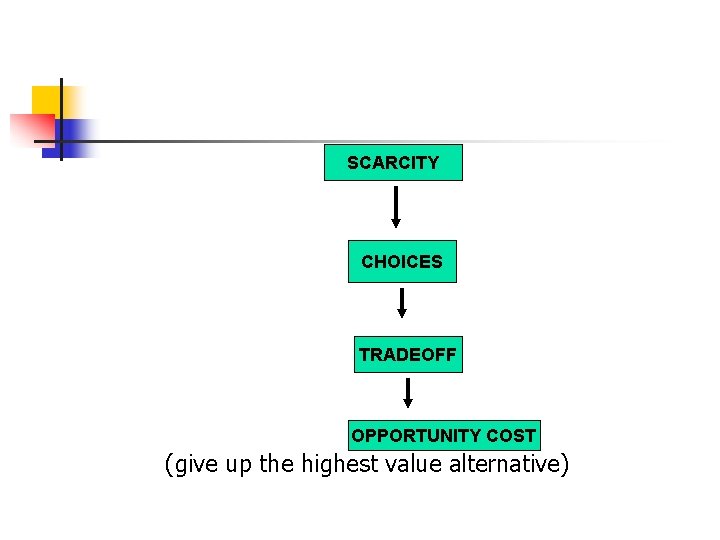
SCARCITY CHOICES TRADEOFF OPPORTUNITY COST (give up the highest value alternative)
The Economic Way of Thinking Opportunity Cost Thinking about a choice as a tradeoff emphasizes cost as an opportunity forgone. The highest-valued alternative that we give up to get something is the opportunity cost of the activity chosen.
The Economic Way of Thinking Choosing at the Margin People make choices at the margin, which means that they evaluate the consequences of making incremental changes in the use of their resources. The benefit from pursuing an incremental increase in an activity is its marginal benefit. The opportunity cost of pursuing an incremental increase in an activity is its marginal cost.
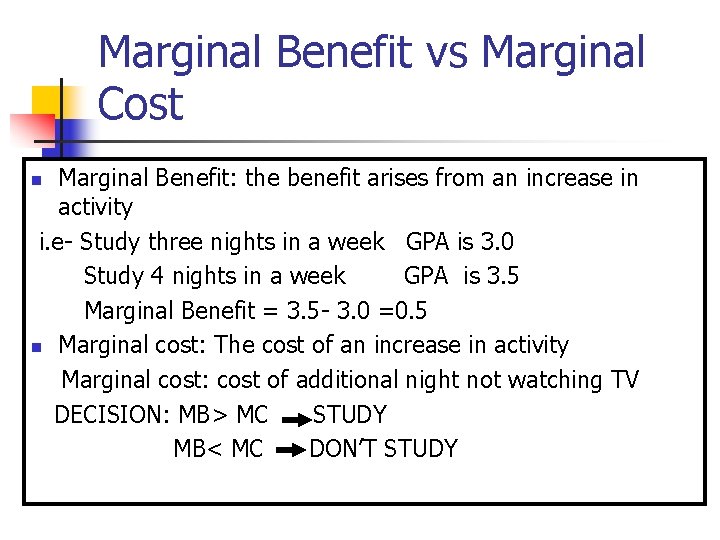
Marginal Benefit vs Marginal Cost Marginal Benefit: the benefit arises from an increase in activity i. e- Study three nights in a week GPA is 3. 0 Study 4 nights in a week GPA is 3. 5 Marginal Benefit = 3. 5 - 3. 0 =0. 5 n Marginal cost: The cost of an increase in activity Marginal cost: cost of additional night not watching TV DECISION: MB> MC STUDY MB< MC DON’T STUDY n
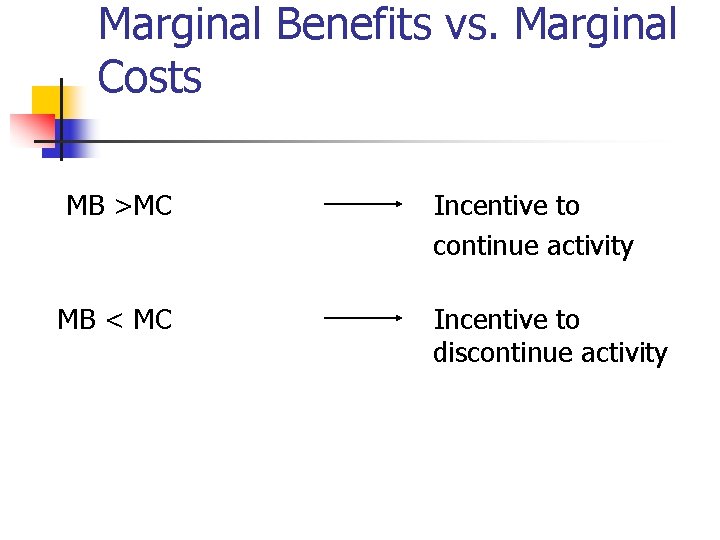
Marginal Benefits vs. Marginal Costs MB >MC MB < MC Incentive to continue activity Incentive to discontinue activity
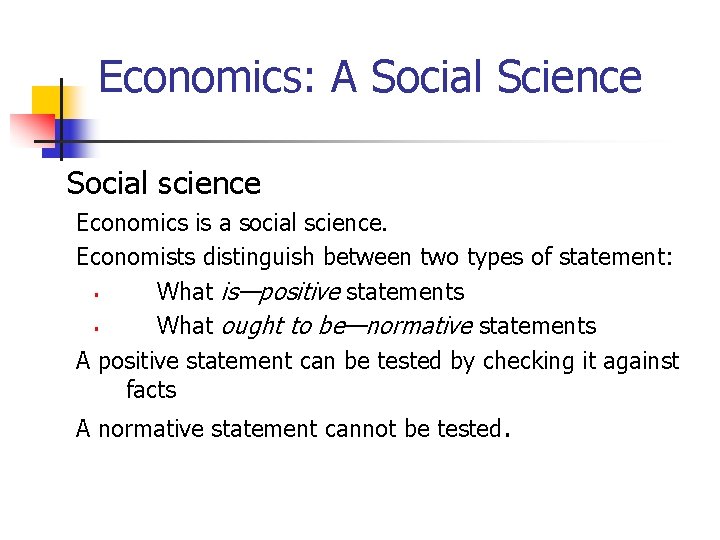
Economics: A Social Science Social science Economics is a social science. Economists distinguish between two types of statement: § What is—positive statements § What ought to be—normative statements A positive statement can be tested by checking it against facts A normative statement cannot be tested.
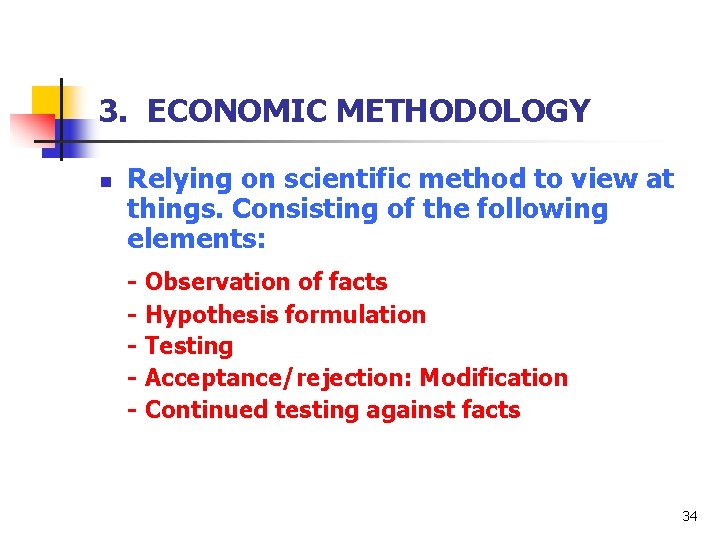
3. ECONOMIC METHODOLOGY n Relying on scientific method to view at things. Consisting of the following elements: - Observation of facts - Hypothesis formulation - Testing - Acceptance/rejection: Modification - Continued testing against facts 34
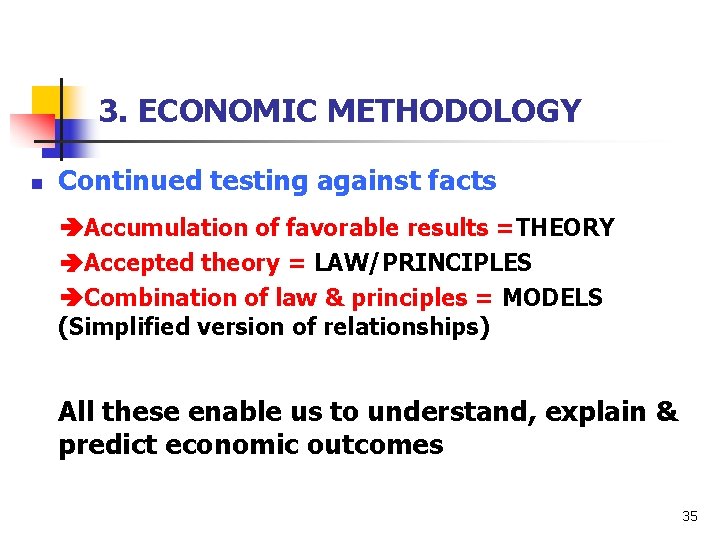
3. ECONOMIC METHODOLOGY n Continued testing against facts Accumulation of favorable results =THEORY Accepted theory = LAW/PRINCIPLES Combination of law & principles = MODELS (Simplified version of relationships) All these enable us to understand, explain & predict economic outcomes 35
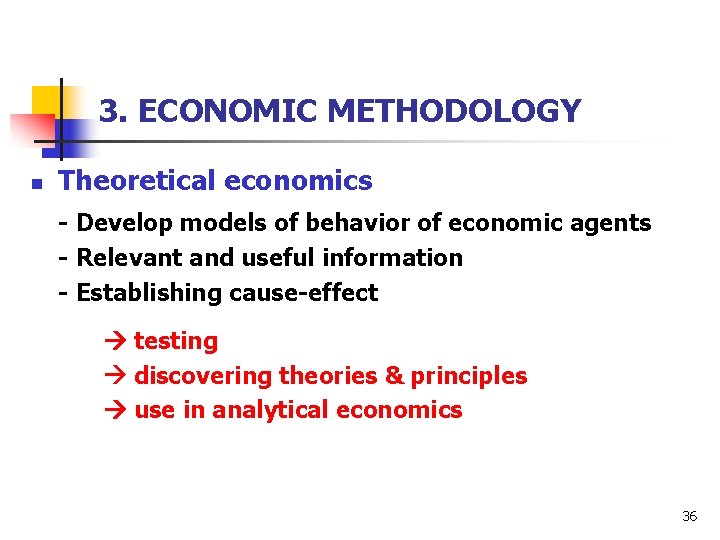
3. ECONOMIC METHODOLOGY n Theoretical economics - Develop models of behavior of economic agents - Relevant and useful information - Establishing cause-effect testing discovering theories & principles use in analytical economics 36
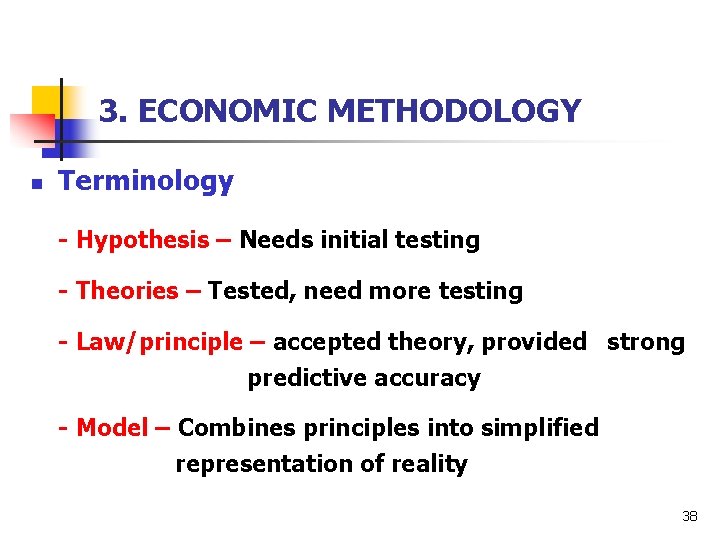
3. ECONOMIC METHODOLOGY n Terminology - Hypothesis – Needs initial testing - Theories – Tested, need more testing - Law/principle – accepted theory, provided strong predictive accuracy - Model – Combines principles into simplified representation of reality 38
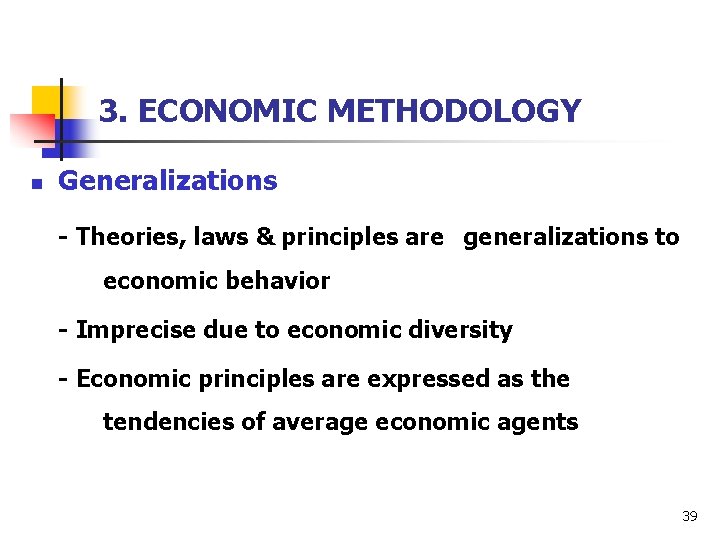
3. ECONOMIC METHODOLOGY n Generalizations - Theories, laws & principles are generalizations to economic behavior - Imprecise due to economic diversity - Economic principles are expressed as the tendencies of average economic agents 39
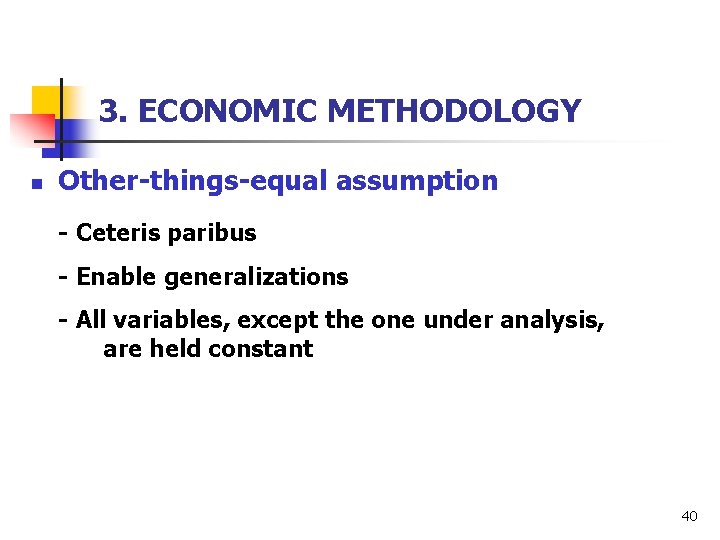
3. ECONOMIC METHODOLOGY n Other-things-equal assumption - Ceteris paribus - Enable generalizations - All variables, except the one under analysis, are held constant 40
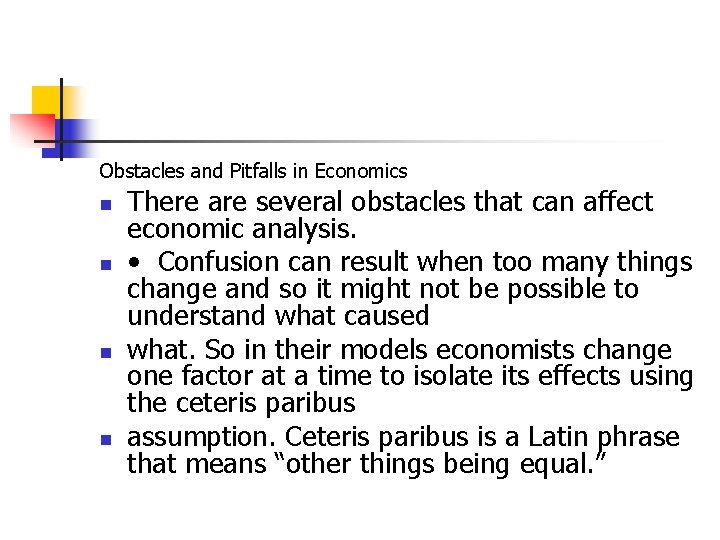
Obstacles and Pitfalls in Economics n n There are several obstacles that can affect economic analysis. • Confusion can result when too many things change and so it might not be possible to understand what caused what. So in their models economists change one factor at a time to isolate its effects using the ceteris paribus assumption. Ceteris paribus is a Latin phrase that means “other things being equal. ”
Economists cannot easily do experiments and most economic behavior has many simultaneous causes. To isolate the effect of interest, economists use the logical device called ceteris Paribus or “other things being equal. Economists try to isolate cause-and-effect relationship by changing only one variable at a time, holding all other relevant factors unchanged.
n n n n • The fallacy of composition is the (false) statement that what is true for the parts is also true for the whole, or what is true for the whole is also true for the parts. For example, one person can walk through the door into the class, so the entire 30 -person class can simultaneously walk through the door. • The post hoc fallacy (from the Latin phrase, post hoc, ergo propter hoc, which means “after this, therefore because of this”) is the error of reasoning that a first event causes a second event because the first event occurred before the second. For instance, claiming that you are delivering an economics lecture because the room first filled with students is a post hoc fallacy.
n n n Agreement and Disagreement Among Economists tend to agree on positive statements, though they might disagree on normative statements. Economists are often accused of contradicting each other. In contrast to the popular image, economists find much common ground on a wide range of issues. (Page X lists twelve different economic propositions that at least 70 percent of all economists polled will agree upon. )
THE END