
What is Drama n Main Entry drama Function
- Slides: 24
What is Drama? n Main Entry: dra·ma Function: noun Etymology: Late Latin dramat-, drama, from Greek, deed, drama, from dran to do, act Date: 1515 1 : a composition in verse or prose intended to portray life or character or to tell a story usually involving conflicts and emotions through action and dialogue and typically designed for theatrical performance
What is Theatre? n The artistic practice of live performance with a live audience n Theatre is a story that comes alive. n Theatre shows us lives like our own and speaking our language as well as shows us a world that never was. n Theatre is a unique art that calls for an audience to react to a lifelike experience.
What is Theatre? n At its fullest power, theatre provides a shared experience that calls upon all our senses. n It is a sensational medium that offers an audience an image of life possessing unusual excitement and, at times, a great and strong simplicity. n When fully mobilized, the power of theatre is almost irresistible.
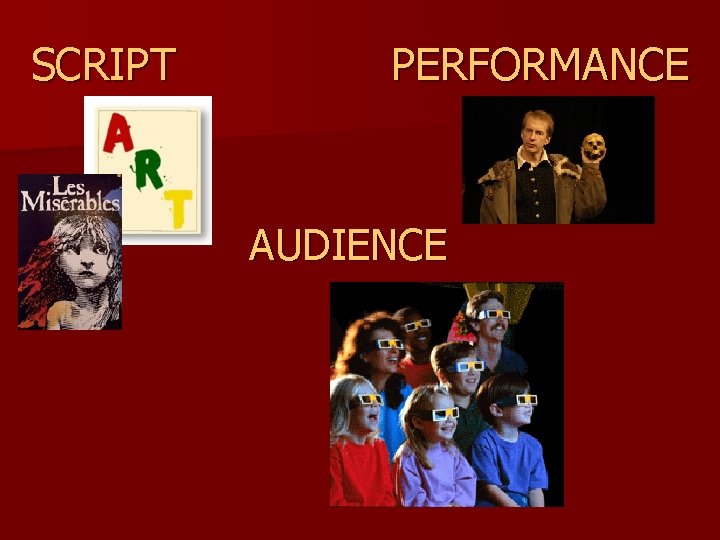
SCRIPT PERFORMANCE AUDIENCE
What is Performed • Many types of activities may be considered Theatre • What is the essence of theatrical performance? Possibilities: • The staged performance of a text • Storytelling • Entertainment such as juggling or improvisation • Since Theatre has a broad range of possibilities, the essence of What is Performed is difficult to define • Therefore Theatre, as a performing art, is difficult to define
The Performance translates the potential of a script, scenario, or plan into actuality. Key Components of the Performance include: • Performance Space where the performance takes place and what the relationship is between the performers and the audience • Artistic Collaboration how the playwright, director, designers and others work together to create the Performance • Theatrical Elements Scenery, Costumes, Music, Lighting and other effects that contribute to the Performance
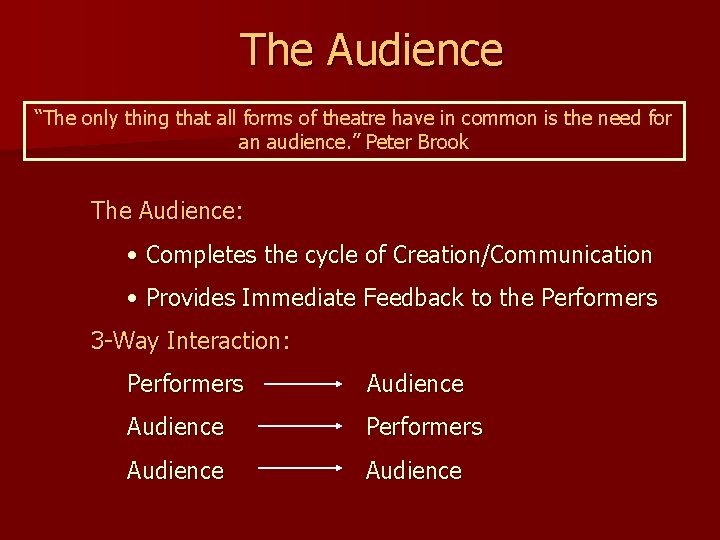
The Audience “The only thing that all forms of theatre have in common is the need for an audience. ” Peter Brook The Audience: • Completes the cycle of Creation/Communication • Provides Immediate Feedback to the Performers 3 -Way Interaction: Performers Audience
Theatre in YOUR Life n List the events in your life that fit the SCRIPT, PERFORMANCE, AUDIENCE model?
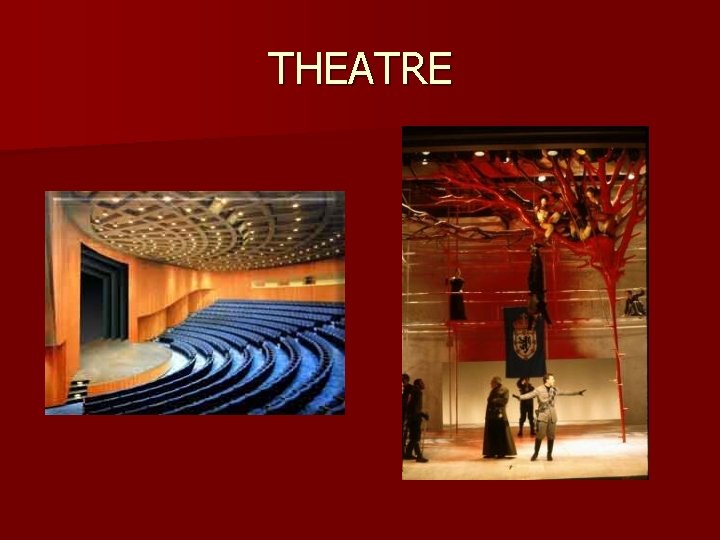
THEATRE
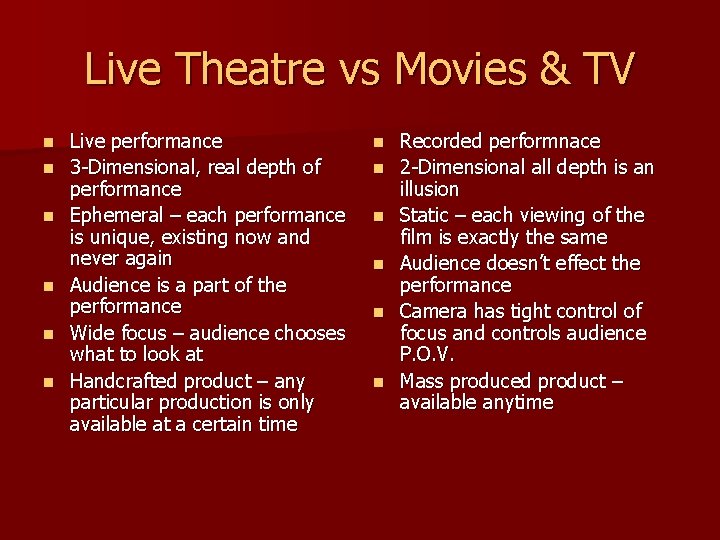
Live Theatre vs Movies & TV n n n Live performance 3 -Dimensional, real depth of performance Ephemeral – each performance is unique, existing now and never again Audience is a part of the performance Wide focus – audience chooses what to look at Handcrafted product – any particular production is only available at a certain time n n n Recorded performnace 2 -Dimensional all depth is an illusion Static – each viewing of the film is exactly the same Audience doesn’t effect the performance Camera has tight control of focus and controls audience P. O. V. Mass produced product – available anytime
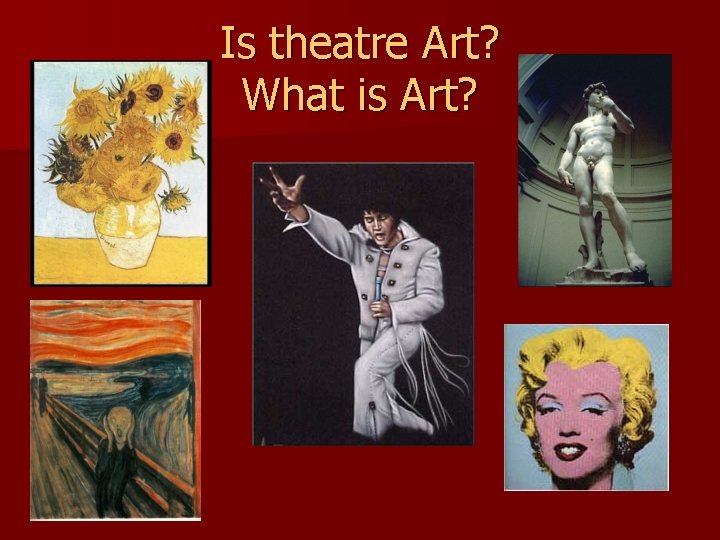
Is theatre Art? What is Art?
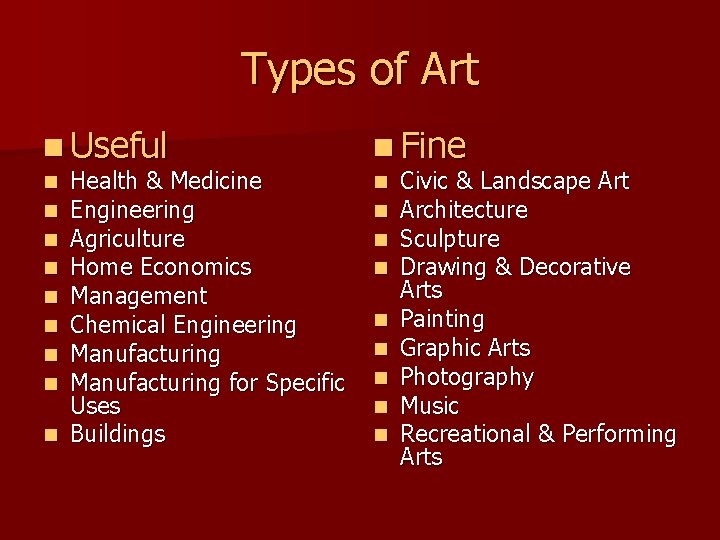
Types of Art n Useful n Fine n n n Health & Medicine Engineering Agriculture Home Economics Management Chemical Engineering Manufacturing for Specific Uses n Buildings n n n Civic & Landscape Art Architecture Sculpture Drawing & Decorative Arts Painting Graphic Arts Photography Music Recreational & Performing Arts
Aesthetics n Main Entry: aesthetic Function: noun 1 : a branch of philosophy dealing with the nature of beauty, art, and taste and with the creation and appreciation of beauty
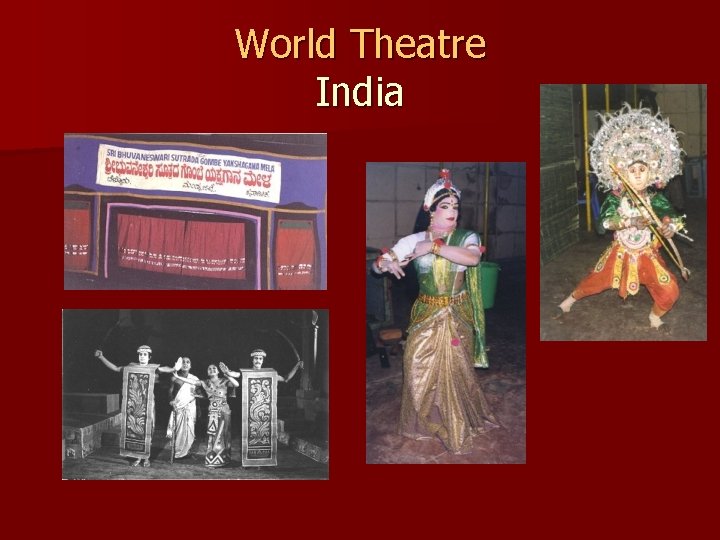
World Theatre India
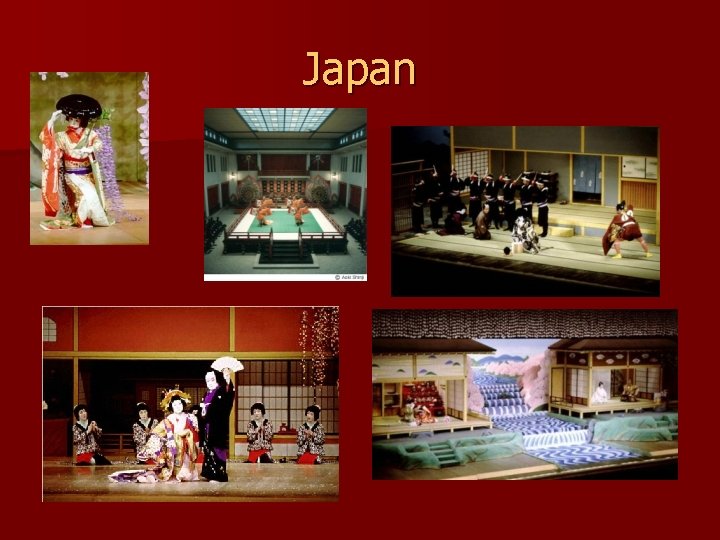
Japan
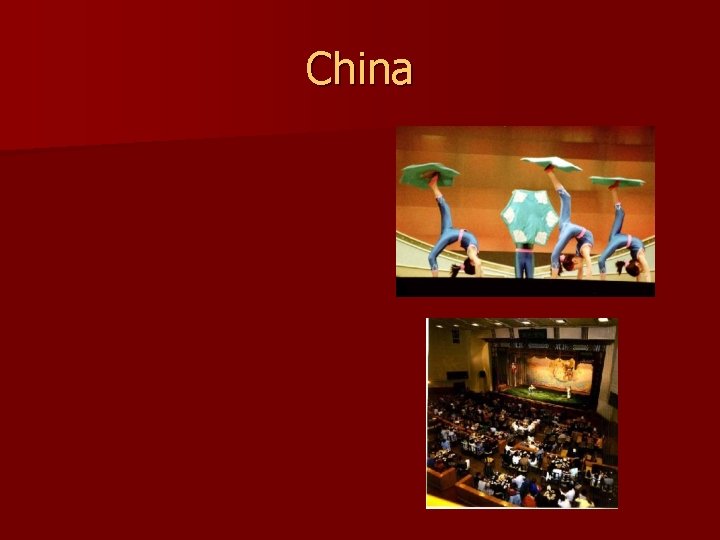
China
Purposes of Art • Art as a means to understand one’s world • Like other disciplines, such as history, Art seeks to discover and record patterns in human experience. • While historians, scientists and other scholars appeal to the mind/intellect, Artists appeal to the senses.
Value of Art n Art has the capacity to improve the quality of life by: – Bringing pleasure – Sharpening our perceptions – Increasing our sensitivity to others – Suggesting that moral and societal concerns should take precedence over materialistic goals
Theatre as an art form n Theatre has great potential as a humanizing force because it allows – Audience enters lives of others so as to understand their aspirations and motivations – Helps us to see who and what we are. – See ourselves in relation to others. – Understand feel for others as human beings
Elements of Theatre Spectatorship “Willing Suspension of Disbelief” • Term from Samuel Taylor Coleridge • We know that the events of the play are not real. • However, we agree, during the experience of the performance, not to disbelieve the events of the play. Example: • When a character kills another character onstage, we do not rush to the stage to help the victim, yet we may still weep or feel an emotional response to the action.
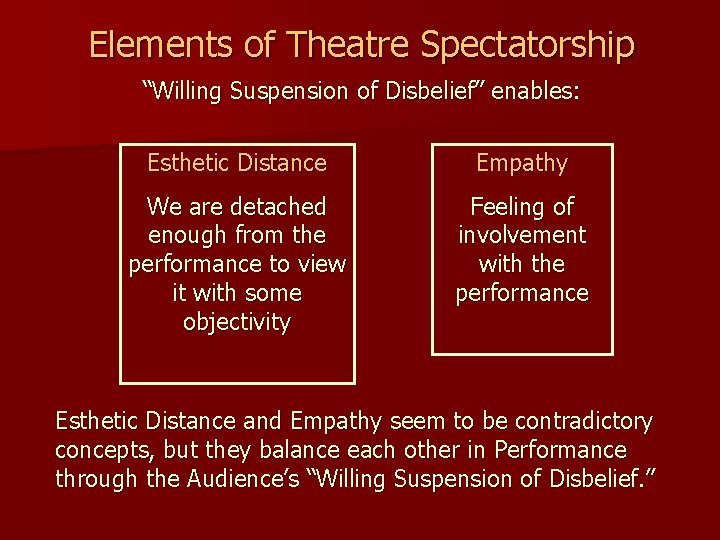
Elements of Theatre Spectatorship “Willing Suspension of Disbelief” enables: Esthetic Distance Empathy We are detached enough from the performance to view it with some objectivity Feeling of involvement with the performance Esthetic Distance and Empathy seem to be contradictory concepts, but they balance each other in Performance through the Audience’s “Willing Suspension of Disbelief. ”
Special Qualities of Theatre Lifelikeness Theatre recreates everyday experiences. Ephemerality Theatre is live performance, and becomes a part of the past immediately after it occurs. Objectivity Theatre “presents both outer and inner experience through speech and action. ”
Special Qualities of Theatre Complexity Theatre combines varied elements such as movement, lighting and sound while also drawing from all of the other Arts. Immediacy Theatre is psychologically immediate, because it transpires in the simultaneous presence of live actors and spectators in the same room.
Theatre holds a mirror up to nature, so Shakespeare said. If you were going to create a work for theatre, what event from your life would you choose, who would your characters be, and where would it be set? The End