
What is DNA Where do we find DNA

- Slides: 36
What is DNA?
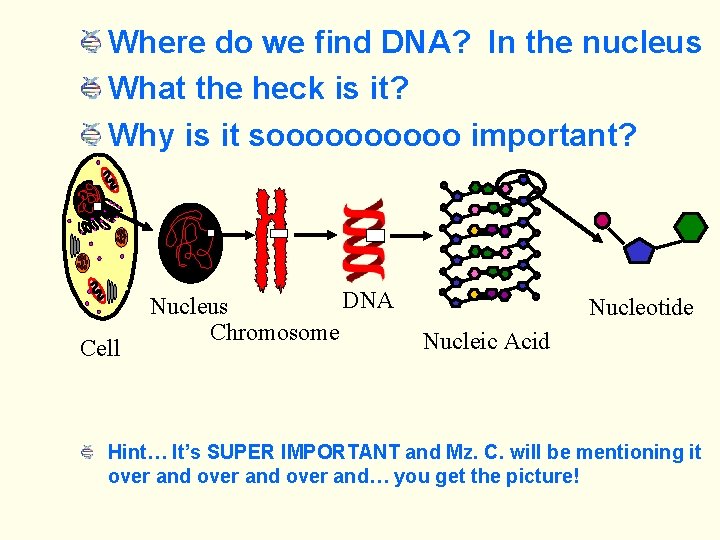
Where do we find DNA? In the nucleus What the heck is it? Why is it sooooo important? Cell DNA Nucleus Chromosome Nucleotide Nucleic Acid Hint… It’s SUPER IMPORTANT and Mz. C. will be mentioning it over and… you get the picture!
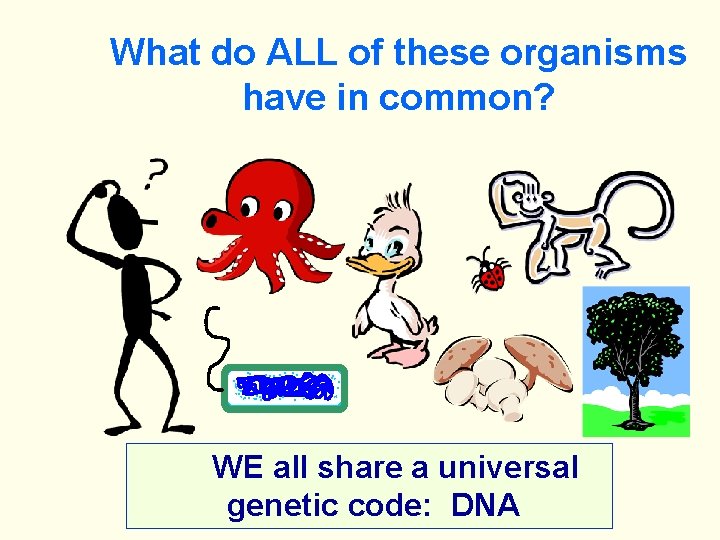
What do ALL of these organisms have in common? WE all share a universal genetic code: DNA
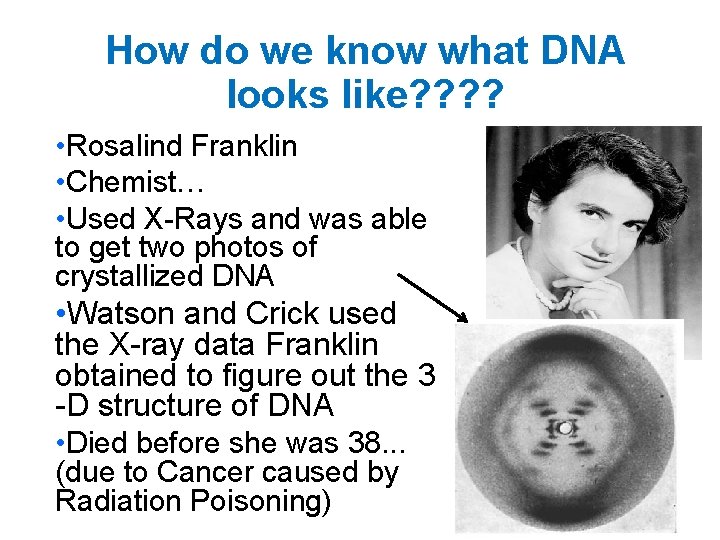
How do we know what DNA looks like? ? • Rosalind Franklin • Chemist… • Used X-Rays and was able to get two photos of crystallized DNA • Watson and Crick used the X-ray data Franklin obtained to figure out the 3 -D structure of DNA • Died before she was 38. . . (due to Cancer caused by Radiation Poisoning)
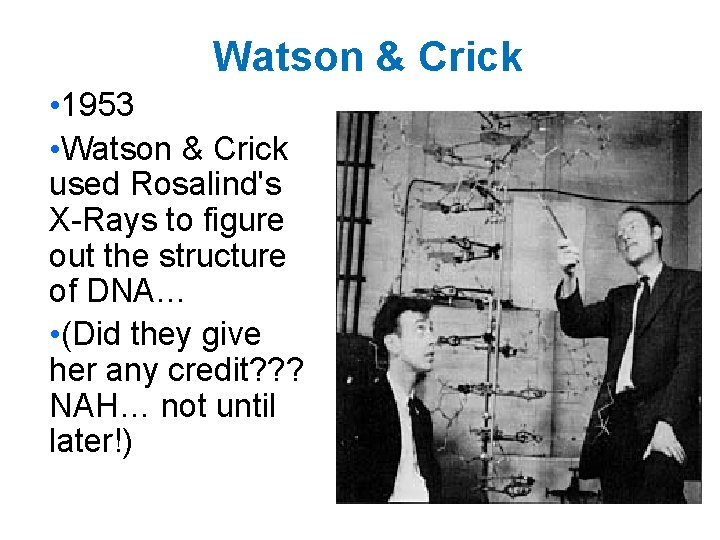
Watson & Crick • 1953 • Watson & Crick used Rosalind's X-Rays to figure out the structure of DNA… • (Did they give her any credit? ? ? NAH… not until later!)
What they “Announced” • Using Rosalind X-Rays, Watson & Crick determined that phosphates and sugars were on the “outside” of the DNA molecule and nitrogen bases were on the “inside” • They also figured out that DNA is a double helix… • Rosalind figured out that DNA was in a helical shape… but… didn’t get any further details • What’s a helical shape? Let’s talk helicopters… and screws…!
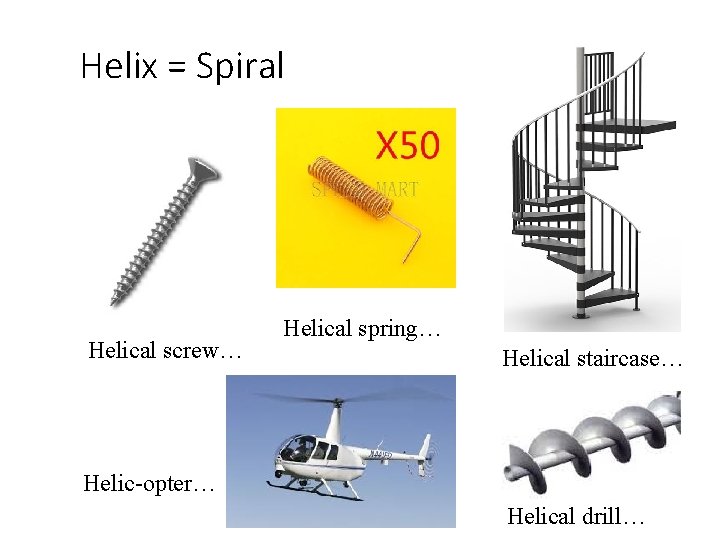
Helix = Spiral Helical screw… Helical spring… Helical staircase… Helic-opter… Helical drill…
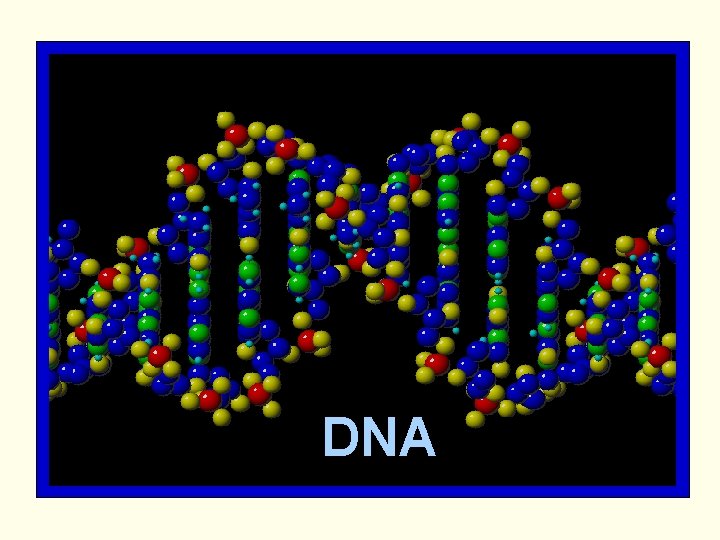
DNA
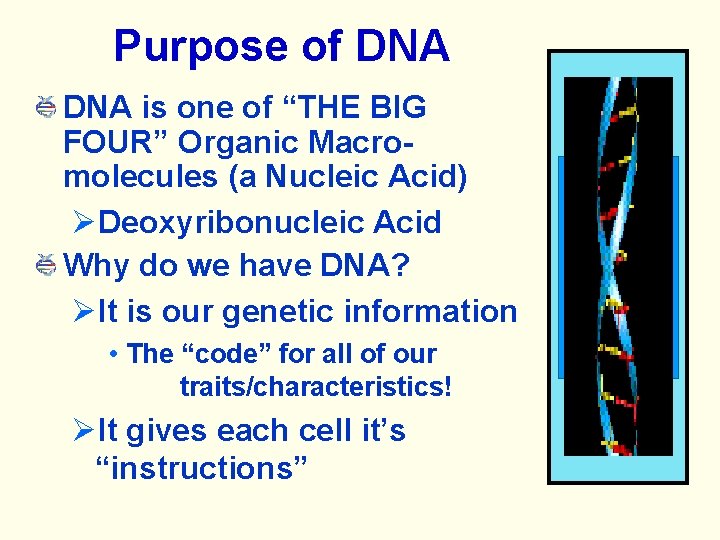
Purpose of DNA is one of “THE BIG FOUR” Organic Macromolecules (a Nucleic Acid) Deoxyribonucleic Acid Why do we have DNA? It is our genetic information • The “code” for all of our traits/characteristics! It gives each cell it’s “instructions”
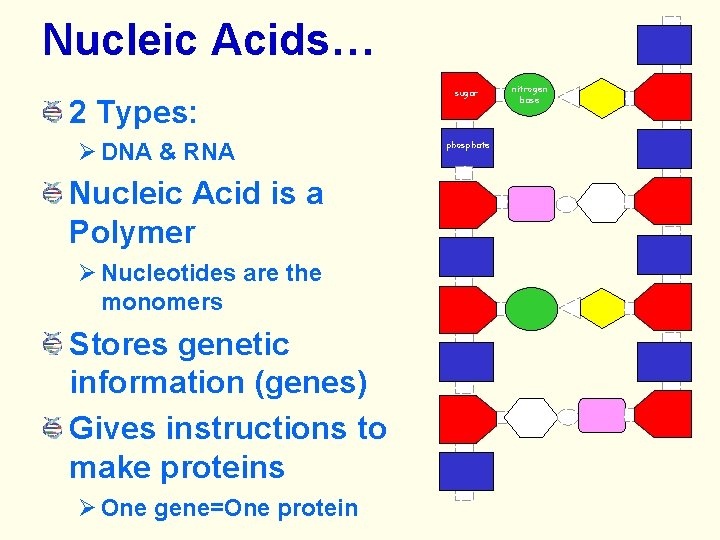
Nucleic Acids… 2 Types: DNA & RNA Nucleic Acid is a Polymer Nucleotides are the monomers Stores genetic information (genes) Gives instructions to make proteins One gene=One protein sugar phosphate nitrogen base
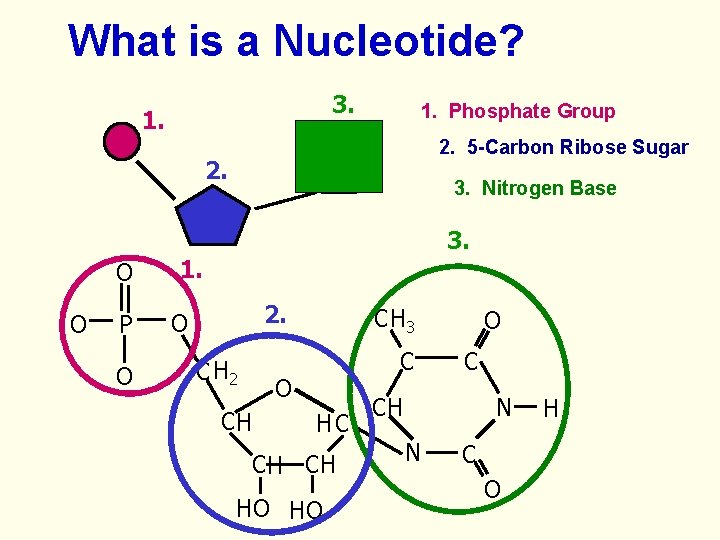
What is a Nucleotide? 3. 1. Phosphate Group 2. 5 -Carbon Ribose Sugar 2. O O P O 3. Nitrogen Base 3. 1. 2. O C H 2 C H 3 C O CH HC C H CH HO H O O C CH N N C O H
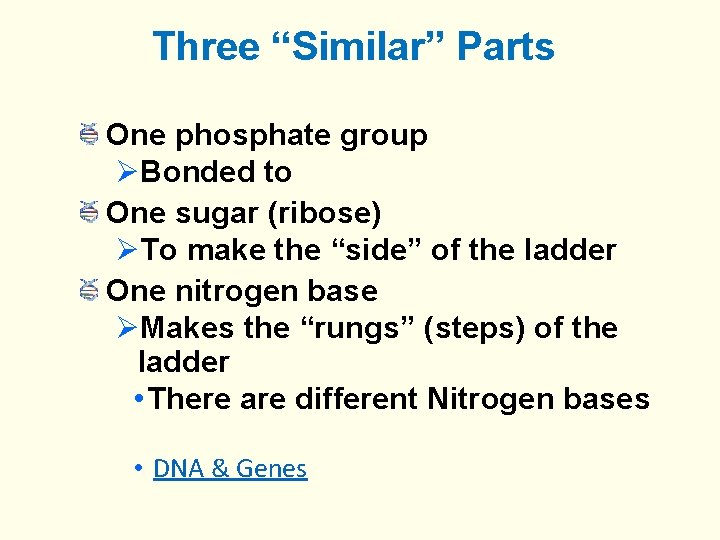
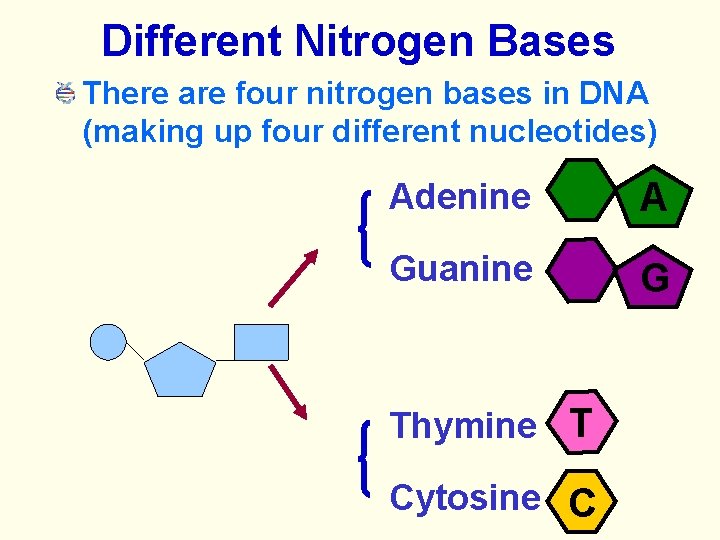
Three “Similar” Parts One phosphate group Bonded to One sugar (ribose) To make the “side” of the ladder One nitrogen base Makes the “rungs” (steps) of the ladder • There are different Nitrogen bases • DNA & Genes
Different Nitrogen Bases There are four nitrogen bases in DNA (making up four different nucleotides) Adenine A Guanine G Thymine T Cytosine C
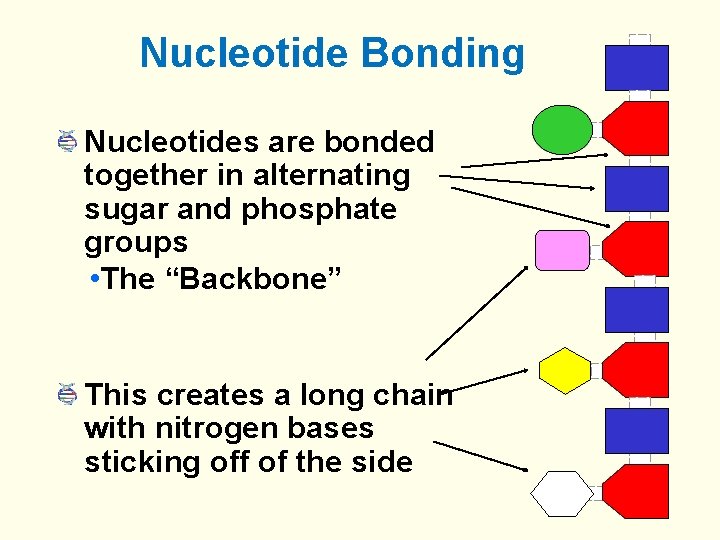
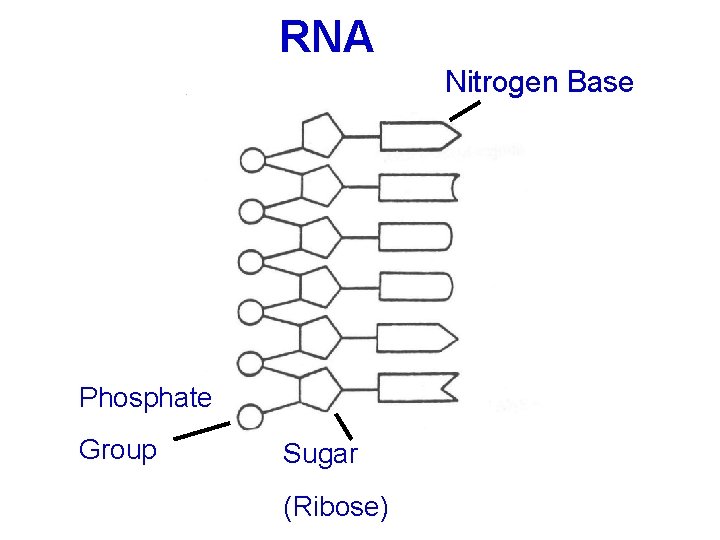
Nucleotide Bonding Nucleotides are bonded together in alternating sugar and phosphate groups • The “Backbone” This creates a long chain with nitrogen bases sticking off of the side
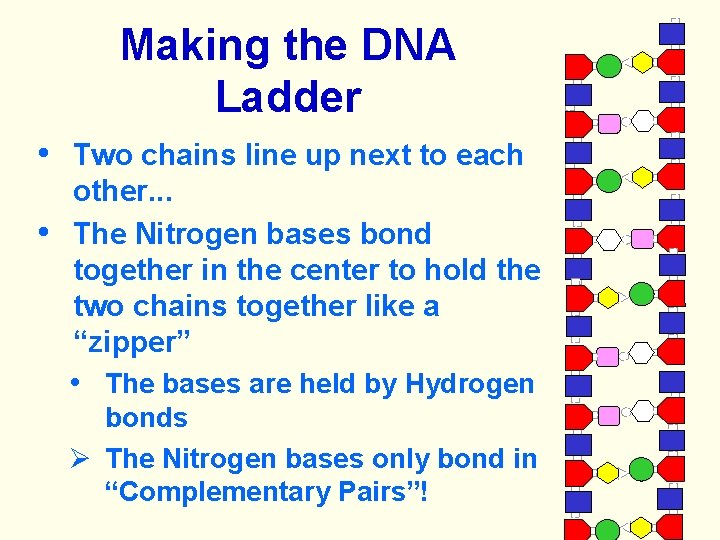
Making the DNA Ladder • Two chains line up next to each other. . . • The Nitrogen bases bond together in the center to hold the two chains together like a “zipper” • The bases are held by Hydrogen bonds The Nitrogen bases only bond in “Complementary Pairs”!
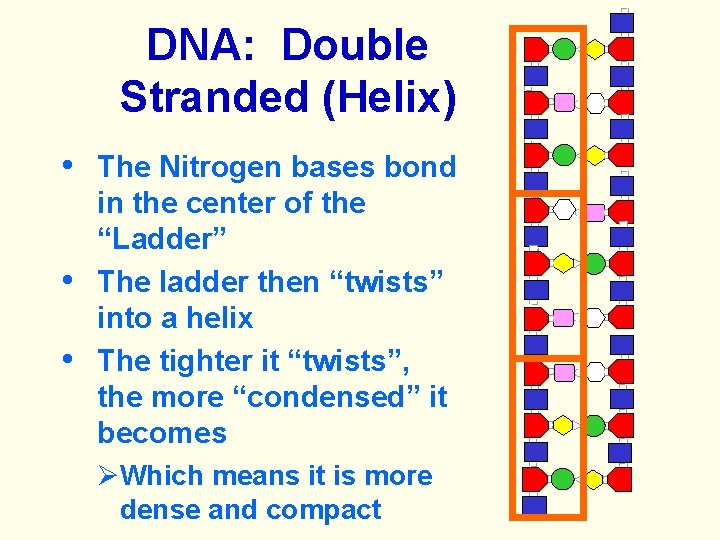
DNA: Double Stranded (Helix) • The Nitrogen bases bond in the center of the “Ladder” • The ladder then “twists” into a helix • The tighter it “twists”, the more “condensed” it becomes Which means it is more dense and compact
DNA DOUBLE HELIX ladder shaped molecule
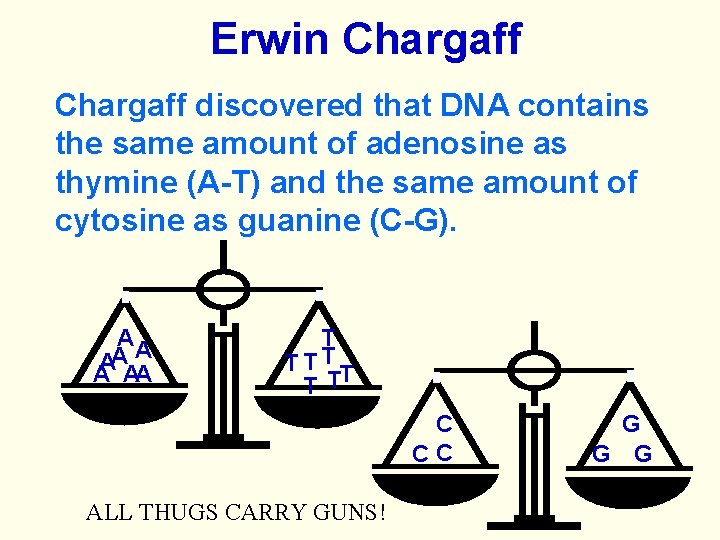
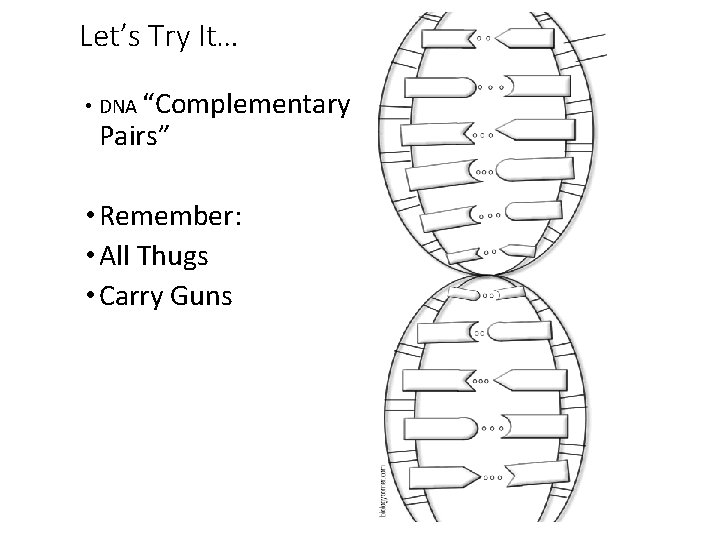
Erwin Chargaff discovered that DNA contains the same amount of adenosine as thymine (A-T) and the same amount of cytosine as guanine (C-G). A AA A A AA T TTTT TT C CC ALL THUGS CARRY GUNS! G G G
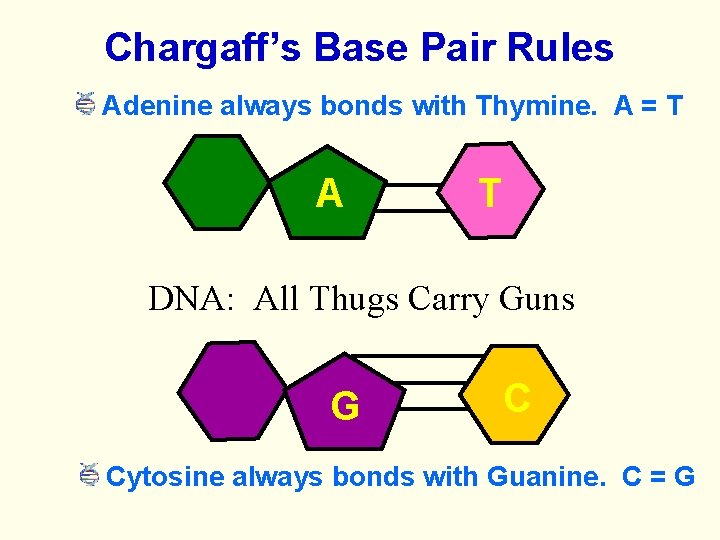
Chargaff’s Base Pair Rules Adenine always bonds with Thymine. A = T A T DNA: All Thugs Carry Guns G C Cytosine always bonds with Guanine. C = G
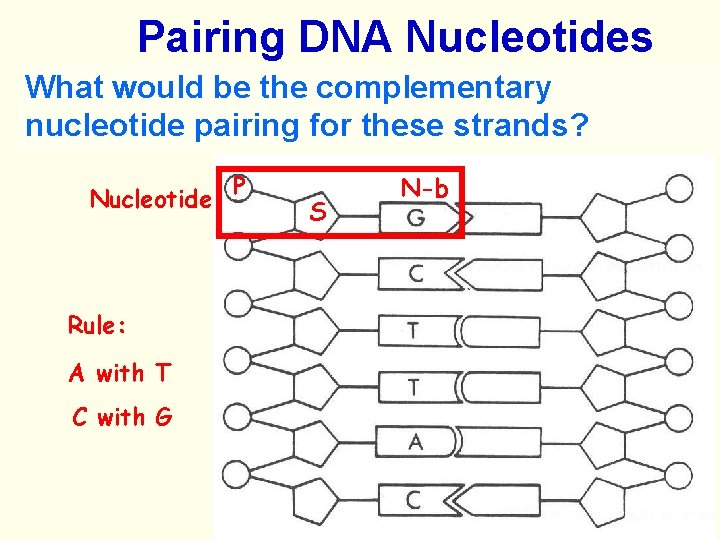
Pairing DNA Nucleotides a the nucleotide? What wouldisbe the base complementary pairing rule? nucleotide pairing for these strands? Nucleotide Rule: A with T C with G P S N-b
DNA • DNA is the “instruction manual” (the “recipe book”) which tells the cell what proteins to make • But, DNA is “stuck” in the nucleus • It is too large to pass through the nuclear membrane • Which organelle makes proteins? • _________ • How do the instructions get from the nucleus to the Ribosome? ? ? ?
RNA – Ribonucleic Acid Small, Single Stranded COPY of the DNA message Copy of ONE GENE RNA is small enough to pass through the nuclear membrane and bring the message to the Ribosome in the cytoplasm 3 differences from DNA This allows the organism to recognize that the RNA is NOT the original!
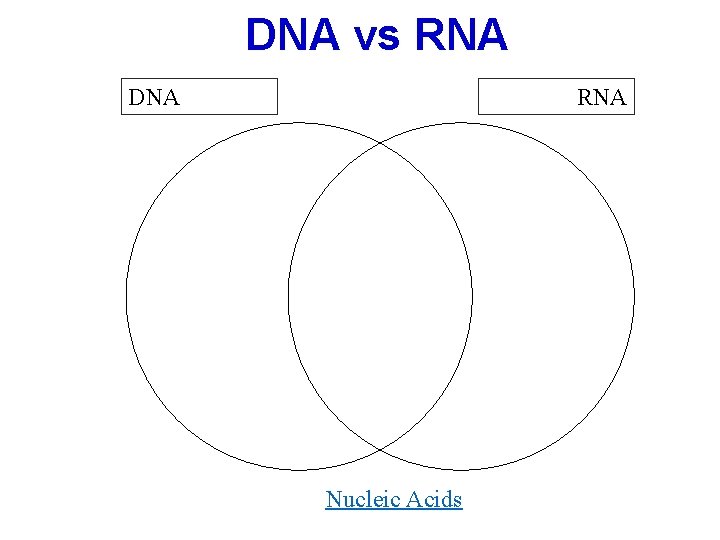
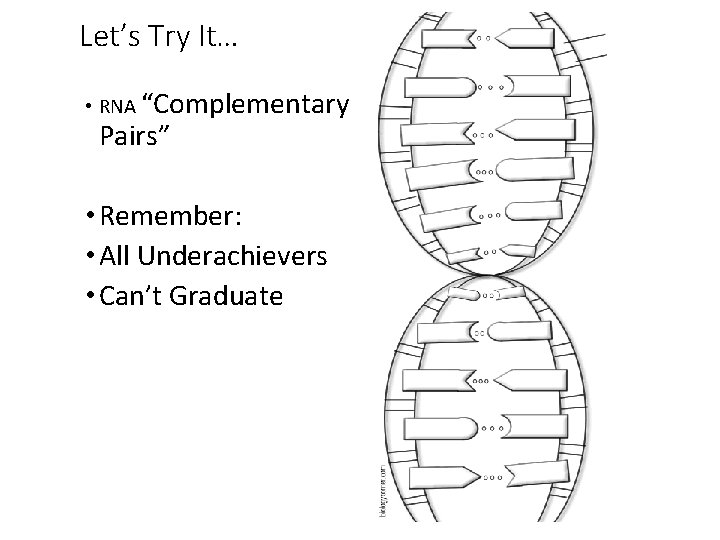
DNA vs. RNA is Ribonucleic Acid – DNA is Deoxyribonucleic Acid An Oxygen molecule is missing… making it “Deoxy”… RNA is a short, single stranded copy DNA is large, double stranded orginal RNA contains a different Nucleotide! Uracil (Not Thymine) Remember: ALL UNDER- ACHIEVERS CAN'T GRADUATE
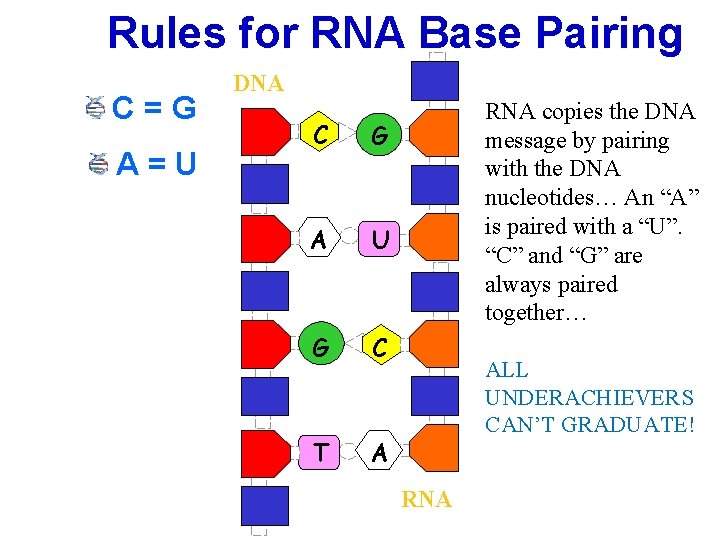
Rules for RNA Base Pairing C=G A=U DNA C G A U G C T A RNA copies the DNA message by pairing with the DNA nucleotides… An “A” is paired with a “U”. “C” and “G” are always paired together… ALL UNDERACHIEVERS CAN’T GRADUATE! RNA
What is the function of RNA? Carries the DNA coded message out of the nucleus RNA copies the information for one gene One gene = One protein Brings message to the Ribosome reads the code and makes the correct protein
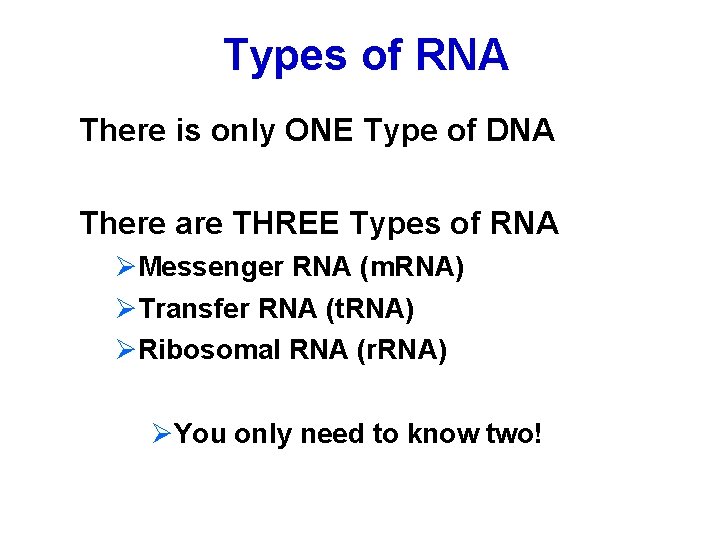
Types of RNA There is only ONE Type of DNA There are THREE Types of RNA Messenger RNA (m. RNA) Transfer RNA (t. RNA) Ribosomal RNA (r. RNA) You only need to know two!
RNA Nitrogen Base Phosphate Group Sugar (Ribose)
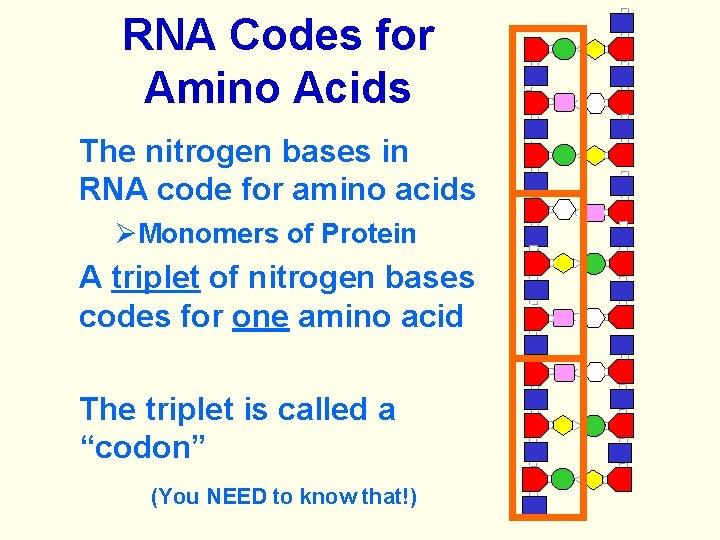
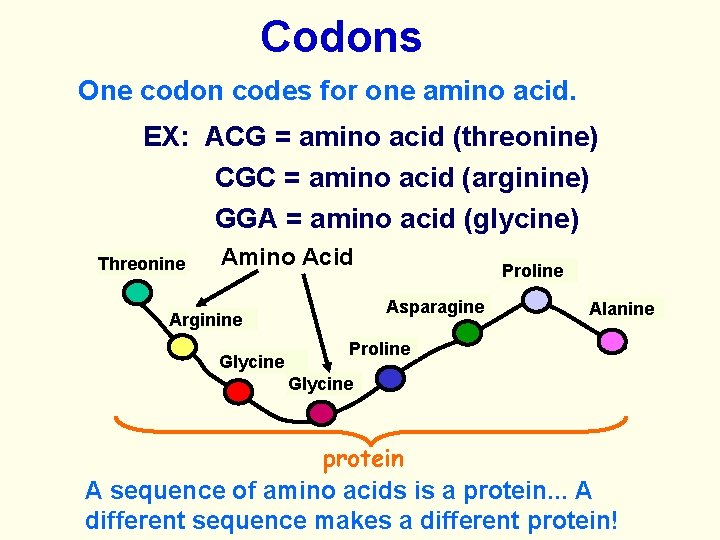
RNA Codes for Amino Acids The nitrogen bases in RNA code for amino acids Monomers of Protein A triplet of nitrogen bases codes for one amino acid The triplet is called a “codon” (You NEED to know that!)
DNA vs RNA DNA RNA Nucleic Acids
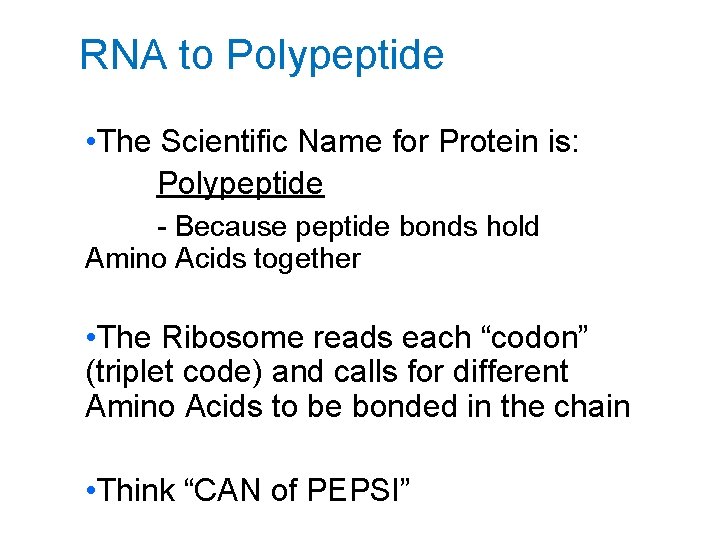
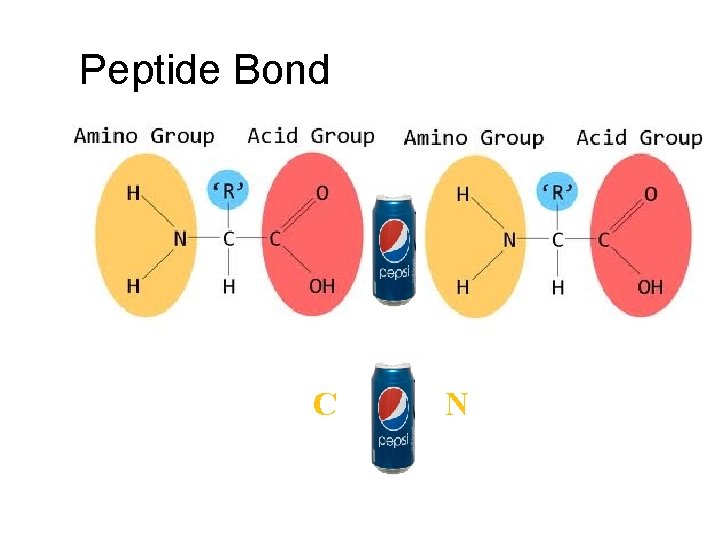
RNA to Polypeptide • The Scientific Name for Protein is: Polypeptide - Because peptide bonds hold Amino Acids together • The Ribosome reads each “codon” (triplet code) and calls for different Amino Acids to be bonded in the chain • Think “CAN of PEPSI”
Peptide Bond C N
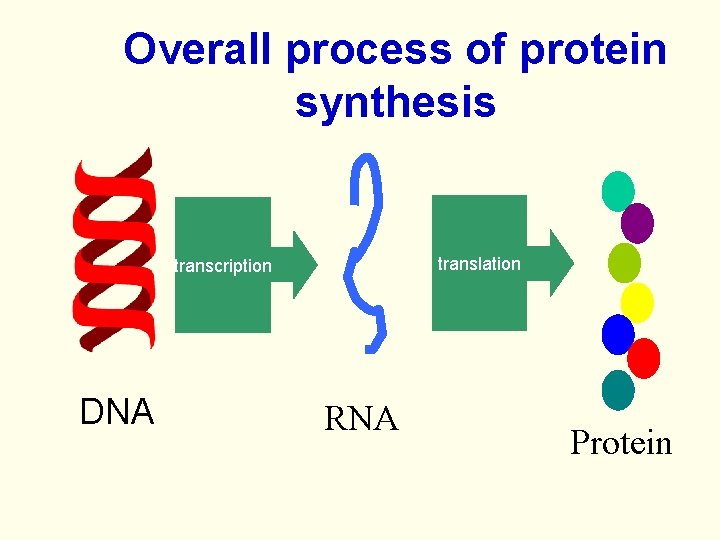
Overall process of protein synthesis translation transcription DNA RNA Protein
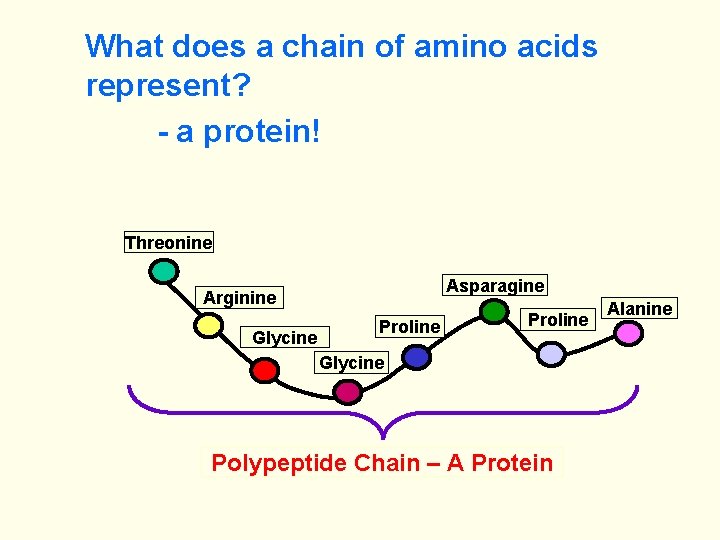
What does a chain of amino acids represent? - a protein! Threonine Asparagine Arginine Glycine Proline Glycine Polypeptide Chain – A Protein Alanine
Codons One codon codes for one amino acid. EX: ACG = amino acid (threonine) CGC = amino acid (arginine) GGA = amino acid (glycine) Threonine ACG Amino Acid Asparagine AAC CGC Arginine Glycine GGA Proline CCG Alanine GCC Proline CCA Glycine GGC protein A sequence of amino acids is a protein. . . A different sequence makes a different protein!
Let’s Try It… • DNA “Complementary Pairs” • Remember: • All Thugs • Carry Guns
Let’s Try It… • RNA “Complementary Pairs” • Remember: • All Underachievers • Can’t Graduate