
What is Disability September 30 th 2008 1
What is Disability…? September 30 th, 2008 1
Today in class we will… n What do I say? n Language/Labels/Stereotypes n Terminology n Etiquette n Basic concepts related to disability and disability studies n Definitions n n n Impairment Handicap Disability 2
n Imagine an action movie that has a clear and stereotypical “good” guy and “bad” guy… 3
More Stereotypes & Labels n How do these images, along with other images of persons with disabilities affect stereotypes of persons w/ disabilities? 4
n What are some slang words associated w/ disabilities or disability related? 5
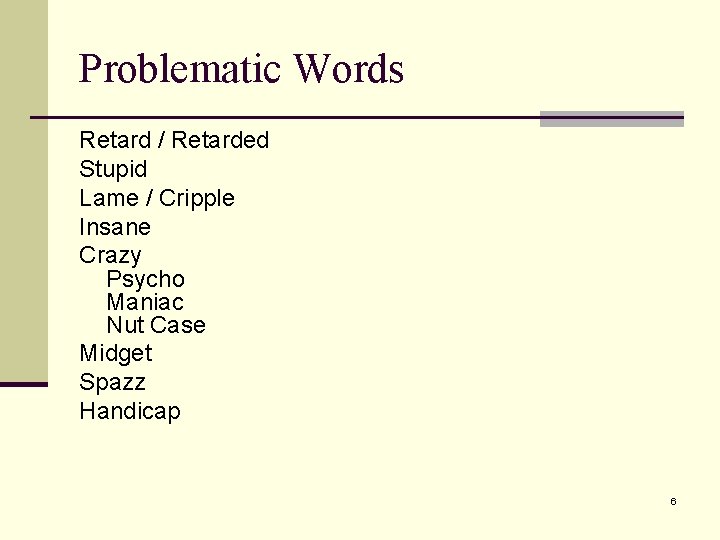
Problematic Words Retard / Retarded Stupid Lame / Cripple Insane Crazy Psycho Maniac Nut Case Midget Spazz Handicap 6
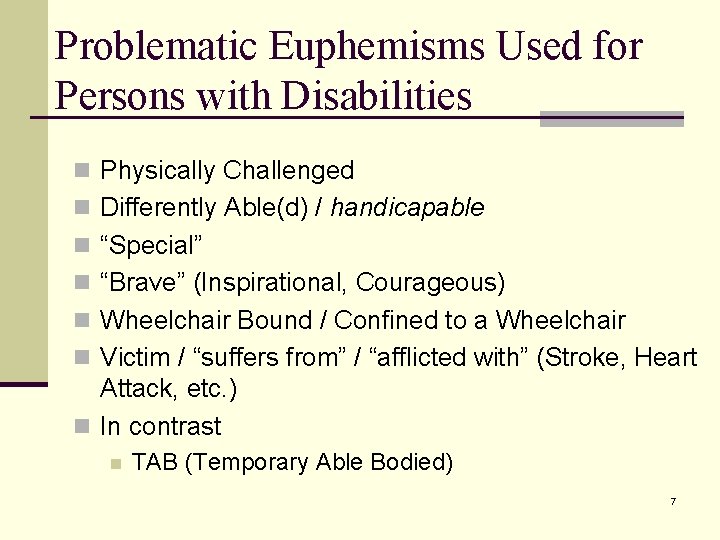
Problematic Euphemisms Used for Persons with Disabilities n Physically Challenged n Differently Able(d) / handicapable n “Special” n “Brave” (Inspirational, Courageous) n Wheelchair Bound / Confined to a Wheelchair n Victim / “suffers from” / “afflicted with” (Stroke, Heart Attack, etc. ) n In contrast n TAB (Temporary Able Bodied) 7
So…What Do I Say? n Remember… n Words have power n Stereotyping and language interconnect n What do we do and say in a society that might be experiencing PC-fatigue 8
“Disability” Linton: “We have decided to reassign meaning rather than chose a new name. ”* n Your reaction to the term disability? n Will reassigning meaning be successful? *Claiming Disability, page 31 9
Acceptable Use of Language n "People First Language” n Person With a Disability (PWD) n Pride First Language n Deaf (Person) n Disabled Person (DP) 10
People First language n "People First Language” n Person Who is deaf / Hard of Hearing n Person with ____ (MS, Cancer, etc. ) n Person with a Disability (PWD) n (Including: Non- Apparent or Hidden Disability) n “Person with a…” (Physical or Mental Difference) 11
Pride First Language n Disabled Person n (Claiming Disability) n Nondisabled 12
Etiquette n How do you “treat” a Person With a Disability? n Reading 13
Other Concepts… n Ableism n Overcoming n Pity n Super Crip 14
n What does it mean to be able-bodied? n What are able-bodied people “able” to do? n What do able-bodied people look like? 15
Ableism n "discrimination in favor of the able-bodied. " Reader’s Digest Oxford Wordfinder n Linton: Person is determined by their disability n Disabled People are inferior to nondisabled people n 16
Overcoming (a common theme) n Overcoming a disability n "I never think of you as disabled. " n "He/she is a credit to his/her race. " 17
Pity n To feel compassionate, commiserate, be sorry for. n Sometimes implying slight contempt for a person on account of some intellectual or moral inferiority attributed to him. n (Oxford English Dictionary, 2 nd ed. 1989) 18
“Super-Crip” (When Stereotypes Tell the Story (National Center on Disability and Journalism -NCDJ) n Disability as Tragedy n Inspiration / Overcoming n Courageous n n Christopher Reeve: Triumph over Tragedy (Alter). The latest item on the TV news, eg a blind man climbing a mountain. 19
Definitions n Impairment n Handicap n Disability 20
Impairment: n Refers to physical or mental limitations such as difficulty walking n Represents a deviation from the person's usual biomedical state. 21
Impairment: n When does physical / mental variation become an impairment? 22
What is the difference between: n Impairment n Illness / “being sick” n Chronic Health Conditions? 23
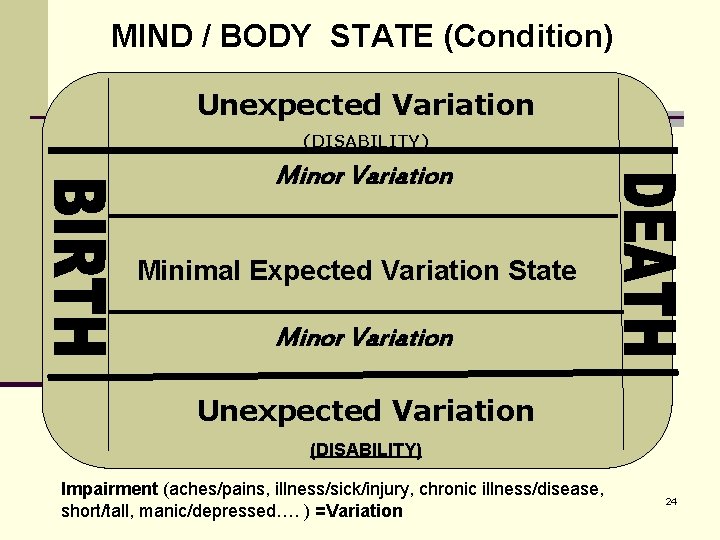
MIND / BODY STATE (Condition) Unexpected Variation (DISABILITY) Minor Variation Minimal Expected Variation State Minor Variation Unexpected Variation (DISABILITY) Impairment (aches/pains, illness/sick/injury, chronic illness/disease, short/tall, manic/depressed…. ) =Variation 24
Handicap n Different meanings throughout time and situation… n The disadvantage experienced by a person as a result of impairments (Now considered offensive) 25
Disability n Oh so many definitions… n Let’s start with the legal (US) definition: n ADA (Americans with Disabilities Act): n (1) has a physical or mental impairment that substantially limits a major life activity, n n (2) has a record of such an impairment, or (3) is regarded as having such an impairment. 26
World Health Org. (WHO) 1980 n Disability n Restriction or lack (from an impairment) of ability considered normal for a human being n Handicap n The disadvantage experienced by a person as a result of impairments *ICIDH-1 (1980) 27
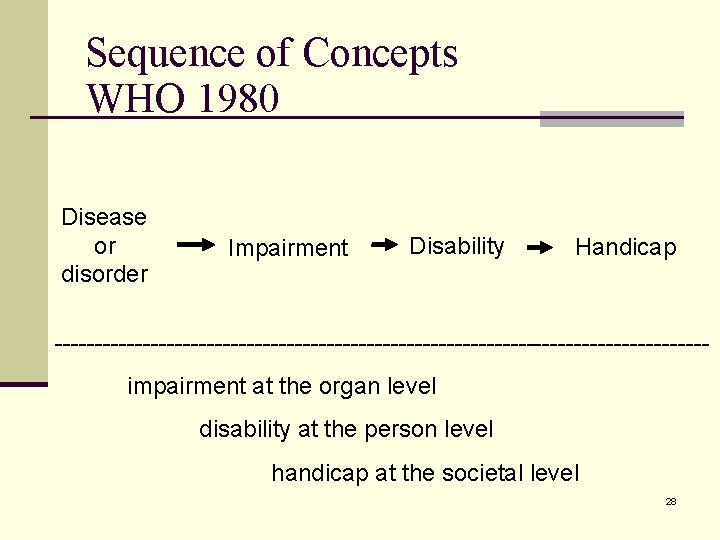
Sequence of Concepts WHO 1980 Disease or disorder Impairment Disability Handicap -----------------------------------------impairment at the organ level disability at the person level handicap at the societal level 28
WHO 2001 n Disability : n outcome or result of a complex relationship between an individual’s: n health condition n personal factors n external factors 29
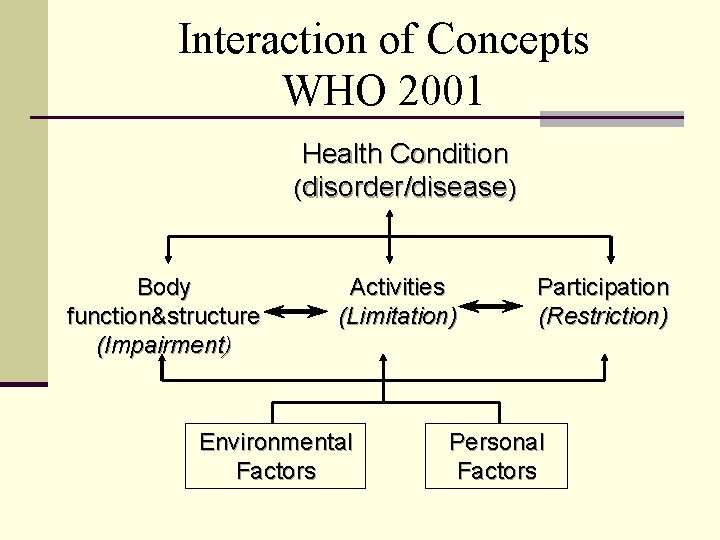
Interaction of Concepts WHO 2001 Health Condition (disorder/disease) Body function&structure (Impairment) Activities (Limitation) Environmental Factors Participation (Restriction) Personal Factors
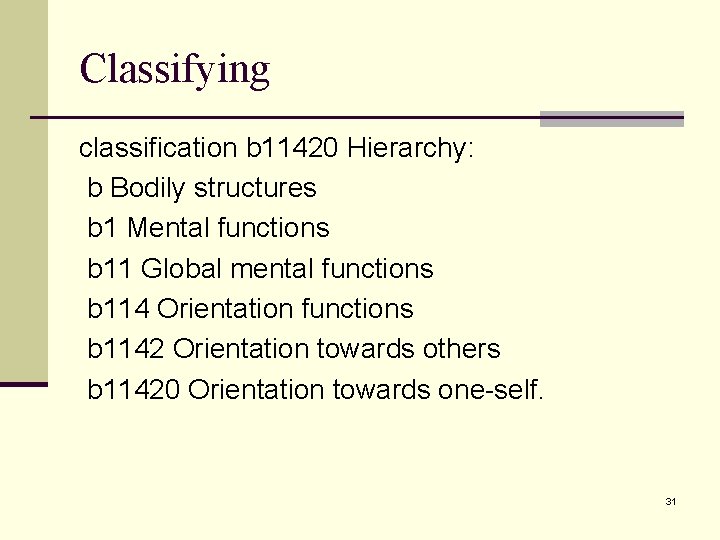
Classifying classification b 11420 Hierarchy: b Bodily structures b 1 Mental functions b 11 Global mental functions b 114 Orientation functions b 1142 Orientation towards others b 11420 Orientation towards one-self. 31
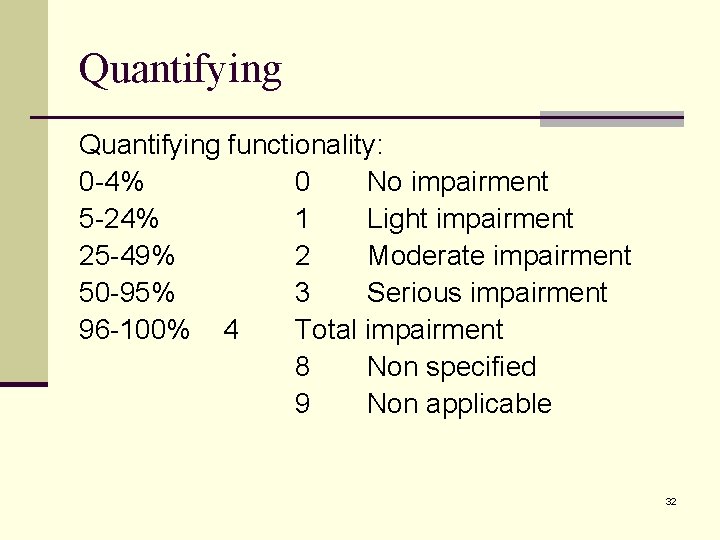
Quantifying functionality: 0 -4% 0 No impairment 5 -24% 1 Light impairment 25 -49% 2 Moderate impairment 50 -95% 3 Serious impairment 96 -100% 4 Total impairment 8 Non specified 9 Non applicable 32
Where is the subjective (QOL)? 33
Other classification systems n DSM IV n ICD 34
Review of some of the definitions: n ADA n n n An individual with a disability is defined as a person who has a physical or mental impairment that substantially limits one or more major life activities a person who has a history or record of such impairment, or a person who is perceived by others as having such impairment. n ICF n n Disability is an umbrella term for impairments, activity limitations or participation restrictions. Environmental and personal factors influence all aspects of health, functioning and disability. n Surgeon General July 26, 2005 n “… disabilities are characteristics of the body, mind, or senses that, to a greater or lesser extent, affect a person’s ability to 35 engage independently in some or all aspects of day-to-day life. ”
n 67 US acts / programs that define disability n 35 have self-contained definitions (although some contain more than one definition) 36
n Which definition do you choose? n Obviously no one has this figured out… 37
Disability Activists (UK)1976 (UPIAS - Union of Physically Impaired Against Segregation) n Disability n “the disadvantage or restriction of activity caused by a contemporary social organization which takes no or little account of people who have physical impairments and thus excludes them from the mainstream of social activities” n Changes the focus of disability away from the individual to Society. (1 st articulation of the “Social Model of Disability”) 38
Social Model n States that inappropriate and discriminatory: n Social Attitudes (Ableism), n Sociopolitical Structures, n Cultural Phenomena n are the central problem for disabled people 39
NEXT SESSION Models of Disability 40
- Slides: 40