
What Is Direct Selling Definition Perspectives and Research
- Slides: 22
What Is Direct Selling? Definition, Perspectives, and Research Agenda - Robert A. Peterson and Thomas R. Wotruba Reporter: 蔡璋贤 (M 934012015)
Before the Paper • Published in 1996. • Data from Paper summary. • Define Direct Selling. • Operational/Tactical/Strategic perspectives. • Suggest Research Agenda.
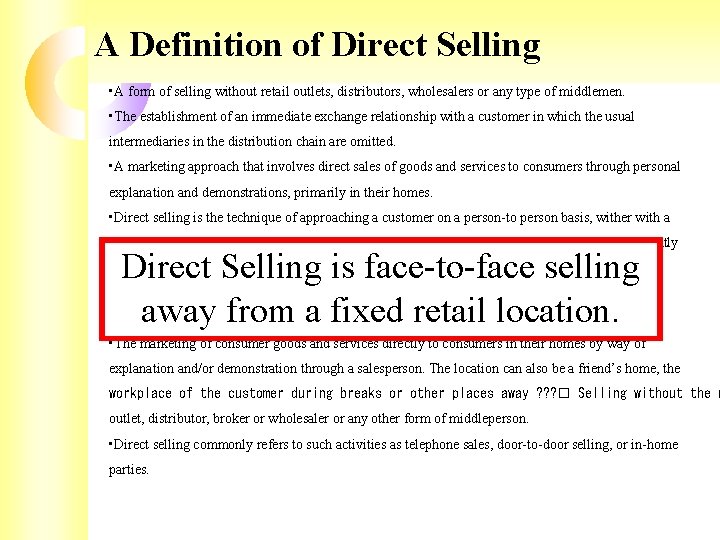
A Definition of Direct Selling • A form of selling without retail outlets, distributors, wholesalers or any type of middlemen. • The establishment of an immediate exchange relationship with a customer in which the usual intermediaries in the distribution chain are omitted. • A marketing approach that involves direct sales of goods and services to consumers through personal explanation and demonstrations, primarily in their homes. • Direct selling is the technique of approaching a customer on a person-to person basis, wither with a group approach (as in in-home party plan) or individually, one-on-one, to offer products conveniently Direct Selling is face-to-face selling • away from a fixed retail location. with a personal service emphasis. A sales approach characterized by personal product explanations and demonstrations, often in the consumer’s home or retail’s establishment. • The marketing of consumer goods and services directly to consumers in their homes by way of explanation and/or demonstration through a salesperson. The location can also be a friend’s home, the workplace of the customer during breaks or other places away ? ? ? � Selling without the u outlet, distributor, broker or wholesaler or any other form of middleperson. • Direct selling commonly refers to such activities as telephone sales, door-to-door selling, or in-home parties.
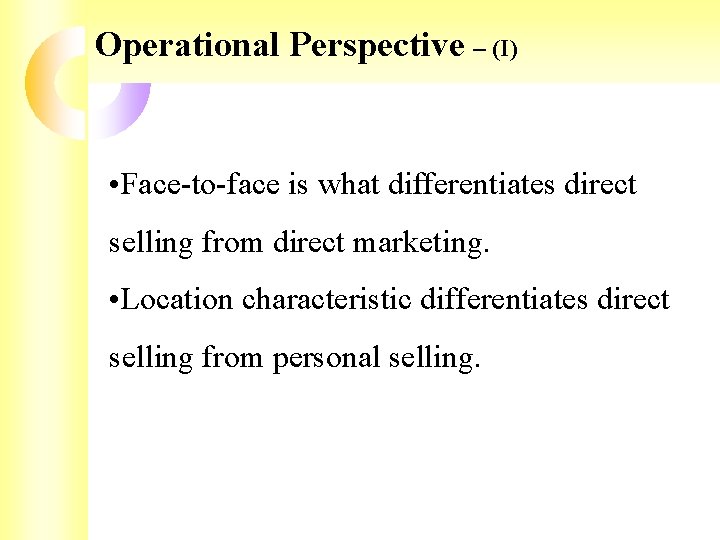
Operational Perspective – (I) • Face-to-face is what differentiates direct selling from direct marketing. • Location characteristic differentiates direct selling from personal selling.
Operational Perspective – (II) • Flexible – place, time. • Communication senses can be utilized. – customized, demonstration, personal involvement. • Relationship marketing. • Generate repeat business.
Tactical Perspective – (I) • Type of salesperson. oemployees vs. contractors (99+%). For cost reason. • Part-time or full-time selling agent? o. Two jobs (50+%), part time (42%), full time (8%). • Selling effort occurs in a home? o. Home (73%), Workplace (12%), Others (15%). • Transaction or relationship oriented? o. Immediate, expensive, durable vs. Long-term, customer retention.
Tactical Perspective – (II) • Party plan format? o. Demonstration, entertainment-oriented. • Pre-notification? ovs. cold-call. • Multi-level? o. Selling and recruiting.
Tactical Perspective – (III) • Selling agents are customers. o. Consumable products, repeat selling. • Selling agents take physical possession. o. Products are directly delivered to end user? • Purchase are delivered and payment is obtained. o. By party host, selling agent? Payment before shipment?
Tactical Perspective – (IV) • Combine 10 characteristics to form a unique tactics. • No guarantee for success or failure. • Christmas gifts, summer vacations.
Strategic Perspective – (I) • Direct selling as a distribution channel. • Direct selling as a means of gaining access to a market. • Direct selling as a way of doing business. • What is known about direct selling? • What can be sold through direct selling? • Who buys from direct selling? • What are the characteristics of direct sellers?
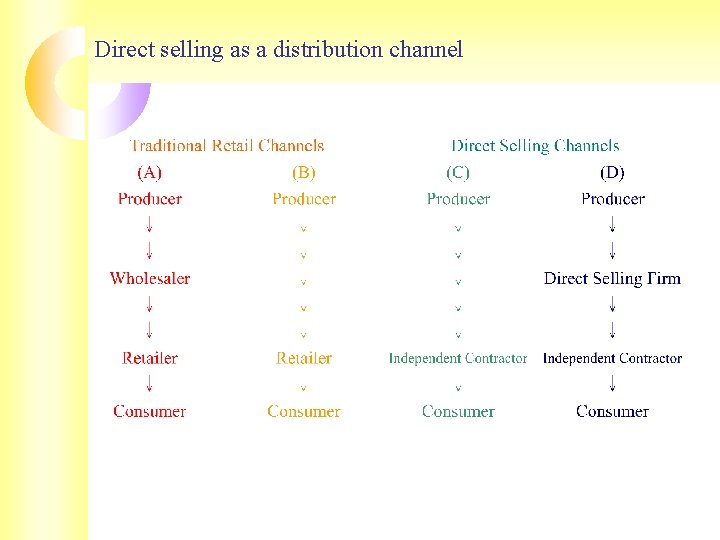
Direct selling as a distribution channel
Direct selling as a means of gaining access to a market • Push marketing strategy. • Vs. traditional 4 P oface to face, away from fixed retail location. • Low capital access in the beginning. owholesaler, fixed retail locations, advertisement. • Distribution system is attractive. o. China, South Korea.
Direct selling as a way of doing business • Preferred channel of distribution. o. Invisible, nothing competitors can monitor. • Relatively little start-up capital. o. Retail outlets, large inventory, advertising. o. But spend on recruiting, training, compensating.
What is known about direct selling? • Lack of knowledge. o. Invisibility characteristics, firms are privately and small. • Direct salespeople. o 6. 2 m in USA, 2 m in Japan, 2 m in Taiwan. • Most productive direct salespeople. o. Switzerland: US$34, 386.
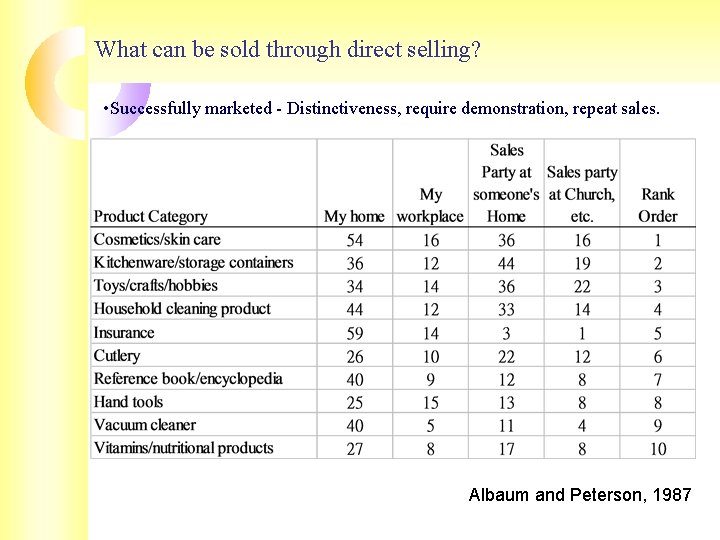
What can be sold through direct selling? • Successfully marketed - Distinctiveness, require demonstration, repeat sales. Albaum and Peterson, 1987
Who buys from direct selling? • 57% purchase at least one in 12 months. • Female, younger, higher education and higher income.
What are the characteristics of direct sellers? – (I) • 95% are women in 1992 USA. • Most with high school diploma. • 56% have at least one other paying job. • Tend to be more outgoing, aggressive, enthusiastic, venturesome. Desire to be their own boss.
What are the characteristics of direct sellers? – (II, successful) • Good communicator, highly motivated. • Higher levels of effort led to higher levels of performance and satisfaction. • Persistence and initiative.
A Research Agenda for Direct Selling • Scope of Direct Selling. • Practice of Direct Selling.
Scope of Direct Selling • Begin with some type of census. o. How many firms, what’s the volume, magnitude…. . • Seller and Buyers in Direct Selling. • Motivation of direct salespeople and customer. • International and comparative analysis
Practice of Direct Selling • Operational perspective. o. Communication process – negotiation, listening, trust-building… • Tactical perspective. oin the throes of change, compensation and reward design, part-time contractor vs. full-time employee…. • Strategic perspective. odirect selling channel vs. alternative marketing method, what about direct selling in the future?
Conclusion • Direct selling is not well understood. o. Face-to-face selling away from a fixed retail location. • Extend the research out of U. S. o. General, large-scale programmatic, systematic, internal research.