
What is Direct and Indirect Characterization Direct Characterization
- Slides: 3
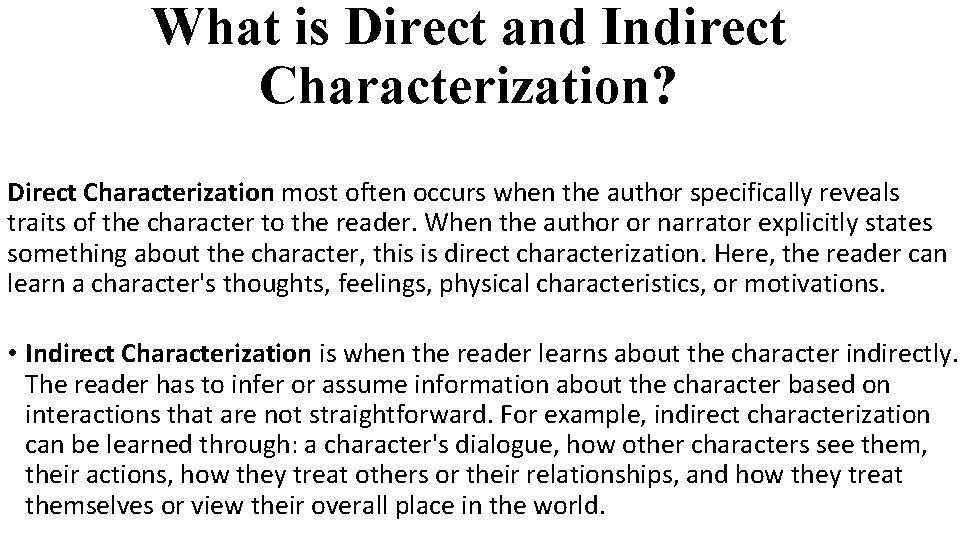
What is Direct and Indirect Characterization? Direct Characterization most often occurs when the author specifically reveals traits of the character to the reader. When the author or narrator explicitly states something about the character, this is direct characterization. Here, the reader can learn a character's thoughts, feelings, physical characteristics, or motivations. • Indirect Characterization is when the reader learns about the character indirectly. The reader has to infer or assume information about the character based on interactions that are not straightforward. For example, indirect characterization can be learned through: a character's dialogue, how other characters see them, their actions, how they treat others or their relationships, and how they treat themselves or view their overall place in the world.
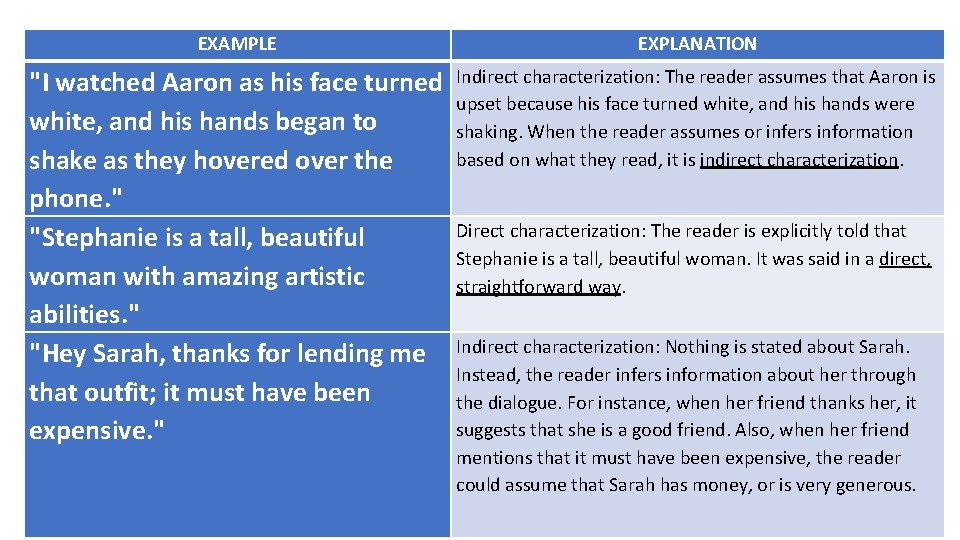
EXAMPLE EXPLANATION "I watched Aaron as his face turned white, and his hands began to shake as they hovered over the phone. " "Stephanie is a tall, beautiful woman with amazing artistic abilities. " "Hey Sarah, thanks for lending me that outfit; it must have been expensive. " Indirect characterization: The reader assumes that Aaron is upset because his face turned white, and his hands were shaking. When the reader assumes or infers information based on what they read, it is indirect characterization. Direct characterization: The reader is explicitly told that Stephanie is a tall, beautiful woman. It was said in a direct, straightforward way. Indirect characterization: Nothing is stated about Sarah. Instead, the reader infers information about her through the dialogue. For instance, when her friend thanks her, it suggests that she is a good friend. Also, when her friend mentions that it must have been expensive, the reader could assume that Sarah has money, or is very generous.
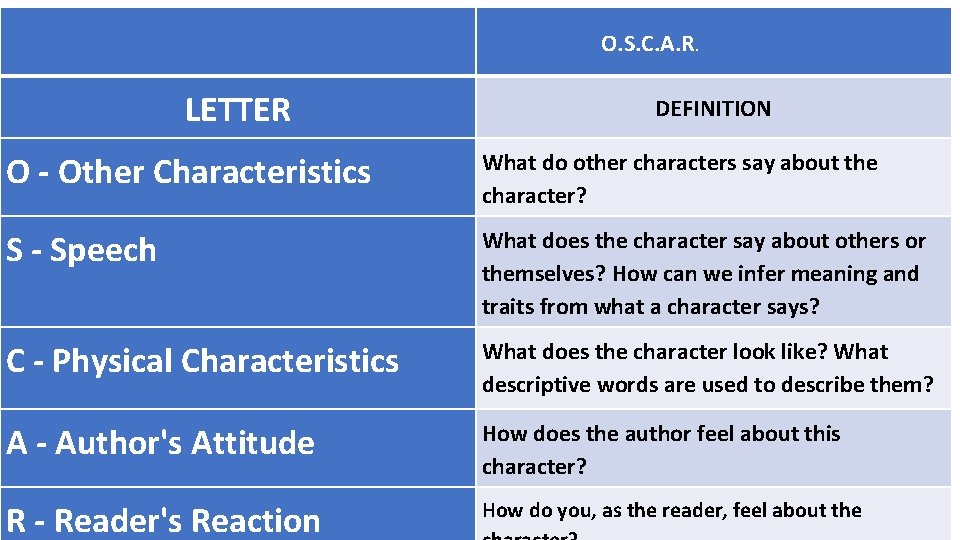
O. S. C. A. R. LETTER DEFINITION O - Other Characteristics What do other characters say about the character? S - Speech What does the character say about others or themselves? How can we infer meaning and traits from what a character says? C - Physical Characteristics What does the character look like? What descriptive words are used to describe them? A - Author's Attitude How does the author feel about this character? R - Reader's Reaction How do you, as the reader, feel about the