
What Is Different About Public Health Limited Control
What Is Different About Public Health? • Limited Control • Many disparate parts – not tied together • Sometimes conflicting missions © 2009 ©PHF 2009
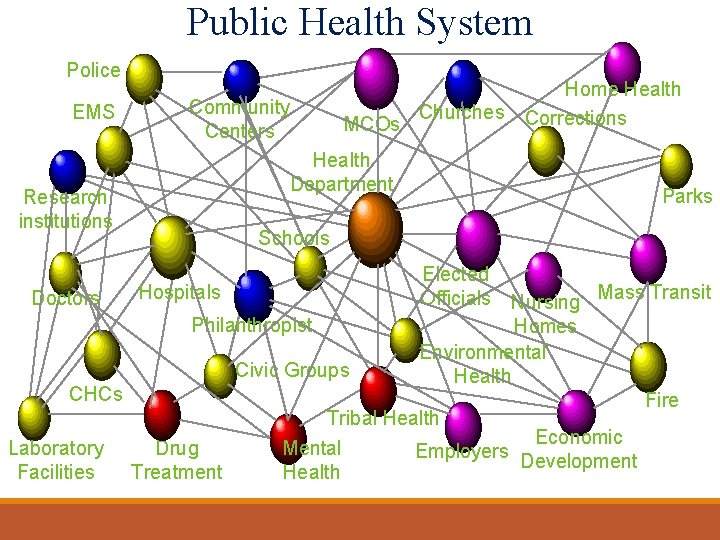
Public Health System Police EMS Community Centers MCOs Churches Health Department Research institutions Home Health Corrections Parks Schools Nursing Mass Transit Philanthropist Homes Environmental Civic Groups Health CHCs Fire Tribal Health Economic Laboratory Drug Mental Employers Development Facilities Treatment Health Doctors Hospitals Elected Officials
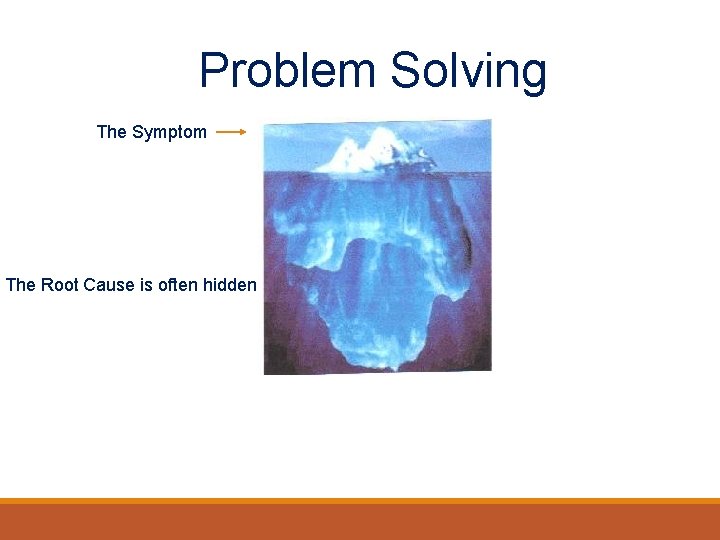
Problem Solving The Symptom The Root Cause is often hidden
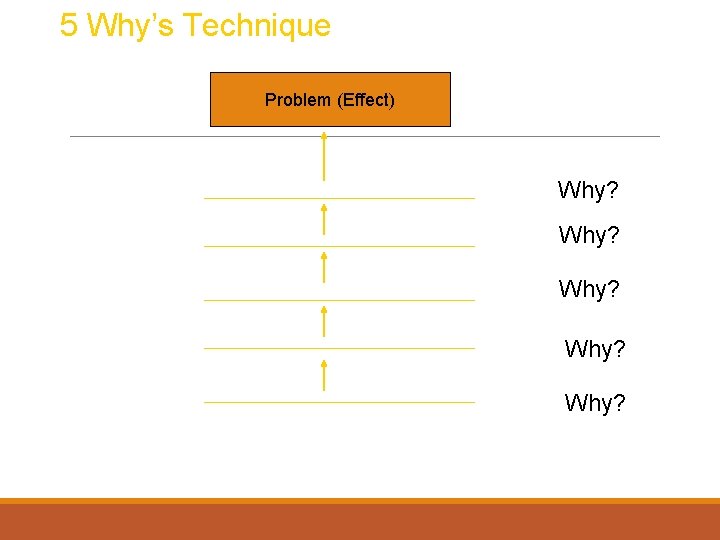
Problem Solving • When confronted with problems people often tackle the obvious symptom • This often results in more problems • Using a systematic approach to find the problem’s root cause is more effective
Types of Strategy • Quantitative - Assessment of objective needs as indicated by data • Qualitative – Opportunities for input from members of the public; those involved in health and public health; key partners internally and externally
Aligning Key Systems • Productivity: Transform knowledge/labor into value • Timeliness: Deliver desired value on time • Reliability: Consistently working or breaking down regularly? • Quality: Deliver value consistently in a manner that meets quality standards
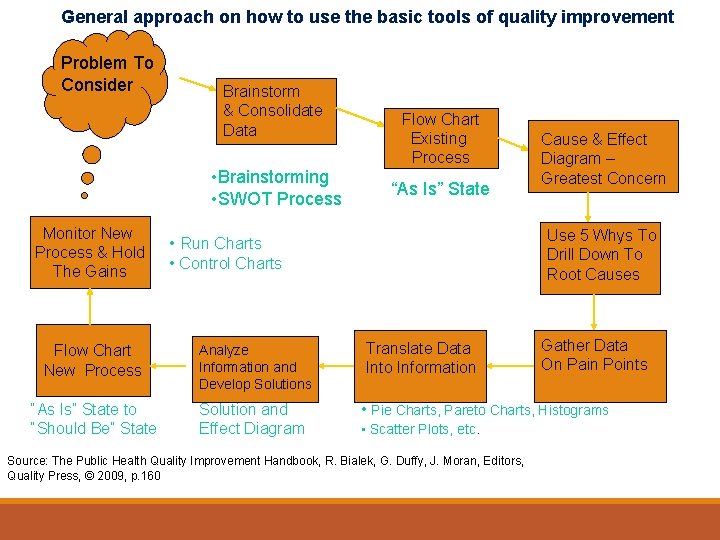
General approach on how to use the basic tools of quality improvement Problem To Consider Brainstorm & Consolidate Data • Brainstorming • SWOT Process Monitor New Process & Hold The Gains Flow Chart Existing Process “As Is” State Use 5 Whys To Drill Down To Root Causes • Run Charts • Control Charts Flow Chart New Process Analyze Information and Develop Solutions “As Is” State to “Should Be” State Solution and Effect Diagram Cause & Effect Diagram – Greatest Concern Translate Data Into Information Gather Data On Pain Points • Pie Charts, Pareto Charts, Histograms • Scatter Plots, etc. Source: The Public Health Quality Improvement Handbook, R. Bialek, G. Duffy, J. Moran, Editors, Quality Press, © 2009, p. 160
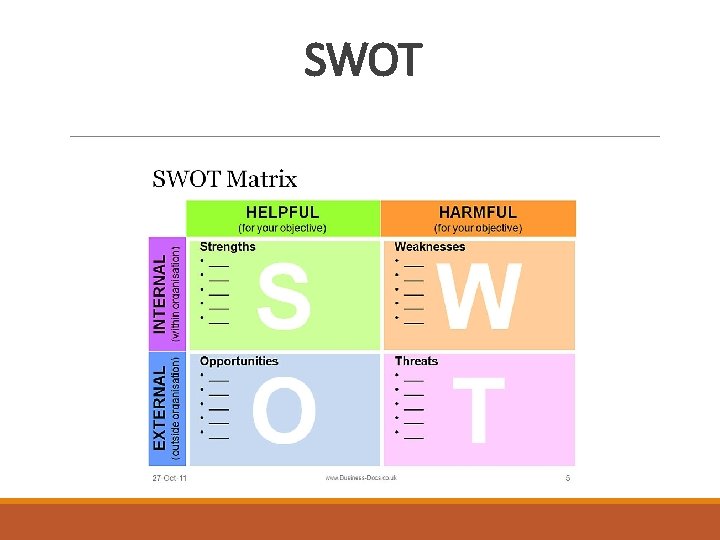
SWOT
Strengths (Internal) • What advantages do we have? • What do we do better than anyone else? • What unique or lowest-cost resources can we draw upon that others can't? • What do Garfield County citizens see as our strengths?
Weaknesses (Internal) • What could we improve upon ? • What should we avoid? • What are people likely to see as weaknesses?
Opportunities (External) • Are there positive changes in government policy related to our field? • Are there changes in social patterns, population profiles, lifestyle, etc. that we can capitalize on? • Are there local events we can partner with?
Threats (External) • What obstacles do we face? • Are quality standards or specifications changing? • Is changing technology threatening your position? • Do we have cash-flow problems? • Could any of our weaknesses seriously threaten the department?
Priorities to Focus on using SWOT • Priority 1: Inform, educate, empower individuals to practice healthy lifestyles • Priority 2: Prevent & Control infectious & communicable diseases • Priority 3: Working towards a healthy environment for all residents • Priority 4: Provide community outreach and education to decrease injuries & violence
Specific Programs for Teams using SWOT Disease & Injury Prevention Immunizations & communicable disease/ overlap EH & PHN with lead & Zoonotic disease Health Promotion (and all Subcategories)
Definition of QI Quality Improvement in Public Health is characterized by the use of a deliberate and defined improvement process, such as Plan-Do-Check-Act, that is focused on activities leading to improved population and individual health. It refers to a continuous and ongoing effort to achieve measurable improvements in the efficiency, effectiveness, quality, performance, and outcomes of services or processes with the goal of improving the health of the community. © 2009 ©PHF 2009
QI in Public Health QI helps Public Health develop solutions to problems that address both those needing services and those providing services and not just one at the expense of the other. © 2009 ©PHF 2009
Organizational Inhibitors Organizational inhibitors are blocks and barriers that exist in the organization They prevent implementing a successful Quality Improvement Program in your Health Department. (Weaknesses & Threats in SWOT) © 2009 ©PHF 2009
Why so difficult? • Funding streams come with their own rules and allow little flexibility • Staffing factors • Political and constituent perspectives • Distractions and/or unanticipated pressures
Typical Public Health Department Issues • Driven by intuition rather than data • Undocumented policies, processes, and procedures • Insufficient training • Complexity of Partnerships & Projects © 2009 ©PHF 2009

Benefits of QI to the Public Health Department • Improved quality of services • Client oriented employees • Improved client relations • Lower costs • Improved community relations = better political relations • Ability to expand services • Improved funding/retaining funding in a difficult climate
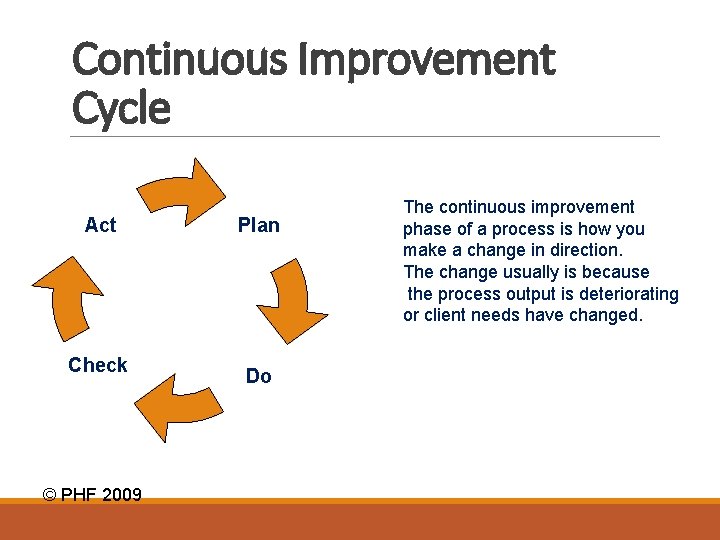
Continuous Improvement Cycle Act Plan Check/ Study Do © PHF 2009 The continuous improvement phase of a process is how you make a change in direction. The change usually is because the process output is deteriorating or client needs have changed.
PLAN • Plan ahead for change • Creation of the implementation team • Measurements to show improvement • Action plans to detail what will be done by who and when • Communication plan to inform needed parties of the changes, timing, and status
DO • Implement the process improvement initiative taking small steps in controlled circumstances • Get approval and support if implementing means going outside your personal area of responsibility • Document the changes so the process can be duplicated/standardized © 2009 ©PHF 2009
CHECK/STUDY • Continually check the results as the process is initiated to determine if the changes are meeting requirements • Determine if the measurements used to determine success are adequate • If not, define the required measurements and how this data can be developed © 2009 ©PHF 2009
ACT • Take action to standardize or improve the process • If the process changes are meeting requirements continue to monitor occasionally • Standardize the changes – SDCA Cycle • If the process still isn’t meeting requirements investigate additional process improvement opportunities © 2009 ©PHF 2009
STANDARDIZE If our process is producing the desired results we standardize what we are doing This is how we will “hold gains” © 2009 ©PHF 2009
Organizational Inhibitors Organizational inhibitors are blocks and barriers that prevent implementing a successful Quality Improvement Program © 2009 ©PHF 2009
Importance/Resistance • Importance is the degree to which this item influences or impacts the successful implementation of a Quality Improvement Program • Resistance is the amount of opposition to an item encountered when trying to implement or change it to successfully implement a Quality Improvement Program. © 2009 ©PHF 2009
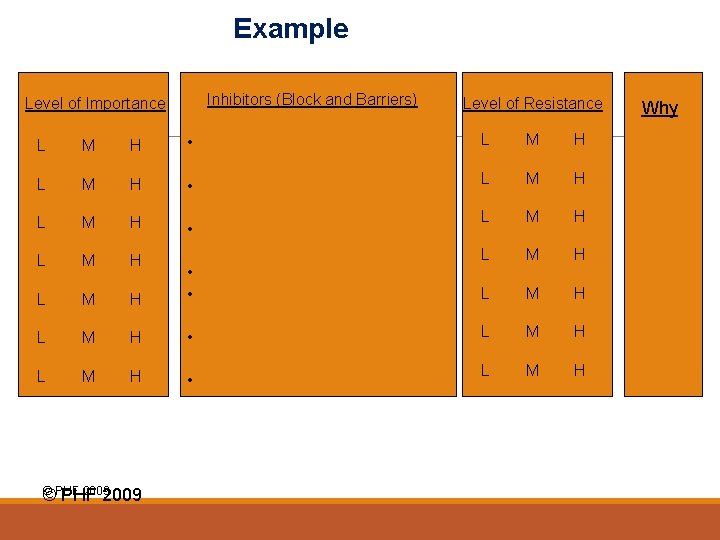
Example Inhibitors (Block and Barriers) Level of Importance Level of Resistance L M H • L M H M H L M H • • L L M H • L M H © 2009 ©PHF 2009 Why
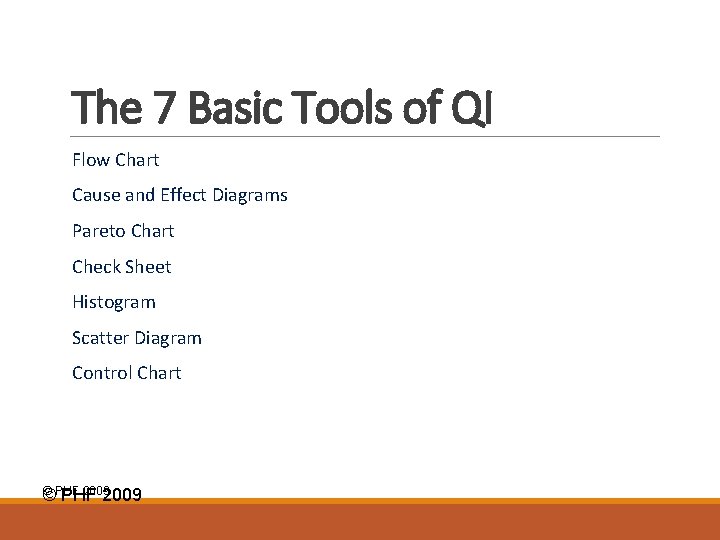
The 7 Basic Tools of QI Flow Chart Cause and Effect Diagrams Pareto Chart Check Sheet Histogram Scatter Diagram Control Chart © 2009 ©PHF 2009
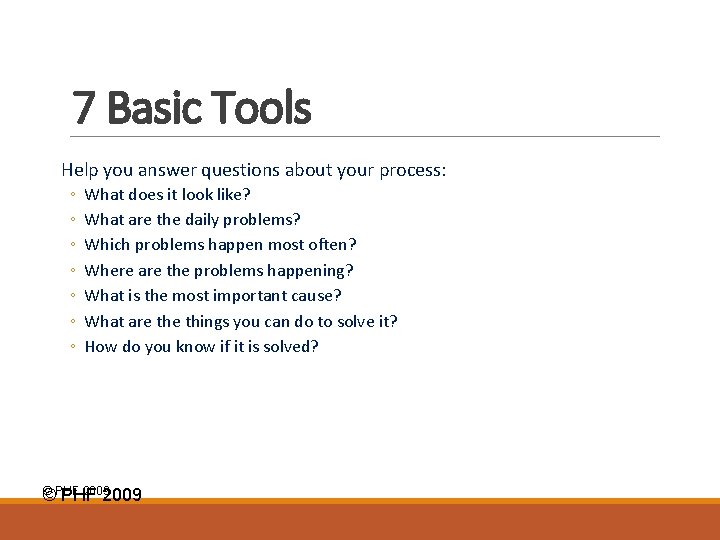
7 Basic Tools Help you answer questions about your process: ◦ ◦ ◦ ◦ What does it look like? What are the daily problems? Which problems happen most often? Where are the problems happening? What is the most important cause? What are things you can do to solve it? How do you know if it is solved? © 2009 ©PHF 2009
SWOT Comes Into Play Using the Weaknesses/Threats we discussed, we will build a cause & effect diagram
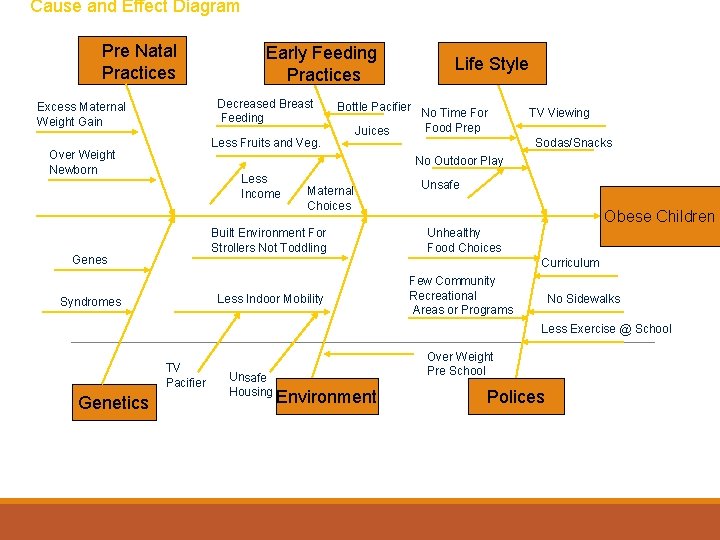
Cause and Effect Diagram Pre Natal Practices Early Feeding Practices Decreased Breast Feeding Excess Maternal Weight Gain Less Fruits and Veg. Over Weight Newborn Life Style Bottle Pacifier No Time For Food Prep Juices TV Viewing Sodas/Snacks No Outdoor Play Less Income Maternal Choices Built Environment For Strollers Not Toddling Genes Unsafe Obese Children Unhealthy Food Choices Curriculum Less Indoor Mobility Syndromes Few Community Recreational Areas or Programs No Sidewalks Less Exercise @ School TV Pacifier Genetics Unsafe Housing Over Weight Pre School Environment Polices
5 Why’s Technique Problem (Effect) Why? Why?
• When the Cause and Effect Diagram is finished it is time to decide what few areas should be focused on to develop solutions to solve the effect. (More on that next time!)
Mini Team SWOT • How did it go? • Any insight gained? • Any threats or weaknesses identified that were surprising? • Any strengths or opportunities that were surprising? © 2009 ©PHF 2009
Workforce Development • CPHA has approved application for workforce development plan assistance • Will be working with MPH Candidate to develop scope of work • Work will specifically focus on development and drafting of a plan © 2009 ©PHF 2009
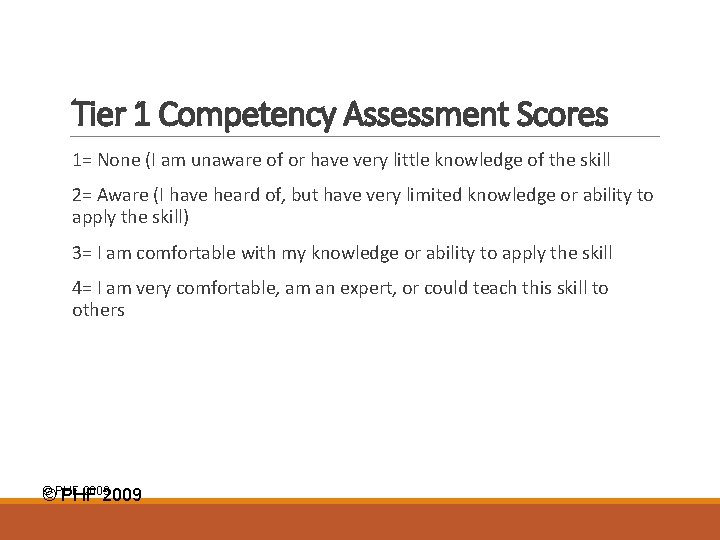
Tier 1 Competency Assessment Scores 1= None (I am unaware of or have very little knowledge of the skill 2= Aware (I have heard of, but have very limited knowledge or ability to apply the skill) 3= I am comfortable with my knowledge or ability to apply the skill 4= I am very comfortable, am an expert, or could teach this skill to others © 2009 ©PHF 2009
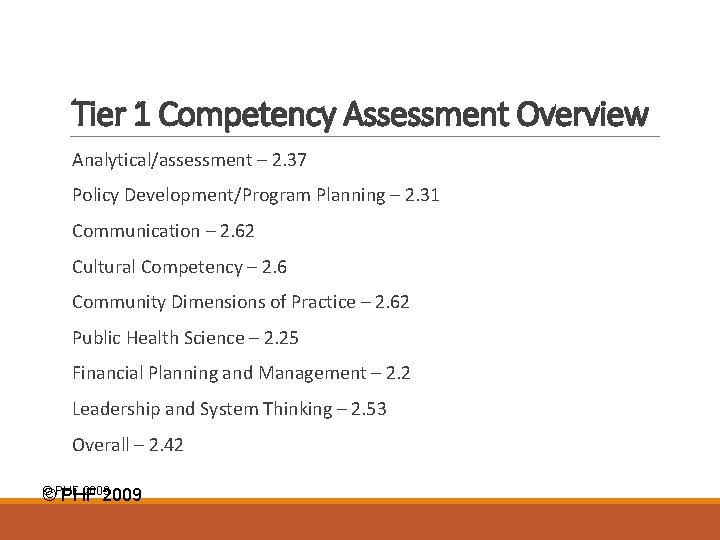
Tier 1 Competency Assessment Overview Analytical/assessment – 2. 37 Policy Development/Program Planning – 2. 31 Communication – 2. 62 Cultural Competency – 2. 6 Community Dimensions of Practice – 2. 62 Public Health Science – 2. 25 Financial Planning and Management – 2. 2 Leadership and System Thinking – 2. 53 Overall – 2. 42 © 2009 ©PHF 2009
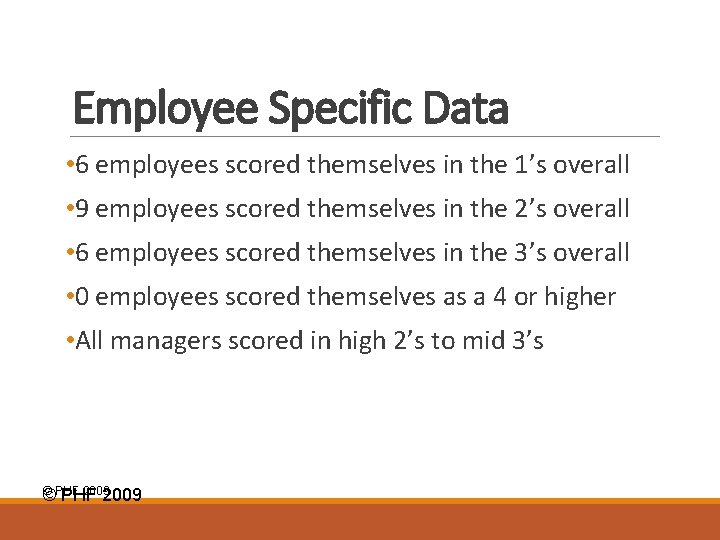
Employee Specific Data • 6 employees scored themselves in the 1’s overall • 9 employees scored themselves in the 2’s overall • 6 employees scored themselves in the 3’s overall • 0 employees scored themselves as a 4 or higher • All managers scored in high 2’s to mid 3’s © 2009 ©PHF 2009
Measurement • Measurement is critical to performance improvement and is the most difficult part of the process • Is the measure important? • Is it related to the overall outcome we want to see? • Is it easily understood and meaningful? © 2009 ©PHF 2009
Does the measure: Accurately determine process effectiveness? Actually show progress over a reasonable time frame? Provide a sense of accomplishment in those responsible for the process? © 2009 ©PHF 2009
Measurement Must Be: Able to promote accountability - define responsibility - no avoidance Able to change behavior - facts related to the process and not people © 2009 ©PHF 2009
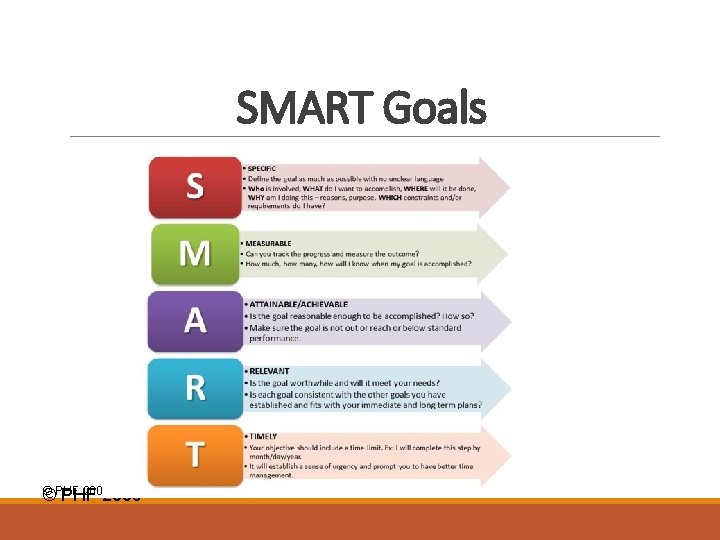
SMART Goals © 2009 ©PHF 2009
Solution Effect Analysis What it is Examines the impact of solutions to problems to find hidden consequences and helps map solution implementation Benefit Highlights side effects which may be as disruptive as the issue being solved. Solution effect analysis identifies and removing any detrimental sideeffects. © 2009 ©PHF 2009
How to Use Solution Effect • Brainstorm all possible effects of the solution selected for analysis. • Classify the effects under the headings: materials, methods, equipment and people. • Draw a solution effect diagram • Write the effects on the diagram under the classifications chosen. © 2009 ©PHF 2009
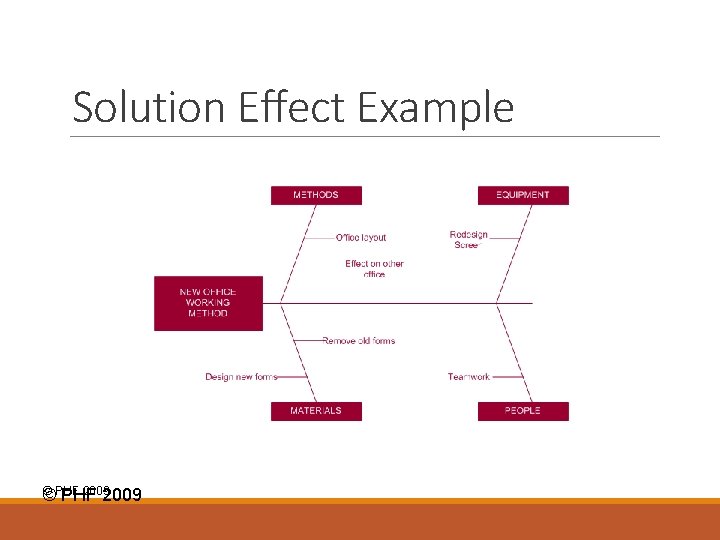
Solution Effect Example © 2009 ©PHF 2009
Gantt Charts The vertical axis lists all the tasks to be performed for a project Each row contains a single task identification The horizontal axis is headed by columns indicating estimated task duration in hours, days, weeks, months, etc. © 2009 ©PHF 2009
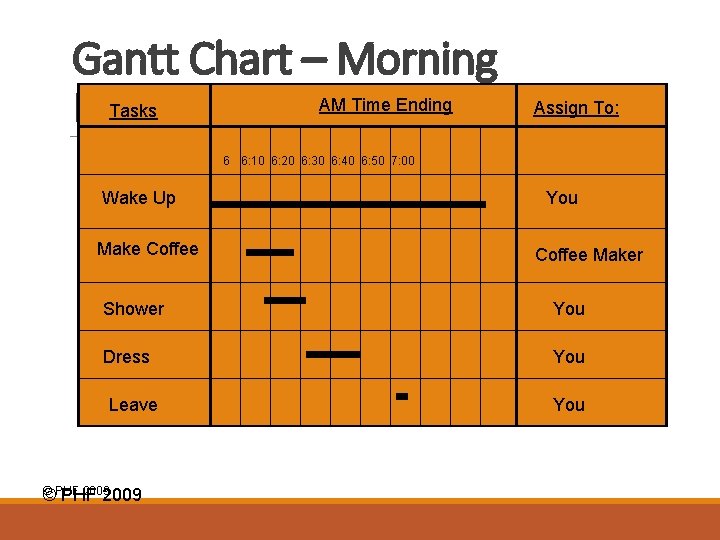
Gantt Chart – Morning Routine Tasks AM Time Ending Assign To: 6 6: 10 6: 20 6: 30 6: 40 6: 50 7: 00 Wake Up Make Coffee You Coffee Maker Shower You Dress You Leave © 2009 ©PHF 2009 You
Benefits Of Gantt Charts Overview of all the tasks Identifies major milestones Easy to review with top management Guidance – suppose to be here now Alerts to problem areas Summary document when project is finished Training tools for future projects © 2009 ©PHF 2009
- Slides: 51