
What is development Domains of development Questions about
• What is development? • Domains of development • Questions about Development: Normative Development and Individual Differences • Goals of developmental psychology • Themes/Issues in developmental psychology
What is development? • Development refers to systematic changes in the individual that occur over time from conception to death

Domains of Development • Physical Development – Changes in the body and brain • Cognitive Development – Changes in thought, intelligence, and language • Socioemotional Development – Changes in relationships, emotions, and personality
Questions about Development • Normative development – Involves typical or average patterns of change
• Individual differences – Involves differences between individuals of approximately the same age
Goals of Developmental Psychology • Describe behavior and how it changes across development • Explain development – • Identify the underlying processes or causes of change Apply knowledge to help children develop in positive directions

Themes/Issues in Developmental Psychology • How do genetic/biological and environmental factors work together to shape development?
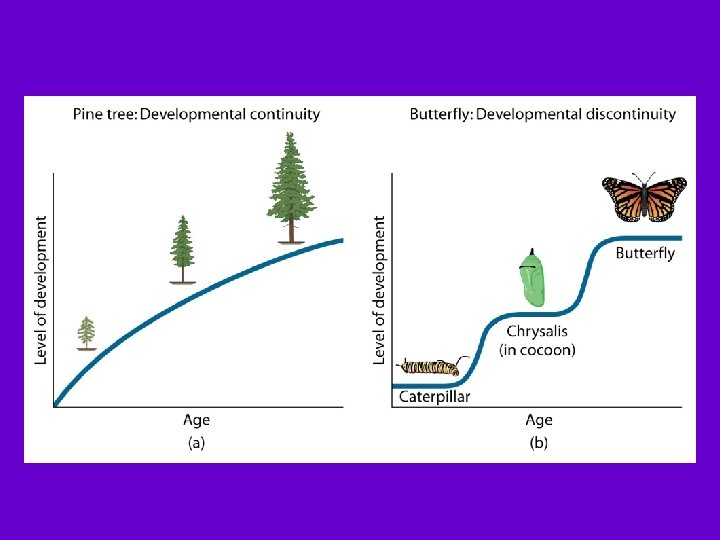
• Is development continuous or discontinuous?
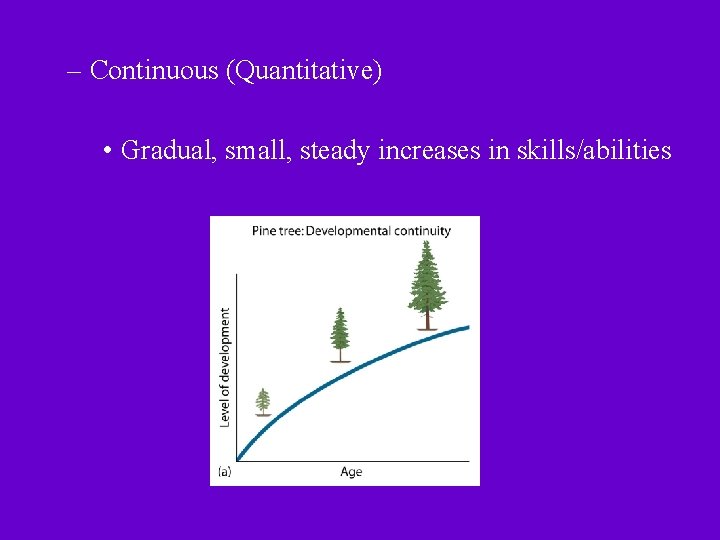
– Continuous (Quantitative) • Gradual, small, steady increases in skills/abilities
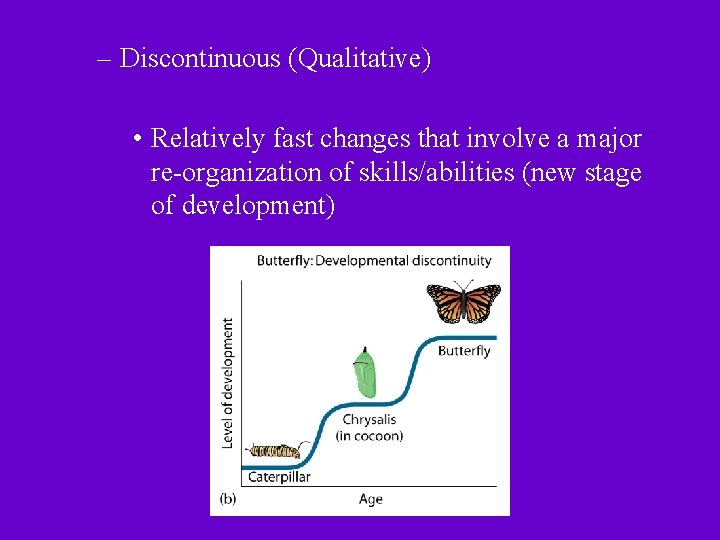
– Discontinuous (Qualitative) • Relatively fast changes that involve a major re-organization of skills/abilities (new stage of development)
• How important is early experience in affecting later development?
• Research Methods in Developmental Psychology – Hypotheses – Data Collection Techniques • Systematic Observation – Naturalistic Observation – Structured Observation • Self-report Measures – Clinical Interviews – Structured Interviews and Questionnaires • Psychophysiological Methods – General Research Designs • Correlational • Experimental – Designs for Studying Development • Longitudinal Designs • Cross-sectional Designs

Research Methods in Developmental Psychology • Hypothesis: A specific prediction that can be tested

Data Collection Techniques • Systematic Observation (2 Types) – Naturalistic Observation • Observe child’s behavior in a natural environment – Exs: playground, school, home
– Structured Observation: • Design a situation that will elicit relevant behavior(s) • Typically conducted in a laboratory setting • Observe different children in the same situation

General Disadvantages (Observation):
• Self-report Measures – Clinical Interviews • More “open-ended” questions—response choices are not limited – Ex: “Tell me about that” • Participants may be asked different questions (depending on their answers)
– Structured interviews and questionnaires • More “close-ended” questions—response choices are limited – Ex: yes/no questions, rating scales, multiple choice questions • All participants are asked the same questions
• Parents, child care providers, and teachers often provide information about infants and young children (and/or about themselves) – Ex: infant/child temperament; behavior problems; social skills
• General Disadvantage (self-report or report by others):
Psychophysiological Methods • Record physiological responses – Exs: heart rate, hormone levels (cortisol), brain wave activity • Infer psychological “states” from these responses (e. g. , perceptions, emotions)
Advantage: • Can be used with preverbal infants and young children (limited language) Disadvantage: • Changes in physiological responses can be caused by many “irrelevant” factors (e. g. , hunger, boredom, movement)
General Research Designs • Correlational Designs – Examine the relationship between two (or more) variables • Variable: Characteristic or experience that varies across individuals – Exs: age, gender, IQ, personality traits
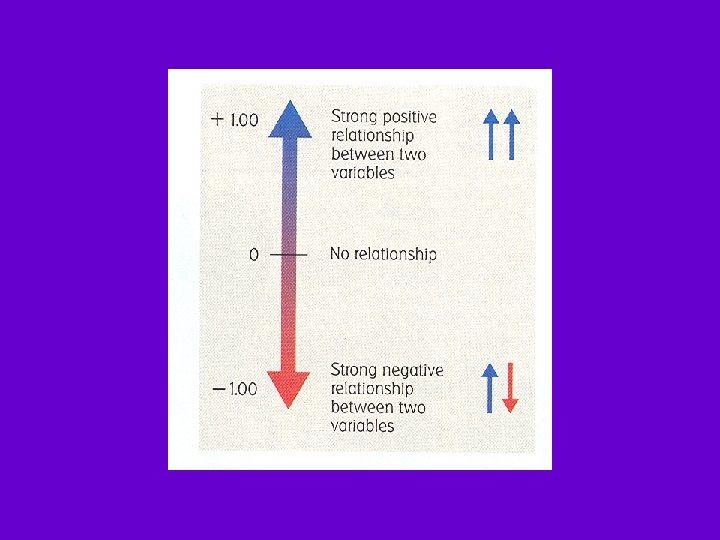
• Correlation Coefficient – Indicates how strongly two measures (variables) are related – Can range from -1. 00 to +1. 00
• Size of the coefficient • Zero correlation
• Sign of the coefficient: – Positive – Negative
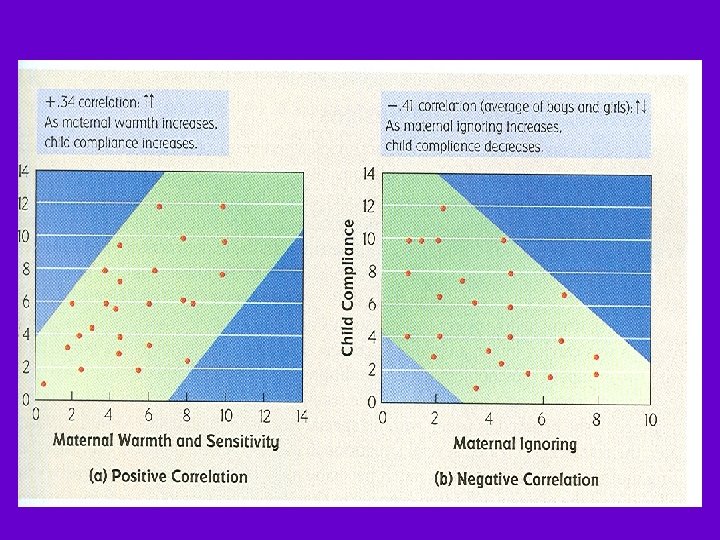

• Major limitation • Why not?
• Experimental Designs – Independent Variable – Dependent Variable
• Groups in an experiment should be equivalent except for their exposure to the independent variable – But individuals are different in a lot of ways • So how can the researcher be sure the groups are the same at the start of the experiment?
• Random Assignment: Participants have an equal chance of being assigned to each group/condition in an experiment – Advantage: Participants’ pre-existing characteristics should be equally distributed across groups/conditions • Ex: Should be same number of highly aggressive kids in each group/condition—so the groups are the same when the experiment starts – Can infer that the independent variable causes changes in the dependent variable
Designs for Studying Development • Purpose: Can examine developmental (agerelated) change

• Longitudinal Design
• Advantages – Can examine stability and change in individual children’s characteristics or behavior over time
• Disadvantages – Non-random participant loss • Participants who finish the study differ in systematic ways from participants who drop out – Final sample is not representative of the group (population) researcher wanted to study—findings may not generalize to the whole group – Practice effects • Change due to familiarity with data collection procedures rather than change due to development

– Time-consuming and expensive

Cross-Sectional Design
• Advantages – More efficient than a longitudinal design (faster, less expensive) – No participant loss – No practice effects
• Disadvantages – Cannot examine stability and change in individual children’s characteristics or behavior over time
- Slides: 41