
What is Design Design A discipline that explores
- Slides: 12
What is Design?
Design A discipline that explores the dialogue between products, people, and contexts. A process that defines a solution to help people achieve their goals. An artifact produced as the result of solution definition.
Point! Implementing a spatial system will result in modifications to existing roles and responsibilities; it may require a modification of responsibilities within the organization, resulting in a new organizational philosophy, new lines of communication, and a realignment of the business process. 1 -3
Point! You will also need to create a governance framework under which the impacts of change can be managed within the existing Information Technology architecture. 1 -4
Tune-up Improved operations Integration of functions Improved effectiveness Improved communication Consistent information Reduced costs Continuity of information
Failures Failed to use a tractable design methodology Failed to plan Failed to breed an enterprise perspective Lacked a common vision and goals Had poorly defined requirements Failed to anticipate the complexity Lacked deliverables Were isolation Had poor communications Lacked of knowledge Failed to account for organizational dynamics
Governance The key to addressing the non-technical issues is governance Key to effective governance is appropriate control Project governance is also key to aligning spatial technology resources to business goals and providing value Governance is needed that will not hinder project delivery while addressing the architecture requirements across the enterprise Organizations that do not implement effective governance will be unable to achieve architecture integration and will have no effective means to manage business goals
Design “The management of constraints" (Dino Dini) Two kinds of constraints, negotiable and nonnegotiable First step in the design is the identification, classification and selection of constraints Design then proceeds from here by manipulating design variables so as to satisfy the non-negotiable constraints and optimizing those which are negotiable. It is possible for a set of non-negotiable constraints to be in conflict resulting in a design with no solution; in this case the non-negotiable constraints must be revised 5/18/2021 V 8. 0 8
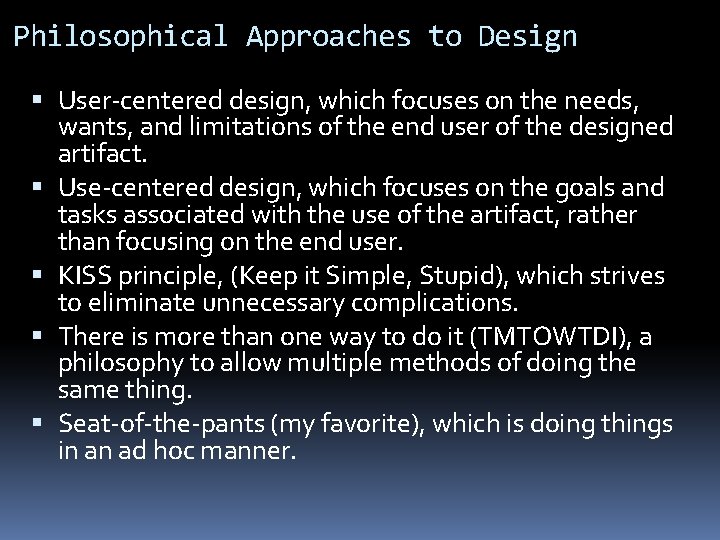
Philosophical Approaches to Design User-centered design, which focuses on the needs, wants, and limitations of the end user of the designed artifact. Use-centered design, which focuses on the goals and tasks associated with the use of the artifact, rather than focusing on the end user. KISS principle, (Keep it Simple, Stupid), which strives to eliminate unnecessary complications. There is more than one way to do it (TMTOWTDI), a philosophy to allow multiple methods of doing the same thing. Seat-of-the-pants (my favorite), which is doing things in an ad hoc manner.
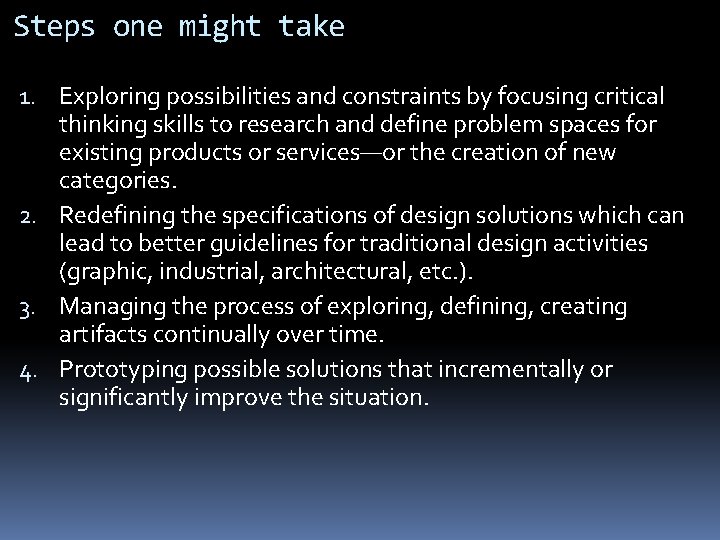
Steps one might take 1. Exploring possibilities and constraints by focusing critical thinking skills to research and define problem spaces for existing products or services—or the creation of new categories. 2. Redefining the specifications of design solutions which can lead to better guidelines for traditional design activities (graphic, industrial, architectural, etc. ). 3. Managing the process of exploring, defining, creating artifacts continually over time. 4. Prototyping possible solutions that incrementally or significantly improve the situation.
“Back to the old drawing board" Teaches us that designs can fail and redesign is often necessary. Something that is redesigned requires a different process than something that is designed for the first time Redesign often includes an evaluation of the existent design and the discovery of redesign needs.
The Designer as a Leader Parallel thinking Vision and climate The whole and the parts Point! Leadership in Spatial System Design Is Often the Antithesis of Good Management Practice 5/18/2021 V 8. 0 12