
What is Debating A debate is a structured
What is Debating? A debate is a structured discussion where two teams put forward arguments for and against a moot (topic) You must use reason, wit, charm, and teamwork to convince an adjudicator that your side has a stronger case
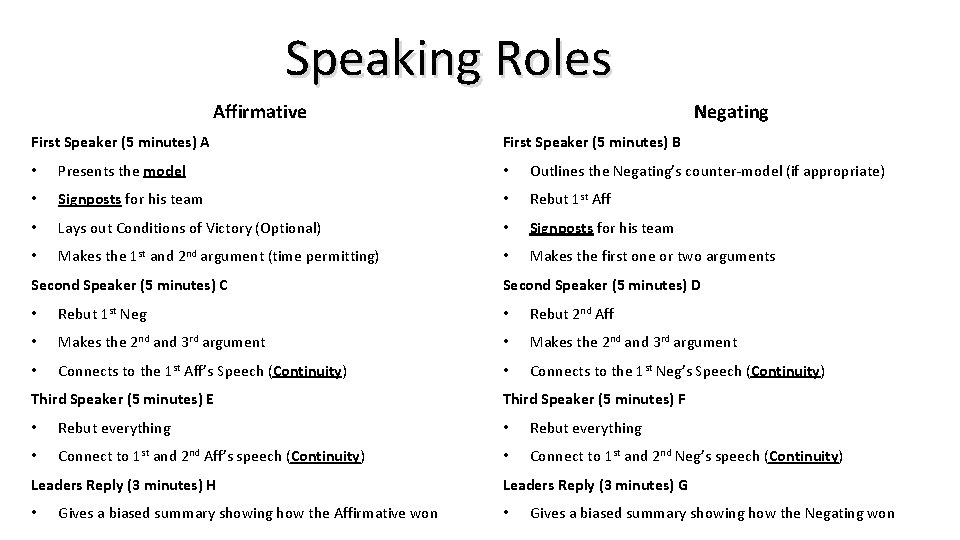
Speaking Roles Affirmative First Speaker (5 minutes) A Negating First Speaker (5 minutes) B • Presents the model • Outlines the Negating’s counter-model (if appropriate) • Signposts for his team • Rebut 1 st Aff • Lays out Conditions of Victory (Optional) • Signposts for his team • Makes the 1 st and 2 nd argument (time permitting) • Makes the first one or two arguments Second Speaker (5 minutes) C Second Speaker (5 minutes) D • Rebut 1 st Neg • Rebut 2 nd Aff • Makes the 2 nd and 3 rd argument • Connects to the 1 st Aff’s Speech (Continuity) • Connects to the 1 st Neg’s Speech (Continuity) Third Speaker (5 minutes) E Third Speaker (5 minutes) F • Rebut everything • Connect to 1 st and 2 nd Aff’s speech (Continuity) • Connect to 1 st and 2 nd Neg’s speech (Continuity) Leaders Reply (3 minutes) H • Gives a biased summary showing how the Affirmative won Leaders Reply (3 minutes) G • Gives a biased summary showing how the Negating won
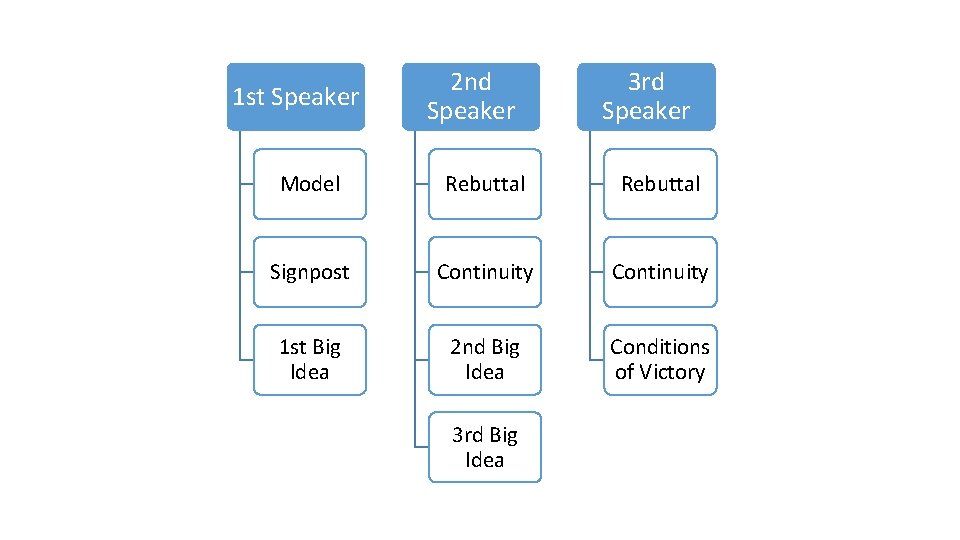
1 st Speaker 2 nd Speaker 3 rd Speaker Model Rebuttal Signpost Continuity 1 st Big Idea 2 nd Big Idea Conditions of Victory 3 rd Big Idea
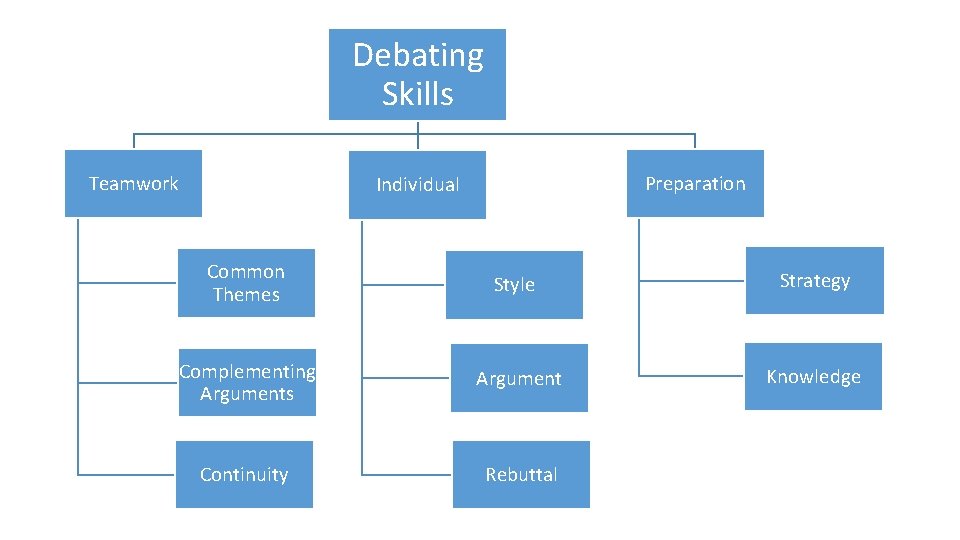
Debating Skills Teamwork Preparation Individual Common Themes Style Strategy Complementing Arguments Argument Knowledge Continuity Rebuttal

Adjudication Each debate takes place in front of an adjudicator, or adjudicators, and an audience. The adjudicator runs the debate, invites each speaker to the stand, and enforces the rules. They will not ask any clarifying questions and will judge only on what is presented. At the end of the debate they will identify the main points of clash and outline each teams argument for each. Best Speaker is assigned based on style, content and strategy. The winner is assigned based on the strongest overall case.
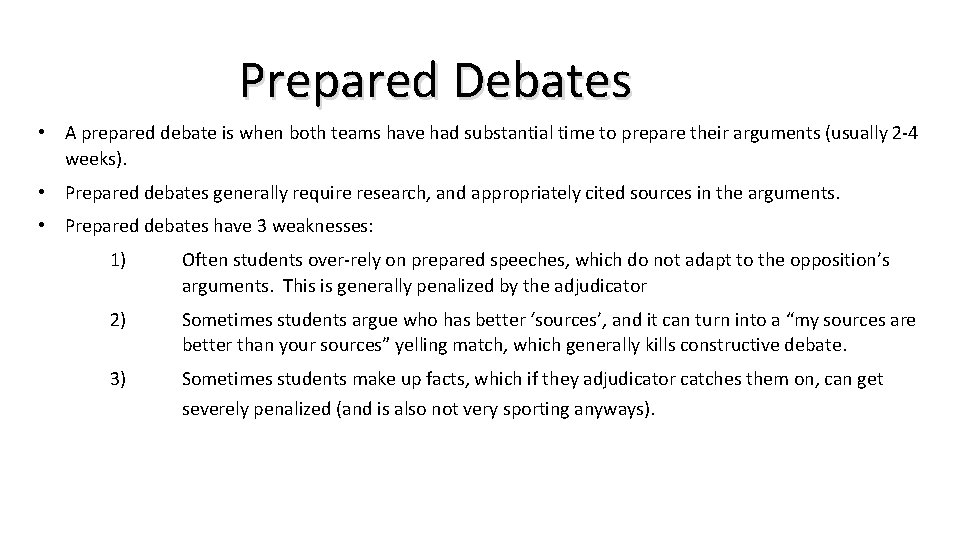
Prepared Debates • A prepared debate is when both teams have had substantial time to prepare their arguments (usually 2 -4 weeks). • Prepared debates generally require research, and appropriately cited sources in the arguments. • Prepared debates have 3 weaknesses: 1) Often students over-rely on prepared speeches, which do not adapt to the opposition’s arguments. This is generally penalized by the adjudicator 2) Sometimes students argue who has better ‘sources’, and it can turn into a “my sources are better than your sources” yelling match, which generally kills constructive debate. 3) Sometimes students make up facts, which if they adjudicator catches them on, can get severely penalized (and is also not very sporting anyways).
- Slides: 6