
What is culture Refers to the learned shared

















- Slides: 44
What is culture? Что такое культура? Refers to the learned, shared and transmitted values, beliefs, norms, and ways of specific individuals or groups that guide their thinking, decisions, and actions and patterned ways (Leininger, 2001)
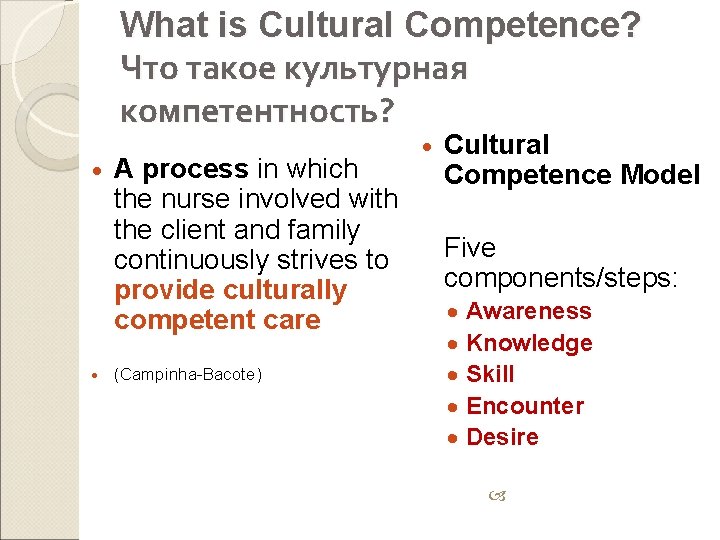
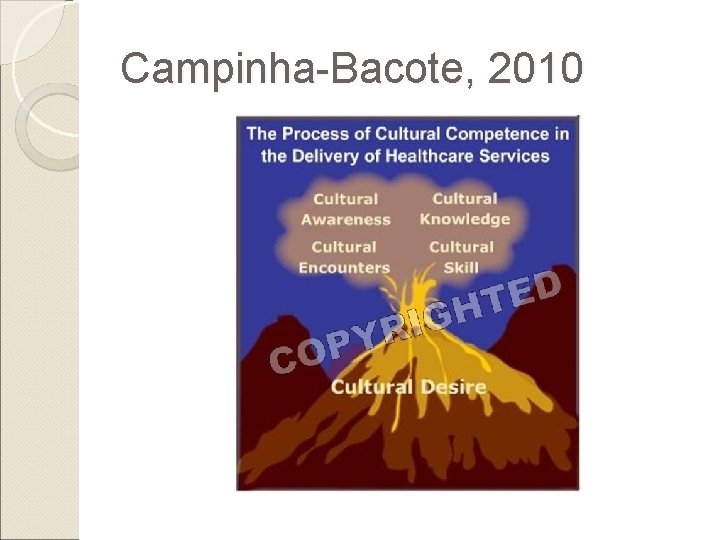
What is Cultural Competence? Что такое культурная компетентность? Cultural Competence Model A process in which the nurse involved with the client and family Five continuously strives to components/steps: provide culturally Awareness competent care (Campinha-Bacote) Knowledge Skill Encounter Desire
Campinha-Bacote, 2010
Cultural Competence Model Модель культурной компетентности 1. Cultural Awareness • A process of self–examination of one’s own biases towards other cultures and an exploration of one’s cultural and professional background. • A process of being aware of the existence of documented racism and other “isms” in health care delivery o self assessment/reflection
2. Cultural Knowledge Defined as a process in which a nurse seeks and obtains a sound educational base about culturally diverse groups. Knowledge to focus on integration of specific issues: health-related beliefs practices, cultural values, disease incidence and prevalence, genetic implications related to drugs, Know current realities of communities Trends, minority groups, marginalized groups, health disparities/risks, economic & social factors
Knowledge R/T Populations Immigration laws have increased the # of immigrants By mid 21 st century minority populations will outnumber whole population # of adults who live past 85 years of age has increased & will increase ◦ Baby Boomer (1945 -1965) 2029 - The last of the boomers will turn 65. 65+ population projected to double to 71. 5 million by 2030
Knowledge Activity Turn to your neighbors and form a group of 3 -4 Complete matching of terms to build your knowledge base
Knowledge: Value Orientations ◦ Cultures have a value system that teaches behaviors by setting norms ◦ Health beliefs and practices tend to reflect a culture’s value system May impact health prevention/education focus and compliance with treatment plan • Value orientations can be identified for most persons within a particular cultural group BUT remember…will find diversity within any cultural group
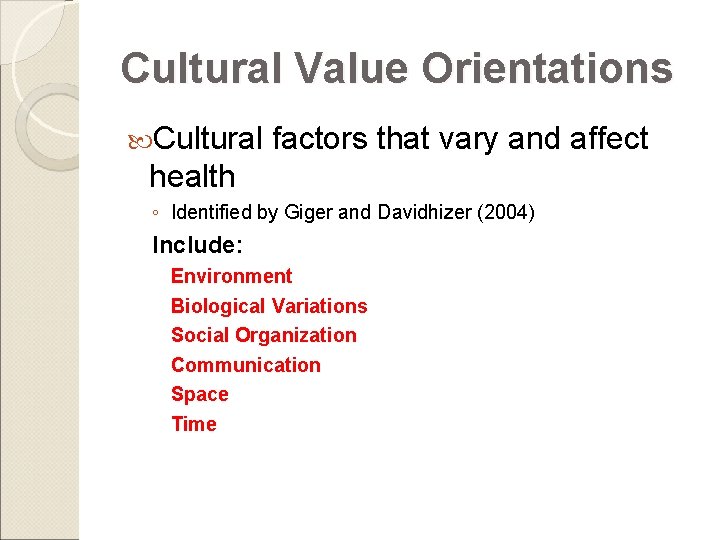
Cultural Value Orientations Cultural factors that vary and affect health ◦ Identified by Giger and Davidhizer (2004) Include: Environment Biological Variations Social Organization Communication Space Time
Consider… Space ◦ Personal comfort ◦ Boundaries and rules Social Organization ◦ Family unit defined ◦ Decision maker Communication ◦ ◦ ◦ Formal & informal Verbal & non-verbal Importance of silence Facts vs. stories orientation Need for interpreter
Consider… Time Orientation ◦ Past-Present-Future viewpoint ◦ Impacts belief regarding: Change of behaviors Appointment punctuality Health promotion & illness prevention strategies Ability to be “present”
Somali Heritage Somali gov. collapsed in Africa – refugees to US Time orientation not part of culture but enculturates over time to time Orientation Muslim Gender preference
3. Cultural Skill • Ability to collect relevant data through the interview process o. Need to know how communication styles and meanings may impact this process o. Non-verbal communication plays a significant role in many cultures o. Identify potential barriers to effective communication process o. Nurse must know when there is a need for a formally trained interpreter in order to avoid potential problems with a non-English/ESL speaking client
4. Cultural Encounter • Process in which the nurse seeks opportunities to engage in crosscultural interactions directly or indirectly • Nurses gain experience from directly working with clients or learning from others who have
5. Cultural Desire o Genuine and sincere desire to work effectively with minority clients and their families o Desire to travel and interact with culturally diverse grps o Campinha-Bacote (2007) sees encounters as the pivotal construct of Cultural Competence!
Campinha-Bacote, 2010
CDC Populations - RACE White Asian American, Black or African American, Hispanic or Latino, Native Hawaiian and Other Pacific Islander, American Indian and Alaska Native www. cdc. gov/minorityhealth/populatio ns/REMP/definitions
RACE White people have The census Bureau predicts by 2060, origins from white Americans will Europe, The middle comprise 50% of East, or North US population Africa White People comprise 70% of US population in 2000 census
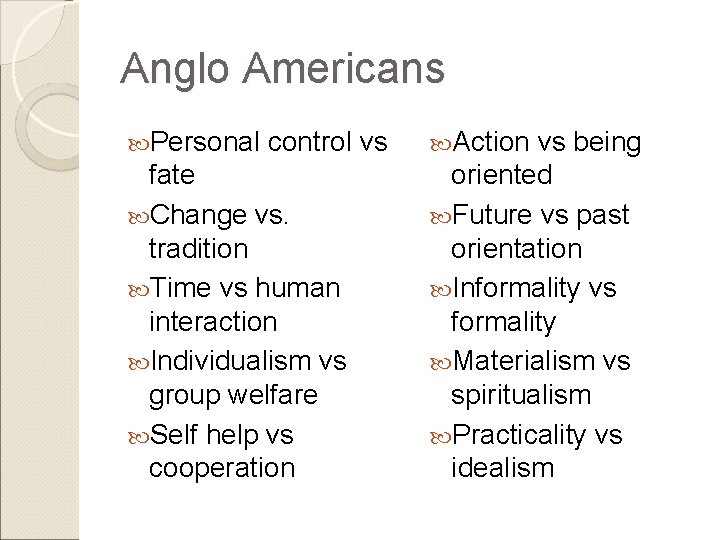
Anglo Americans Personal control vs Action vs being fate Change vs. tradition Time vs human interaction Individualism vs group welfare Self help vs cooperation oriented Future vs past orientation Informality vs formality Materialism vs spiritualism Practicality vs idealism
Anglo Americans Personal control vs Action vs being fate Change vs. tradition Time vs human interaction Individualism vs group welfare Self help vs cooperation oriented Future vs past orientation Informality vs formality Materialism vs spiritualism Practicality vs idealism
Hispanic or Latinos Hispanic 2013 = 17 %of US pop. Largest Ethnic grp in US Mexican(64%), Puerto Rican(9. 4%, Salvodoran, Cuban Dominican, Gualemalan Risks: ↑ B/P, heart, diabetes, obesity, lactose intolerant
Mexican American Language dialects Space – closer Time is relative and present oriented Several formal names - so ask & address formally Traditional roles Family is a priority. Predominant religion is Roman Catholic Folk health providers Show respect and include family- ? Eye contact Direct confrontation disrespectful Ask before touching but usually very tactile
Barriers Language Barriers These impede communication and ability to express thoughts & feelings Foreign languages, dialects, and idioms, slang, street talk are all types of barriers that may impede communication in the U. S. families even have own informal language! Differences related to socio-economic status effect communication style (Ruby Payne; Bridges Out of Poverty)
National Standards for Cultural Competence Culturally & Linguistically Appropriate Services (CLAS) Developed by the U. S. Department of Health and Human Services, Office of Minority Health With intent to ensure that the recipients of health care services are provided equitable and effective treatment The standards address the inequities that exist in the provision of health care services to the people of color
Russian Americans Language is Use Touch Russia but many speak English Time orientation – on time or early Medication hording Use eye contact except with government officials Do not interpret eye contact as aggressive or loud tone Health = absence of disease Hospital stays in Russia 3 weeks. Warmth =+ Stoical with pain Folk practices
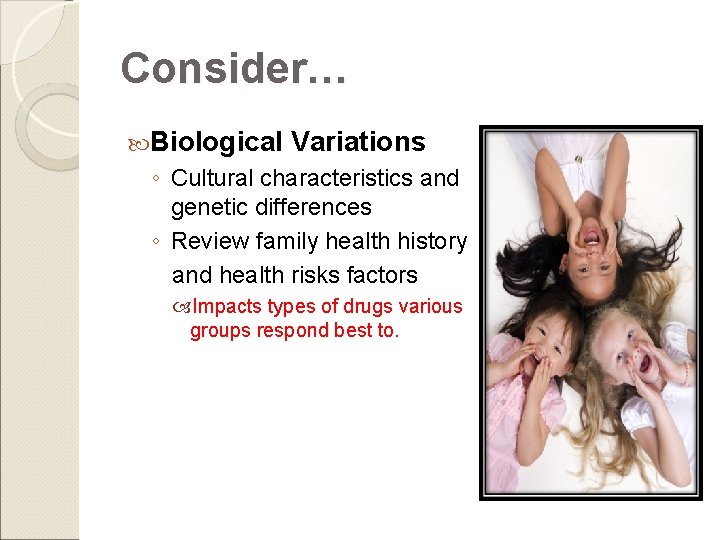
Consider… Biological Variations ◦ Cultural characteristics and genetic differences ◦ Review family health history and health risks factors Impacts types of drugs various groups respond best to.
RACE: African Am. Or Black In 2012, the population of African Americans including those of more than one race was estimated at 44. 5 million, making up 14. 2% of the total U. S. population. In 2060 projects will be 18. 4%
RACE: African Am. Or Black Differ based on Headed by single- socioeconomic grp, sub culture Language: English Nonverbal important Close personal space Extended families important parent woman but varies Risks: Sickle cell, ↑ B/P, heart, Cancer. diabetes, lactose intolerant, obesity, Genetic differences in response to drugs for ↑ /P
Transcultural Communication Barriers Lack of Knowledge The failure to understand cultural differences in values, behaviors and communication styles is a common stumbling block for nurses Each culture dictates what “normal” behavior is when one is sick Will learn this in DON curriculum and throughout nursing career
Barriers to Cultural Competency Fear and Distrust Fear, dislike and distrust are emotions that erupt when people from different cultures first meet What other emotions may play a part in initial interactions? How do we overcome this initial reaction?
Barriers to Cultural Competency Racism Most nurses find it hard to believe that racism even exists in the world of nursing Individual Against biological characteristics Cultural Heritage superiority Institutional At one time black nurses were not allowed to join the ANA
Barriers to Cultural Competency Bias and Ethnocentrism The belief that one’s own culture or traditions are better than those of other cultures Attitudes toward western medicine constitute one of the biggest barriers to transcultural communication between American nurses and their clients/families You, the nurse, must admit that biases exist in order to overcome & advocate for clients
Barriers to Cultural Compentency Stereotyping Assigning certain beliefs and behaviors to groups without recognizing individuality Unsubstantiated assumption that all people of a certain racial and ethnic group are alike This is especially harmful when negative traits imposed on all members of a cultural group (example - all Native Americans are alcoholics)
Barriers to Cultural Competency Cultural Blind Spot Syndrome Just because client looks and behaves much as you do - do not assume no cultural differences (are all Caucasians alike? Are all Asian Americans alike) Remember all patients are individuals with unique characteristics and personal histories
Barriers to Cultural Competency Ritualistic Behavior These allow nurses to remain in control of situations without individualizing care We need to ask ourselves which nursing care rituals really have a scientific basis for following them Movement behind evidenced-based practice – do we practice based on accumulated scientific knowledge? … What is the Best Practice!
Barriers to Cultural Compentency Different Perceptions & Expectations Cultural, behavioral, and language differences between nurses, patients and patients families … can lead to: Greater probability that patients will misunderstand nursing care and instructions Often cultures vary in perception of health promotion and disease prevention Cultural home remedies - often 1 st treatment of choice
Resource Campinha-Bacote J. (1998, 2002, 2010) The process of cultural competence in the delivery of healthcare services. Munoz, C. & Luckmann, J. (2005). Transcultural communication in nursing. Clifton Park, New Jersey: Delmar.
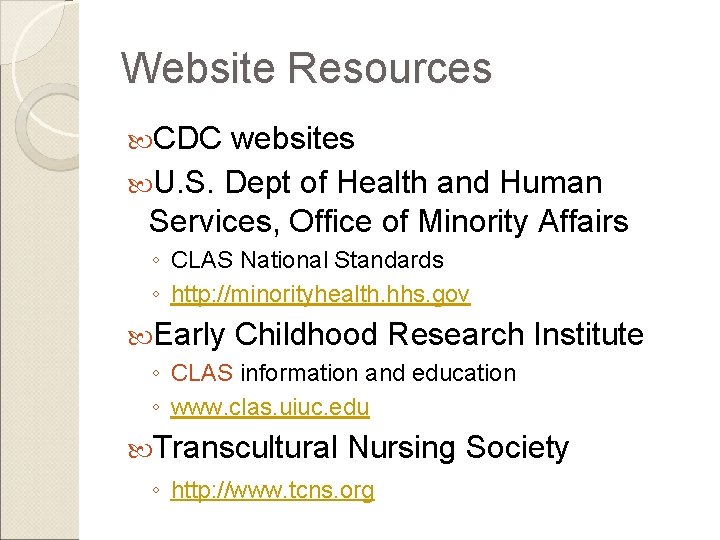
Website Resources CDC websites U. S. Dept of Health and Human Services, Office of Minority Affairs ◦ CLAS National Standards ◦ http: //minorityhealth. hhs. gov Early Childhood Research Institute ◦ CLAS information and education ◦ www. clas. uiuc. edu Transcultural Nursing Society ◦ http: //www. tcns. org
RACE: Pacific Islanders/ People having origins in any of the original peoples of Hawaii, Guam, Samoa, or other Pacific Islands. Pacific Islanders
Asian American 2010 Census 4. 8% but by 2050 can rise to 9. 2% Asian +Pacific Islanders top causes of death include: Cancer, Heart, Stroke, Unintentional injuries, diabetes Chinese, Filipinos, Asian Indian, Vietnamese, Koreans, Japanese
American Indian/Alaska Natives U. S. Census Bureau in 2011 = 1. 6% of the U. S. total population. 29% lacked health insurance Top 5: Heart disease, cancer, unintentional injuries, diabetes, Liver & Cirrhosis,